
When you get down to it, the real hmo and ppo difference is a balancing act between cost and flexibility. HMO plans usually have lower monthly premiums, but they ask you to stick with in-network doctors and get a referral before seeing a specialist. On the other hand, PPO plans give you the freedom to see almost any doctor you want, including specialists outside the network, but that freedom often comes with a higher price tag.
Unpacking The HMO And PPO Difference
Choosing a health plan can feel like you're trying to learn a new language. But getting a handle on the structure of a Health Maintenance Organization (HMO) versus a Preferred Provider Organization (PPO) is the first real step toward a smart decision that fits both your health needs and your wallet. These two plan types are the most common you'll find today.
The choice you make impacts more than just your monthly bill; it determines which doctors you can see and how you get specialized medical care. And while we're talking about health protection, it's also worth understanding the fundamental distinction between health insurance and travel insurance, as they're built for entirely different situations.
Comparing Core Plan Features
An HMO works with a "gatekeeper" system. You pick a Primary Care Physician (PCP) from the plan's network, and that doctor becomes your home base for all your health needs. If you need to see a cardiologist or a dermatologist, you have to get a referral from your PCP first. It’s a model designed to keep your care coordinated and costs under control.
A PPO, however, is all about flexibility. You aren't required to choose a PCP, and you can book an appointment with a specialist directly—no referral needed. While these plans have a "preferred" network of doctors where you'll get the best rates, you can also see providers outside that network. You’ll just pay more out-of-pocket for it.
That's the high-level view. To really see how they stack up, the table below breaks down the key differences side-by-side. As you look it over, think about what matters more to you: lower costs or more freedom in choosing your doctors. Our guide on how to compare health insurance plans can also give you a great framework for thinking through your options.
HMO vs PPO Key Distinctions at a Glance
This table provides a high-level summary comparing the core features of Health Maintenance Organization (HMO) and Preferred Provider Organization (PPO) plans. It's a quick way to see the fundamental trade-offs between cost, control, and convenience.
| Feature | HMO (Health Maintenance Organization) | PPO (Preferred Provider Organization) |
|---|---|---|
| Primary Care Physician (PCP) | Required; acts as a gatekeeper for your care. | Not required; you can self-refer to specialists. |
| Specialist Referrals | Required from your PCP to see most specialists. | Not required; you have direct access to specialists. |
| Out-of-Network Coverage | Not covered, except for true medical emergencies. | Covered, but at a higher out-of-pocket cost than in-network care. |
| Typical Premiums | Generally lower. | Generally higher. |
| Provider Network | More restrictive; must use doctors and hospitals within the network. | Broader; offers a wider choice of doctors and facilities. |
| Best For | Individuals prioritizing lower costs and coordinated care. | Individuals prioritizing flexibility and direct access to specialists. |
Ultimately, whether an HMO or a PPO is the right fit comes down to your personal priorities. Do you prefer a structured, cost-effective approach, or is the freedom to choose your own providers worth a higher premium?
How Each Health Plan Actually Works

To really get the hmo and ppo difference, you have to look beyond the acronyms. Think of them as two different roadmaps for your healthcare journey. They don't just list benefits; they dictate how you see doctors, get specialist care, and manage your health day-to-day.
An HMO is built around a "gatekeeper" model. It's coordinated and structured, with your Primary Care Physician (PCP) at the center of everything. The goal is to streamline your care and keep costs in check.
A PPO, on the other hand, is all about flexibility. It puts you in the driver's seat, letting you choose your own path without needing a gatekeeper to open doors for you. That freedom is the heart of the PPO experience.
The HMO Patient Journey: A Coordinated Approach
When you join an HMO, your first move is picking a PCP from the plan's list. This doctor isn't just for when you're sick—they're the quarterback of your entire healthcare team. Need to see a specialist? You have to go through your PCP first to get a referral.
This referral process is what defines the HMO model. Your PCP checks your symptoms and, if it’s necessary, sends you to a specialist—like a cardiologist or dermatologist—who is also in the HMO's network. It keeps everything connected, ensuring your doctors are all on the same page.
Key Insight: The HMO's gatekeeper system isn't just about control; it's designed to stop unnecessary specialist visits and keep your medical records tidy under one main doctor. You trade some freedom for more organized, and often more affordable, care.
Let's see how this plays out in real life.
HMO Scenario: Seeing a Dermatologist
- You notice something: You see a new mole and want a specialist to look at it.
- First stop, your PCP: You book a visit with your primary doctor. They examine the mole and agree it's worth getting a second opinion.
- The referral: Your PCP's office sends a referral request to the HMO. Once it's approved, you're cleared to see an in-network dermatologist.
- Book the specialist: Now you can make that appointment. Without that referral, the HMO won't cover the visit.
The PPO Patient Journey: A Flexible Path
With a PPO, your experience is completely different. It's all about direct access and your personal choice. You don't have to pick a PCP, though it's always a good idea to have one. The big deal here is you can see any doctor you want, whether they're in your plan’s network or not.
That means you can refer yourself. Want to see a dermatologist? Just find one you like and make an appointment. No need to get permission from your PCP first. This kind of autonomy is a huge plus for people who want to manage their own healthcare. If you're new to this, our guide on what is health insurance and how does it work can help clear things up.
The PPO uses a tiered cost system. You'll pay the least when you stick with "preferred" in-network doctors. But if you decide to see someone out-of-network, the plan will still cover part of the cost. It’s a safety net that gives you the freedom to choose.
PPO Scenario: Seeing a Dermatologist
- You notice something: You've found a mole and want an expert opinion.
- You take charge: You research dermatologists and pick one. You can check if they're in-network to save money, but the choice is yours even if they aren't.
- Book the specialist: You call the dermatologist's office directly and set up the appointment. No referral needed. Your coverage will just depend on whether that doctor is in or out of your network.
Analyzing Provider Networks and Physician Choice
When you dig into the real HMO and PPO difference, it almost always comes down to one thing: your freedom to choose your doctor. That choice is directly linked to the plan’s provider network—the list of doctors, hospitals, and specialists you can see without racking up huge out-of-pocket bills.
HMO networks are built for efficiency. They are usually smaller, more local, and often centered around a specific hospital system or clinic group that works together seamlessly. This design is all about keeping costs down and making sure your care is coordinated.
On the other hand, PPO networks are built for choice. They’re generally much bigger, often stretching across multiple states and including a massive number of independent doctors and major hospital chains. This gives you the freedom to find care almost anywhere you go.
The Structure of HMO Networks
HMOs run on what's called a closed-network model. With very few exceptions (like a true emergency), you have to see doctors who are part of that specific network to be covered. This tight structure is what allows the HMO to negotiate lower rates, which means lower monthly premiums for you.
The "gatekeeper" model is the heart of an HMO. Your Primary Care Physician (PCP) is your main point of contact for everything. They guide your healthcare, making sure any specialist you see is necessary and that everyone is on the same page. It’s a very integrated system.
This isn’t just an idea; it’s a structural fact. Research shows that HMOs are intentionally designed to steer patients into these tight-knit physician groups. While this leads to well-coordinated care, it definitely narrows your options compared to a PPO.
The Breadth of PPO Networks
PPO plans offer a completely different experience because they put flexibility first. They still have a "preferred" list of in-network providers where you'll pay the least, but they also give you the freedom to see doctors who are out-of-network. You'll pay more for it, but the choice is always yours.
This is perfect for anyone who already has a doctor they love and doesn’t want to switch, or for people who want to see a specialist without having to get a referral first. If your trusted dermatologist isn't in a particular HMO's network, a PPO lets you keep seeing them, no problem.
The Trade-Off: With a PPO, you're essentially paying a higher premium for two things: a bigger phonebook of doctors and the peace of mind that you can go outside that list if you need to. You're paying for autonomy.
A Data-Driven Look at Network Size
The difference in network size isn't small. An analysis of federal health insurance marketplaces found that 56% of HMOs had 'extra small' physician networks. This means their networks contained less than 10% of the average number of doctors available in that area. This number really drives home how restrictive an HMO can feel. You can read more about these network structure findings on pmc.ncbi.nlm.nih.gov.
This structure forces you to pick a PCP who then refers you to other doctors who are already closely connected within that same network. It’s a closed loop, built for efficiency.
PPOs, by their very nature, are the opposite. While they use networks to manage costs, their main selling point is how big those networks are—and your freedom to step outside of them. If you're curious about plans that try to blend the best of both worlds, you can check out our guide on what a POS plan means in health insurance.
In the end, it’s all about what matters more to you: the cost savings of an HMO or the expansive choice of a PPO.
A Detailed Breakdown of Costs and Expenses
When you’re looking at the HMO and PPO difference, it’s easy to get fixated on the monthly premium. But the real story of what you’ll pay is more complex. It's about balancing what you pay every month versus what you pay when you actually need care.
Think of it like this: one plan saves you money upfront, while the other offers a different kind of financial safety net. Let’s break it down.
HMOs are built for cost control. That almost always means lower monthly premiums, which is a huge draw if you're on a tight budget. But in exchange for that lower fixed cost, you agree to play by the rules—and that means staying inside the network.
PPOs are the opposite. You'll pay higher monthly premiums, no doubt about it. But what you're buying is freedom: the freedom to see specialists without a referral and the flexibility to go out-of-network if you need to. That higher monthly payment can be worth every penny if you value choice above all else.
Comparing Premiums and Deductibles
The first thing you’ll notice is the premium. The numbers don't lie. Recent data from employer-sponsored plans shows that the average annual premium for a PPO is $8,906 for an individual and a whopping $25,228 for a family. HMOs are kinder to your wallet, averaging $8,203 for individuals and $23,758 for families. That makes PPO plans about 8-9% more expensive right out of the gate, a price tag that buys you that bigger network and no-referral convenience. You can discover more about these PPO benefits on redirecthealth.com.
Deductibles are the next piece of the puzzle. Because HMOs manage care so tightly within their network, they often have much lower deductibles. In fact, 33% of people with an HMO plan have no annual deductible at all for their individual coverage.
PPOs are a different story. Only 10% of PPO members get a plan with no deductible. The higher deductible is part of the trade-off. You pay more out of your own pocket before your insurance starts kicking in, especially if you venture outside the network.
The Bottom Line on Costs: An HMO is designed to keep your monthly payments low and predictable, as long as you stay in-network. A PPO asks for more money each month to give you a financial cushion that covers a much wider world of doctors and hospitals.
Understanding Out-of-Pocket Expenses
Your total spending isn't just about premiums and deductibles. It’s also about what you pay each time you see a doctor or fill a prescription. These are your copayments, coinsurance, and out-of-pocket maximum.
- Copayments (Copays): This is that flat fee you pay for a service, like $25 for a doctor's visit. HMOs love copays because they make costs simple and predictable for in-network care.
- Coinsurance: This is a percentage of the bill you pay after your deductible is met. If your coinsurance is 20% on a $1,000 bill, you pay $200 and your insurer pays $800. PPOs use coinsurance a lot, and that percentage can jump up significantly if you see an out-of-network provider.
- Out-of-Pocket Maximum: This is your ultimate financial protection. It’s the absolute most you’ll have to pay for covered care in a year. Once you hit that number, your plan pays 100%. Both HMOs and PPOs have this, but be careful—PPOs often have a separate, much higher maximum for out-of-network care.
How deductibles and copays are structured is at the very heart of the financial trade-off between an HMO and a PPO. If you want to dive deeper, our guide on navigating deductibles and copays breaks it all down.
Ultimately, an HMO gives you cost predictability in a structured system, while a PPO offers financial flexibility for a higher upfront price.
Which Plan Is Right for You? Real-World Scenarios
The technical details are one thing, but seeing how an HMO or PPO actually plays out in real life is what makes the choice click. Let's move past the definitions and put these plans to the test in a few common situations.
By looking at how different people with different needs navigate their healthcare, you can start to see yourself in their shoes and figure out which path makes the most sense for you.
The Young Professional Who Needs to Save
Meet Alex. He's a 28-year-old graphic designer, healthy, and really only sees a doctor for his annual checkup. Since Alex is self-employed, keeping his monthly bills low and predictable is everything.
For someone like Alex, an HMO is a near-perfect match. The lower monthly premiums hit his biggest priority right on the head. Because he doesn’t have a long-standing relationship with any specific doctors, choosing a Primary Care Physician (PCP) from a local network is no big deal. The structured "gatekeeper" model of an HMO gives him a simple, straightforward way to manage his health without the higher price tag of a PPO.
- Why an HMO works: Alex cares more about saving money each month than having a massive list of doctors to choose from. The trade-off of needing a referral for a specialist—something he rarely needs—is easily worth the lower premium.
- When a PPO would be better: If Alex were to develop a specific health issue and wanted to see a top-rated specialist who wasn't in any local HMO networks, a PPO’s flexibility would suddenly become a top priority.
The Family Managing a Chronic Condition
Now, let's think about the Miller family. Their teenage son has a chronic condition, and he sees a pediatric endocrinologist regularly. They’ve built a trusted relationship with this specialist over years. For the Millers, continuity of care isn't just a preference; it's non-negotiable.
A PPO is the clear winner here. It lets them see their preferred specialist whenever they need to, without having to get a referral from a PCP for every single visit. If they wanted a second opinion from an expert in another state, the PPO's out-of-network coverage would act as a critical safety net, even if it meant paying a bit more out-of-pocket.
This exact scenario is why PPOs became so popular in the first place. They offered a middle ground between the tight restrictions of early HMOs and the sky-high costs of traditional insurance.
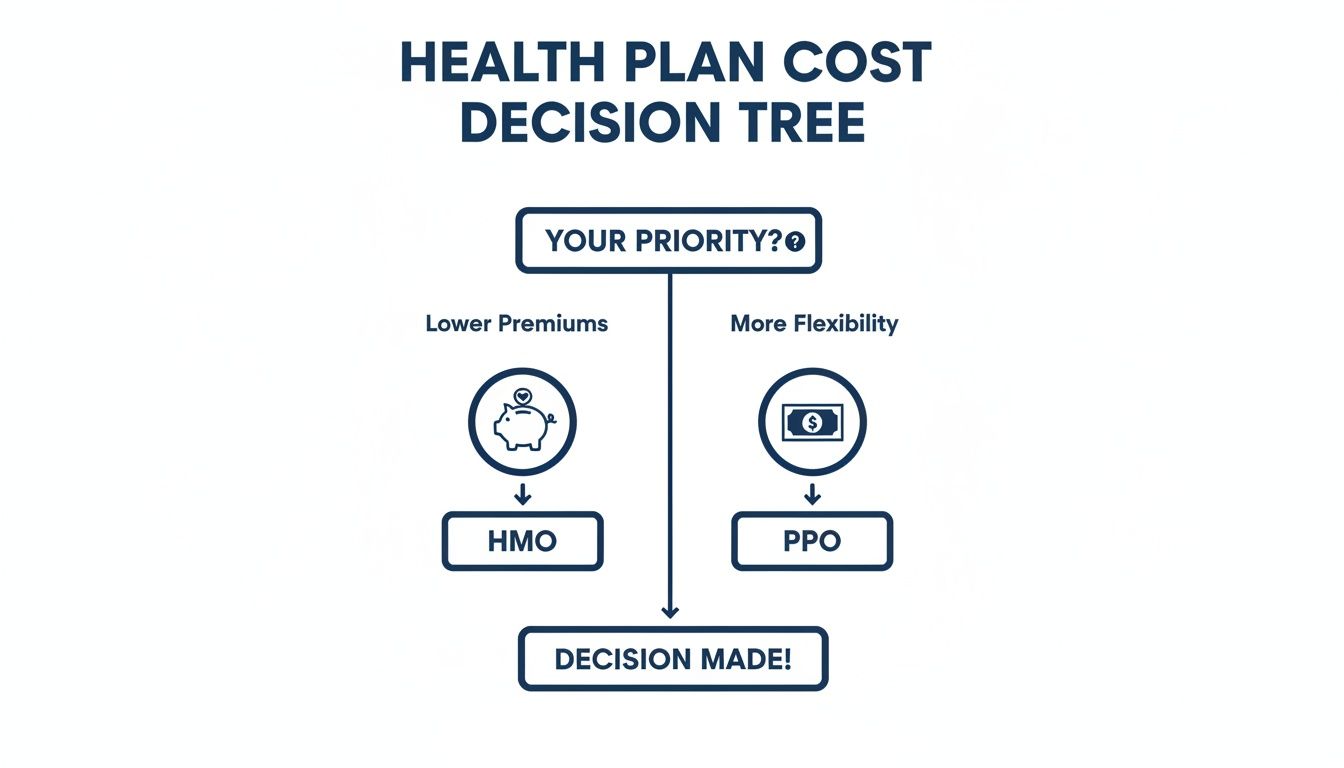
This decision tree nails the core choice: if your main goal is keeping monthly costs down, start by looking at an HMO. If your priority is having the freedom to choose your doctors and see specialists easily, a PPO is likely where you'll land.
The Frequent Traveler or Digital Nomad
Finally, there’s Sarah. She’s a consultant who travels for work three weeks out of every month. Her home base is in Texas, but she could easily need a doctor while on a project in California or Florida.
For Sarah, a local HMO network would be a constant source of stress. What if she gets sick on the road? A PPO with a broad, national network is an absolute must-have. It ensures she can find in-network doctors and urgent care clinics no matter what state she’s in, saving her from massive bills and logistical nightmares.
Situational Recommendation: If your life or job keeps you on the move, a PPO is almost always the right call. The risk of paying 100% out-of-pocket for non-emergency care with an HMO is just too high to ignore.
For those living and working abroad, the decision gets even more layered. You have to think about international networks and emergency coverage. Learning how to compare health insurance plans for expats is essential—the core principles of balancing cost and access are the same, just on a global scale.
Your Top HMO vs. PPO Questions, Answered
When you get down to the nitty-gritty of health insurance, the real questions pop up. It's one thing to know the hmo and ppo difference on paper, but it’s another to understand how they work when life gets complicated.
Let’s tackle some of the most common questions we hear every day.
Can I Switch from an HMO to a PPO Mid-Year?
This is a big one. Generally, you can't just switch plans, like from an HMO to a PPO, whenever you feel like it. The main time to make a change is during the annual Open Enrollment Period.
But life happens, and major events can unlock a special exception. These are called Qualifying Life Events (QLEs). If you have a QLE, you get a Special Enrollment Period to change your coverage.
Common Qualifying Life Events include:
- Getting married or divorced.
- Having a baby or adopting a child.
- Moving to a new zip code or county where your plan isn't offered.
- Losing other health coverage (for example, after leaving a job).
If one of these happens to you, you typically get a 60-day window from the date of the event to pick a new plan. Otherwise, you’ll have to wait for the next Open Enrollment.
What Happens If I Need Emergency Care Out of Network with an HMO?
This is a huge source of anxiety for people leaning toward an HMO. Thankfully, there’s a critical protection in place under federal law. All health plans, HMOs included, must cover emergency medical care at in-network rates, no matter what hospital or facility you end up at.
You don't need to get approval from your HMO before heading to the ER. An emergency is legally defined as a situation with symptoms so severe that a reasonable person would believe their health is in serious danger without immediate medical attention.
Here's the crucial part: While the initial emergency visit is covered, pay close attention to what happens next. Any follow-up care you get from out-of-network doctors after you're stabilized might not be covered by your HMO. It’s vital to contact your insurance plan as soon as you can after an emergency to get any ongoing care coordinated with in-network providers.
Are There Hybrid Plans That Blend HMO and PPO Features?
Yes, absolutely. The insurance world has created hybrid models that try to give you the best of both worlds—the cost savings of an HMO with some of the flexibility of a PPO.
The two you’ll see most often are:
- Point of Service (POS) Plans: Think of a POS plan as an HMO/PPO combo. Like an HMO, you’ll probably need to choose a Primary Care Physician (PCP) and get referrals to see specialists. But like a PPO, it also lets you go out-of-network for care, though you’ll pay more for it.
- Exclusive Provider Organization (EPO) Plans: An EPO plan is like a PPO, but without any out-of-network coverage for non-emergencies. You get a larger network of doctors than a typical HMO, and you don't need referrals for specialists. But if you see someone outside that "exclusive" network, you'll be paying 100% of the cost.
These plans can be a fantastic middle-ground for people who want more freedom than a standard HMO but don't want to pay the higher premiums for a PPO’s extensive out-of-network benefits.
How Do I Find Out if My Doctor Is in a Plan's Network?
This is probably the single most important thing to check before you sign up for a plan. Never, ever assume your doctor is covered.
Here’s a simple checklist to make sure:
- Check the Insurer's Online Directory: Every insurance company has an online search tool for each specific plan. You can look up your doctors, specialists, and local hospitals to see if they’re listed.
- Use the Marketplace Tools: If you’re shopping on an official marketplace like HealthCare.gov, they have built-in tools that let you check for your providers as you compare different plans.
- Call Your Doctor’s Office directly. Honestly, this is the most foolproof method. Online directories aren’t always up-to-the-minute. Call the billing department, give them the full, exact name of the plan you're considering (e.g., "BlueCross BlueShield Gold PPO Plan B"), and ask them to confirm they accept it.
Taking a few minutes to do this can save you from a mountain of stress and unexpected medical bills later. It's a small step that makes a huge difference, especially if keeping your doctor is important to you.
Feeling clearer on the HMO vs. PPO puzzle? The next move is to see what plans and prices are actually available to you. At My Policy Quote, we make it simple to compare your options and find the right fit for your life.