

A Qualifying Life Event (QLE) is a fancy term for a major life change that gives you a special ticket to sign up for or change your health insurance outside the usual Open Enrollment window.
Think of it as a pass to update your healthcare coverage right when you need it most, instead of having to wait months for the next designated signup period.
Your Key to Changing Health Insurance Mid-Year

Imagine your health insurance options are like a train that only leaves the station once a year during Open Enrollment. Most of us have to get on board at that specific time.
A Qualifying Life Event is like an unexpected, urgent stop just for you. Events like having a baby or losing your job-based coverage are big enough to signal the train to stop and let you on. This whole process makes sure you aren't left stranded without coverage after a major life shift.
This special access is officially called a Special Enrollment Period (SEP). It’s a crucial window—usually 60 days—that opens up the moment your QLE happens. Getting a handle on what counts as a QLE is your first step to taking control of your health coverage, especially when life throws you a curveball.
Why Do Qualifying Life Events Even Exist?
The whole idea behind QLEs is to provide a safety net. After all, life doesn't operate on a neat annual schedule. This flexibility prevents scary gaps in coverage that could leave you and your family financially exposed.
Without this system, someone who loses their job in March would have to wait all the way until the next Open Enrollment period in the fall to get a new plan. That could mean months without insurance, which is a risk nobody should have to take.
So, What Counts as a QLE?
Most Qualifying Life Events fall into a few main categories, which makes them easier to spot once you know what to look for.
Changes in Your Household: Big family changes almost always count. This includes getting married, having a baby, or adopting a child. A divorce or legal separation also qualifies; figuring out your health insurance options after divorce is a critical piece of that puzzle.
Loss of Other Health Coverage: This is a big one. It includes losing your health plan from a job, turning 26 and aging off a parent’s plan, or losing your eligibility for programs like Medicaid or CHIP.
A Change in Where You Live: Moving to a new ZIP code or county can trigger a QLE, but only if your old plan isn't available in your new area.
If your situation fits into one of these buckets, you can feel confident taking the next steps. To get the full scoop on the specific rules and timelines, check out our complete guide on the Special Enrollment Period.
To make it even simpler, here's a quick rundown of the most common events that will open up a Special Enrollment Period for you.
Quick Guide to Common Qualifying Life Events
| QLE Category | Common Examples |
|---|---|
| Household Changes | • Getting married or divorced • Having a baby or adopting a child • Death in the family |
| Loss of Coverage | • Losing a job with health benefits • Turning 26 and leaving a parent's plan • COBRA coverage expiring |
| Changes in Residence | • Moving to a new ZIP code or county • Moving to or from a shelter • A student moving to attend school |
| Other Qualifying Events | • Gaining U.S. citizenship • Leaving incarceration • Gaining/losing eligibility for subsidies |
This table covers the basics, but it's always a good idea to confirm if your specific situation qualifies. Life changes can be complicated, and the rules around them sometimes are, too.
Understanding the Four Main Types of Qualifying Life Events
Think of Qualifying Life Events (QLEs) as being sorted into four main buckets. This isn't just random industry jargon—it’s a simple framework to help you figure out if a recent shift in your life unlocks a Special Enrollment Period.
Getting a handle on these categories is the key. Once you do, you can quickly see if your situation qualifies you to get or change health coverage outside the standard Open Enrollment window. Let's break down each one with real-world examples.
Type 1: Loss of Health Coverage
This is probably the most common reason people find themselves needing a new plan mid-year. It’s a safety net designed for when you lose your existing health coverage for reasons outside of your control.
Here are a few classic scenarios that fall into this bucket:
- Losing your job-based insurance. Maybe you were laid off, left a job, or had your hours cut back. If it makes you ineligible for your employer's plan, that's a QLE.
- Turning 26. The big birthday. If you're on a parent's health plan, you'll "age out" when you turn 26, which automatically opens the door for you to get your own coverage.
- Your COBRA coverage runs out. When your COBRA continuation coverage expires, you're eligible for a Special Enrollment Period. Just remember, voluntarily dropping COBRA or losing it because you didn't pay doesn't count.
- Losing Medicaid or CHIP. A change in your income or household size might make you ineligible for these programs. That event triggers a window for you to buy a plan on the marketplace.
The one major exception? You generally won’t qualify if you just decide to cancel your plan or if it gets terminated because you stopped paying the premiums.
Type 2: Changes in Your Household
Life doesn’t stand still, and neither should your health insurance. Your plan is built to adapt when your family structure changes in a big way—whether you need to add someone, remove someone, or find a whole new policy that fits your new reality.
This category covers some of life’s biggest milestones.
A major change to your family, like getting married or having a baby, completely reshapes your coverage needs. The rules for QLEs exist to make sure your health insurance can grow right along with you, protecting new family members when it matters most.
Here are some of the clearest examples of a household change:
- Getting married. Tying the knot lets you and your new spouse enroll in a plan together.
- Having a baby, adopting a child, or becoming a foster parent. Welcoming a new child is a classic QLE. It allows you to add them to your current plan or switch to a new one that better suits your growing family.
- Getting divorced or legally separated. If a divorce or separation means you lose the health coverage you had through your former spouse, you can enroll in your own plan.
- A death in the family. If a death results in you losing your health insurance—for instance, if you were covered under the deceased person's plan—this event qualifies you to find new coverage.
Type 3: A Change in Residence
Where you live has a massive impact on your health insurance options. Most plans are tied to specific geographic areas, like a ZIP code or county. So, when you move, your old plan might not even be available anymore. This triggers a QLE so you can find a new plan that actually works where you now live.
Not every move counts, though. The key is whether you've moved to an area with a different set of health plan options. Moving across town in the same county probably won't do it.
But these moves typically do:
- Moving to a new ZIP code or county.
- A student moving to or from the place they attend school.
- A seasonal worker moving to or from where they both live and work.
- Moving into the U.S. from another country.
Type 4: Other Qualifying Circumstances
Finally, there’s a catch-all category for other specific situations that the Health Insurance Marketplace recognizes. These are often tied to shifts in your eligibility for coverage or financial help.
They might be less common, but they are just as valid for triggering a Special Enrollment Period. These events are pretty diverse and can include everything from becoming a U.S. citizen to changes in your military status, which you can learn more about by reviewing these insights on QLEs from TriNet. This last bucket makes sure that unique life changes don't leave people stranded without a way to get covered.
How to Report Your Qualifying Life Event
So, a big life change just happened. Great! Knowing you have a Qualifying Life Event (QLE) is the first step, but now you have to act on it.
This is where the Special Enrollment Period (SEP) comes in. Think of it as a special 60-day pass to get new health insurance outside of the usual annual enrollment window. The clock starts ticking the very day your life event occurs. Get married on June 1st? Your 60-day countdown begins then. Lose your job-based coverage on August 15th? That’s day one.
If you miss this deadline, you’ll most likely have to wait for the next Open Enrollment period. So, let's make sure that doesn't happen.
Your Step-by-Step Action Plan
Enrolling can feel like a maze, but it’s really just a few straightforward steps. Follow them, and you’ll get through it without missing a beat.
- Confirm Your Event and Timeline: First thing's first—pinpoint the exact date of your QLE. This date is your anchor. It sets your 60-day window in motion.
- Gather Your Essential Documents: You can't just tell the Marketplace you got married; you have to prove it. Before you even think about applying, get your paperwork in order. This could be a marriage certificate, a new lease agreement, a birth certificate, or a letter from your old employer about losing coverage.
- Start Your Application: Head over to the Health Insurance Marketplace at HealthCare.gov (or your state’s own exchange). You’ll either create an account or log in to update your existing one, reporting your QLE and confirming your income details.
- Compare and Choose Your Plan: Once the Marketplace gives you the green light, the fun part begins. You get to shop for a plan that actually fits your new life. Compare everything—premiums, deductibles, doctor networks, and prescription coverage.
This visual breaks down the main types of life events that can open this door for you.
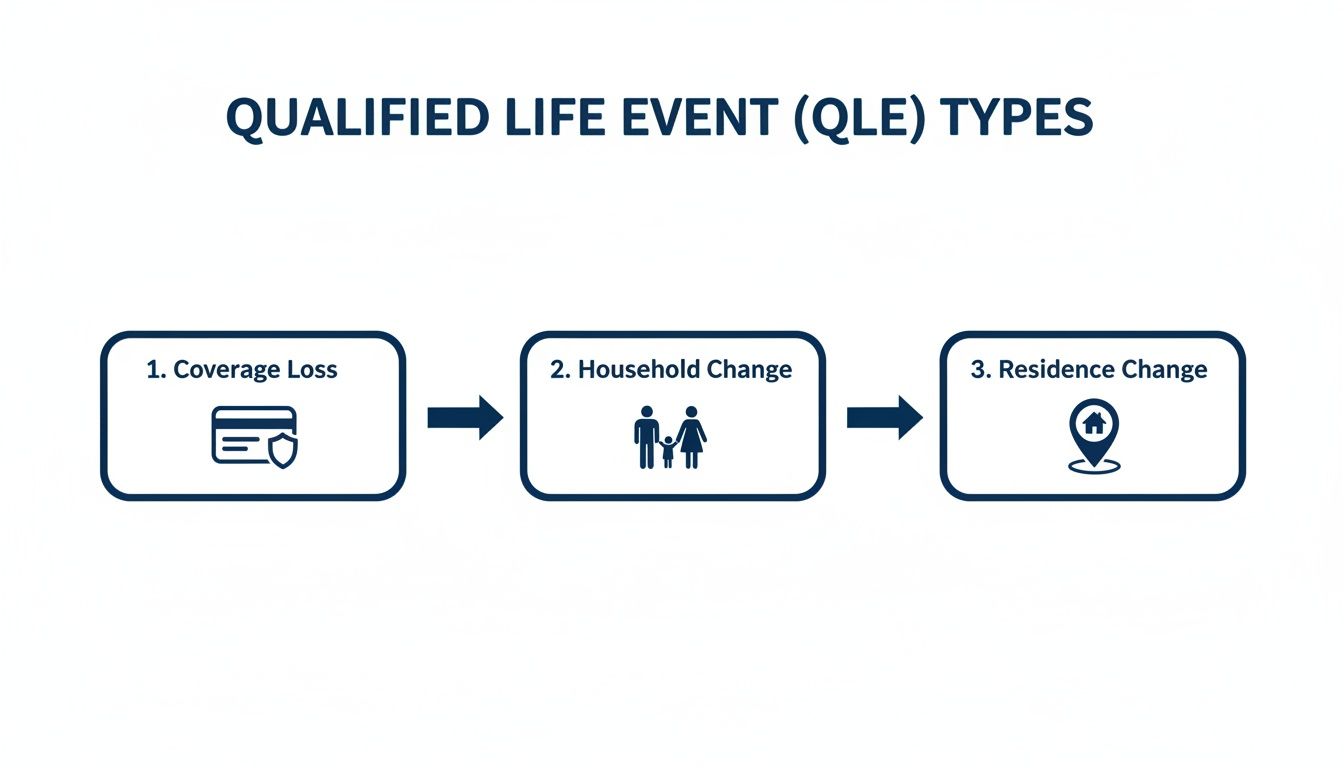
Whether you’re moving, growing your family, or changing jobs, these events all point to one thing: a chance to get the coverage you need, right now.
Submitting Your Application and Proof
Once you've picked your plan, you're on the home stretch. The final step is submitting the application and uploading your proof. The Marketplace usually gives you about 30 days from the day you select your plan to get those documents in.
Don't drag your feet on this part. Your coverage isn't official until they've verified your QLE and you've made that first premium payment. So, if you move and pick a new plan on July 10th, you’ll have until around August 9th to upload a copy of your new utility bill or lease. If you miss that deadline, they could cancel your application, and you’ll have to start all over again.
Common Pitfalls to Avoid
The process is pretty clear, but a few common slip-ups can cause headaches or, worse, a missed opportunity. Watch out for these:
- Waiting Until the Last Minute: That 60-day window feels long, but it flies by. Start the process the moment your QLE happens. Give yourself plenty of time.
- Forgetting to Pay the First Premium: Just choosing a plan isn't enough. Your coverage only kicks in after the insurance company gets your first payment. Be on the lookout for an email or letter from your new insurer with instructions on how to pay.
- Assuming Any Move Qualifies: A quick move across town probably won’t cut it. To count as a QLE, you generally need to move to a new ZIP code or county where the available health plans are different.
Knowing these steps makes all the difference. If you want a deeper dive into the application itself, our guide on how to apply for health insurance has you covered. By being prepared and proactive, you can make a smooth switch to a plan that truly fits your life.
The Essential Documents You Need to Provide
Just saying you’ve had a life-changing event isn’t quite enough to unlock a Special Enrollment Period. You’ll need to show official proof. Think of it like showing your ticket before you get on a train—the insurance marketplace needs to verify your eligibility before you can hop on board a new plan.
Having the right paperwork ready from the get-go makes everything so much smoother. It cuts out the frustrating back-and-forth and stops delays that could leave you without coverage when you need it most.
Proving Household Changes
When your family grows or your marital status changes, you need the official records to prove it. These documents give a clear timeline and confirm who is now part of your household.
- Getting Married: The key here is a copy of your marriage certificate. It’s the official, state-issued document that seals the deal.
- Having a Baby: You’ll need a copy of the birth certificate. Sometimes, a hospital record of the birth can work as temporary proof while you wait for the official one to arrive.
- Adopting or Fostering a Child: For an adoption, you’ll need the final adoption record or a court-issued agreement. For foster care, it’s the official foster care placement papers.
- Getting Divorced or Legally Separated: You’ll need a copy of the divorce decree or a court order for legal separation. The crucial part is that the document must show you lost your health coverage because of it.
Proof for Losing Health Coverage
Losing your health insurance is probably the most common reason people find themselves looking for a new plan. Proving it usually means getting paperwork from your old employer or insurer that clearly states why and when your coverage ended.
Key Takeaway: The document you use has to show the exact date your previous coverage ended. A vague email won't cut it. The marketplace needs a specific end date to confirm you're within your 60-day window to enroll.
Here’s what usually works:
- A letter from your old employer confirming you lost your job-based plan and the date it stopped.
- A notice showing you are eligible for COBRA or that your COBRA coverage has expired.
- A letter from your insurance company explaining that your plan was discontinued or is no longer offered.
- Paperwork showing you’ve “aged out” of a parent’s plan, like a notice from their insurer.
Want a full rundown of all the paperwork you might need for insurance? Check out our guide on what documents you need to get insurance.
Verifying a Change of Residence
When you move, you have to prove two things: that you have a new primary home and that you had health coverage before you moved. This ensures the move is legitimate and qualifies you for a new set of local plans.
First, you’ll need documents with your new address, like:
- A new lease agreement or mortgage statement.
- Recent utility bills (gas, electric, water) with your name on them.
- An updated driver's license or state ID.
You’ll also need to prove you had "minimum essential coverage" for at least one day in the 60 days right before your move. A letter from your old insurer or an old insurance card usually does the trick. This rule is in place to confirm you didn't just drop your coverage before deciding to move.
Documentation Checklist for Common QLEs
To make things even simpler, here’s a quick-glance table of common life events and the documents you'll need to have on hand.
| Qualifying Life Event | Required Document(s) |
|---|---|
| Marriage | Copy of the official marriage certificate. |
| Birth of a Child | Copy of the birth certificate or hospital record of birth. |
| Adoption/Foster Care | Final adoption record, court order, or official foster placement papers. |
| Divorce/Separation | Copy of the divorce decree or legal separation order showing loss of coverage. |
| Loss of Job-Based Insurance | Letter from the employer or a COBRA notice with the coverage end date. |
| Aging Off a Parent's Plan | Letter from the insurance company confirming the termination of dependent coverage. |
| Moving to a New ZIP Code | Lease/mortgage, utility bills, or updated ID, plus proof of prior coverage. |
Keeping these documents organized and ready will save you a massive headache and help you get covered without any unnecessary delays.
How QLEs Work in Your Real Life
The official rules for Qualifying Life Events are one thing, but life itself is messy and unpredictable. A QLE for a growing family looks totally different from one for a freelancer or someone retiring early.
The key is figuring out how these events apply to your unique situation. Let's move past the technical definitions and see how QLEs play out for real people.
For Self-Employed Professionals and Contractors
When you’re your own boss, your work life is always in motion. You don't have an HR department to hold your hand, so it’s up to you to spot the moments that open the door to new health insurance.
A major shift in your business can be a QLE. For instance:
- A big dip in income: Lose a major client? That sudden drop in income might make you newly eligible for subsidies (premium tax credits) on a Marketplace plan. That change in eligibility is your QLE.
- Moving for work: If you relocate to a new city or state for a long-term contract, that move is a QLE. It lets you find a plan with doctors and hospitals in your new area.
For Early Retirees Bridging the Gap to Medicare
Retiring before you hit 65 creates a major insurance challenge: you have to bridge the gap until you’re eligible for Medicare. For anyone in their early 60s, a QLE can be an absolute lifeline.
The most common QLE here is simple: losing your employer-sponsored health plan when you retire. That event kicks off your 60-day clock to enroll in a new plan on the Marketplace.
Retiring early doesn’t mean you have to go without coverage. Losing your job-based insurance is a powerful QLE designed specifically to help you transition smoothly to the next chapter of your life, giving you immediate access to new health plan options.
This is your moment to lock in continuous coverage, protecting both your health and your retirement savings from a surprise medical bill.
For Growing Families and New Parents
For families, life changes fast. Bringing a new member into your household is one of the most common—and joyful—Qualifying Life Events.
- Having a baby or adopting: The birth or adoption of a child is a classic QLE. It allows you to add your new little one to your current plan or switch to a completely different one that better fits your growing family’s needs. For example, you might want a plan that covers specific things, like how to get a lactation consultant covered by insurance.
- Getting married: Tying the knot lets you and your spouse jump onto a family plan together. This is often way more affordable than keeping two separate policies.
- A change in subsidy eligibility: When you add a dependent, your household size goes up. This can change your income eligibility for subsidies, which could make your health insurance much cheaper. That change is also a QLE.
For Parents of Adult Children
That moment when your child turns 26 is a big one. It’s a QLE that affects both you and them, marking a shift in who is responsible for their health coverage.
Once your child ages out of your plan, they get their own 60-day Special Enrollment Period to sign up for a policy. It could be a plan through their job, the Marketplace, or another route. This is a change you can see coming, so it’s smart to plan ahead. You can learn more about the rules in our article on the dependent health insurance age limit.
Seeing these examples helps you understand that QLEs are more than just a list of government rules. They are practical tools designed to make sure your health coverage can keep up with your life.
Let's Figure This Out Together
Going through a big life change is already a lot to handle. Trying to navigate health insurance at the same time can feel completely overwhelming.
As we've covered, a Qualifying Life Event opens a special window for you to get the coverage you need, right when you need it most. The rules are there to help you, but you don't have to decipher them all by yourself.
If you're ready to see what's out there, our team at My Policy Quote is here to help you move forward with confidence. We offer personalized, one-on-one help to take the guesswork out of your Special Enrollment Period.
How We Can Help
We're experts at making complicated insurance decisions feel simple and clear. Here’s how we can support you:
- Confirm Your QLE: First things first. We’ll look at your situation, make sure you have a valid QLE, and pinpoint your exact 60-day deadline so there are no surprises.
- Find the Right Plan: Forget spending hours getting lost in plan details. We’ll show you the best options for your new reality, whether you're welcoming a baby or getting ready for Medicare.
- Make Enrollment Easy: We’ll walk you through the entire application, from gathering the right documents to hitting "submit," making sure it’s all done right and on time.
Don’t let confusion or a ticking clock stop you from getting the coverage you and your family deserve. The right guidance can turn a stressful task into a straightforward, empowering one.
Let us handle the insurance maze. That way, you can focus on what really matters—adjusting to this new chapter of your life with the peace of mind that comes from knowing you’re protected.
Contact My Policy Quote today to get started with your special enrollment.
Got Questions About QLEs? We've Got Answers.
Even after you get the basics down, a few specific questions always pop up. It’s totally normal. Let's walk through some of the most common things people ask when life changes and they need to adjust their health coverage.
What Happens If I Miss My 60-Day Window?
This one is a big deal. If you miss your 60-day window to enroll after a qualifying life event, you’ll almost certainly have to wait until the next Open Enrollment period to get a new plan. That could leave you without coverage for months.
There are very, very few exceptions to this rule, which is why acting fast is so important. Think of that 60-day timeline as a hard deadline. Once it passes, the door to enroll mid-year closes until the fall.
Can I Change My Existing Plan or Just Get a New One?
You can absolutely change your existing plan! A QLE isn't just for people who are uninsured. It's also your chance to switch to a different plan if the one you have no longer makes sense after your life event.
For example, after having a baby, that high-deductible plan you loved might not feel so great anymore. A QLE gives you the power to switch to a plan with better coverage for all those new pediatrician visits. It’s all about making sure your plan keeps up with your life.
Key Insight: Think of a Qualifying Life Event like a personal Open Enrollment period. You get the same freedom to sign up for a new plan, switch your current one, or add a family member to your policy.
Does Moving to a New Apartment in the Same City Count?
It depends on your new address. A move only triggers a QLE if you relocate to a new ZIP code or county where a new set of health plans is available. So, if you just move across the street but stay in the same ZIP code, it probably won’t count.
The whole point of this rule is to make sure you're not stuck with a plan that has no in-network doctors or hospitals near your new home.
How Quickly Does My New Coverage Actually Start?
Your start date usually hinges on when you finish your enrollment. It’s a bit of a two-part rule:
- If you pick a plan between the 1st and the 15th of the month, your coverage will kick in on the first day of the next month.
- If you enroll between the 16th and the end of the month, your coverage typically starts on the first day of the second month.
So, if you enroll on July 20, your coverage would likely begin on September 1. And remember, your plan isn't active until your eligibility is confirmed and you've made that first premium payment.
Navigating these rules can feel like a maze, but you don't have to find your way through it alone. At My Policy Quote, our experts are here to give you clear, personalized guidance so you can find the right coverage without the stress. Explore your health insurance options with My Policy Quote today.