

Finally stepping out on your own feels incredible. You're building a life, chasing goals, and making your own rules. But that independence comes with responsibility, and one of the smartest moves you can make is getting insurance for young adults.
It’s easy to see it as just another bill to pay. But it's so much more than that. Think of it as the foundation you're laying for your entire financial future—a safety net that catches you when life throws a curveball.
Why Insurance Is Your Financial Safety Net
When you're starting out, your budget is tight. You're juggling rent, maybe some student loans, and just trying to have a life. One unexpected disaster—a car wreck, a sudden trip to the ER, or your laptop getting stolen—could knock your entire plan off course.
This is exactly where insurance comes in. It's your financial bodyguard.
Instead of a boring expense, try to see it as a powerful investment in yourself. You pay a small, predictable amount each month (your premium), and in exchange, you hand off the risk of a massive, bank-breaking bill to an insurance company. It’s a simple decision that protects your savings, your health, and your sanity.
Building a Foundation for Financial Health
Imagine insurance is like the shock absorbers on your car. You don't really notice them on a smooth, freshly paved road. But hit a massive pothole? They absorb the blow, keeping the car from spinning out of control and preventing serious damage.
Insurance does the same thing for your finances. Without it, you're on the hook for the full cost of every "pothole" life throws your way.
Just think about these all-too-common scenarios:
- A fender-bender: Even a minor car accident can rack up thousands of dollars in repair costs and medical bills before you know it.
- A medical emergency: One trip to the ER can cost more than a few months' rent. A longer hospital stay? That could easily top $40,000.
- A fire or theft in your apartment: Imagine having to replace everything you own—your computer, your furniture, your clothes. It could wipe out your savings in a single day.
An Asset, Not an Expense
Making smart insurance choices right now is one of the most adult things you can do. It shows you're thinking ahead and taking control of your financial life. Every policy you have adds another layer of security, giving you the freedom to go after your dreams with confidence.
You can focus on building your career, saving up for a down payment, or traveling the world without that nagging worry that one mishap could send you back to square one.
Insurance gives you the freedom to take calculated risks in other areas of your life. When you know your health, property, and income are protected, you can invest more confidently, start a side hustle, or make a career change without fear of financial ruin from an accident.
When you look at it that way, the small monthly cost of a premium is nothing compared to the catastrophic financial hit of being uninsured. The consequences can set you back for years. You can learn more about what you can lose by not having good insurance today to see just how critical this protection is for your long-term success.
Navigating Your Health Insurance Options
For most young adults, health insurance is the first major policy you’ll ever have to deal with. It can feel intimidating, but understanding your options is the first step toward making a smart choice that protects both your health and your wallet.
Let’s be honest, nobody gets excited about insurance paperwork. But getting this one right is a huge step in adulting. So, let's break down the main paths to getting covered.
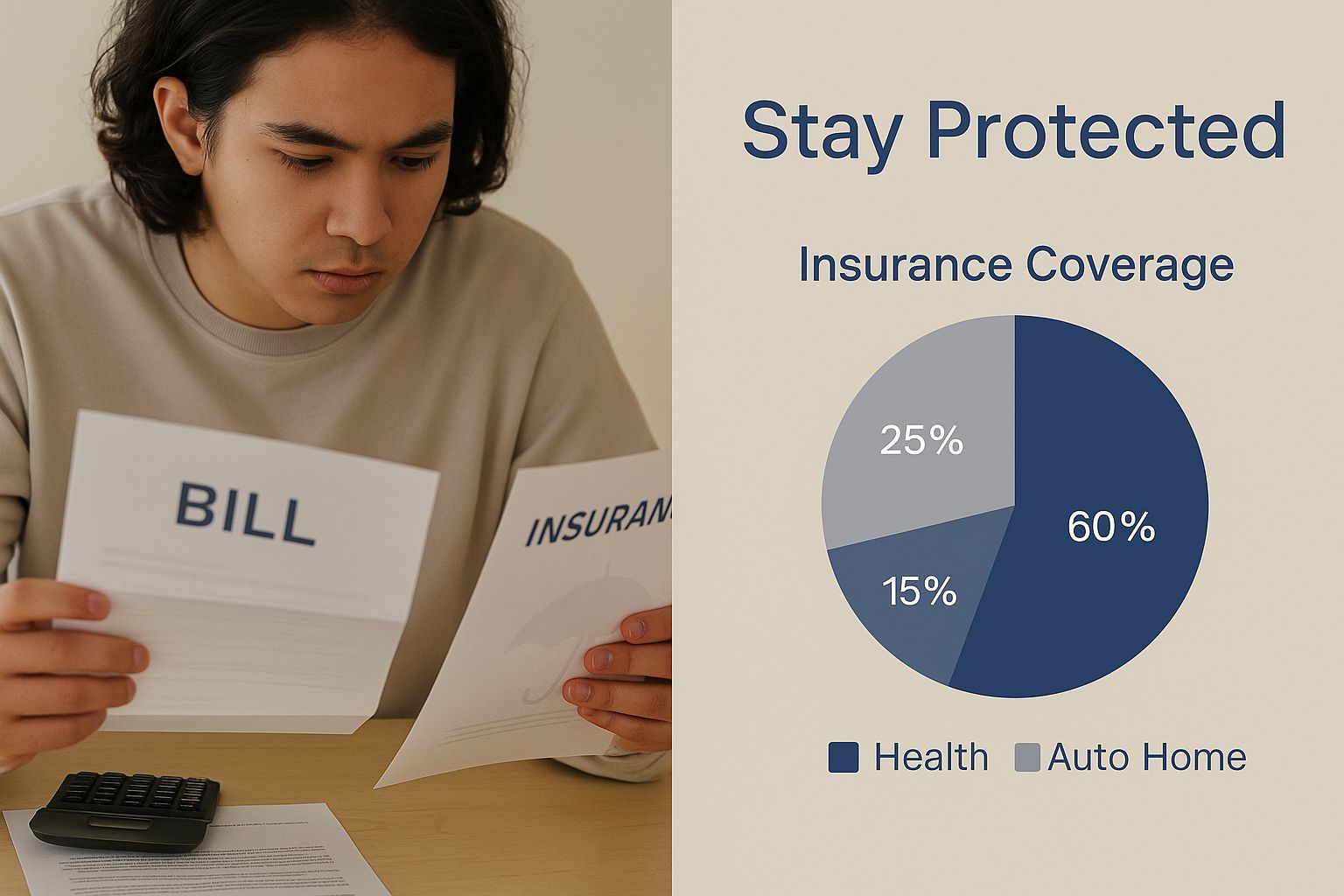
As you can see, reviewing your options carefully is a key part of managing your personal finances and securing your future.
The Parent Plan: The Most Common Starting Point
The simplest and most popular route for young adults is staying on a parent's or guardian's plan. Thanks to the Affordable Care Act (ACA), you can remain covered under their policy until you turn 26. Easy, right?
This is often the most affordable choice, especially if you're still in school or just kicking off your career. It's so common that for those aged 18 to 25, 72% are covered as dependents on a family member's plan. That number is highest for 18 and 19-year-olds (93%) and naturally drops to 50% by ages 24 and 25 as more people land jobs with their own benefits. You can see more data on these trends over at KFF.org.
Just one heads-up: if you move out of state for college or a job, your parent's plan might have a limited network of doctors in your new area. That could mean routine care is expensive or hard to find.
Employer-Sponsored Plans: Coverage Through Your Job
Once you land a full-time job with benefits, you’ll likely get access to an employer-sponsored health plan. This is a fantastic perk because companies typically cover a big chunk of the monthly premium, making it a super cost-effective option.
When you start looking at these plans, you'll see a few key terms pop up:
- Premium: The fixed amount you pay each month to keep your insurance active. Think of it like a subscription fee.
- Deductible: The amount you have to pay out-of-pocket for medical services before your insurance starts chipping in.
- Copay/Coinsurance: Your share of the cost for a covered service. It might be a flat fee for a doctor's visit (copay) or a percentage of the total bill (coinsurance).
A lower deductible usually means a higher monthly premium, and vice-versa. Employer plans often offer a few choices, so you can pick the one that best fits your health needs and budget. For a deeper dive, check out our guide on individual vs group health insurance to see how these plans differ.
Your health is your most valuable asset. A single trip to the emergency room can cost thousands of dollars without insurance. A comprehensive health plan acts as a financial shield, ensuring a medical issue doesn't become a financial crisis.
The Health Insurance Marketplace: For Freelancers And Entrepreneurs
What if you're self-employed, work part-time, or your job doesn't offer insurance? Don't worry. The Health Insurance Marketplace, also known as the ACA exchange, is your go-to resource. It's a government-run service where you can compare and buy health plans from different companies.
A huge advantage here is that you might qualify for subsidies (premium tax credits) based on your income. These subsidies can slash your monthly premium, with many people paying $10 a month or less. It’s designed to make insurance accessible for young adults, no matter their job situation.
Other Important Options To Know
Beyond the main paths, a couple of other options might apply to your situation.
- Medicaid: This is a public health insurance program that provides free or low-cost coverage to Americans with limited income. Eligibility rules vary by state, but it’s a vital safety net for many. When you apply through the Marketplace, it will automatically check if you qualify.
- Short-Term Plans: These are designed as temporary stopgaps—say, if you're between jobs. They are less expensive but also less comprehensive and don't have to cover pre-existing conditions. Think of them as a temporary bridge, not a permanent solution.
To make things even clearer, here’s a quick breakdown of your main choices.
Comparing Health Insurance Paths for Young Adults
| Insurance Path | Who It's For | Key Benefit | Main Consideration |
|---|---|---|---|
| Parent's Plan | Young adults under 26 | Often the most affordable and simplest option | Your network of doctors might be limited if you live far from home |
| Employer Plan | Employees at companies offering benefits | Employer pays a large portion of the premium, lowering your cost | Your choice of plans is limited to what your employer offers |
| Marketplace (ACA) Plan | Freelancers, part-time workers, or those without job-based insurance | You may qualify for subsidies that make premiums very low | You need to enroll during the Open Enrollment period each year |
| Medicaid | Individuals and families with low income | Provides free or very low-cost comprehensive coverage | Eligibility is based on strict income limits that vary by state |
| Short-Term Plan | People needing temporary coverage between jobs or plans | Lower monthly premiums and quick to get | Offers very limited benefits and doesn't cover pre-existing conditions |
Ultimately, choosing the right path comes down to your unique situation—your age, job, income, and health needs. Each option offers a different balance of cost, coverage, and convenience.
Protecting Your Car with Smart Auto Insurance
Getting your driver's license is one of life's biggest milestones. It’s freedom, it's independence—but it also comes with some serious responsibility. Car insurance isn't just a piece of paper the law requires; it's the financial shield standing between you and the chaos of the open road.

Let’s be real: for young drivers, the price tag on insurance can feel steep. But once you understand what you're actually paying for, it all starts to make sense. Think of it less like a bill and more like a protective toolkit you build yourself.
Your Core Coverage Toolkit
Auto insurance isn't a one-size-fits-all deal. It's a bundle of different coverages that you piece together. These three are the absolute essentials that create your safety net.
- Liability Coverage: This is the bedrock of every policy and the part that's legally required almost everywhere. If an accident is your fault, liability pays for the other person's car repairs and medical bills. It’s what protects your own money from being on the line.
- Collision Coverage: This piece of the toolkit is all about your car. It pays to fix or replace it if you hit another vehicle or run into something like a pole or a fence.
- Comprehensive Coverage: Think of this as the "life happens" protection for all the non-accident stuff. It covers things completely out of your control, like theft, vandalism, fire, hail damage, or hitting a deer.
These three work together to make sure you’re covered, whether you’re at fault for a fender-bender or find your car damaged in a parking lot.
Smart Strategies to Lower Your Premiums
It’s true—young adults often get hit with the highest insurance rates simply because they have less experience behind the wheel. The good news? You have way more control over that number than you might think. A few smart moves can make a huge difference.
First off, your grades can literally pay off. Most insurers offer a good student discount if you keep a "B" average or better, which could shave as much as 25% off your premium.
Another game-changer is a telematics program or safe driver app. These use your phone to track your driving habits—things like your speed, how hard you brake, and if you're using your phone. Prove you’re a safe, responsible driver, and you can earn some pretty deep discounts.
One of the biggest questions is whether to stay on your parents' policy or get your own. A family plan is usually cheaper, but if the car title is in your name, you'll almost always need your own separate policy. The best move is to get quotes for both scenarios.
Fine-Tuning Your Policy for Savings
Beyond just discounts, you can tweak the nuts and bolts of your policy to save cash. The single most effective way is to choose a higher deductible.
A deductible is simply the amount you agree to pay out-of-pocket on a claim before your insurance company starts paying. Raising it from, say, $500 to $1,000 tells the insurer you’re willing to share more of the risk, and they'll reward you with a lower monthly premium.
As you navigate your transportation needs, it's also helpful to look at the bigger picture, like understanding the distinction between personal and auto loans. The choices you make about your vehicle and how you finance it can ripple through your entire budget, including your insurance costs.
Ultimately, building the right auto insurance policy is a balancing act. You need enough coverage to sleep at night, but you don't want to be paying for extras you don't need. With these strategies, you can build a plan that keeps you safe on the road and your money right where it belongs: in your pocket.
Why Renters Insurance Is a Must-Have
If you're renting your first apartment, it’s so easy to think your landlord's insurance has you covered. This is one of the most common—and most expensive—mistakes young adults make.
Here's the deal: your landlord's policy protects the building. The walls, the roof, the pipes. It does absolutely nothing for your stuff.

Think of it like this: your landlord owns the box, but you own everything inside it. If a fire breaks out, a pipe bursts, or someone breaks in, replacing your laptop, furniture, and clothes is 100% on you. That’s where renters insurance, a key part of any plan for insurance for young adults, becomes your personal safety net.
What Your Policy Actually Protects
Renters insurance is a surprisingly powerful tool, and it’s not just about protecting your belongings. It bundles three crucial types of protection into one simple package.
Once you see what each part does, you’ll understand why it’s a non-negotiable part of renting smart.
- Personal Property Coverage: This is the heart of the policy. It covers the cost to repair or replace your things if they're stolen, damaged, or destroyed. We’re talking about events like fire, smoke, a burst pipe, or vandalism. From your brand-new sofa to your bike, this coverage means you don't have to start over from scratch.
- Liability Protection: This is the coverage you hope you never use, but you’ll be so grateful for if you do. If a friend slips and gets hurt in your apartment, this helps pay their medical bills and can even cover your legal costs if they sue. It also protects you if you accidentally damage a neighbor’s unit, like if your bathtub overflows and ruins their ceiling.
- Additional Living Expenses (ALE): If a fire or major leak makes your apartment unlivable, where do you go? ALE—also called "loss of use"—helps pay for temporary housing like a hotel, plus food and other essentials while your place gets fixed.
How This Works in the Real World
Definitions are one thing, but let's talk about real-life situations.
Imagine your bike gets stolen from the locked rack outside your building. Renters insurance can help cover the cost of a new one. Or what if a small kitchen fire ruins your cabinets and fills your apartment with smoke? Personal property coverage helps replace your stuff, while ALE pays for your hotel.
The value here is off the charts. For a monthly cost that's often less than a few lattes, you get protection against losses that could easily hit thousands of dollars. It protects your savings and stops a simple accident from becoming a financial nightmare.
The Incredible Value of a Small Investment
The most shocking thing about renters insurance is just how cheap it is. The average cost is only around $15 to $20 per month.
Compare that tiny expense to the cost of replacing your laptop ($1,200+), your TV ($500+), your furniture, and your entire wardrobe. The math is simple.
This is why it's one of the most important types of insurance for young adults. You're trading a small, predictable expense to transfer the risk of a huge, unpredictable financial blow over to an insurance company. Without it, you’re just one unlucky moment away from a crisis that could wipe out your savings. Don’t leave your financial future up to chance.
Securing Your Future with Life and Disability Insurance
Thinking about life and disability insurance can feel a little… weird. Especially when you’re young, healthy, and focused on building your life, not planning for the worst. It’s easy to file these away as something for “later”—for when you have a mortgage or a family.
But here’s the thing: these policies aren't just for later. They're powerful tools for right now. They act as a financial backstop, making sure one unexpected moment doesn’t derail the future you’re working so hard to create. Protecting your journey is just as important as saving for it.
Why Life Insurance Matters, Even If You're Young
Life insurance isn’t really about you. It’s about protecting the people you love from the financial mess you might leave behind. Even if you’re single, you likely have financial ties that would become someone else's problem if you were suddenly gone.
The most common one? Co-signed debt. If a parent or loved one co-signed your student loans, they could be on the hook for the entire balance. A simple, surprisingly affordable life insurance policy can lift that weight off their shoulders. It’s an act of love and financial responsibility.
Now, let's talk about the biggest myth: the cost. Most young adults think life insurance is wildly expensive. It's not. A study by LIMRA and Life Happens found that adults under 30 overestimate the cost of a term life policy by 10 to 12 times what it actually costs. You can see the full research findings for yourself.
For most young adults, term life insurance is the perfect fit. It’s straightforward, incredibly affordable, and covers you for a specific period—like 20 or 30 years. That’s long enough to pay off debts and build your own wealth.
Wondering how much coverage makes sense for you? Our life insurance needs calculator can give you a solid estimate based on your personal situation.
Protecting Your Paycheck with Disability Insurance
If life insurance protects your loved ones when you’re gone, disability insurance protects you while you're here.
Think of it as paycheck protection. Right now, your most valuable asset isn't your apartment or your car—it's your ability to get up every day and earn an income for the next 40-plus years.
What happens if a serious illness or an accident takes that away for months, or even years? How would you pay rent? Buy groceries? Keep the lights on? That’s the exact gap disability insurance is built to fill. It provides you with a monthly income while you focus on getting better.
There are two main types you'll run into:
- Short-Term Disability (STD): This kicks in pretty quickly, usually after a week or two, and pays benefits for a few months. It's perfect for covering things like recovery from a major surgery or a bad injury.
- Long-Term Disability (LTD): This is for the bigger, scarier stuff. If you’re out of work for an extended period, LTD takes over where short-term leaves off. It can provide income for years, sometimes even all the way to retirement.
A lot of employers offer disability coverage as a benefit, sometimes for free or at a very low cost. If yours doesn't, you can always get a private policy. Securing your income stream is one of the smartest things you can do for your financial stability.
Key Questions Young Adults Ask About Insurance
Stepping into the world of insurance can feel like learning a new language. As you get more independent, real-life questions pop up that need straight, simple answers. This guide cuts through the noise and tackles the most common things young adults wonder about, so you can make smart moves without getting buried in jargon.
Let’s dive into the scenarios you're probably already thinking about.
When Should I Get My Own Car Insurance Policy?
The easiest rule to remember is this: once the car title is in your name, it's time for your own auto insurance policy. Sure, staying on a parent's plan is almost always cheaper, but most insurers will require you to get your own coverage once you move out for good—especially if you're in a different state.
Your best bet is to compare quotes for both options. Rules and rates can be wildly different from one company to the next, so the goal is to find the right coverage for your new, independent life.
Is Renters Insurance Really Worth the Money?
Yes. 100%. For what often amounts to the cost of a few coffees a month—usually around $15-$20—renters insurance protects all your stuff from things like theft, fire, or a burst pipe. We're talking thousands of dollars worth of your belongings.
But here’s the most important part: it also includes liability coverage. That means if a friend gets hurt at your place, you're financially protected.
Considering how little it costs and how much it can save you, renters insurance is one of the smartest, most affordable financial safety nets a young adult can have. It’s a tiny price for a massive amount of peace of mind.
What Happens to My Health Insurance When I Turn 26?
Turning 26 is a big milestone, and in the insurance world, it’s known as a “Qualifying Life Event.” This is actually great news for you. It opens up a special 60-day window where you can enroll in a new health plan right away, without having to wait for the annual open enrollment period. After your 26th birthday, you can no longer stay on a parent's plan.
So, what are your options?
- A health plan offered by your employer.
- A policy you find on the Health Insurance Marketplace (you might even get subsidies to lower the cost).
- Medicaid, if your income falls within your state's guidelines.
Start looking into these a few months before your birthday. This will help you avoid any gaps in coverage and make the switch smoothly. To choose confidently, you'll need to grasp some core ideas, and this guide on understanding insurance policy limits is a fantastic place to start. And when you're ready to apply, our article on what documents do I need to get insurance will help you get everything in order.
At My Policy Quote, we make it easy to find the right insurance plan for every stage of your life. Get a free quote today and secure the protection you deserve.