

Burial insurance quotes should be judged against the final expenses your family needs to fund, not just the monthly premium. Your actual rate depends on your health, tobacco use, coverage amount and the carrier's underwriting rules.
A low payment can look reassuring until you discover that the benefit won't cover the planned funeral or that full coverage doesn't begin immediately. Start with a written expense budget, identify money your family can readily access, and then compare policies for the remaining gap.
Typical Burial Insurance Premiums by Age and Coverage
| Age band | $5,000 face amount | $10,000 face amount | $20,000 face amount |
|---|---|---|---|
| Ages 50-59 | Request a personalized non-smoker quote | Request a personalized non-smoker quote | Confirm eligibility and request pricing |
| Ages 60-69 | Request a personalized non-smoker quote | Request a personalized non-smoker quote | Confirm eligibility and request pricing |
| Ages 70-79 | Confirm rate class and benefit timing | Confirm rate class and benefit timing | Confirm the carrier's coverage ceiling |
| Ages 80-85 | Confirm issue-age eligibility | Confirm eligibility and coverage ceiling | Ask whether this amount is available |
These are quote-request categories, not sample premium ranges. There isn't a verified age-based rate schedule available here, so assigning monthly prices would create a misleading benchmark.
The face amount is the policy's stated death benefit, subject to its terms. The premium is the payment required to maintain coverage. Read across the row to identify the amounts you want priced, but don't assume that a larger policy costs an exact multiple of a smaller one.
Put the benefit before the payment
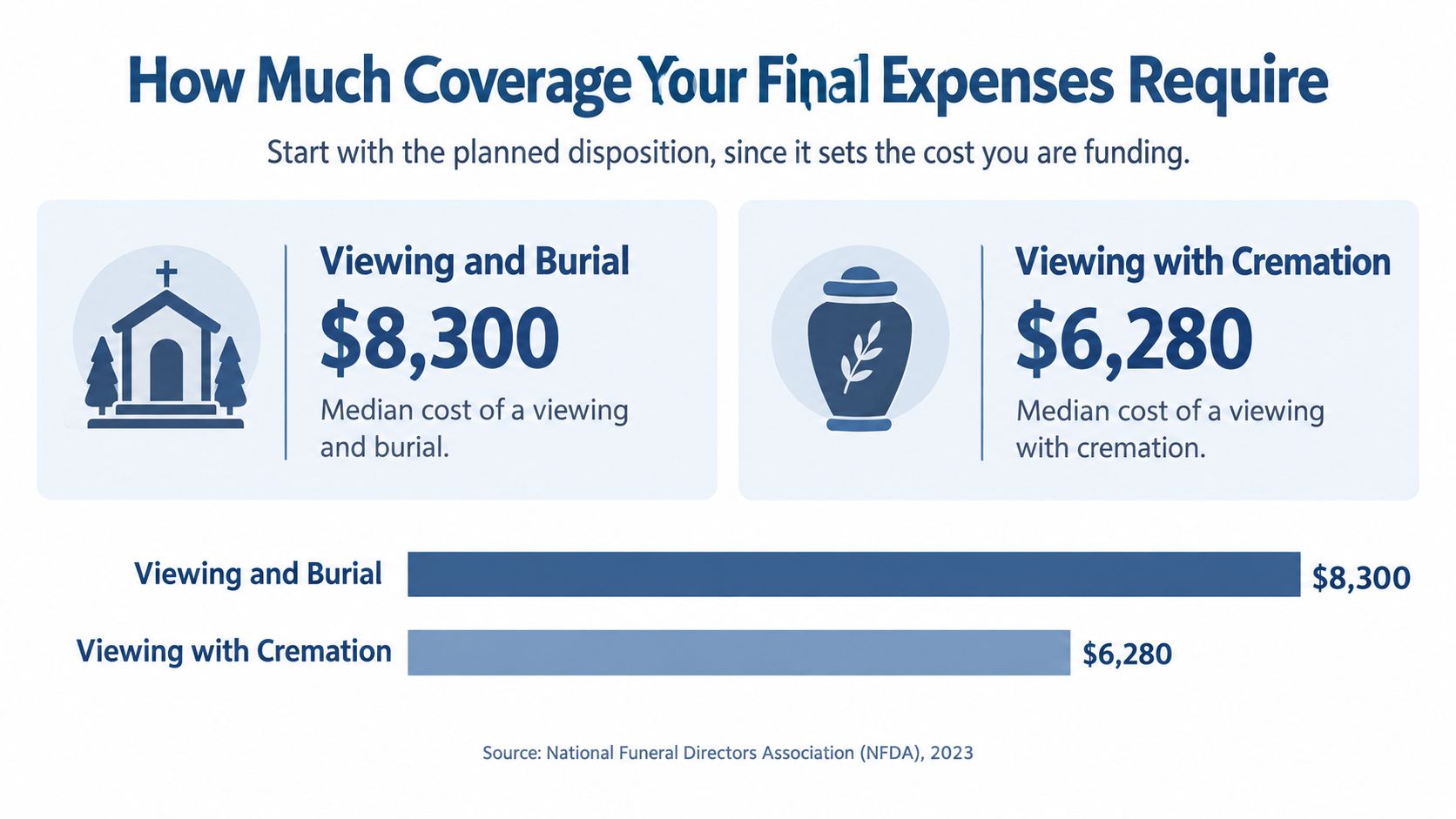
For context, the National Funeral Directors Association's 2023 General Price List Study reported national median costs of $8,300 for an adult funeral with viewing and burial and $6,280 for a funeral with cremation, including an alternative cremation container and urn. Those medians exclude cemetery interment, a monument or grave marker, and cash-advance items such as flowers and obituary notices.
Use the table in this order:
- Find your age band. Ask which products accept applicants at your exact age.
- Choose a benefit to price. Base it on your funeral budget rather than an advertised payment.
- Confirm the assigned class. An initial estimate isn't a reliable comparison until the insurer has considered your application details.
Age helps organize the search. It doesn't establish what you'll pay.
How Much Coverage Your Final Expenses Require
Start with the planned disposition, since it sets the cost you're funding. Direct cremation, cremation with a ceremony, and burial with cemetery arrangements need different budgets.
| Planned disposition | Cost reference to collect | Face amount to request | Costs to add |
|---|---|---|---|
| Direct cremation | Itemized local direct-cremation price | Unfunded arrangement costs | Death certificates, urn, obituary |
| Cremation with service | Cremation provider and ceremony estimates | Unfunded cremation and service costs | Viewing or memorial, flowers, notices |
| Traditional burial with viewing | Funeral home's itemized burial estimate | Unfunded funeral and cemetery costs | Plot, opening and closing, grave marker |
| Burial with cemetery plot and monument | Separate funeral, cemetery and monument estimates | Combined unfunded total | Location-specific cemetery and monument charges |
The amount to request is a calculation, not a standard package. A national median can help you recognize an incomplete budget, but it can't price your local cemetery or your family's choices.
Include the choices that come after cremation
The NFDA statistics page projected cremation at 63.4% of dispositions in 2025, compared with 31.6% for burial, and reports that 37.8% of people who prefer cremation would still prefer to bury or inter cremated remains in a cemetery. Choosing cremation therefore doesn't necessarily eliminate cemetery expenses.
Say Daniel, a self-employed electrician, wants direct cremation and a small memorial. His wife would also like a cemetery niche later. They should obtain separate estimates, decide whether the niche belongs in the insurance budget, and document who will fund it if it doesn't.
That distinction prevents a disagreement from becoming an unexpected bill. It also keeps Daniel from buying coverage for an arrangement he never intended to fund.
Budget rule: Separate the arrangement you've chosen from optional expenses your family may choose later.
Add transportation, unpaid obligations and family travel only when you intend the policy to help pay them. Don't count the same savings toward both funeral costs and another household need.
For a planning companion, you can plan funeral coverage with Coveredly. A guide to life insurance for funeral costs can also help you distinguish the expense budget from the policy used to fund it.
Write down the disposition, optional family costs and total funding target before requesting a price.
What a Burial Insurance Quote Actually Includes
A burial insurance quote is an insurer's proposed price for a specified death benefit under stated application and policy assumptions. Like a car's sticker price, it means little without knowing the version and terms you're buying.

Look for these components:
- Benefit and beneficiary: The stated amount and who receives an approved claim.
- Payment schedule: The premium, payment frequency and how long payments continue.
- Underwriting type: How the insurer evaluates eligibility.
- Benefit restrictions: Any waiting period, graded benefit or modified payout.
- Exclusions: Circumstances in which the contract limits or excludes payment.
- Effective date: When coverage starts, not merely when you request a quote.
Separate guarantees from projections
The National Association of Insurance Commissioners' Life Insurance Buyer's Guide distinguishes guaranteed policy elements from non-guaranteed elements and explains that some premiums and values depend on investment earnings, claims costs and expenses. An illustrated outcome isn't automatically a contractual promise.
A quote is a promise only where the policy states the relevant terms as guaranteed.
For final-expense planning, prioritize the guaranteed death benefit, guaranteed premium schedule and benefit restrictions. Treat projected cash values as secondary to the money your family needs when a covered death occurs.
Ask how long the quoted offer remains valid and what could change after application review. Don't assume an estimate locks in coverage or price.
Also request the missed-payment provisions. The policy's grace period describes the time allowed to resolve a late payment before coverage can end under its terms. If the policy lapses, any remaining cash value or nonforfeiture option is governed by the contract, not by the total premiums you've paid.
Ask the agent to show you those provisions rather than just saying the policy builds value.
Pricing Drivers Behind Your Burial Insurance Quote
| Driver | How it can change the quote | What to check |
|---|---|---|
| Age at application | Affects pricing and product eligibility | How the carrier determines insurance age |
| Health and medications | Can affect approval, rate class and benefit timing | Complete diagnoses and prescription history |
| Tobacco use | Can change the pricing category | The carrier's definition and lookback questions |
| Coverage amount | Changes the insurer's payment obligation | Product minimums and maximums |
| Policy type | Changes application requirements and available terms | Whether health screening could improve your offer |
| Payment mode | Can change the total scheduled cost | Monthly and annual totals |
| Rating factors and state | Can affect available products and pricing | The rules applicable to your application |
Underwriting is the insurer's process for deciding whether to offer coverage and on what terms. The factors don't operate independently: the same medical history can receive different treatment under different carriers' product rules.
The Society of Actuaries' report on simplified-issue underwriting identifies final-expense coverage as a common application of an approach that generally avoids physical examinations and fluid collection, using health-and-lifestyle questions and often third-party health data instead. It also explains that simplified issue typically supports fewer rate classes and lower maximum coverage amounts than full medical underwriting.
Similar applicants can receive different offers
Consider applicants of the same age requesting the same benefit. One reports controlled blood pressure without recent hospital care; another reports insulin use and a recent hospitalization.
A carrier might offer them different classes, benefit schedules or eligibility decisions. That's a hypothetical illustration, not a prediction about either condition: the exact application questions and insurer rules control.
Don't assume no medical exam means no health assessment. Prescription checks and application answers can still matter substantially. This explanation of what underwriting means in insurance can help you prepare for that review.
Use the video as an additional explanation of the quote process.
Before comparing prices, record the policy type, assigned class and timing of full natural-death coverage. Keep the face amount and payment mode consistent so a cheaper quote doesn't merely reflect a smaller benefit or different contract.
How to Get an Accurate Burial Insurance Quote
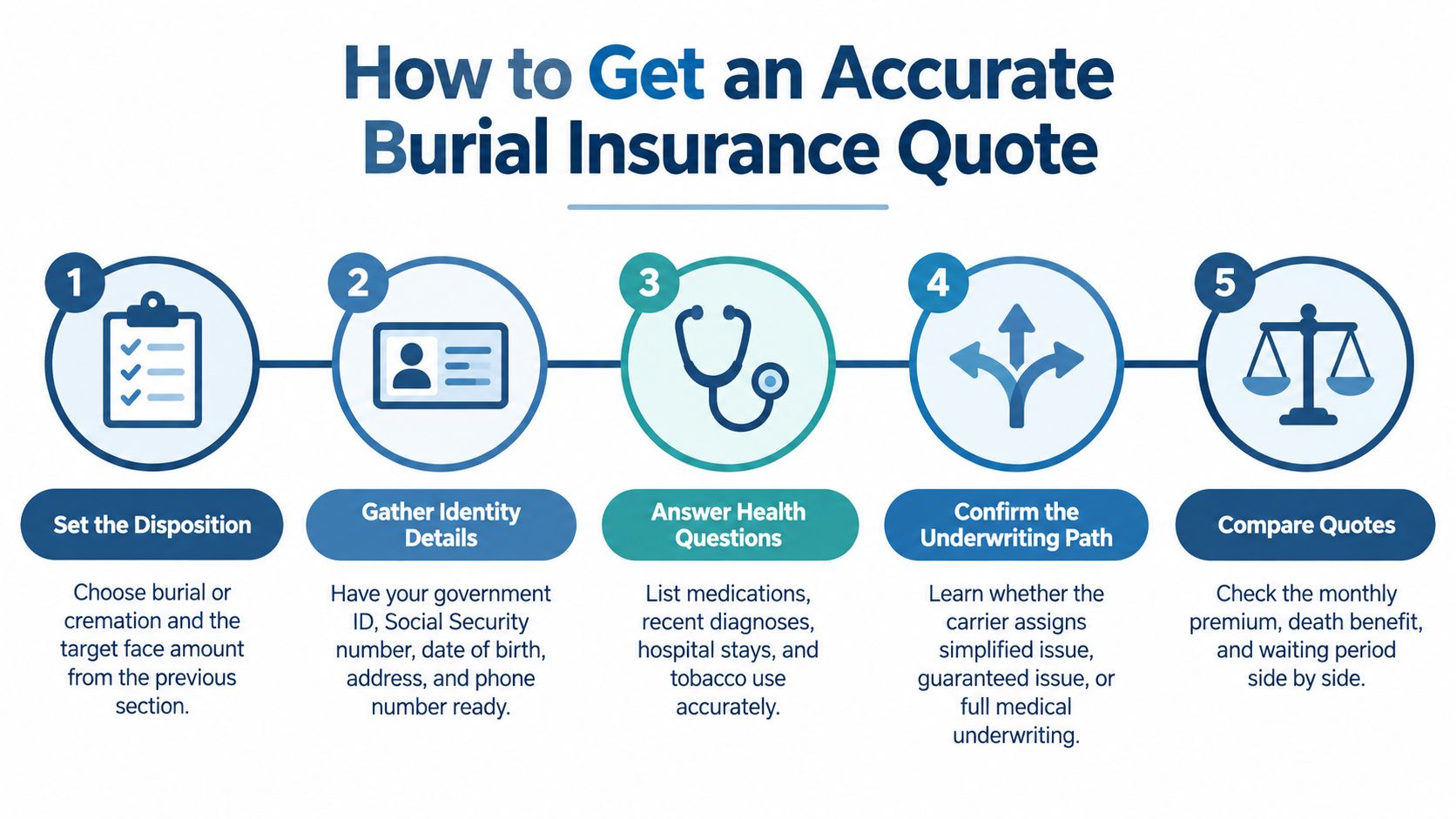
Prepare your information before opening quote forms or scheduling calls. Accurate answers help the insurer evaluate the coverage you actually qualify for rather than producing an attractive estimate that changes later.
Prepare the information the insurer needs
Set your expense target. Save the funeral and cemetery estimates supporting your chosen arrangement. Note which expenses are essential and which are optional so you can adjust the benefit deliberately if the premium is unaffordable.
Gather basic application details. Have your date of birth, address, contact information, height and weight available, along with proposed beneficiary details. You generally shouldn't need to provide bank credentials merely to compare preliminary prices; provide sensitive identity and payment information only through a verified, secure application process.
Build an accurate medical list. Include prescriptions, doses, reasons for treatment, diagnoses, hospital stays and tobacco history. Follow each application's exact time periods rather than applying a single assumed lookback window to every insurer.
Request comparable offers. Use the same benefit, policy type and payment frequency with each carrier. Record whether the price is preliminary, reviewed or approved so you don't compare different stages as though they're equivalent.
Ask questions that reveal the contract
Ask about guarantees and restrictions. Is the premium guaranteed for the full payment period? Ask when full benefits begin, whether early benefits are reduced, which underwriting class applies and which exclusions govern the policy.
Resolve uncertain health answers before submitting. If you don't remember a diagnosis or hospitalization date, check your records rather than guessing. Inaccurate answers can affect underwriting and create difficulties if the insurer reviews the application during a claim investigation.
Save the offer and supporting documents. Keep the carrier name, quote date, validity terms, policy summary and application answers together. Ask when any payment will be collected, what it authorizes and when coverage becomes effective.
A guide to requesting an insurance quote online can help you organize the digital process without treating the first displayed price as approval.
Avoid this shortcut: Don't answer as the healthier person you hope the insurer will see. Answer as your medical records and the application questions require.
The most damaging comparison mistake is building a shortlist from inaccurate health assumptions. You can't make an informed choice if every appealing price belongs to a class you won't receive.
Online Quotes Versus Working With an Agent
| Decision point | Online quote process | Licensed agent |
|---|---|---|
| Working style | Enter details at your own pace | Discuss questions and trade-offs |
| Medical complexity | Useful when the form fits your circumstances | Helpful when answers need clarification |
| Carrier access | Limited to the platform's participating insurers | Limited to the agent's appointments |
| Documentation | Save displayed assumptions and disclosures | Request written summaries of recommendations |
| Follow-through | You may need to resolve questions yourself | Ask what application and claim support is offered |
Neither channel automatically produces the better policy. Your choice should reflect how much help you need and whether the person or platform can show relevant alternatives.
For a straightforward application, an online process can make initial comparisons easier. You can enter consistent information, review payment options and save offers without discussing sensitive circumstances in an unexpected sales call.
Match the channel to the difficulty
If you have multiple conditions, a previous decline or a recent hospitalization, an agent may help identify application questions that materially affect eligibility. Ask the agent to explain why a particular insurer fits your circumstances, not merely why its premium looks attractive.
A complicated ownership or beneficiary arrangement also deserves a conversation. For example, someone buying coverage on a relative needs to understand whose consent is required, who controls the policy and who receives the benefit.
Ask about scope and compensation directly:
- Carrier selection: Which insurers can you quote, and which aren't included?
- Cost: Are there separate fees, and does this channel affect the quoted premium?
- Recommendation: Why does this policy fit better than the alternatives?
- Service: Who handles changes, missed-payment questions and beneficiary updates?
Don't assume an agent represents the entire market or that an online comparison includes every available carrier. Likewise, don't assume the same product must cost more just because someone helps you apply.
Whatever channel you choose, retain an offer that identifies the carrier, benefit, premium, underwriting approach and validity terms. If someone won't provide those details in writing, pause before authorizing an application or payment.
Comparing Quotes Side by Side Before You Buy
| Factor | Where to find it | Strong sign | Warning sign |
|---|---|---|---|
| Death benefit | Quote and policy summary | Covers the documented funding gap | Early reduction without a clear schedule |
| Premium guarantee | Policy summary | Clear guarantee and payment duration | Adjustable cost you can't budget for |
| Underwriting type | Application and offer | Appropriate to your health and budget | Limited-underwriting option chosen without alternatives |
| Waiting period | Benefit provisions | Timing fits your family's funding plan | Family can't fund expenses during restricted coverage |
| Exclusions | Policy | Clearly defined restrictions | Unexplained or ambiguous limitations |
| Carrier rating | Rating agency's assessment | Financial-strength information you understand | No verifiable assessment or unclear rating identity |
| Beneficiary and payout | Application and claim instructions | Named beneficiaries and clear claim steps | Unclear recipient or inaccessible paperwork |
Similar premiums can buy very different contracts. Use a written checklist when comparing life insurance quotes so the decision doesn't come down to whichever monthly payment is easiest to remember.
Calculate the residual funding gap
The 2025 Cremation and Burial Report identifies the Social Security lump-sum death payment as $255, which is not a substitute for a dedicated funeral funding plan. Confirm eligibility and the recipient before including that payment in your calculation, and don't assume it arrives when a funeral provider needs payment.
Use this calculation:
Documented final-expense target − confirmed public payment − accessible, dedicated savings = residual funding gap.
Subtract only savings that the appropriate person can access and that the household has genuinely reserved for these expenses. Money needed for the surviving spouse's rent shouldn't simultaneously count as funeral funding.
For a hypothetical household, suppose accessible savings and a confirmed public payment cover part of the documented arrangement. The policy must fund what remains, but its restricted early benefit may be smaller than its advertised face amount. Test the payout applicable at different stages of coverage, not just the eventual full benefit.
Identify who pays first
Ask who could advance payment while a claim is processed. A death benefit, an estate asset, a payable-on-death account and an uncertain crowdfunding campaign aren't interchangeable sources of ready cash.
Check claim requirements with the insurer and payment requirements with the funeral provider. Don't assume a provider will accept an insurance assignment or postpone payment.
Keep only the quotes that pass both tests: the contract fits your needs, and the payable benefit covers the residual gap when your family would need it.
Choose the Right Quote and Confirm Your Next Step
Choose the policy your household can maintain and your beneficiary can use, not the largest benefit a salesperson offers. Affordability matters across the full payment schedule, including periods when income is lower.

- Self-employed professionals and contractors: Include premiums in household cash-flow planning and keep a payment reserve for slow work periods.
- Early retirees: Review continuing employer coverage and the affordability of a new premium alongside retirement expenses.
- Working-class families: Price the arrangement you really want rather than stretching the budget for an assumed traditional funeral.
- People without dependable work benefits: Test whether you could maintain the policy after an income reduction. Health insurance and life insurance solve different needs.
- Financial advisors: Retain the disposition decision, itemized estimates, quote set and funding-gap calculation.
- Parents buying for adult children: Confirm consent, insurable interest, ownership and beneficiary requirements before applying.
- People referring a spouse or relative: Have that person provide their own health information and participate in the coverage decision.
Your next action is straightforward:
- Choose the situation that fits your household.
- Document the intended arrangement and available funding.
- Set the benefit needed before requesting quotes.
My Policy Quote offers life insurance quote requests and comparisons, including options relevant to final-expense planning. Visit My Policy Quote with your documented funeral budget and funding gap, then ask to compare coverage amounts, guaranteed premiums and benefit timing.