

Term life insurance pays named beneficiaries only if the insured dies during a chosen period, and it generally buys financial protection rather than cash value. Common coverage periods include 1, 5, 10, or 20 years.
You may be looking at an unpaid invoice, a mortgage statement, or a family budget that depends on your next paycheck. The useful question isn't just what a policy costs. It's which bills would remain, who would pay them, and how long that person would need help.
Why Term Life Insurance Matters Now
A contractor finishes a job, sends an invoice, and waits for payment. At home, the mortgage and grocery bills don't wait. If that contractor died, the household would need more than money for immediate expenses. It would need a way to keep paying those bills without the next contract.
A working family faces a similar question when most of its income comes from one wage. A spouse nearing retirement may worry about something different: whether the younger partner could manage the home and ongoing expenses alone. These aren't abstract insurance problems. They're questions about keeping daily life workable.
Having coverage isn't the same as having enough
Term insurance is a mainstream choice. In 2022, 45.6% of U.S. households owned term life insurance, compared with 16.9% holding cash-value insurance, with overlap because some households owned both, according to the ACLI household ownership data.
That same report shows overall life insurance ownership fell from 69.2% in 1998 to 56.0% in 2022, while the median face value of all in-force policies rose from $61,000 to $150,000. These figures describe ownership, not whether a particular family could manage financially after a death.
The face amount is the stated amount of coverage. To judge yours, put it beside the expenses your household would face:
- Lost earnings: What income would disappear, and how long would someone need help replacing it?
- Debts and housing: Which payments would continue without you?
- Care and education: What childcare, household help, or education spending would still be needed?
- Immediate costs: What final expenses and near-term bills would need attention?
For someone without workplace life insurance, there may be no employer benefit to include in that calculation. Even when a workplace policy exists, check its amount and what happens if employment changes rather than assuming it will always be available.
Start by gathering those obligations, not choosing a product name. The practical aim is to match the amount of money needed with the years that need will last.
What Term Life Insurance Actually Covers
Think about a mortgage with a final payment date. Your household needs protection while that debt remains, but the need may look different after it's paid off. Term life insurance lets you plan around that kind of deadline.
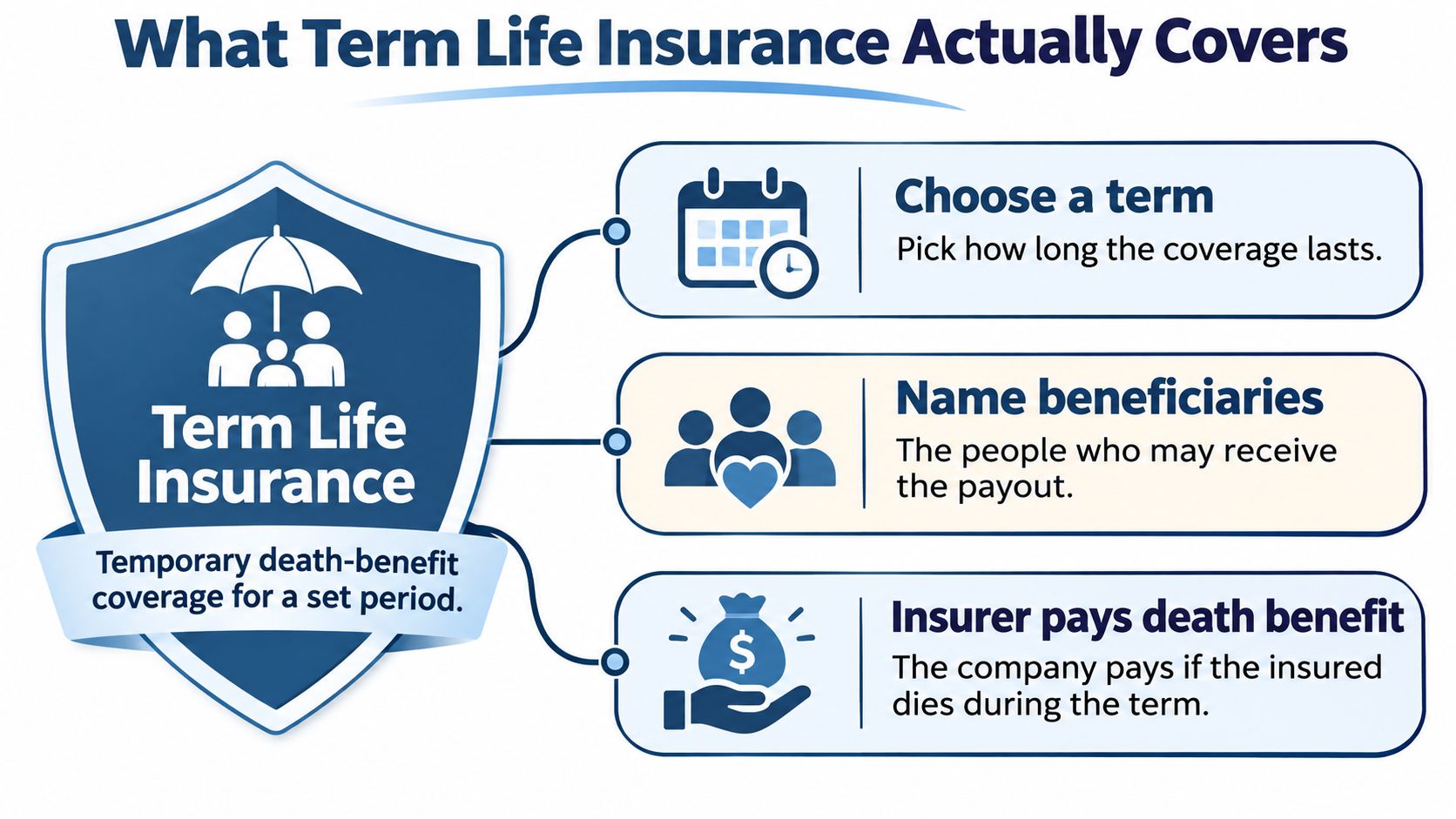
The contract provides temporary death-benefit coverage. The insured is the person whose life is covered; the beneficiaries are the people named to receive the benefit if that person dies while coverage is active.
A promise with a beginning and an end
The National Association of Insurance Commissioners' life insurance guide describes common terms of 1, 5, 10, or 20 years, or coverage through a specified age such as 65. It also explains that term policies generally don't accumulate cash value and generally offer lower premiums in the early years, with more protection per premium dollar than permanent insurance.
A useful analogy is renting protection for a particular stretch of life. You're paying for the insurer's commitment during those years, rather than building a savings balance inside the policy. The analogy isn't a substitute for reading the contract, but it helps explain why temporary coverage can fit a temporary obligation.
The basic relationship looks like this:
Match the promise to the responsibility
A business loan, years of supporting dependent children, and a mortgage may each create a different deadline. Don't assume the shortest available term is adequate just because its starting payment looks manageable.
Ask yourself:
- What ends the need? Identify the event, such as repayment of a loan or a child becoming financially independent.
- What could extend it? Allow for responsibilities that might last longer than expected.
- What does the contract promise? Check the coverage dates and conditions rather than relying on a verbal description.
Practical rule: Choose the obligation's end date before choosing the policy's end date.
Term coverage isn't automatically the right answer to a need that has no foreseeable end. If someone may depend on you indefinitely, raise that concern before selecting a temporary policy. The key is to recognize the difference between a responsibility with a likely finish line and one that could continue throughout your life.
How a Term Life Policy Works
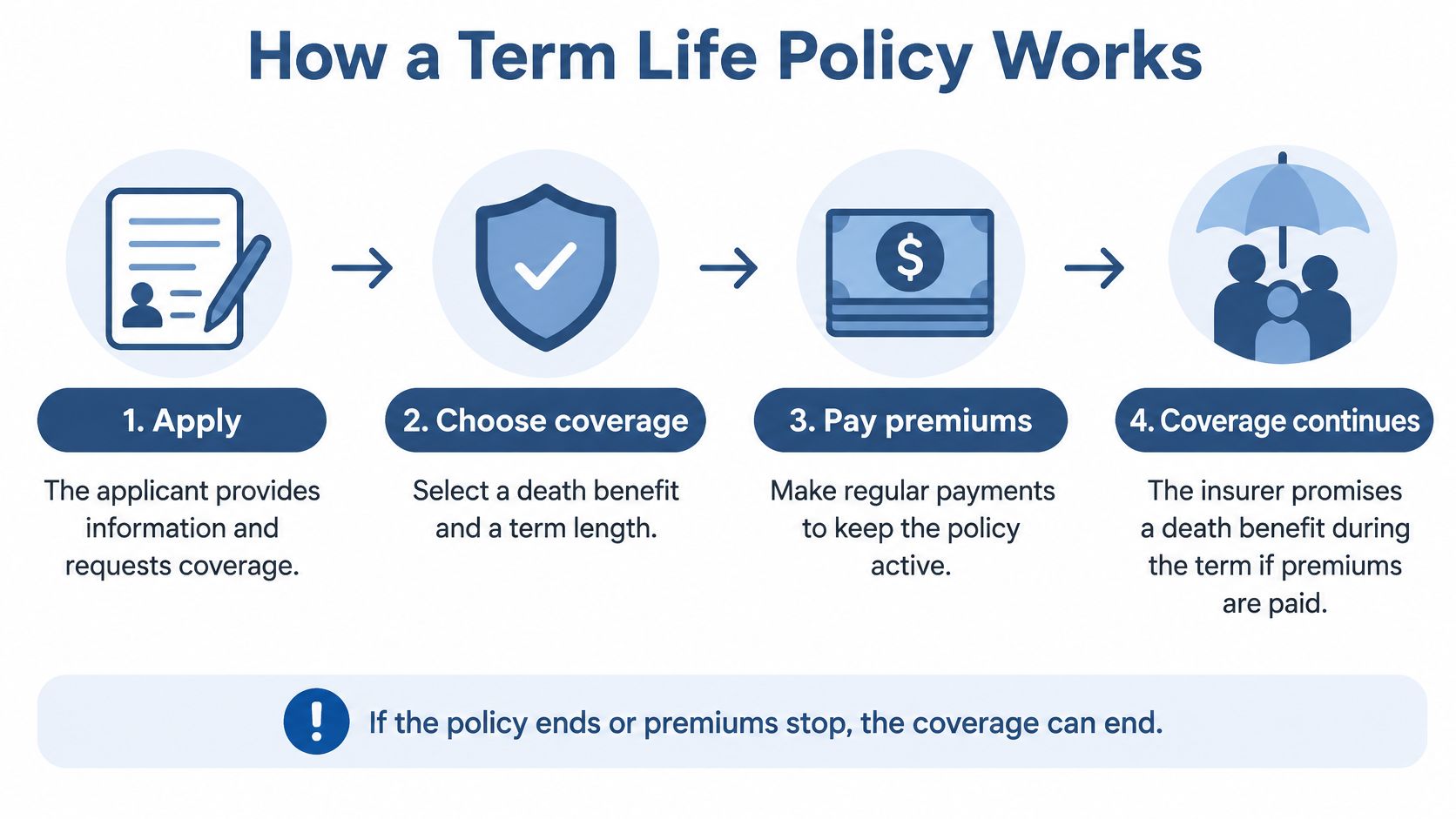
An application turns a household plan into a request for coverage. You select the amount you want and the period you want it to last, then review what the insurer offers before accepting the policy.
The regular payment is the premium. Paying it as required keeps the coverage in force under the contract's terms. If the insured dies while the policy is active, the named beneficiaries request payment of the death benefit through the insurer's claim process.
Follow the policy from application to payment
Keep the sequence clear:
- Apply for coverage: Provide the requested information and identify the person to be insured.
- Review the offer: Check the death benefit, coverage dates, payment schedule, and policy provisions.
- Maintain the policy: Keep payments current and contact information accurate.
- Prepare the recipients: Tell beneficiaries where to find the policy and how to contact the insurer.
This diagram puts those moving parts in order:
Separate the coverage period from the price promise
A level premium stays steady for the period specified in the contract. Renewable coverage concerns the ability to continue coverage under the policy's renewal provisions. These describe different features, so don't treat them as interchangeable.
A policy might offer a steady payment during its initial period and a different price afterward. Ask to see both the guaranteed premium schedule and any renewal provisions. Don't assume that a familiar payment amount continues for as long as you're allowed to keep coverage.
Your premium buys protection during the agreed period. Check separately how long the coverage lasts and how long the payment stays level.
If other policy types appear in your quotes, this comparison of term and whole life insurance can help you distinguish the choices without mixing up their promises.
Beneficiary selection deserves the same attention as the payment. Don't assume the insurer will identify whoever needs the money most. Review the named recipients, ask how to name an alternate recipient, and get guidance if a child or someone needing help managing money is involved.
Before putting the policy away, confirm that the insurer's records reflect your intentions. A clear beneficiary designation and accessible paperwork make the plan more usable for the people you're trying to protect.
Who Term Life Insurance Protects Best
Different households can use the same kind of policy for very different purposes. The following are illustrative situations, not claims about actual customers.
The people and responsibilities may change, but the planning question stays concrete: what needs funding, and until when?

A contractor with uneven income
Consider a self-employed electrician whose household depends on income from completed jobs. Deposits vary, but the family still relies on that work to pay for housing and food. In this example, there's no employer life benefit.
A term aligned with the household's remaining years of financial dependence could address that exposure. A separate business loan may require its own review, especially if someone else has co-signed it.
The next check isn't the electrician's strongest month. It's the amount the household normally needs from the business, how long that support would be necessary, and whether business obligations would remain.
A working family with overlapping deadlines
For a family raising children, the responsibilities may include childcare now, education later, and mortgage payments throughout. A term that ends when childcare spending falls could still leave the mortgage or education need uncovered.
The surviving parent may also need room to adjust work hours rather than immediately replace all lost wages. Ask which expenses would change after a death, including the cost of replacing unpaid care and household work.
Parents considering coverage on an adult child's life face a separate question: what financial loss would they personally face? This guide to term life insurance for parents provides related planning context.
The video below offers another way to approach the topic before reviewing your own obligations.
An adult approaching Medicare
For someone ages 60 to 64, the question may be less about replacing a full working career and more about protecting a remaining obligation. Consider a person preparing to retire while a spouse still relies on shared income for housing, health expenses, and retirement needs.
A shorter remaining mortgage or business transition might call for a different coverage period than ongoing support for a dependent adult. Don't use a retirement date or Medicare eligibility date as an automatic stopping point.
For each situation, check:
- The actual deadline: When could the surviving household manage without the benefit?
- The remaining exposure: What would still be unpaid or unsupported if coverage ended earlier?
- The available contract: Does the offered term fit that need, subject to eligibility and policy terms?
What Happens When the Term Ends
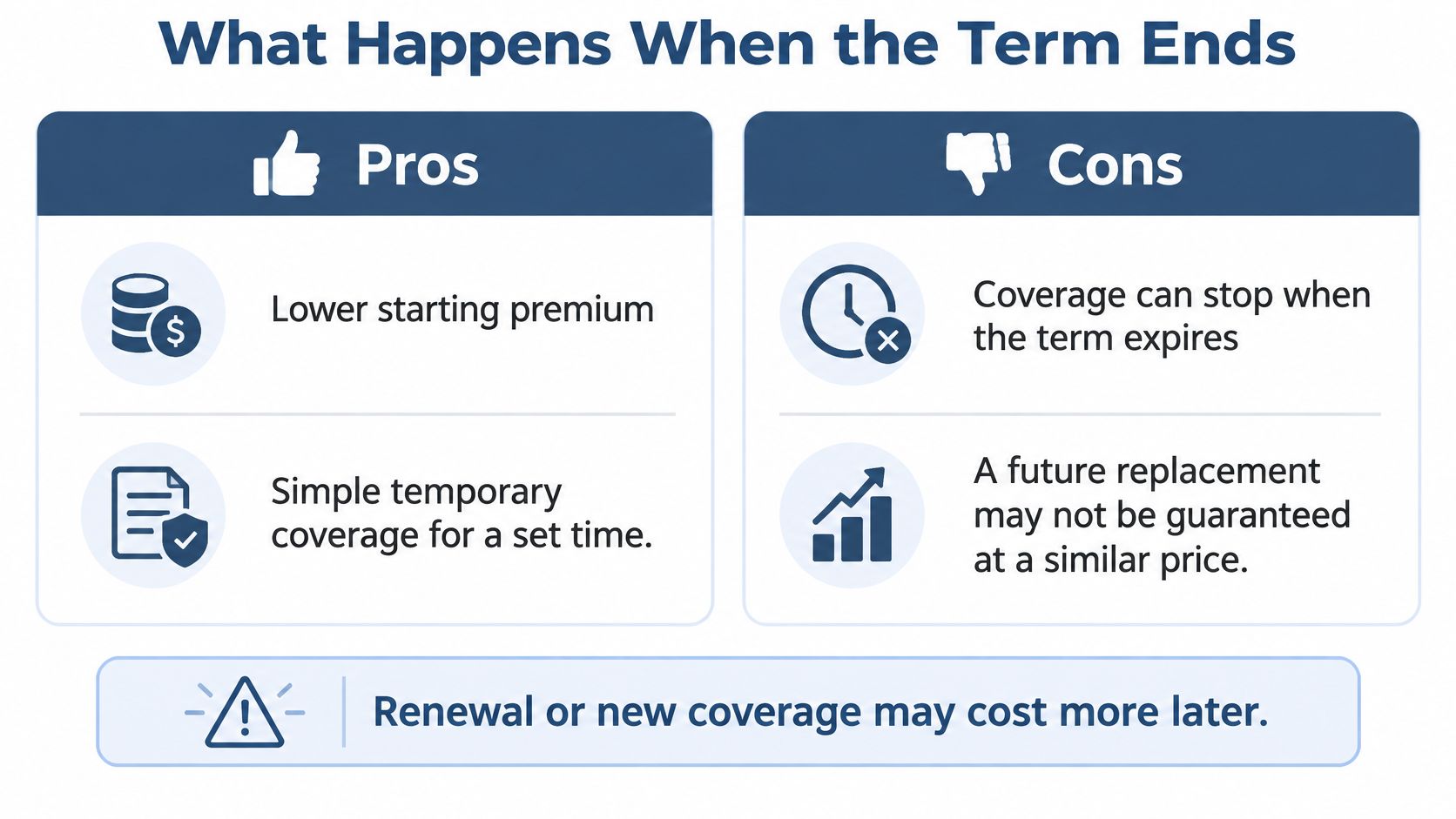
A manageable starting premium doesn't settle the whole decision. You also need a plan for the date that initial protection ends, especially if your health, work, or family responsibilities might change.
The NAIC guide cited earlier warns that coverage can end at expiration and renewal may cost more. Don't assume you'll be able to replace a policy later at a price similar to today's.
The end-of-term trade-off deserves attention before you buy:
Review separate paths, not a single fallback
Ask the insurer or agent to explain which options your contract provides:
- Renewal: Check whether continued coverage is available, the permitted duration, and the future premium schedule.
- Conversion: If the policy includes a conversion privilege, confirm the deadline, eligible coverage, cost, and applicable requirements.
- A new application: Compare replacement coverage, while recognizing that future eligibility and pricing shouldn't be assumed.
These aren't promises that every policy offers every option. Request the relevant provisions in writing and mark any deadlines on your calendar.
A remaining mortgage, support for a dependent adult, a business transition, or a spouse's expenses can outlast the original income-replacement plan. Review those obligations before deciding that expiration won't matter.
Replace price guesses with contract details
Misunderstanding can affect the decision long before expiration. A 2025 LIMRA study of young adults found that they overestimated the cost of a $250,000, 20-year level-term policy by roughly 10 to 12 times; 53% of young adults who considered themselves insufficiently knowledgeable had a coverage gap.
Those findings concern younger adults, not every age group. The practical lesson for any buyer is to check actual offers and policy provisions instead of relying on an assumed price or an assumed renewal option.
Before expiration: Compare the household's remaining need with the choices available under the existing contract.
Start that review while you still have time to act on conversion or other deadlines. This explanation of what happens at the end of term life insurance can help you prepare questions for the insurer.
Don't cancel existing protection while a replacement is merely being discussed. Confirm the status and effective date of any proposed coverage before making changes.
How to Choose the Right Term Coverage
Start with what your household would lose, not a multiple of your salary. For irregular earners, a strong year can exaggerate the need, while a weak year can hide the support the household depends on.
Uncertainty is a real barrier. The 2025 Insurance Barometer findings report that 40% of U.S. adults, nearly 100 million people, believe they need more life insurance; almost one-quarter haven't purchased because they don't know how much they need or which type to buy. Nearly half say they'd have difficulty paying living expenses within six months of the primary wage earner's death.
Match the Term to the Obligation
Use household spending and business records to build a list. Focus on money available to support the household, not gross business receipts.
| Obligation | What to Count | How It Should Shape the Term |
|---|---|---|
| Household income | Essential spending the surviving household couldn't cover | Extend protection through the expected period of dependence |
| Mortgage and other debts | Balances and payments that would remain | Align coverage with repayment needs |
| Childcare and education | Paid care, replacement household help, and planned support | Account for when each responsibility is expected to end |
| Final expenses | The amount you want available for immediate costs | Include it in the benefit rather than overlooking it |
| Business or co-signed obligations | Debts and transition needs requiring review | Check whether business commitments outlast family needs |
| Lost benefits | Support that wouldn't remain after death or leaving work | Verify existing coverage before counting it |
From that total, identify resources you intend survivors to use. Avoid counting the same savings or existing benefit against several needs. A life insurance needs calculator can help organize the inputs, but review the assumptions behind the result.
Compare structures and shopping routes
Laddering means using more than one policy with different end dates to match different obligations. It's a planning option to discuss, not an automatic improvement. Compare its total cost and administration with a single policy that covers the full period.
A single-company quote shows that insurer's offer. An advisor conversation can help test your assumptions, while a side-by-side comparison helps you examine matching benefit amounts, terms, and provisions. My Policy Quote is one option for comparing life insurance coverage and connecting with licensed agents, including for self-employed people, families, and adults approaching Medicare.
If your concern involves who should control or receive the proceeds, consider legal guidance. Coto & Waddington's insurance trust guide, from Coto & Waddington, Attorneys at Law, is a resource to discuss with your own attorney rather than a reason to assume every policy needs a trust.
Review the plan annually and after changes in work, health, or family responsibility. Update beneficiaries and compare the remaining dollars and years with the coverage still in place.
Your Next Step After Understanding Term Life
Set aside the quote forms until you have a short household worksheet. Write down the responsibility with the longest remaining timeline, the income or benefit that would disappear, and the people you intend to protect.
Use actual statements where you can: mortgage records, loan balances, household spending, existing policy documents, and business commitments. Where you're uncertain, mark the question rather than filling the gap with a confident guess.
Look for mismatches before requesting quotes
Review your notes for these problems:
- The term ends too soon: A debt or dependent's need continues after the proposed coverage stops.
- The benefit misses irregular income: The calculation uses a convenient salary figure instead of the support your household relies on.
- The ending is unplanned: You haven't checked renewal provisions, conversion deadlines, or what would remain exposed.
- The recipients don't match your intentions: Beneficiary records no longer reflect the people or arrangements you want.
Bring those questions to a licensed agent. Ask for proposals using the same benefit amount and coverage period so differences in price don't conceal differences in protection.
Make the decision usable for your household
Self-employed readers can bring business and household records separately, then identify where obligations overlap. Working families can include the value of care and household work, not just wages. Adults approaching Medicare can identify which responsibilities continue beyond retirement instead of treating retirement as the end of every financial need.
Keep the final worksheet with your policy records and tell a trusted person where to find it. After a meaningful change in work, health, or family duties, return to that worksheet and check whether the plan still fits.
You don't need to predict every future expense perfectly. You need a clear starting amount, a defensible coverage period, and a deliberate plan for reviewing both.
My Policy Quote offers life insurance quote comparisons and connections with licensed insurance agents. Visit My Policy Quote with your obligation list, proposed benefit, and coverage timeline to compare current options and ask how each policy handles renewal and conversion.