

Indexed universal life (IUL) is permanent life insurance with a death benefit and a cash-value account that earns interest linked to an outside index such as the S&P 500, while the policyholder does not own the index itself. You're probably looking at an illustration with a rising line, a death benefit, and language about downside protection, and wondering which parts are guaranteed. The honest way to read that page is to follow the charges first, then the credits.
The Short Answer and Why IUL Sells So Well
What is indexed universal life insurance in plain terms? It's permanent life insurance designed to last for life if you keep it funded. One part pays your beneficiaries if you die. The other part is a cash-value account that can receive interest based on an index formula.
Think of a shop window. The window shows the weather outside, which is the market index moving up or down. Your money stays inside the shop, in the insurer's policy account. The shop also charges rent every month for keeping the doors open, and that rent is the cost of insurance and policy fees.
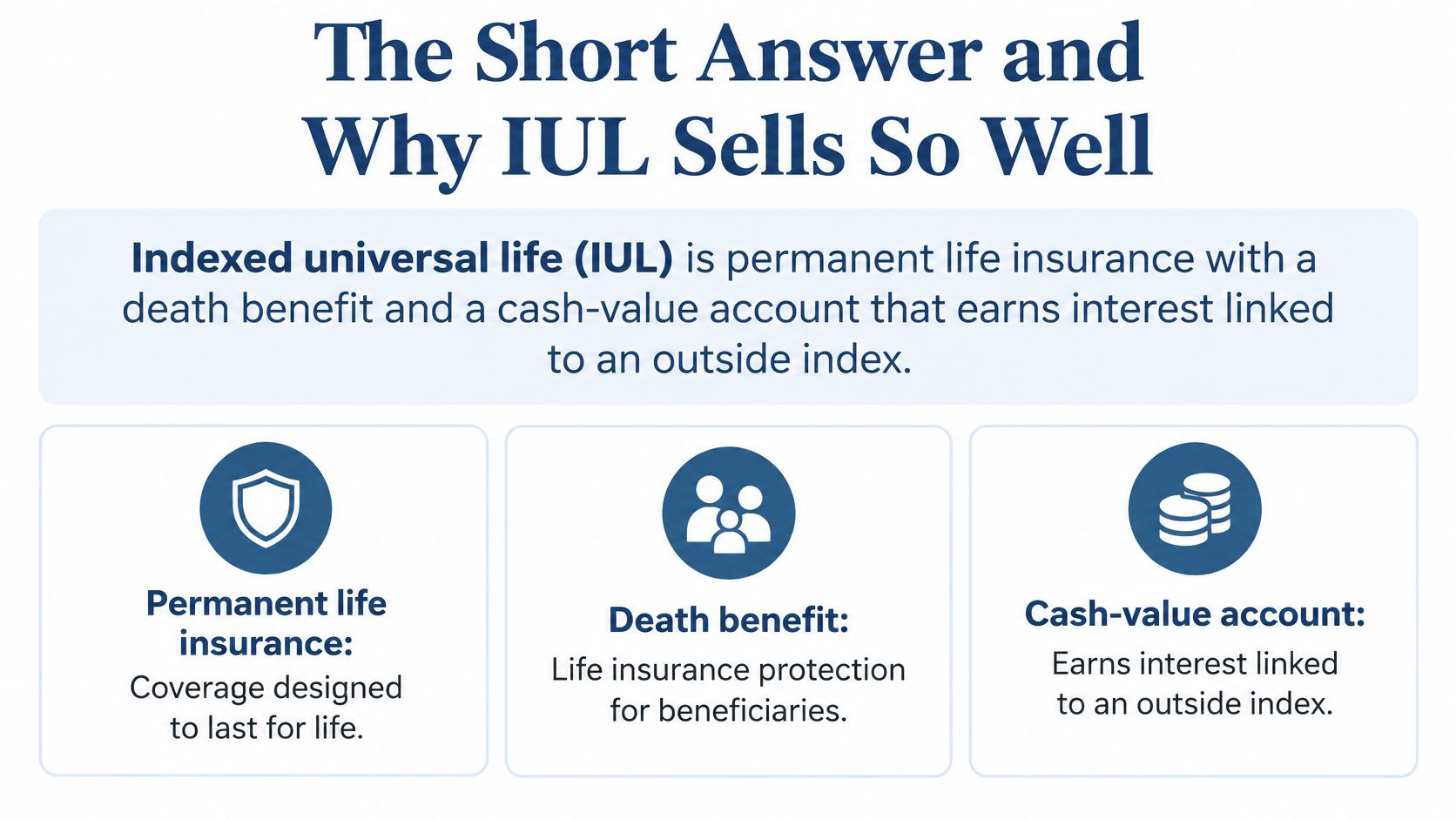
The two parts you are buying
Every IUL combines a death benefit for beneficiaries with a cash-value account you may be able to borrow from or withdraw from while you're alive. Neither part works on its own. The cash value helps carry the cost of keeping the death benefit in force.
Flexible premiums mean you can usually vary how much you pay and when, within contract rules. That flexibility has a limit. If the account doesn't hold enough to cover monthly charges, the policy can lapse and coverage ends.
Practical rule: Flexible doesn't mean optional. It means you're responsible for keeping enough money in the policy.
This product sells at scale. LIMRA reported IUL new annualized premium reached a record $3.8 billion in 2024, up 4% from 2023, representing 24% of total U.S. individual life new premium, according to LIMRA's 2024 individual life insurance sales release. The number of policies sold also rose 10% year over year in that same release. Those figures measure popularity, not whether your policy will perform well.
A sceptical buyer should ask three simpler questions. How is interest credited? What comes out in charges every year? What happens in a flat year, a down year, and a year you can't pay?
How an IUL Policy Divides Your Money
Your premium doesn't go straight into an investment account. It moves through a pipeline. Money comes in, the insurer deducts charges, the remainder lands in cash value, and index credits may be added later.
The diagram below shows that split between charges and the account that remains.
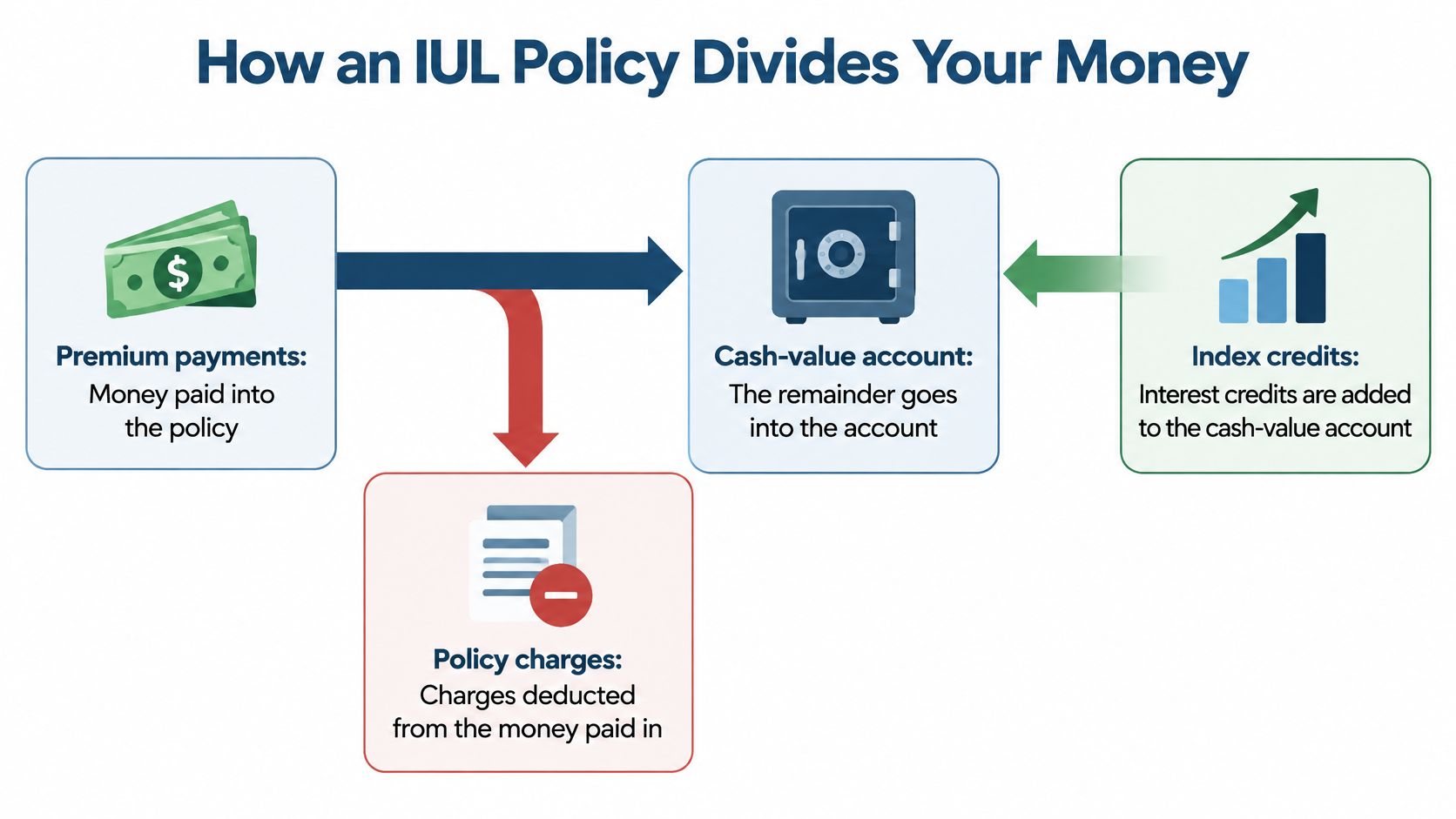
The six pieces on an illustration
- Premium payments: Money you pay in, flexible in timing and amount, but still needed to keep the policy funded.
- Cost of insurance: The monthly charge for the death benefit. It generally rises as the insured gets older.
- Administrative and rider fees: Ongoing charges for running the policy and for any optional riders you add. They continue whatever the index does.
- Cash-value account: The balance that receives index credits and supports the policy. Your surrender value comes from this account, minus any applicable charges.
- Death benefit: The amount paid to beneficiaries, often a level or increasing option. Outstanding loans usually reduce what beneficiaries receive.
- Surrender charges: Penalties that can apply if you cancel or take money out in the early years.
This structure explains why early cash value often looks disappointing. In the first years, charges and surrender provisions can consume a large share of what you paid. A buyer who expects bank-like access in year two is usually looking at the wrong product.
The video below walks through the same premium split in visual form.
Two premium numbers that are not the same
Most illustrations show a target premium. That's the payment the projection assumes you'll make to produce the values on the page. It isn't a bill that guarantees those results.
The minimum premium is different. It's the least needed to keep coverage alive for a period under the stated assumptions. Paying only the minimum can leave very little going into cash value, which makes the policy fragile later when insurance costs rise.
The National Association of Insurance Commissioners distinguishes universal life from whole life by this flexible-premium structure, noting owners can vary timing and amount as long as the policy remains adequately funded, in its NAIC consumer guide to life insurance. That same framework is why understanding what a universal life insurance policy is helps before you compare indexed versions.
Premium flexibility is not the same as guaranteed affordability or guaranteed cash-value growth.
Before you compare projected balances from two insurers, find each charge on your own illustration. If you can't locate the cost of insurance, fees, and surrender schedule, you're not ready to judge the projection.
How Index Crediting Turns Market Moves Into Interest
IUL is not market investing with an insurance wrapper. It's life insurance with index-based interest crediting. You don't buy shares of the S&P 500 or any other index, you don't receive dividends from owning it, and you can't sell it. The insurer watches the index, runs a formula, and credits interest to your policy account.
If the index falls during a crediting period, a zero floor can stop the credited rate from going below zero for that period. That protection is narrower than many buyers think. It stops negative index crediting, but it doesn't stop monthly insurance charges, fees, loan interest, or withdrawals from reducing cash value.
Four terms control the credit
A cap is the ceiling. A participation rate is the share of the index gain used in the formula. A spread, sometimes called a margin, is a percentage subtracted from the gain. A floor is the minimum credited rate for the period.
| Crediting term | How it works | Index up 12% | Index down 15% |
|---|---|---|---|
| Cap | Credited rate cannot exceed a set ceiling | 10%, ceiling applies | 0%, floor applies |
| Participation rate | Credited share of the index gain | 7.2% at 60% participation | 0% |
| Spread or margin | Fixed percentage subtracted from the gain | 10% after a 2% spread | 0% |
| Zero floor | Stops negative credits in a bad year | Depends on the cap or rate | 0% |
These are illustrative terms using a 10% cap, 60% participation, and a 2% spread. Your contract may use one method or combine methods, and different index segments can have different terms. If you're still sorting out what an index itself measures, Finzer's stock index glossary entry gives a plain definition you can use while reading the crediting page.
Notice what the table doesn't show. It doesn't show charges. A 7.2% credit followed by policy deductions produces a smaller net change in cash value, and a 0% credit followed by deductions produces a decline.
Timing changes the result
Annual point-to-point crediting compares the index at the start and end of a term. It ignores the path in between. A strong year that ends flat can credit nothing.
Monthly averaging uses index values across the term, which can smooth a late spike or a late drop. Monthly cap methods apply limits month by month, so one very strong month can't fully offset several weak ones. Two policies linked to the same index can credit different interest because their timing rules differ.
That is also where IUL differs from policies where cash value is placed in separate investment options, a distinction covered in this explanation of variable life insurance. With IUL, the insurer's formula sits between you and the index result.
NAIC guidance treats life illustrations as estimates under specified assumptions, not guarantees, and addresses maximum illustrated crediting rates and the use of policy loans, as described in NAIC guidance on life insurance illustrations. Caps, participation rates, and spreads may also change within contract limits. Ask which term your policy uses today, which terms the insurer can change, and what the guaranteed minimums are. Get the answers in writing.
Following One IUL Policy Through Three Market Years
Maya is 42 and self-employed as a designer. Her hypothetical policy holds $50,000 in cash value. For this example, she pays no extra premium during the three years, her policy has a 10% annual cap, and total policy charges are assumed to be $3,000 a year.
Those charges are simplified to make the arithmetic visible. A real policy deducts charges monthly, and the cost of insurance usually changes with age. The shape of the result is what matters.

Year one looks good, but not as good as the headline
The index rises 18%. Maya doesn't get 18%. The cap limits her credited interest to 10%, which adds $5,000 to her $50,000 balance.
The insurer then deducts $3,000 in charges. She ends the year at $52,000. She gained ground, but the gain is the capped credit minus charges, not the index return.
Years two and three show the quiet risk
In year two, the index is flat. Credited interest is 0%. Charges still take $3,000, leaving $49,000.
In year three, the index falls 20%. The floor credits 0%, so the index loss itself doesn't reduce her account. Charges take another $3,000 anyway, leaving $46,000.
| Year | Index result | Credited interest | Cash value effect |
|---|---|---|---|
| Year 1 | Index up 18% | 10%, cap applies | $50,000 plus $5,000, minus $3,000, equals $52,000 |
| Year 2 | Index flat at 0% | 0% | $52,000 minus $3,000, equals $49,000 |
| Year 3 | Index down 20% | 0%, floor applies | $49,000 minus $3,000, equals $46,000 |
| Three-year total | Index moved +18%, 0% and -20% | $5,000 credited in total | $9,000 in charges, ending at $46,000 |
The decline came from charges, not from a market loss being passed into the account.
That distinction is the centre of IUL. The floor protected Maya from a negative credit. It did not protect her balance from the cost of keeping insurance in force.
Charges usually become more important later, because the cost of insurance rises as you age. A flat period at age 42 may be manageable if premiums continue. The same flat period at an older age, with higher monthly deductions and no new premium, can pull the balance down faster.
Try rebuilding Maya's example with your own numbers. Use your starting cash value, your current cap, and the annual charges shown in your illustration. Then run one good year and two zero-credit years. If that simple version already worries you, the full illustration needs closer scrutiny.
Where IUL Policies Break Down
An IUL policy stays alive while cash value can cover insurance and policy charges. When it can't, the policy can terminate. Coverage ends, beneficiaries lose the death benefit, and any cash value problem becomes a protection problem.
FINRA describes universal life as coverage supported by a cash account, and notes the policy can terminate when cash value is insufficient to pay insurance costs, in its FINRA overview of insurance as an investment product. That single rule explains most IUL failures.
Three common triggers
- Skipped or low funding: Charges continue even when you stop adding premium. A thin cash-value balance gets consumed month by month.
- Reduced crediting terms: A cap might be lowered at a later reset, for example from an illustrated level to a lower contract-permitted level. Future credits then have less room to offset charges.
- Rising cost of insurance: Monthly insurance deductions generally grow with age. The policy needs more cash value, more premium, or both in later years.
None of these requires a stock market crash. A policy can weaken during ordinary flat years if funding was built around optimistic credits.
Loans add a second drain
Policy loans and withdrawals reduce available cash value and usually reduce the death benefit. Loan interest also works against the remaining balance. A loan that looked manageable when cash value was rising can become heavy after several zero-credit years.
The tax trap is sharper. If a policy lapses with an outstanding loan, the previously untaxed loan amount can become taxable income. You may owe tax even though the policy ended and there's no cash left to pay the bill. That's why buyers should understand how life insurance tax rules can affect a policy before treating loans as painless income.
Consider a 1099 contractor who funds an IUL heavily in two strong years. Work slows, so he skips premiums for two years and borrows for living costs. Charges keep coming out, loan interest builds, and a flat index period adds nothing back. Eventually the remaining value can't carry the deductions, and the policy lapses with a loan still outstanding.
He didn't lose coverage because the index fell through the floor. The floor did its limited job. He lost coverage because outflows beat inflows for too long.
Watch the balance, not just the index: A policy can lapse in a period when credited interest never goes below zero.
Pros and Cons of IUL Compared With Alternatives
IUL has real features buyers want. It also attaches conditions to each one. Read them in pairs, so no benefit is considered without its limit.
| Advantage | Limit that comes with it |
|---|---|
| Permanent death benefit while the policy stays funded | Coverage can end if cash value can't cover charges |
| Index credits without directly owning the index | Caps, participation rates, and spreads limit credited interest |
| Flexible premium timing | Paying too little can leave the policy underfunded |
| Tax-advantaged accumulation inside the policy | Loans and withdrawals reduce cash value and death benefit |
| Loan access against cash value | Loan interest and a later lapse can create cost and tax problems |
The cost side is not incidental. Insurance charges and administrative fees continue every year. Surrender charges can penalise an early exit. Crediting terms can be lowered within contract limits, which means today's illustrated path may not be available later.
For readers comparing flexible premium designs more broadly, Kons Law's discussion of flexible premiums and investment risk is a useful reminder that flexibility doesn't remove market or funding risk. The product name changes, but the funding discipline question remains.
What to compare it against
Guaranteed universal life usually offers more predictable cost for a death benefit, with little emphasis on cash-value upside. It's a cleaner fit when your main job is keeping coverage to a chosen age.
Term insurance plus separate saving or investing separates protection from accumulation. You control the savings account or investment account directly, and a missed investment contribution doesn't cancel your life insurance. The trade-off is discipline, because nobody forces the separate saving to happen. A side-by-side look at term versus universal life insurance can help frame that choice.
A funded emergency reserve belongs in the comparison too. It covers the car repair, slow client month, or medical bill that might otherwise cause skipped premiums or a policy loan. Without that buffer, even a well-illustrated IUL can become fragile.
IUL fits best when you want permanent coverage, you can fund it through lean years, and you've compared it carefully with guaranteed universal life and term plus separate savings.
Who an IUL Policy Suits and Who Should Pass
Suppose your income rises and falls through the year, but your policy charges are due every month. That mismatch matters more than an attractive illustration. LIMRA reported that U.S. IUL new annualized premium reached a record $4.5 billion in 2025, up 17% from 2024 and representing about 25% of total individual life new premium, in LIMRA's 2025 individual life insurance sales release. High sales show that people are buying IUL. They do not show that a particular buyer can keep funding a policy for decades.
| Buyer group | Where IUL may fit | Main caution |
|---|---|---|
| Self-employed professionals and 1099 contractors | Permanent coverage when strong-year income can support premiums through lean years | Irregular income can leave monthly charges underfunded |
| Working-class families and blue-collar workers | Coverage when there is stable surplus income after emergency savings | A premium commitment can squeeze a tight household budget |
| People without health coverage through work | Life insurance protection alongside separate health coverage | An IUL policy does not pay ordinary medical bills |
| Parents buying for adult children | Coverage or legacy goals when policy roles are agreed on | Owner, insured, beneficiary, and premium payer should be clear |
| Pre-Medicare adults aged 60 to 64 | Permanent coverage if premiums can be maintained without relying on policy loans | Loans can weaken the value available to cover rising insurance costs |
Who should pass
Pass on an IUL for now if premiums would compete with rent, utilities, emergency savings, or other necessary expenses. A policy that depends on surplus money needs that surplus to last. If your budget has no room for lean months, the obligation can become difficult to sustain.
Self-employed and 1099 workers should pass if their funding plan depends on repeating a strong income year. Income may arrive in lumps, while policy charges continue regularly. Set aside enough to cover premiums in weaker periods before treating an IUL as affordable.
Pre-Medicare adults aged 60 to 64 should not rely on policy loans as a bridge to retirement income without understanding the lapse risk. A loan reduces the cash value supporting insurance costs. If the policy lapses with an unpaid loan, you may lose coverage and face tax consequences.
Working-class families without an emergency reserve should build one before taking on a long-term premium commitment. People without health coverage through work should arrange health insurance separately. Life insurance provides a death benefit, not payment for a hospital bill while you are alive.
Parents considering a policy for an adult child should wait until everyone agrees on who owns it, who is insured, who receives the benefit, and who pays if circumstances change. If you are buying for yourself, pass if you cannot maintain premiums during a downturn or need quick access to the money you contribute.
An IUL may suit a buyer with a lasting need for coverage and dependable funds to support it through difficult years. Before signing, decide how much you could pay during a lean year, then compare that amount with the policy's required funding. If the numbers leave no room for missed income, choose a more affordable form of coverage instead.
Stress-Test an IUL Illustration Before You Commit
An IUL illustration can look steady while the policy's costs keep coming. Before signing, check whether the funding plan can carry those charges through low-crediting years and uneven income. The checklist below covers five reviews, matching the infographic.
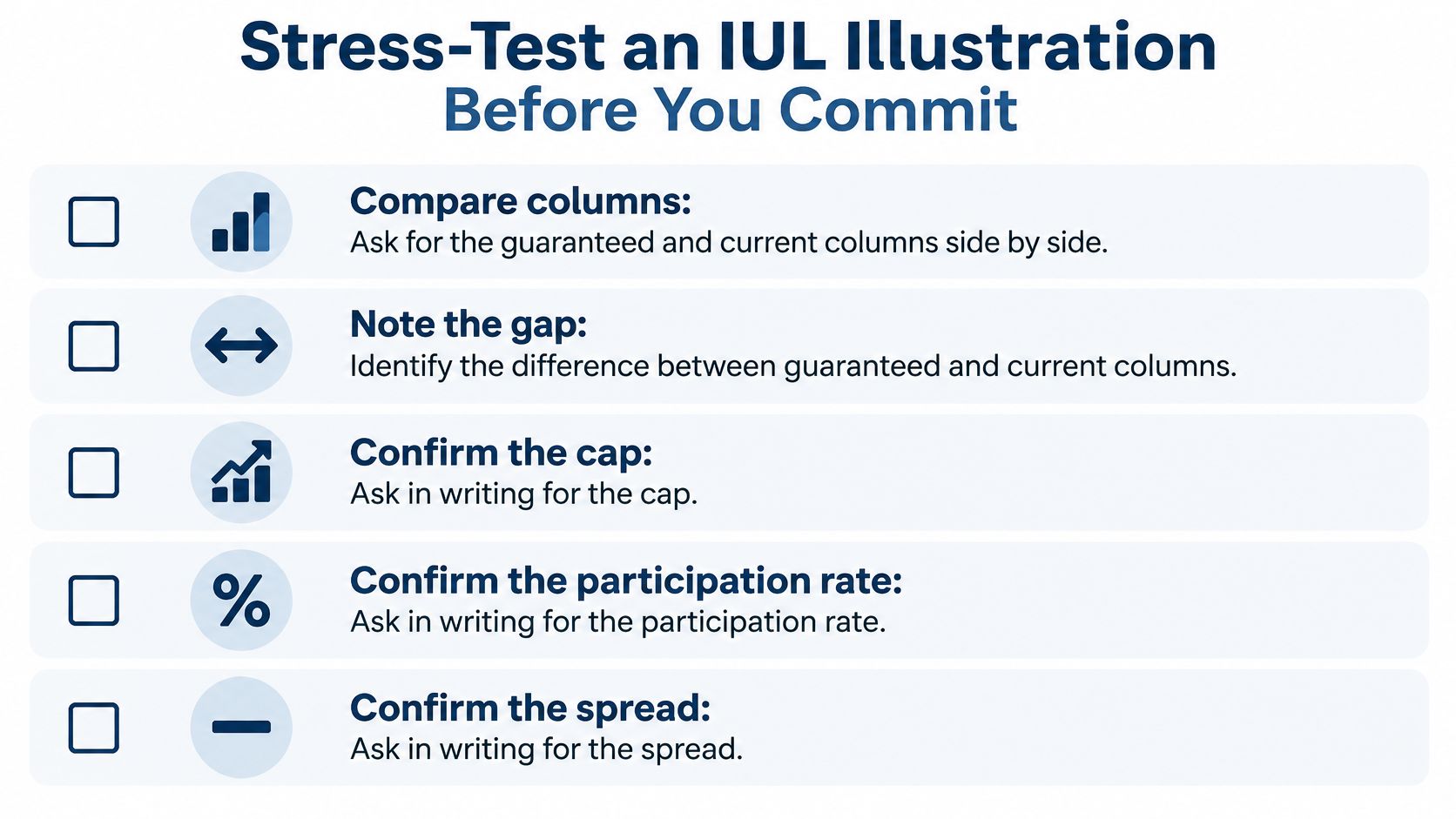
Five checks before you apply
Compare guaranteed and current columns: Set the values side by side. The difference shows how much the projection depends on assumptions that are not guaranteed.
Confirm crediting terms in writing: Find the cap, participation rate, and spread. Ask which terms the insurer can change and what limits the contract sets.
Run zero-credit years: Ask for a scenario with 0% credited interest for three to five years. Check whether the cash value can still cover policy charges.
Test your lean-year premium: Compare the target premium with the minimum premium. Decide what you could pay if income falls, rather than relying on what you can afford today.
Check later-age costs and loans: Review the cost of insurance shown around ages 60, 70, and 80. Then model a loan using the policy's loan interest rate. See whether a large loan could push the policy toward lapse, without assuming you will repay it quickly.
These checks test whether the policy is a funded obligation your budget can sustain, not just an attractive projection. Compare it with guaranteed universal life, term insurance with separate saving, and building an emergency reserve first.
A licensed advisor or a comparison service such as My Policy Quote can review the numbers side by side. Bring the full illustration, including guaranteed values and charge pages, rather than only its summary.
Proceed only if the policy remains in force in the bad-year scenario and its premium fits your lean-year budget. If it depends on strong credits and steady income, the illustration may describe a life that is easier to fund than yours.
If you're weighing an IUL illustration against guaranteed universal life or term coverage, My Policy Quote can help compare guaranteed columns, charges, and lean-year funding requirements before you apply. Bring your current illustration and ask for a zero-credit stress test, so you can judge how the policy behaves in flat years as well as under its strongest projection.