
You and your partner both bring home a paycheck, and the mortgage only works if both of those paychecks keep arriving. One of you has been shopping for cover, and a single joint premium looks cheaper than two separate policies. That lower bill is tempting, especially if you're self-employed, on a 1099, or living without a group plan at work.
Before you sign, ask a blunt question. Which death is this contract supposed to answer? A cheap premium that pays nothing when the first partner dies can leave the survivor paying the house, the medical bills, and the debt alone. A joint life insurance policy is one contract on two lives, with one death benefit, and the timing of that benefit is set by the type you buy.
First-to-Die and Second-to-Die Joint Life Insurance at a Glance
Think of the contract as a shared umbrella. A first-to-die policy pays the first time anyone under it is caught in the rain, then the umbrella is gone. A second-to-die, also called survivorship, waits until everyone under it has been soaked. Same two people, same idea of one benefit, completely different cash in the survivor's hands.
Couples usually reach for first-to-die when lost wages or a loan would wreck the household the month after a death. Second-to-die is the tool people use when the actual bill shows up only after both partners are gone, often estate costs or an inheritance that needs balancing.
| Feature | First-to-die | Second-to-die (survivorship) |
|---|---|---|
| Pays out when | The first insured dies | Both insureds have died |
| Cash to surviving partner after first death | Yes, the full benefit | No, nothing is paid yet |
| Premium per dollar of benefit | Higher | Lower, because payment is deferred |
| Typical purpose | Replace income, clear mortgage or debt | Cover estate taxes, fund trusts, equalise inheritance |
| Ownership and beneficiary review | Usually simpler | Often needs estate-planning review |
Three questions that settle the choice
Who depends on whose income? If either paycheck keeps the lights on, you need cash at the first death.
Is estate settlement the core concern? If the survivor can live on remaining income and the problem is liquidity for heirs, a later payout can fit.
What monthly budget can you sustain? A lower premium only helps if the survivor still has money for the first year alone.
Practical rule: Price the contract against the month the survivor is still paying the mortgage, not against the brochure that says one policy is simpler.
When Each Policy Pays and What the Survivor Receives
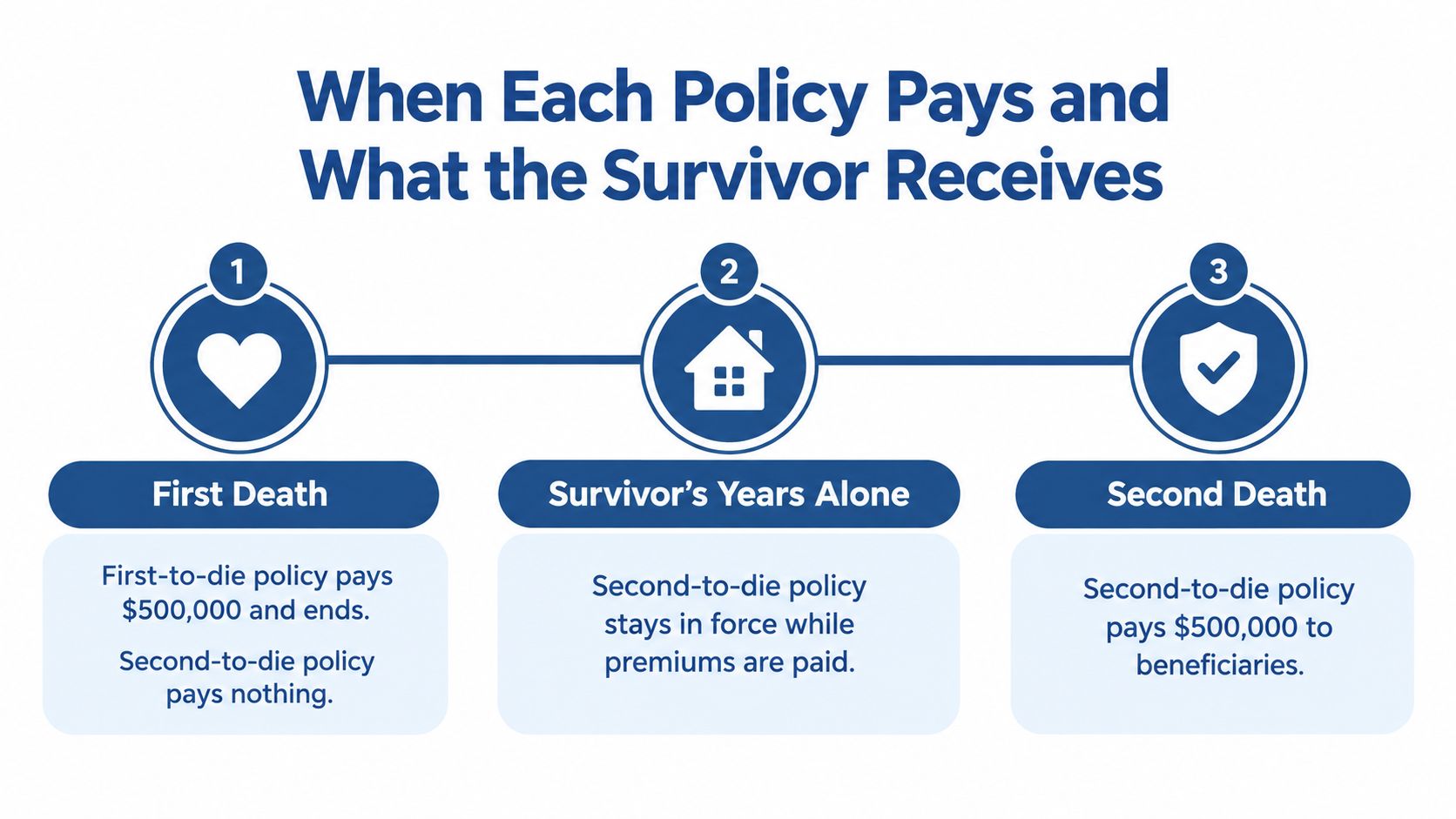
The difference becomes clearest when one household moves through three stages. A lower joint premium can leave the surviving partner with less cash when they need it most.
Stage 1, the first death. Suppose both partners are in their early 60s and share a house payment. A first-to-die policy pays its full benefit after the first partner dies, then ends. The survivor can use that money to replace income or cover the mortgage, medical bills, and joint debt. A second-to-die policy pays nothing at this point, so those costs must come from savings or the remaining paycheck.
Stage 2, the years alone. The first-to-die policy has already paid and provides no further cover. The second-to-die policy remains in force only while premiums are paid, yet the survivor receives no benefit during this period. The premium may be lower, but that saving does not put cash in the survivor's hands after the first death.
Stage 3, the second death. The survivorship policy pays its benefit to the named beneficiaries. That money can cover estate bills or help equalise an inheritance among children. It arrives after the survivor's lifetime, so it cannot pay the bills they faced alone.
Why the insurer charges less to wait
The payout trigger shapes the price. A first-death benefit depends on at least one insured person dying, which is more likely to happen before both have died. A second-death benefit depends on both insured people dying, so the insurer expects to pay later and charges less per dollar of coverage. Actuaries use joint-and-survivor mortality factors to value that later claim. IRS actuarial guidance in Publication 1457 discusses actuarial factors used to value future benefits.
A delayed payout can serve an estate plan while leaving the surviving partner without immediate cash. To compare the true trade-off, price both policy types for the same benefit and write down what the survivor would have available during the first 12 months after each death. For the payment process and claim timing, see how a life insurance payout works before comparing the quotes.
Pros, Cons and When Separate Policies Win
A lower joint premium can look like an easy saving, until the surviving partner needs cash and the policy has already paid or is still waiting to pay. Compare the amount and timing of the payout with the bills each person would face, not just the premium.
What it does well
- One application and one premium: Both people apply under one contract and pay one bill.
- Often a lower sticker price: One contract can cost less than two policies with similar face amounts, especially when the benefit is deferred until both people have died.
- A match for estate liquidity: Survivorship cover can provide money for estate costs after the second death.
- Less paperwork day to day: There is one renewal date and one set of policy documents.
Where it disappoints
- One payout, then silence: A first-to-die policy pays after the first death and ends. If the surviving partner later dies, that contract provides no second benefit.
- A hard split later: Divorce or remarriage can leave ownership and beneficiaries tied to a shared contract, making it harder to give each person a policy they control.
- A blended rate: When partners differ in age or health, a joint price may not show the rate the healthier partner could receive on an individual policy.
A cheaper premium does not mean the survivor has enough protection. For two self-employed partners, or a household without employer coverage, the person left behind may still need money for housing, medical costs, debt, or business continuity soon after the first death. If the joint policy pays once and ends, that payout must cover the need it was meant to address. If it pays only after both deaths, it does not provide immediate cash to the survivor. Compare a joint policy, two individual policies, and a mix by asking what money is available after each death and what happens if the couple separates.
The verdict by situation
| Situation | Better choice | Reason |
|---|---|---|
| Two earners who each need their income replaced | Two individual policies | Each death can trigger its own payout, while a joint first-to-die policy pays only once |
| Large age or health gap between partners | Two individual policies | Separate underwriting can show each person's own price rather than blending both risk profiles |
| Divorce or remarriage is likely | Two individual policies | Each person can retain control of their policy and beneficiaries |
| Only one partner's income must be replaced, on a tight budget | Single term policy on the earner | Cover is focused on the income that needs replacing |
| Estate tax or equal inheritance at the second death | Second-to-die joint policy | The benefit arrives after both deaths, when the estate plan needs funds |
Separate policies give each partner a distinct owner and payout. If only one income needs protection, a term policy on that earner keeps the cover focused. A combination can address two different needs: cash for a mortgage after the first death and funds for estate planning after the second. Couples can also hold more than one policy; having two life insurance policies can match separate financial obligations.
Three Sample Cases Worked Through From Setup to Payout
Numbers make the tradeoff harder to wave away. These three households are hypothetical, with ages and goals stated up front so you can see who receives the money.

A mortgage that cannot wait
Priya, 52, and Luis, 55, are both self-employed. They carry a $400,000 mortgage and neither has employer coverage. They buy a first-to-die policy for $500,000. Luis dies three years later. The benefit pays at that first death, clears the mortgage, and leaves Priya about $100,000 toward living costs while her business income continues. The risk that changes the story is the second death. The contract is already over, so nothing remains for their adult daughter unless Priya buys new cover at an older age.
An estate bill that arrives late
Helen, 68, and Mark, 66, hold a home and other assets worth about $1.8 million, with two adult children. They place a second-to-die policy of $1,000,000 inside an irrevocable trust. Helen dies first and Mark receives no claim check, which is acceptable only because his pension and savings cover his own bills. When Mark dies, the trust receives $1,000,000 to pay settlement costs and to even out what each child inherits. The risk is funding. If premiums lapse during Mark's years alone, the heirs get nothing.
Watching a plain walk-through of how a claim is triggered helps before you lock a face amount to one of these patterns.
A marriage that ends before either death
Andre and Camille have been married 12 years. Andre owns their joint policy and pays the premium. They separate. The contract cannot be sliced into two policies. Their choices are a buyout of Andre's interest, a transfer if the insurer allows it, or replacement coverage that Camille shops at a higher age and, often, a higher price. The person who needed protection can walk away with no policy at all.
All three outcomes turn on who the payout is for, not on which quote had the smaller monthly number.
Eligibility, Underwriting and Ownership Checks
Each person is underwritten on their own record. The insurer then prices the pair. A decline or a high rating on one partner can make the whole joint policy more expensive or unavailable. One bad exam result is a shared verdict.
| Factor | How it is assessed | Effect on joint premium |
|---|---|---|
| Age of each insured | Current age and age gap between partners | Older age in either life raises the price; a wide gap changes the pair's risk profile |
| Health and medical history | Each person's history, medications and exam results | A poor result for one partner can raise or block the whole joint policy |
| Tobacco use | Recent smoking status checked for each person | Non-smoker rates may apply only if both partners qualify |
| Occupation and hazards | Risky work or hobbies for each person | Adds a loading that applies to the pair |
| Insurable interest and consent | Both insureds consent and the owner has a financial link to each | Without it the policy cannot be issued |
A roofer who smokes and a desk worker who doesn't will not get two independent prices inside one contract. The loading sits on the pair. If you want the sequence of exams, records, and rate classes, the life insurance underwriting process is the same machinery, applied twice and then combined.
The same dollars, two different tax paths
For U.S. policyholders, ownership changes the tax result even when the death benefit is identical. IRS Publication 525 states that life insurance proceeds paid because of the insured's death are generally excluded from the recipient's gross income. Those proceeds may still be included in the insured's estate when the insured kept ownership rights, or when the estate itself is the beneficiary. Estate inclusion can pull the benefit into estate-tax analysis, and naming the estate can also send it through probate.
Name individuals instead of the estate and payment usually goes straight to them, which sidesteps probate. That choice does not automatically remove estate-tax exposure. Couples using survivorship cover to fund estate obligations need the owner, the beneficiary, and any trust lined up with as much care as the face amount.
Say one spouse owns the policy and names the estate. The survivor or the children may wait on the court, and the benefit can be measured for estate tax. The same payout, owned by a properly funded trust and payable to adult children as named beneficiaries, can be paid directly and kept outside that probate path. It still needs a professional check, because trust paperwork done late does not fix ownership the insured already kept.
Review owner, beneficiary, and trust setup with an estate-planning professional before you apply, especially when one spouse owns the policy, a trust is in the picture, or adult children are the people meant to receive the money.
Confirm the Structure Before You Apply
Work this list before anyone takes an application. Each step exists so the survivor's cash, not the premium, decides the contract.
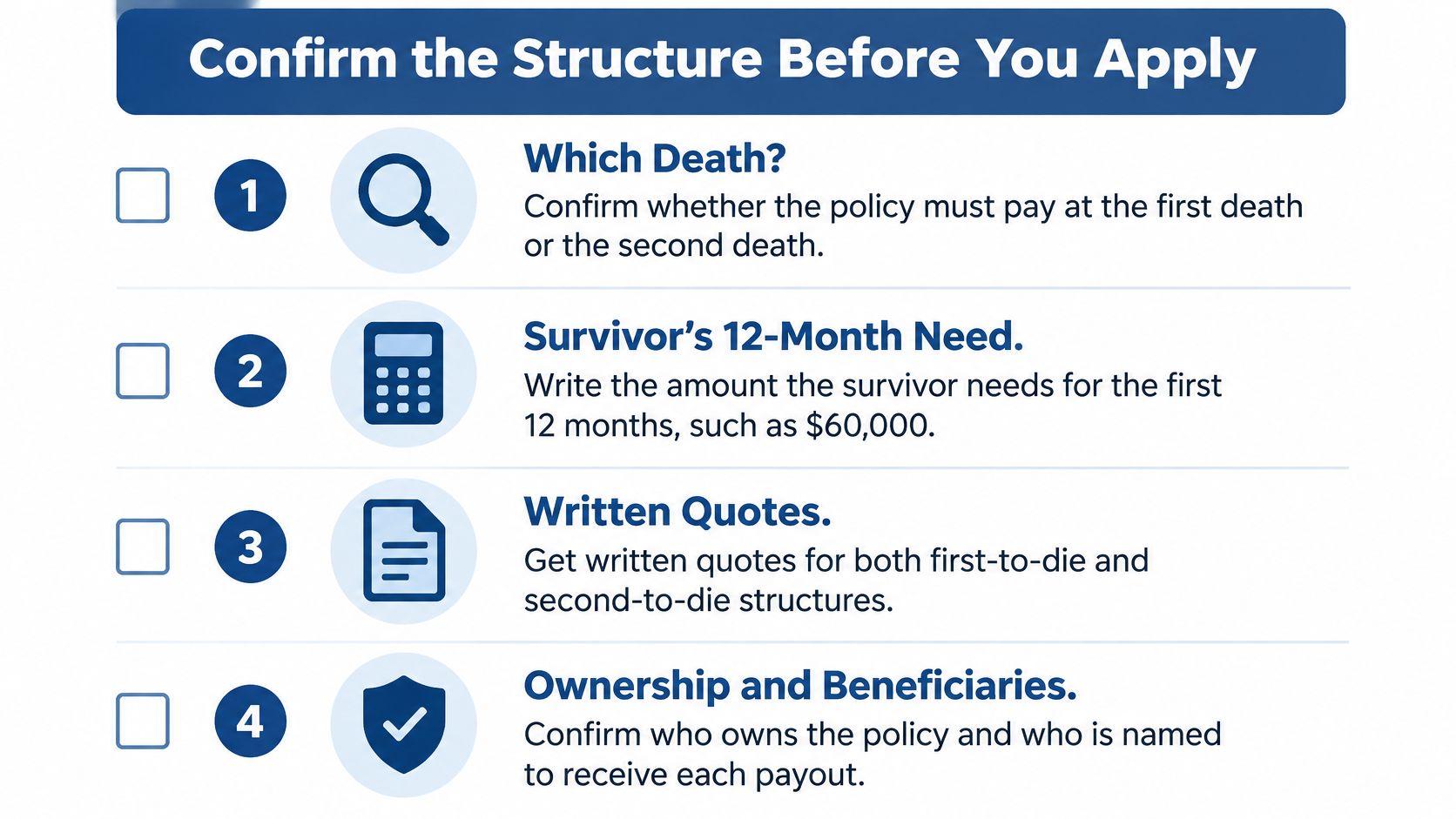
- Name the death the policy must answer. Write the dollar amount the survivor needs for the first 12 months, including housing and any business costs. If that number is large, a contract that pays nothing at the first death fails the test.
- Collect three prices for the same benefit. Ask for first-to-die, second-to-die, and the combined cost of two individual policies. A single joint quote hides the comparison.
- Run first death, second death, and separation. Note who receives money in each case, and whether a split forces a buyout or a new policy at an older age.
- Confirm age, health, and tobacco for each partner. Ask what the insurer does if one person is declined or rated. A joint file can stall for both of you.
- Decide the owner and the beneficiary now. If a trust, a spouse-owner, or adult children are involved, have an estate-planning professional read that page before you pay the first premium. The owner also needs a real financial link to each insured life, which is the point of insurable interest in life insurance.
Do that on paper this week. A signed application is a poor moment to discover the survivor would have had an empty account for a year.
My Policy Quote can price a first-to-die contract, a second-to-die contract, and two individual policies side by side for the same benefit, so you can see the survivor's cash next to the premium before anyone signs. That comparison is built for couples, self-employed partners, and households that don't have coverage through work. Visit My Policy Quote and ask for those three quotes on your ages and the benefit you need.