

You may be reviewing life insurance after a job change, getting close to retirement, or realizing that an old policy won't cover the need you have now. The first question isn't “How big a policy can I get?” It's “What bill or income gap would this policy need to handle?” That purpose matters because life insurance quotes for over 60 depend on more than age. The policy type, coverage period, health details, and amount all affect what you'll be offered and what you'll pay.
Start by choosing the job for the coverage, such as paying funeral costs, clearing a mortgage, or supporting a spouse. Then compare policies built for that job, rather than choosing by the headline death benefit alone.
Life Insurance Types Available After 60
Say a 63-year-old wants coverage mainly to pay off the seven years left on a mortgage. A lifetime policy could do the job, but she would keep paying for protection long after the need is gone. A 10-year term policy covers the same mortgage for a lower premium. The policy type that fits is the one built for the job, and the price follows from that choice.
Applicants over 60 generally compare five policy types, and each trades off health questions, coverage length, and cost in a different way. The table is a starting point, not a promise of what every insurer offers, since issue ages, face amounts, and availability vary by carrier and state.
| Policy type | Typical issue ages | Coverage length | Health questions | Typical face amount | Best fit |
|---|---|---|---|---|---|
| Term life | Varies by carrier | 10, 15, or 20 years, or to age 80–85 | Full underwriting, exam, or medical records | $100,000 and up | Mortgage payoff, income years, dependents |
| Simplified issue | 40–85 | Term or whole life, usually lifetime for whole life | A few yes-or-no questions, no exam | Varies by carrier | Moderate health, wants a faster decision |
| Guaranteed issue | 50–85 | Whole life, lifetime | None | Varies by carrier | Serious health conditions; may have a waiting period with reduced benefit |
| Final expense | 50–85 | Whole life, lifetime | Simplified or guaranteed | Varies by carrier | Funeral and burial costs |
| Fully underwritten whole life | 40–80 | Lifetime | Full medical underwriting | $25,000 and up | Estate or legacy goals, stable income for higher premiums |
Read each row as two questions: how long does the job last, and how many health questions can the applicant comfortably answer?
Term life works like renting protection. You pay less while you hold it, and it ends on a set date. If the debt or income need is still there when the term expires, renewing can cost more, so term fits best when the job has a clear end date.
Whole life works more like owning. Coverage lasts for life as long as the required premiums are paid, and the policy builds a reserve called cash value that grows over time. The trade-off is a higher premium than term, and a lifelong payment can be hard to maintain on a fixed retirement income.
Simplified-issue and guaranteed-issue policies sit between those two on the health side. Simplified issue asks a short list of yes-or-no health questions and skips the exam. Guaranteed issue asks nothing at all, but read the benefit terms closely: some policies pay a reduced amount if the insured dies during an early waiting period. Final expense is usually a small whole-life policy marketed for funeral and burial costs, and it can be offered on either a simplified or guaranteed basis.
Quick rule: If the need should end within 10 to 20 years, start by comparing term. For funeral costs, look at final-expense coverage. If health is a concern, compare simplified issue and guaranteed issue instead of assuming only one will work.
For a plain-language overview of these product categories, see this guide to different types of life insurance. Once the job is defined, narrowing to two policy types makes the quotes that follow far easier to compare.
Choose Your Coverage Amount and Term
A 63-year-old asks for a $500,000 policy because the figure sounds responsible. The premium comes back at three times what his retirement income allows, so he shelves the whole idea. The order was wrong. The job the policy must do should set the face amount, and the face amount sets the price.
Two terms carry the decision. The face amount is the sum the insurer pays your beneficiaries if you die while covered. The term is how long the coverage stays in force. Both come out of one calculation, worked in this order:
Name the job first. Funeral costs, a mortgage balance, a spouse's missing income: pick the specific gap the payout has to fill. Trying to cover every future expense pushes the face amount past what a fixed income can sustain.
Add debts a survivor would inherit. The remaining mortgage, a car loan, credit card balances your family would still owe.
Estimate the income gap. Count how many years a spouse or dependent would need support, then reduce that figure by any Social Security survivor benefit or pension survivor payout that applies.
Subtract what you already have. Savings earmarked for the purpose, and any group coverage through work. Check the end date on that group policy, because retiring or changing jobs often ends it.
Match the term to the job's end date. A mortgage with twelve years left calls for coverage that outlasts twelve years. Paying for extra years adds premium without adding protection.
Set a premium ceiling from retirement income. A payment that only works while you earn full time is a policy you may drop later, and a lapsed policy protects no one.

Here is how the arithmetic plays out for one household. A self-employed contractor still owes $35,000 on a mortgage, wants $10,000 set aside for funeral costs, and has a spouse with no income. A policy in the $45,000 to $60,000 range lines up with those stated needs far better than a $500,000 term policy the contractor cannot afford to keep. Those figures fit this example; your own list will produce a different number.
Whatever your list produces, you can treat the smallest workable figure as minimum viable coverage: enough to settle the most pressing bill or gap. Covering more of the list, debt plus ongoing survivor income, costs more and may still be worth quoting. Ask for prices at two face amounts so you can see what each extra layer of protection costs before you commit. For a walkthrough of the full calculation, see this guide to how much life insurance you may need at 60.
Gather Your Health Details Before Quoting
The first number you see is an estimate built on your own answers. After an insurer reviews your records, that number can move. At older ages, underwriting commonly weighs medical history, daily-living abilities, physical activity, and mental status, and the evidence requested can include attending-physician statements, electrocardiograms, and physical examinations, as described in a Society of Actuaries survey of underwriting practices.
Accuracy matters more as the policy's job grows. A modest policy meant to cover a funeral may face a lighter review than one sized to pay off a mortgage or replace a spouse's income, because a larger obligation usually brings closer scrutiny. Your answers work like directions given to a driver: one wrong turn early can put the whole trip off course. A forgotten prescription or a conflicting diagnosis date can change the offer, and inaccurate information may create problems later if the insurer reviews a claim.
| Item | What to write down | Why insurers ask |
|---|---|---|
| Tobacco use | Date of last cigarette, cigar, vape, or nicotine product | Recent use may affect the rating class |
| Medications | Name, dose, and reason for each prescription | Medication can reveal a condition not asked about directly |
| Diagnoses | Condition, diagnosis year, and current status, including heart disease, diabetes, cancer, or COPD | Risk depends on the condition and how it's controlled |
| Hospital stays and procedures | Date, reason, and hospital for the past five to ten years | Recent events can be especially relevant |
| Height and weight | Current measurements | Used to assess body size |
| Daily-living abilities | Any difficulty bathing, dressing, or walking stairs, and any recent falls | Functional limitations can affect underwriting |
| Occupation and hobbies | Job duties, self-employment type, flying, scuba diving, or motorsports | Some activities can affect the offer |
| Existing coverage | Employer, union, or group policies and when they end | Helps show whether a new policy must fill a gap |
| Beneficiaries | Names, birth dates, and contact information | Needed to complete the application |
A practical routine is to request your medication list from the pharmacy, check diagnosis dates in your doctor's patient portal, and write down hospital stays and procedures before you sit down with the application. Then compare your notes against each answer before submitting. If an exam is part of the process, this guide to a life insurance medical exam explains what to expect.
A no-exam or simplified-issue policy is not automatically cheaper or easier. It may ask fewer medical questions while charging a higher premium, offering a lower benefit, or adding a waiting period. Readiness test: before applying, you should be able to state each diagnosis, its medication, and its date clearly and consistently.
How Age and Health Change Your Quote
Age is a starting point, not a verdict. In 2023, life expectancy at age 65 was 19.5 additional years for the total U.S. population, 18.2 years for men, and 20.7 years for women, according to the National Center for Health Statistics. Insurers consider coverage duration alongside age: a 10-year term covers a different period of risk than a policy intended to last to age 90 or beyond.
| Factor | Effect on price | Example |
|---|---|---|
| Age band | The same benefit usually costs more at an older age | The same coverage may cost more at 70 than at 62 |
| Tobacco use | Can raise the premium substantially | Insurers may classify tobacco users differently from non-users |
| Medical conditions | May affect the underwriting class or add a surcharge | A recent heart event may be assessed differently from a well-controlled condition |
| Medications | Can influence the rating class | Insulin use may be assessed differently from oral medication for the same diagnosis |
| Sex | Can affect actuarial pricing | Average life expectancy differs for men and women |
| Coverage length | Longer coverage generally costs more | Lifetime whole life costs more per month than a 10-year term for the same face amount |
| Guarantee type | Guaranteed terms lock in stated premiums and benefits; non-guaranteed projections rely on assumptions | A universal-life illustration may change if its assumptions don't hold |
| Payment frequency | Monthly billing may cost more than annual billing | Check whether a payment schedule includes added charges |
Health details can separate two applicants of the same age. Insurers may assess medical history, tobacco use, occupation, family history, requested benefit, and policy duration. A diagnosis doesn't tell the whole story; its treatment and control also matter.
Some factors are within your influence, such as stopping tobacco use or working with your clinician to manage blood pressure or blood sugar. Age and sex aren't. Compare quotes within the same policy type first, then compare different types only after you understand what coverage each one provides.
How to Compare Quotes on an Equal Basis
Two policies with the same death benefit can do very different jobs. One might exist to cover a funeral and small debts, while another is meant to fill a spouse's income gap for a decade. Before you compare premiums, name the job the policy must do. Then judge each price against that job, because a cheaper premium that fails the job is expensive in the way that matters.
Comparing quotes works like checking unit prices at the grocery store: the sticker price means little until the sizes match. The National Association of Insurance Commissioners' life insurance guidance advises buyers to decide how much coverage they need, how long they need it, and what they can afford, then compare similar policies.
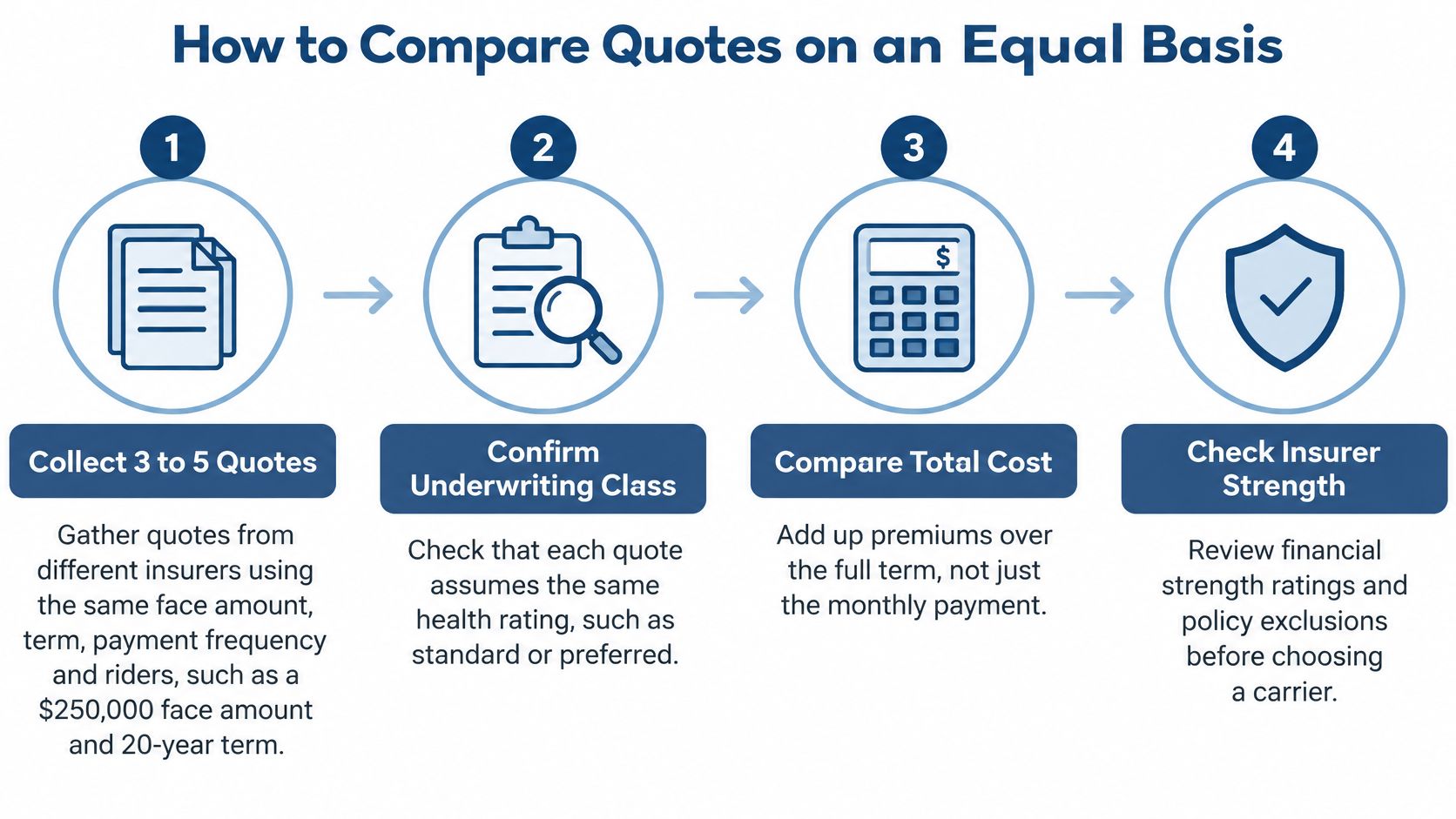
Collect comparable quotes. Request three to five quotes from different insurers using the same face amount, term, payment frequency, and riders. Otherwise, a price difference may reflect only a different policy design.
Confirm the underwriting class. Ask what health rating each quote assumes, then check the final offer after underwriting. An online estimate may change once the insurer reviews your application and records.
Separate guarantees from projections. Compare guaranteed premiums and benefits side by side. Treat values that depend on future assumptions as projections rather than promises.
Check waiting periods, graded benefits, and exclusions. Find out whether the full death benefit starts immediately and read the policy's exclusions. A waiting period or graded benefit can make a cheaper offer unsuitable for an urgent need, such as funeral costs your family would face right away.
Review conversion and renewal terms. Conversion rights may let you change term coverage to permanent coverage without new medical underwriting, subject to the policy's rules. Check when conversion is allowed and what renewal premiums may be after the level-premium period ends.
Check the insurer's financial strength. Review ratings from agencies such as A.M. Best or S&P, along with the contract's actual terms. A rating is one part of your decision, and the policy wording still controls what gets paid.
Stress-test the premium. Ask whether you can keep paying if your income falls after retirement. Consider the full intended coverage period, not only the first monthly bill.
An example shows why the order matters. Quote A costs $89 a month and carries a two-year graded benefit, while quote B costs $112 a month and pays the full benefit from day one. If the job is covering a funeral, quote A leaves that need exposed for two years, so its lower price buys less of the protection you wanted.
| Check | Quote A | Quote B |
|---|---|---|
| Monthly premium | $89 | $112 |
| Underwriting class assumed | Confirm with insurer | Confirm with insurer |
| Waiting period and graded benefit | Two-year graded benefit | Full benefit from day one |
| Exclusions and suicide clause | Review policy terms | Review policy terms |
| Conversion rights and renewal pricing | Confirm in contract | Confirm in contract |
| Insurer financial strength rating | Check current rating | Check current rating |
| Premium affordable if income halves at retirement | Test against budget | Test against budget |
Write your answers in one comparison table before choosing. This guide to comparing life insurance quotes can also help you keep the offers on the same basis.
This short video walks through the same decision:
Ways to Lower Your Premium Without Losing Protection
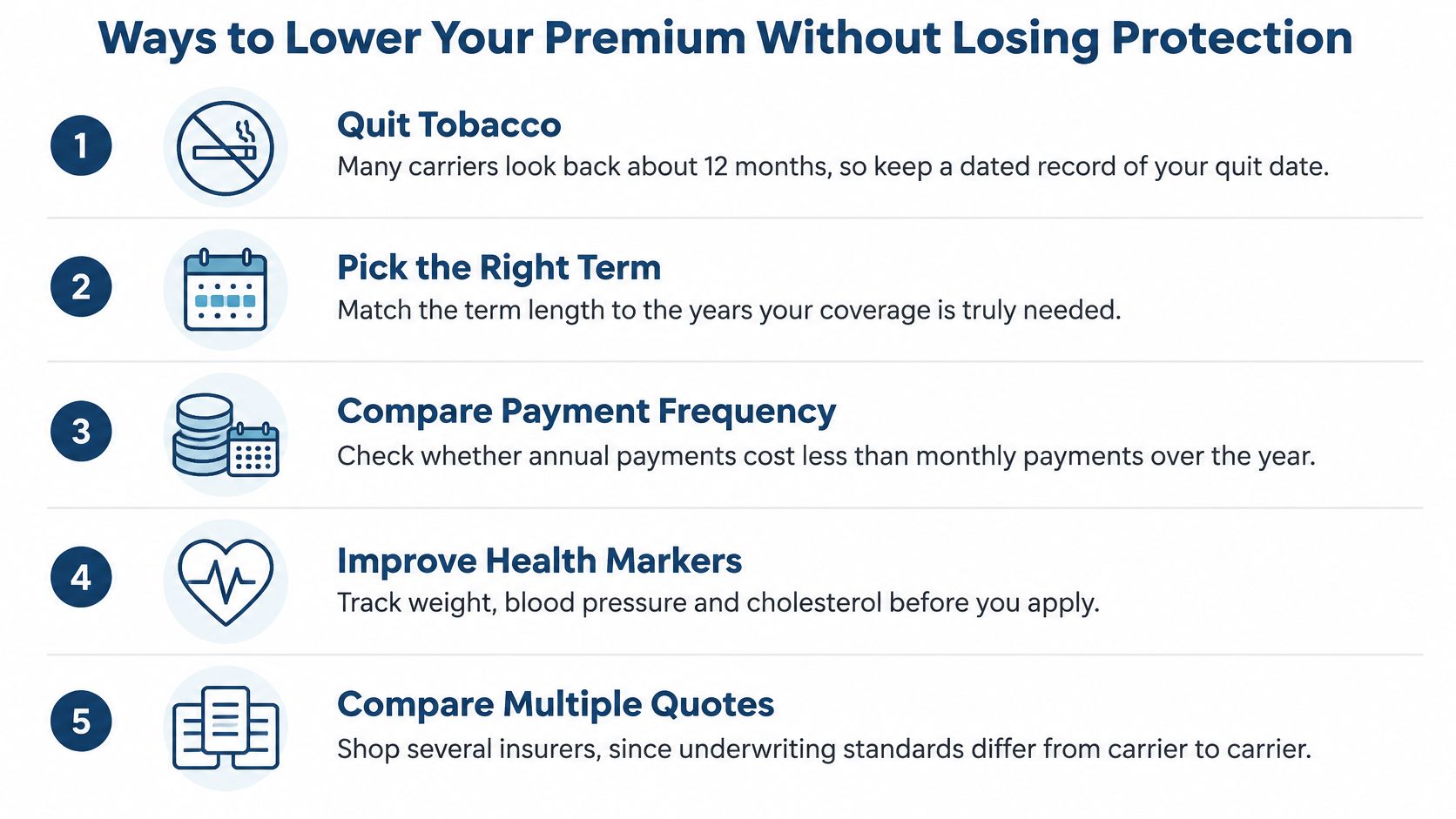
Quitting tobacco can affect your rating class. Tell the insurer the date you stopped using cigarettes, cigars, vapes, or other nicotine products, and answer questions about nicotine replacement truthfully. Carriers set their own rules, so ask how they treat your specific product and history.
Other ways to manage cost include:
- Review your medication list with your prescriber. Make sure the insurer has accurate information about your prescriptions and why you take them. Don't stop or change medication to affect an insurance application.
- Match the term to the need. If the coverage is for a mortgage or a defined income gap, compare terms that end around the time that need ends.
- Ask for a lower face amount. A smaller benefit aimed at the most important expense may be easier to sustain than coverage that tries to solve every financial risk.
- Compare payment schedules. Ask whether annual payments cost less overall than monthly billing, and choose a schedule that fits your cash flow.
- Remove riders that don't serve a purpose. Waiver-of-premium or accidental-death riders can add cost; keep them only if the extra protection matches a need.
Accurate disclosure matters more than a fast or low initial quote. Never understate tobacco use, medications, or health history. An application that doesn't match your records can lead to a changed offer or complications later.
Turn Your Quotes Into Coverage You Keep
Start with the job, not the price tag. Go back to the need you defined earlier, whether that was a funeral, a mortgage balance, or a spouse's income gap, and choose the policy that covers exactly that need, stays affordable at the lowest income you expect during the term, and carries the strongest guarantees among your quotes. A larger face amount loses its value quickly if the premium turns into a bill you cannot keep paying.
When you apply, answer every question from your records rather than memory. Keep copies of what you submit and note the application date. If an insurer makes you an offer, read the actual policy before accepting, since the contract, not the quote, controls what your family receives. Many states give you a free-look period, often 10 to 30 days depending on the state, to cancel for a full refund, so confirm the exact window in your policy and local rules.
If you are declined or offered a higher premium than expected, ask the agent for the reason in writing. Another underwriting path, such as simplified issue or guaranteed issue, may still fit your circumstances. Keep any existing coverage active until the new policy is in force.
A cheap quote is only a good quote once the guarantees, waiting period, and monthly cost match the job the policy must do.
One final step ties everything together. Write the purpose, benefit, premium, and guarantees on a single page and check that the policy still fits your budget after retirement. A broker comparison can line up guaranteed values from several carriers side by side, and My Policy Quote provides an online quote request form for personalized estimates you can review alongside your existing coverage before you commit.