
You're 60, still working, and wondering whether the life insurance policy you bought years ago is enough. Maybe the mortgage isn't gone, your spouse depends on your income, or you're self-employed without employer coverage. Perhaps you're single, debt-free, and only want to prevent final expenses from becoming your family's problem. The right answer depends less on your age than on which financial risks would remain if you died this year.
The practical question isn't “How much income do I earn?” It's, “How much money would my household need, for how long, after existing assets and benefits are counted?” That remaining-risk-window approach gives you a more useful answer than blindly applying an income multiple.
Why Life Insurance Needs Look Different at 60
A 60-year-old couple may have very different needs from a couple in their 30s. Their children may be independent, college costs may be finished, and retirement savings may already cover much of the household's future spending. But the mortgage, business obligations, medical costs, or one spouse's dependence on the other's income may still create a serious gap.
Consider a married 60-year-old who plans to work for several more years. The household has retirement savings, but the surviving spouse couldn't comfortably keep the home or maintain the planned retirement lifestyle on one income. That person may not need a policy designed to replace an entire career. They may need coverage that pays off the remaining mortgage, clears debts, and supports the spouse through a defined transition period.
A single 60-year-old faces a different calculation. With no dependents and adequate savings, the need may be limited to final expenses and outstanding obligations. A self-employed professional may need more, particularly if a business loan, personal guarantee, or income-producing practice would become difficult to manage after death.

Longevity still belongs in the calculation
Age 60 isn't the financial finish line. U.S. Social Security actuarial life tables show average remaining life expectancy at age 60 of 21.79 years for men and 24.73 years for women, with one-year death probabilities at exact age 60 of 1.1337% for men and 0.6923% for women (U.S. actuarial life-table reference).
That doesn't mean you should automatically buy decades of coverage. It does mean a surviving spouse could face a long period without your income, pension contributions, household labor, or business earnings. The policy should cover the financial dependency period, not merely the next few years.
Health also affects the decision. Insurers generally price and underwrite coverage more carefully as applicants get older, so delaying an application can reduce your available choices if your health changes. Still, many people at 60 remain eligible for traditional term or permanent coverage, especially when they apply for an amount tied to a clear financial purpose.
For broader context on policy options and planning considerations, review this guide to life insurance for people over 50. The key takeaway is simple: coverage at 60 should be smaller and more targeted when your obligations have declined, but it shouldn't be dismissed just because you're approaching retirement.
How to Calculate Your Coverage Number Without Guesswork
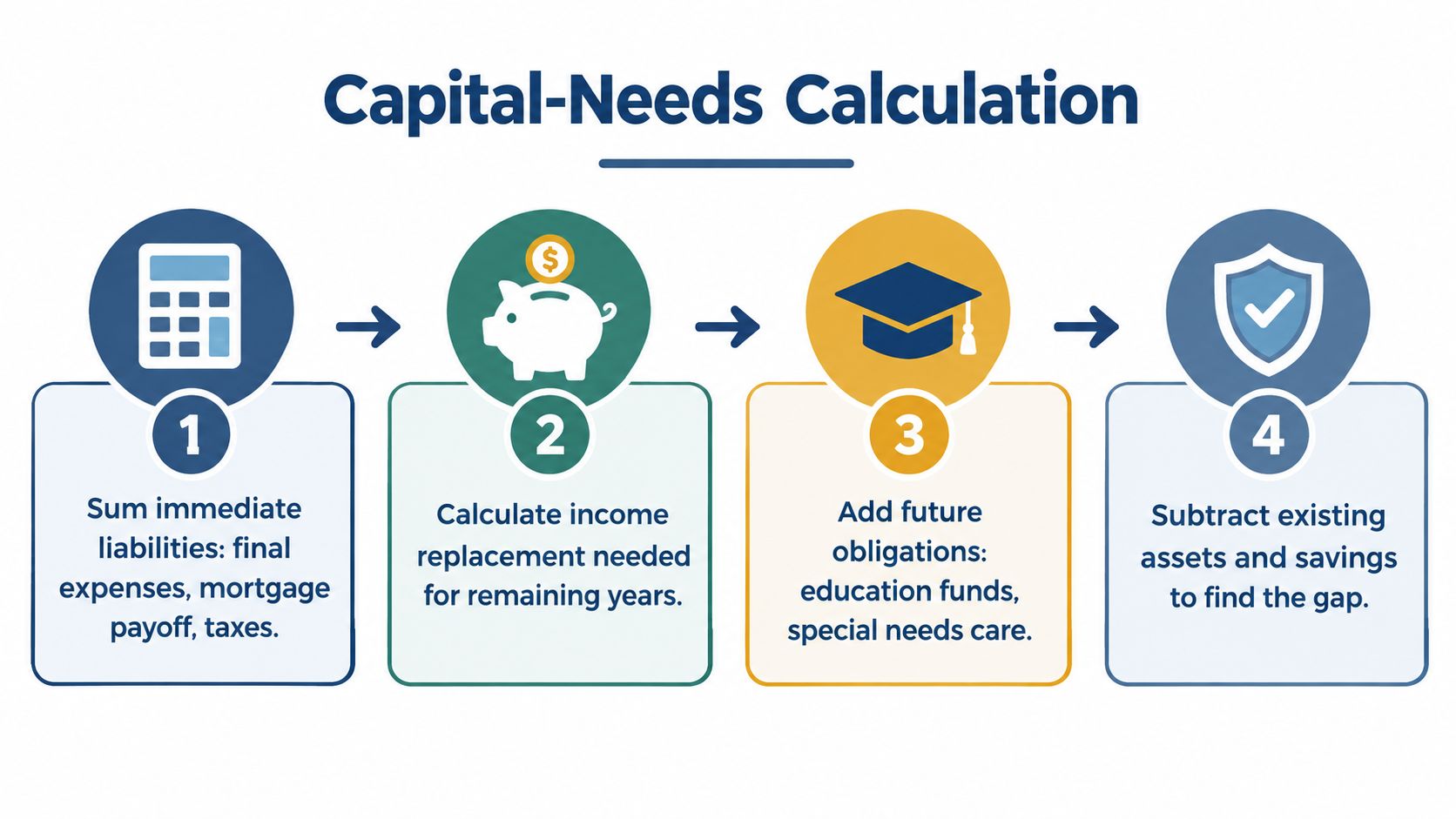
The most reliable approach is the capital-needs method. You add the money your household would need immediately, estimate the present value of future support, then subtract resources already available to your beneficiaries. The technical formula is described as immediate liabilities plus the present value of ongoing support needs, minus liquid assets, existing policies, and survivorship benefits in NerdWallet's life insurance needs guidance.
Start with the expenses that would arrive quickly after your death. Gather your mortgage statement, loan balances, credit obligations, expected final expenses, and any taxes or business liabilities that your family would need to address. Don't use a vague estimate if you can find the actual balance in an account statement or lender portal.
Identify the support horizon
Next, decide how long your spouse or dependent would need financial support. This is the most important judgment in the calculation. Ask when the mortgage will be paid off, when your spouse expects to retire, when a dependent would become financially independent, or when a business transition could reasonably be completed.
Don't assume the support period equals your life expectancy. Life expectancy helps you understand longevity risk, but your insurance term should match the years of financial dependence. A spouse who can retire once the mortgage is cleared may need a shorter income bridge than a spouse who would need ongoing support for much longer.
Convert the support need into a present-value figure rather than multiplying income by a large number. Use the amount the survivor would need from your earnings, not your gross salary if household spending doesn't require all of it. Account for the income your spouse would continue to receive from work, pensions, Social Security, or other sources.
Subtract what your family already has
List liquid savings, taxable investments, retirement assets that can realistically support the survivor, existing life insurance, and expected survivor benefits. Be careful with retirement accounts. If an asset is already earmarked for the surviving spouse's retirement, don't count it as both an available insurance offset and a separate retirement reserve.
Employer life insurance deserves special attention. It may disappear when you retire or leave the company, so treat it as dependable only if the policy terms clearly allow continuation and the premium remains manageable. Self-employed people should also check whether personal savings could be accessed without disrupting the survivor's retirement plan.
Practical rule: Count an asset only once, and subtract only resources your beneficiary can realistically use for the obligation you're insuring.
Your worksheet should therefore contain four sections:
- Immediate liabilities: Add final expenses, debts, mortgage payoff, and other obligations due after death.
- Ongoing support: Estimate the survivor's income gap over the years of dependency.
- Future commitments: Include education support, special-needs care, business continuity, or other obligations that would remain.
- Available resources: Subtract savings, investments, existing coverage, and survivor benefits.
The result is your coverage gap. If the number feels larger than expected, check whether you've included income your spouse won't need to replace, or counted assets that already cover part of the same expense.
You can also use a life insurance needs calculator to organize income, debts, future expenses, and existing assets before comparing policies.
Real World Coverage Examples for Couples and Singles at 60
Worked examples make the method easier to apply, but they're illustrations, not personal recommendations. The correct amount depends on the obligations, resources, and support horizon in your household.
Married homeowner with a dependent spouse
Assume a 60-year-old married homeowner has a $300,000 mortgage, $40,000 in other debts, and $30,000 in immediate final and administrative expenses. The surviving spouse needs $60,000 of annual support for 15 years, producing $900,000 before considering the timing and present value of those payments.
The household has $500,000 in accessible assets, $100,000 of existing life insurance, and $200,000 in expected survivor benefits and other dependable resources. Using a simplified capital-needs illustration, total needs equal $1,270,000, while available resources equal $800,000, leaving a suggested coverage gap of approximately $470,000.
The policy could be structured around that gap, with the term selected to match the support period and mortgage risk. If the mortgage is paid down faster or the spouse has stronger retirement income, the required amount falls. If the spouse's income gap is larger, the coverage should rise.
Single adult with limited obligations
Now consider a single 60-year-old with no dependents. The person has $25,000 in final expenses, $15,000 in remaining debt, and $40,000 in liquid savings specifically available for these obligations. The assets exceed the immediate need, so additional life insurance may not be necessary for financial protection.
If those savings are intended for retirement and cannot reasonably be used for final expenses, the analysis changes. In that case, a modest policy could prevent the estate from selling investments or passing the debt to family members who aren't legally responsible for it.
| Household Scenario | Total Needs | Minus Assets and Benefits | Suggested Coverage |
|---|---|---|---|
| Married homeowner with 15-year spouse-support horizon | $1,270,000 | $800,000 | $470,000 |
| Single adult with no dependents | $40,000 | $40,000 | $0 |
These examples also show why a national need-gap doesn't determine your personal number. LIMRA reports that 92 million U.S. adults need life insurance or more coverage, identified in the 2026 Insurance Barometer as the current national need-gap (industry benchmark details). That figure describes broad underinsurance, not the amount any particular 60-year-old should buy.
My recommendation is firm: don't copy another household's face amount. Build your own liability total, support horizon, and resource offset. A couple may need substantial temporary protection, while a financially independent single person may need little or none.
Income Multiples and DIME Shortcuts and When They Mislead
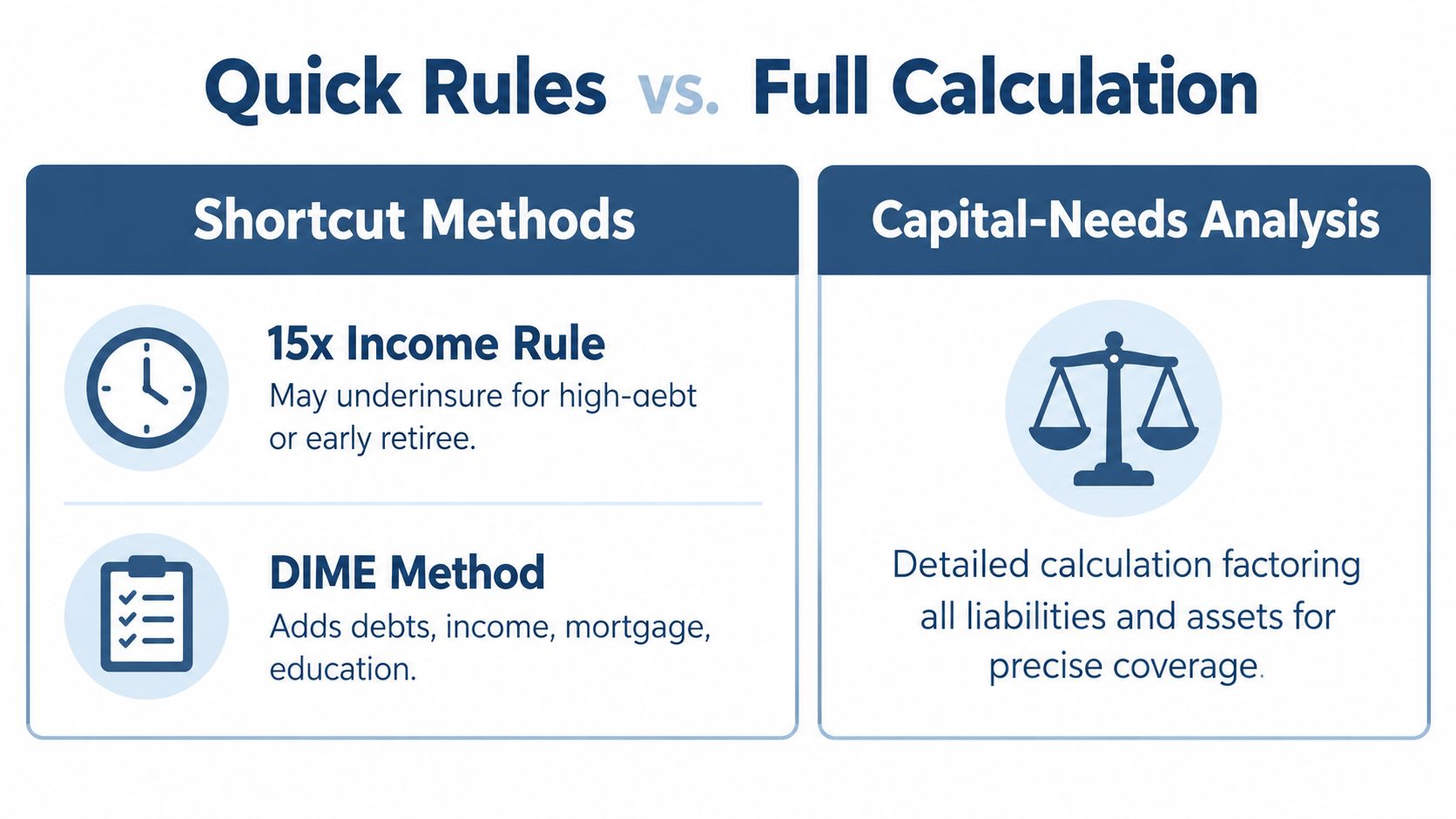
Income multiples are useful for a quick conversation, but they're a poor final answer at 60. A common benchmark for ages 51 to 60 is about 15 times annual income, with the recommendation typically falling to 10 times income for ages 61 to 65 (Guardian's income-multiple and DIME guidance).
Under that shortcut, a 60-year-old earning $100,000 could see an estimate near $1.5 million before subtracting assets and benefits. That may be reasonable for someone with major debts and a dependent spouse, but it could be excessive for someone with a nearly paid-off home and substantial retirement assets.
Use shortcuts for speed, not precision
The income rule works as a screening tool. It can flag a potentially serious shortfall when you have a spouse, ongoing earnings, and several obligations. It becomes misleading when it ignores mortgage balance, employer coverage, retirement savings, and Social Security survivor benefits.
The DIME method adds Debt, Income, Mortgage, and Education costs, then reduces the result by existing resources. It's more disciplined than a bare income multiple, but it can still overstate need if education costs no longer apply or if retirement assets already cover the income gap.
Capital needs is the tie-breaker
Use capital-needs analysis when your situation includes uneven income, self-employment, a pre-Medicare bridge, a pension decision, or a spouse whose retirement date matters. Those details determine both the amount and the policy length.
For a self-employed professional, the calculation might include business debt and the cost of transitioning clients or equipment. For a pre-Medicare household, the risk window may involve keeping the surviving spouse financially stable until other income and health coverage arrangements become available. The shortcut won't capture those details without additional work.
The best estimate is the one that explains exactly what the death benefit would pay for and when that risk ends.
Use an income multiple to get a rough range. Use DIME to make sure you haven't forgotten a major category. Then use the capital-needs method to make the purchase decision. If income replacement is the primary purpose, this guide to life insurance for income replacement can help frame the support question without treating salary as the entire need.
Matching Your Coverage Amount to the Right Policy Length and Cost
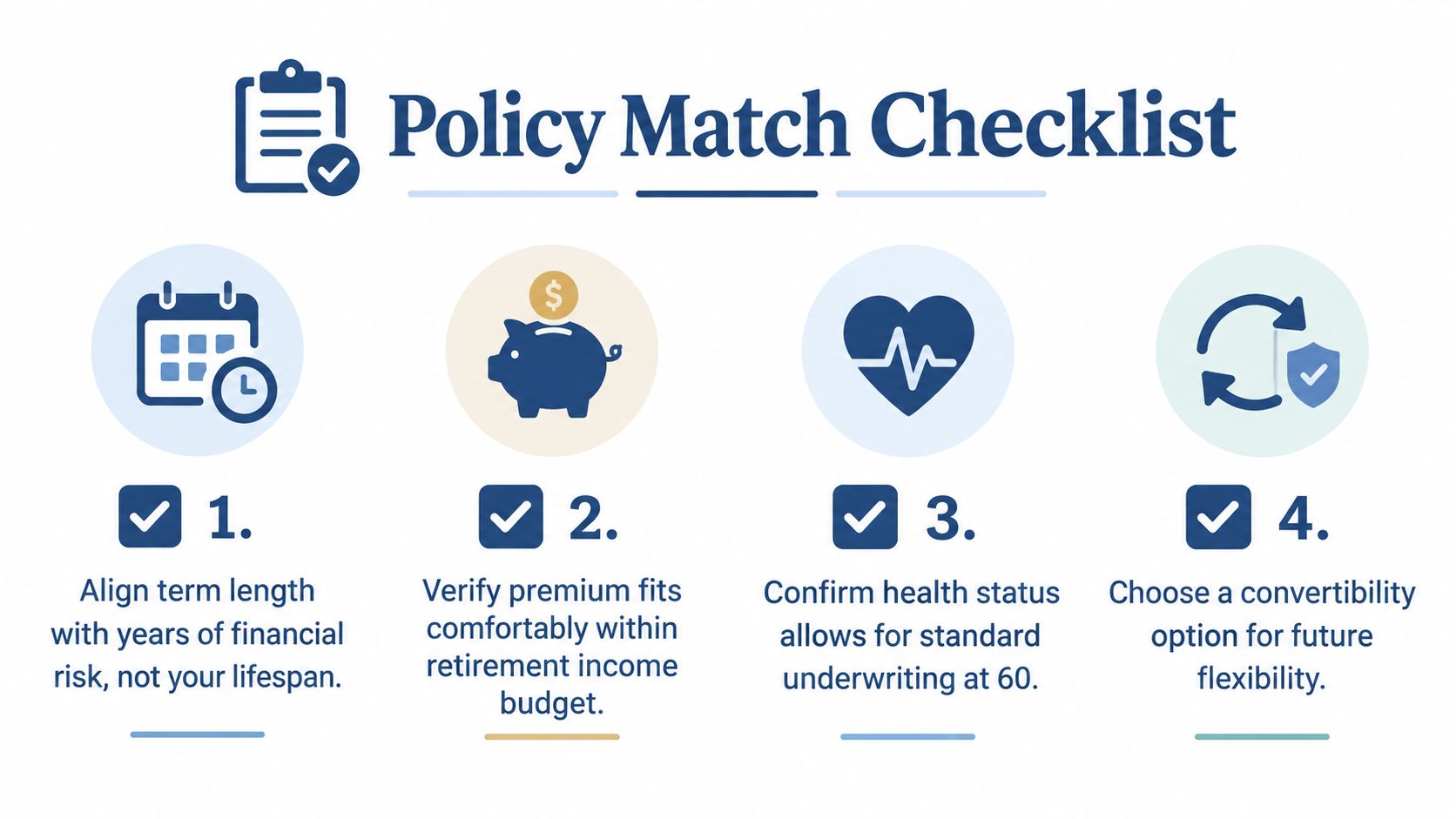
At 60, policy length should follow the remaining risk window. If your spouse needs income until retirement, a mortgage has years left, or a dependent still relies on you, insure that period. Do not automatically pay for coverage through an age when the financial obligation has already ended.
Match the term to the obligation. A mortgage nearing payoff calls for protection through the remaining loan period. A spouse approaching retirement may need a bridge until dependable retirement income begins. A business loan or professional obligation with a defined payoff date usually needs coverage only until that liability ends.
Term insurance often fits temporary gaps
Current market examples include $39 to $58 per month for a $250,000 10-year term for a healthy 60-year-old, along with $63 to $83 per month in other 2026 rate illustrations (market pricing and issue-age examples). Your premium will reflect health, underwriting, tobacco use, insurer, policy design, and coverage amount.
Age limits can narrow the available term choices. Ten-year policies commonly have maximum issue ages ranging from 60 to 80, while 30-year options are much less available and often end in the 50s, according to the same market reference. Apply early enough to compare insurers and term lengths instead of assuming every carrier offers the duration you want.
Permanent coverage has a narrower job
Permanent insurance fits a need that lasts for life, such as guaranteed final-expense funding, estate liquidity, or support for a lifelong dependent. It is harder to justify for a mortgage payoff or temporary spouse support, because you may pay for benefits after the financial risk has disappeared.
Check three points before choosing it: the premium must fit your retirement income, the contract must state whether the death benefit is guaranteed, and any conversion provision must work for your plan. Do not purchase cash-value features solely because they sound broadly useful.
Medical expenses belong in the retirement budget, but they are separate from life insurance. If you are reviewing related protection, hearing aid insurance coverage can help with that distinct question.
For the difference between temporary and lifelong protection, compare life insurance versus term life insurance. My recommendation is direct: use term insurance for a defined risk window, and reserve permanent coverage for a clearly permanent need.
Final Checklist to Lock In the Right Amount at 60
You don't need a complicated financial model to make a sound decision. You need accurate inputs and a policy that matches the obligation you're transferring.
Before applying, confirm the following:
- Immediate obligations: Verify the current mortgage, loans, credit balances, final expenses, and business liabilities.
- Survivor income gap: Calculate what your spouse or dependent would lack after your death, not your entire gross income.
- Support horizon: Identify the date when the mortgage ends, your spouse retires, a dependent becomes independent, or a business obligation is resolved.
- Available assets: Review liquid savings, investments, retirement accounts, and any assets your beneficiary can realistically use.
- Existing policies: Check your personal and employer coverage, beneficiary designations, conversion provisions, and whether employment-based coverage continues after retirement.
- Survivor benefits: Include dependable pension and Social Security survivor benefits without counting uncertain sources twice.
- Policy affordability: Test the premium against retirement income, not just today's paycheck.
- Health and timing: Apply while your current health gives you a reasonable range of underwriting options.
Review the policy amount after a major mortgage payment, retirement, inheritance, business sale, or change in marital or dependent status. You don't need to keep an outdated face amount forever, and you shouldn't cancel existing coverage before confirming that replacement coverage is approved and active.
At 60, the right policy is often smaller than it would have been at 40. That doesn't make it unimportant. It means the policy should be precise, with enough money to solve the remaining problem and no unnecessary benefit that strains your budget.
Get competing quotes for the same coverage amount and term, then compare the underwriting class, conversion rights, exclusions, premium structure, and financial strength of the insurer. A low initial premium isn't useful if the policy ends before the risk does.
My Policy Quote can help you organize income, debts, future expenses, and existing assets before you compare coverage options. Visit My Policy Quote to evaluate your coverage gap and request quotes that fit the remaining years of financial risk.