

A self-employed contractor finishes a tax return and pauses at an old question about health coverage. An early retiree does the same after a Marketplace premium rises, wondering whether checking “exempt” will solve the problem. The confusion is understandable, but the answer depends on three different questions: Is there a penalty? Can you qualify for financial help? Can you afford the coverage you need?
Those questions overlap, but they aren't interchangeable. A health insurance exemption may have excused a federal payment in the past, while subsidy eligibility determines whether a plan becomes cheaper, and affordability includes the premiums, deductible, network, prescriptions, and medical bills you could face.
What a Health Insurance Exemption Actually Means Today
Suppose Daniel works as a 1099 contractor. His income changes from month to month, he has no employer plan, and his tax software still asks about coverage. He assumes that “exempt” means he can skip insurance without consequences or that the government will help him buy a plan.
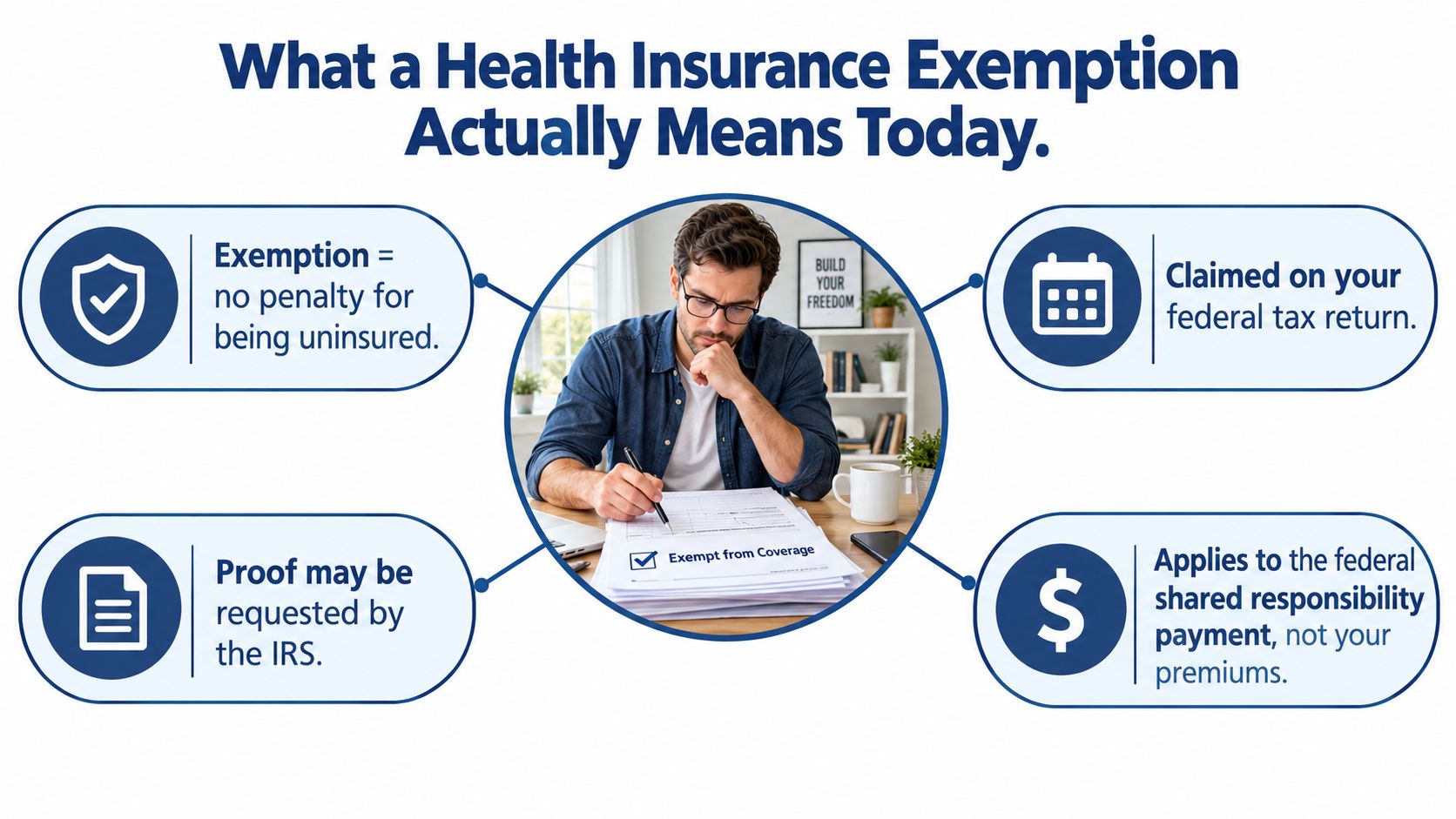
That assumption combines several separate ideas. Historically, a health insurance exemption meant that a person qualified for relief from the Affordable Care Act's federal shared-responsibility payment for specific months. It didn't provide insurance, lower a premium, approve a Marketplace plan, or protect Daniel from medical bills. The qualifying reasons included income, hardship, affordability, religious affiliation, tribal status, incarceration, immigration status, and other defined circumstances, as described by the Kaiser Family Foundation's explanation of the individual mandate.
The federal question in 2026
The federal penalty for lacking qualifying coverage was reduced to zero beginning January 1, 2019. That means the vast majority of households don't need a federal exemption to avoid a federal payment today. The underlying exemption categories and historical records still matter in conversations with a Marketplace, a tax preparer, or a state tax agency, but “no federal penalty” isn't the same as “I have an exemption.”
A person can therefore be:
- Not subject to a federal payment, because the federal amount is zero.
- Eligible for a formal exemption, under a qualifying category that may matter for records or state rules.
- Eligible for a subsidy, which is a separate financial-assistance question.
- Uninsured, with no plan paying covered claims.
Practical rule: Treat “exempt,” “subsidized,” and “covered” as three different labels until you've checked each one.
For self-employed people, the more useful starting point is often whether Marketplace coverage, Medicaid, or another plan fits their projected household income and medical needs. Understanding what counts as minimum essential coverage can help clarify the coverage question, but it doesn't replace checking current federal and state rules.
The Main Federal Exemption Categories and Who Qualifies
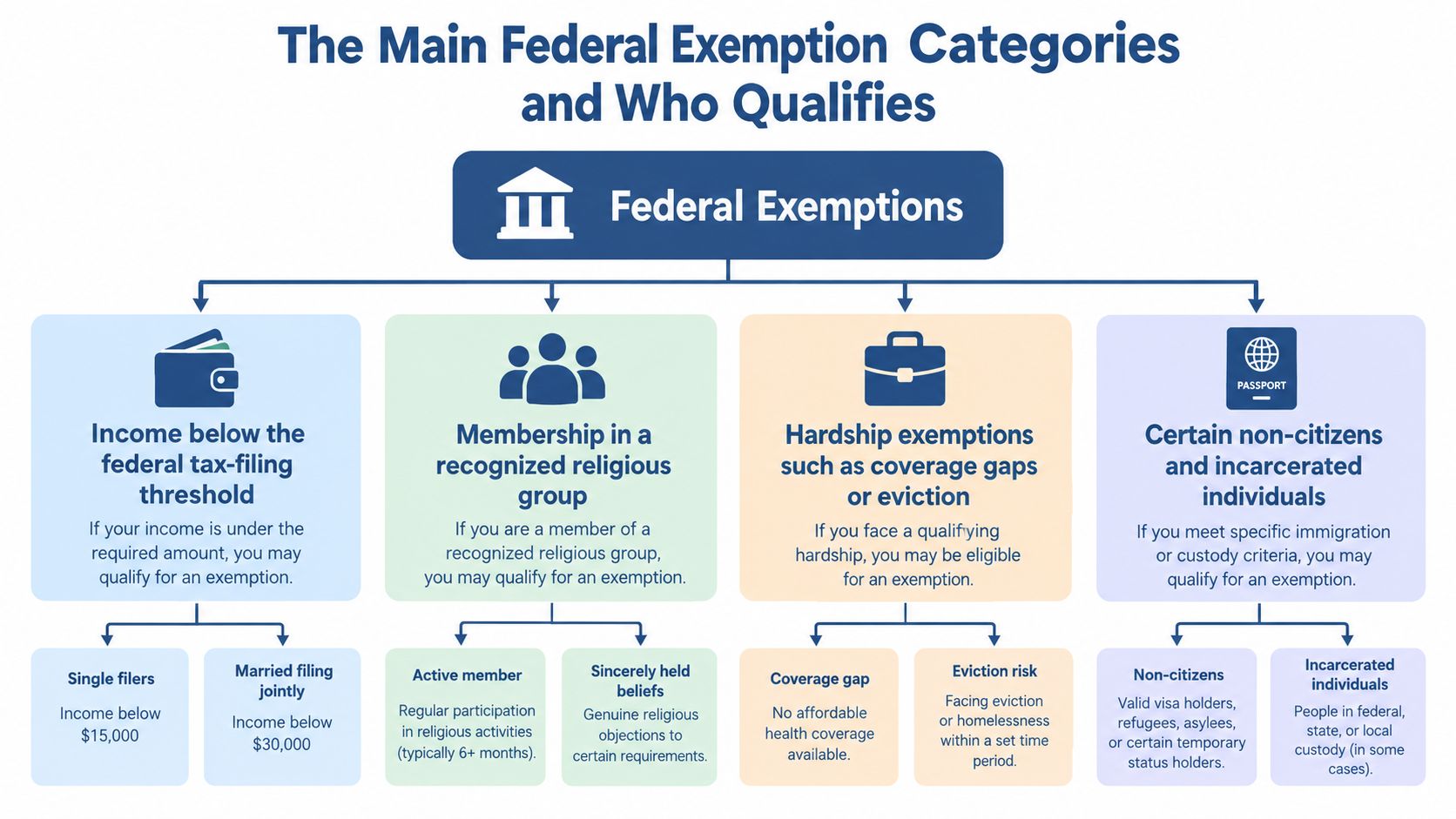
Federal exemptions were designed for people whose circumstances made coverage unrealistic, legally unavailable, or inconsistent with the mandate rules. The category tells you why relief may apply. It doesn't automatically enroll you in a plan.
Income and status categories
Income below the federal tax-filing threshold generally applied when a person wasn't required to file a federal return because income fell below the applicable filing threshold. A tax return, income records, or the absence of a filing requirement could establish the relevant signal.
Recognized religious groups could qualify when a person belonged to a recognized sect or religious organization that objected to insurance or relied on an accepted alternative arrangement. Documentation generally involved an approved religious exemption record or information requested by the appropriate agency.
Eligible members of federally recognized tribes could qualify through tribal membership or another recognized status. A tribal identification document or related verification could support the claim.
Incarcerated individuals could qualify for the months they were confined. Release records or correctional documentation might establish the applicable period.
Undocumented immigrants were among the status-based categories that could receive relief from the federal mandate rules. Immigration and Marketplace records would determine whether the category applied.
Hardship, affordability, and timing
Specified financial hardships covered circumstances that made obtaining coverage impractical, such as severe financial disruption, eviction-related problems, substantial medical costs, or other recognized hardship conditions. A Marketplace application could request supporting evidence, including notices, bills, or formal records.
Unaffordable required contributions were especially relevant to contractors, early retirees, and people without an employer plan. The test compared the required premium contribution, after applicable employer contributions and subsidies, with household income. If the required amount exceeded the statutory share of household income, the person could qualify for relief under the historical mandate rules.
Short coverage gaps addressed brief periods without insurance. The dates matter, because a short gap isn't evaluated the same way as a full-year affordability claim. Gather termination notices, enrollment records, and the start date of replacement coverage.
Certain residents abroad could qualify when they met the applicable residence-abroad requirements. Proof of foreign residence, tax status, or travel history might be relevant.
The practical boundary is important. A qualifying category historically excused a federal payment. It didn't pay premiums, create subsidy eligibility, guarantee a Marketplace plan, or cover medical treatment. If you're unsure whether the legal requirement applies to your situation, learn how health insurance requirements work before treating an exemption as a coverage strategy.
Why the Rules Changed and What That History Means for You
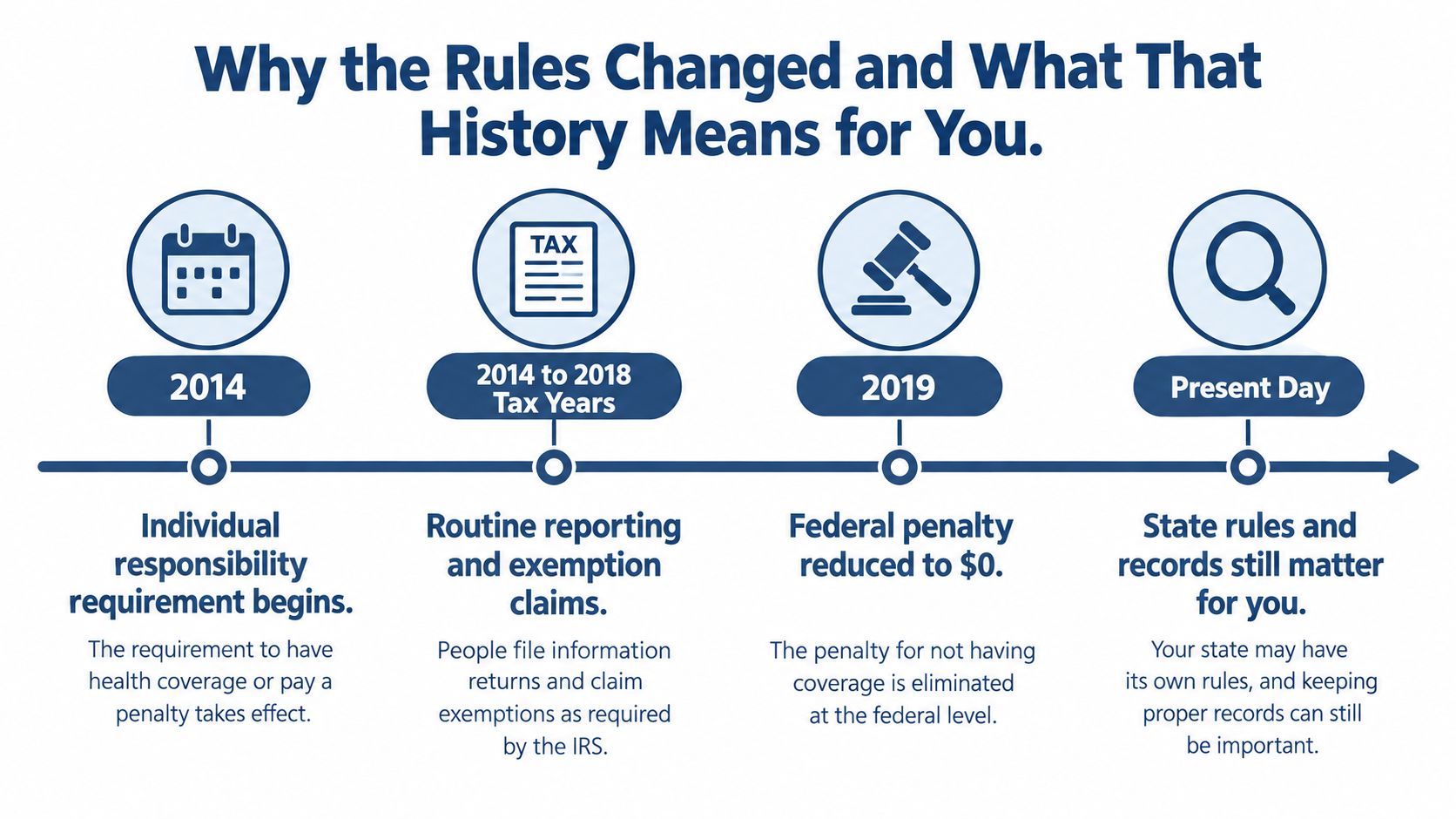
The federal story begins in 2014, when the ACA's individual responsibility requirement took effect. Filers were expected to maintain qualifying coverage or meet an exemption. During the tax years from 2014 through 2018, taxpayers generally reported coverage, claimed an exemption, or calculated the applicable payment.
The records show how routine that process became. Census Bureau modeling found that 85.5% of federal tax returns reported all individuals insured in 2014, rising to 87.1% in 2015 and 87.6% in 2016. In tax year 2015, about 12.7 million taxpayers claimed an individual-mandate exemption, while 6.5 million taxpayers reported a shared-responsibility payment, according to the Congressional Research Service history of the ACA mandate.
Congress changed the financial consequence through the Tax Cuts and Jobs Act, signed on December 22, 2017. The federal penalty was reduced to zero for months beginning January 1, 2019. For tax years 2017 and 2018, taxpayers still had to complete the applicable reporting, exemption, or payment process.
Why old language still appears
Tax software, older forms, and insurance explanations may still use “exemption” because the term belonged to the earlier federal process. A Marketplace may also ask questions about hardship or eligibility because those answers can affect enrollment pathways, documentation, or state requirements.
The important distinction is historical relief versus current action. Someone told in the past that they “qualified for an exemption” may have received a valid answer under the mandate rules, but that doesn't tell them whether their current plan is affordable, whether they qualify for financial help, or whether their state imposes a separate requirement.
State-Level Individual Mandates That Still Apply
A self-employed person can hear “there's no federal penalty now” and assume the issue is over. In some places, it is not. California, Massachusetts, New Jersey, Rhode Island, Vermont, and the District of Columbia still have individual-mandate systems, and each one can set its own forms, exemptions, and possible payments.
That is the first distinction many guides blur. A zero federal penalty does not automatically mean your state also dropped its rules. It also does not answer whether you qualify for premium help or whether coverage is affordable for your household. Those are separate questions, and they can point to different next steps.
State rules also do not line up neatly. One state may base a payment on household income and filing status. Another may compare it with the cost of a benchmark plan or use a flat calculation. Exemptions vary too, so a hardship that works in one state may need different proof somewhere else.
Start with one practical question. Where did you live during the tax year?
That matters more than where you picked up clients or crossed state lines for work. If you moved, check the months tied to each residence. If you kept hearing older federal language about “exemptions,” treat it as background, not as a current answer to your state filing obligations.
A quick check usually clears up the confusion:
- Does your state still enforce an individual mandate?
- Is there a separate exemption form or tax filing step?
- What documents support hardship, affordability, income, or a gap in coverage?
- Did you change residence during the year?
- Are you relying on outdated federal guidance instead of current state instructions?
If a coverage decision is straining the rest of your budget, you may also want to find state-specific borrowing rules. For the insurance side, compare your state instructions with the possible fine for not having insurance, because any state payment is separate from the federal system.
Why Affordability, Not Exemption Status, Is Often the Problem
A self-employed person can clear one insurance question and still be stuck on another. You might learn there is no federal penalty for going uninsured, then realize that answer does nothing to lower the premium, shrink the deductible, or help with a surprise bill. That is why exemption status, subsidy eligibility, and affordability need to be separated instead of lumped together.
KFF reports that 61.7% of uninsured adults ages 18 to 64 cited unaffordable coverage as a reason for lacking insurance, while 21.0% reported difficulty signing up and 28.9% said they weren't eligible, according to its key facts about the uninsured population. Those are different problems, and they lead to different next steps.
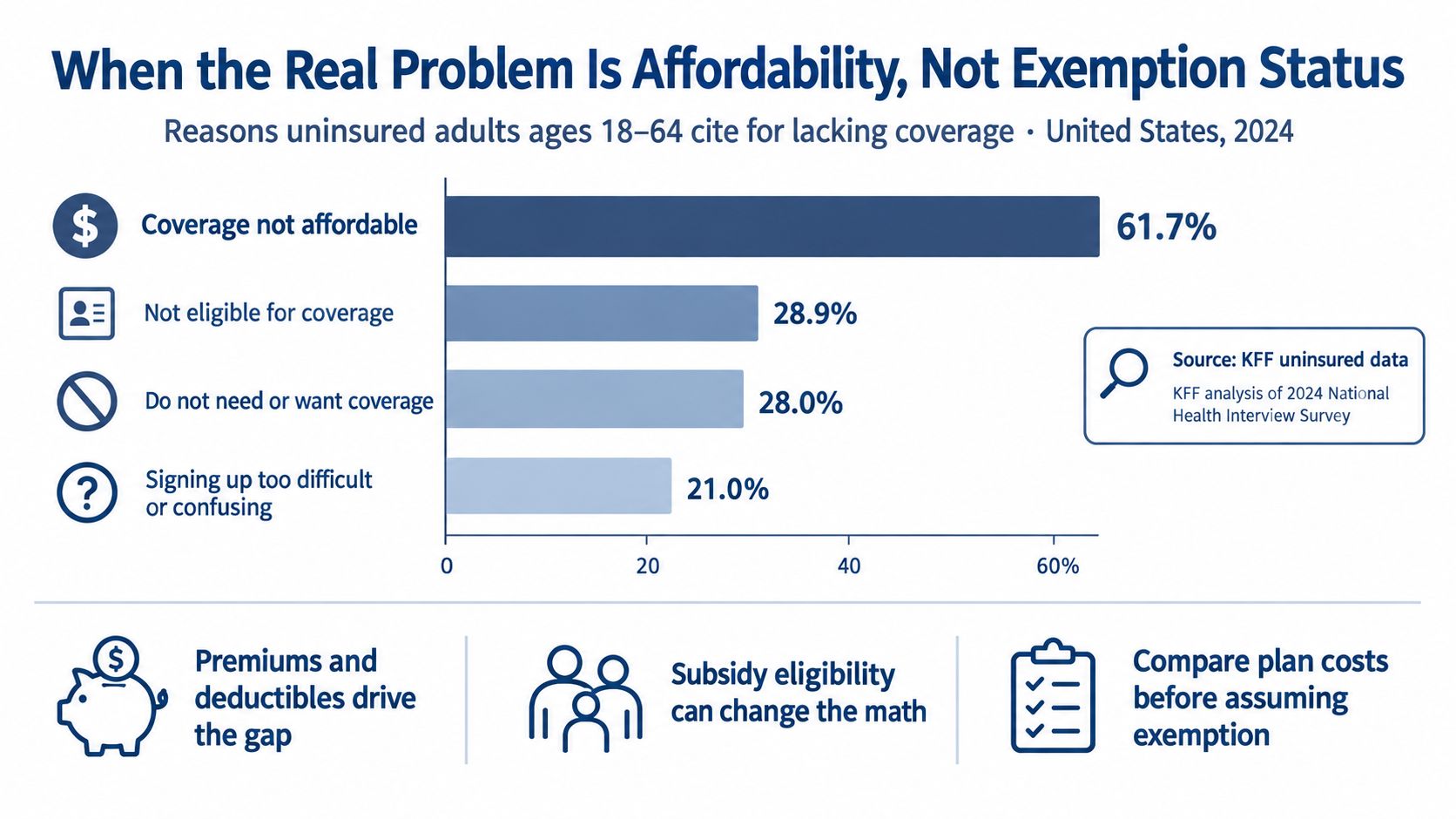
One person may qualify for Marketplace help and still feel boxed in by out-of-pocket costs. Another may be eligible for a plan but get stalled during enrollment. A third may sit outside a program's income rules. Calling each case an "exemption issue" blurs the practical choice in front of them.
Income swings make this harder for freelancers and contractors. Your Marketplace assistance is based on an income estimate, not a fixed salary carved in stone. If business improves or drops midyear, the advance premium tax credit may no longer match your final income, which can affect what happens at tax time. An exemption does not cancel that reconciliation. It also does not protect you from bills from doctors, hospitals, or pharmacies if you stay uninsured.
KFF also describes a coverage gap in non-expansion states affecting an estimated 1.4 million uninsured people. For those households, the obstacle is not a missed form or a misunderstood exemption. Available programs and household income do not line up.
Before you drop coverage, compare the full cost picture:
- monthly premium
- deductible and other out-of-pocket costs
- prescription coverage
- provider network
- emergency and hospital coverage
- the chance of repaying assistance after income changes
A spreadsheet can help. An automated money-saving monitor can help too. But the key question stays the same: What does this plan cost to keep, and what could no coverage cost if you need care?
How to Claim an Exemption and What Documentation You Need
A self-employed person often gets stuck here after the hard part already happened. Coverage ended, income changed, or a bill pileup made premiums unrealistic. The next step is to match the problem to the place that decides it, because an exemption request, an enrollment issue, and a tax record are related, but they are not the same thing.
Start by building a timeline. Write down what happened, the exact month it started, and how it changed your access to coverage. If you lost job-based insurance, had a sudden drop in contract income, received an eviction notice, or took on large medical bills, those details matter more than a general statement like “insurance was too expensive.” Insurance systems usually sort claims by event and date first, then by explanation.
Where you file depends on what you are trying to do. A Marketplace application may review hardship, affordability, or another qualifying circumstance during enrollment. A state tax return may ask for its own exemption form. Older federal tax filings handled exemptions for months when the federal mandate still applied. That distinction trips people up. No federal penalty does not mean no paperwork anywhere, and it does not automatically mean you qualify for help with premiums.
The documents should tell the same story as your timeline. Useful records can include housing records such as an eviction, foreclosure, or utility shutoff notice, medical expenses that show serious debt, income records like pay stubs, contractor invoices, or profit and loss statements, household records showing a move or change in family size, and personal safety records tied to domestic violence or another recognized hardship.
A good rule is simple. Save the notice, the date on it, who issued it, and the period it covers.
That habit helps because different exemption types do different jobs. A hardship determination may apply around the hardship period if it is approved. A short coverage-gap exemption focuses on a brief lapse. An affordability exemption asks whether the required contribution was too high compared with household income. Those are separate questions, even if they started from the same financial strain.
Keep copies of everything you send and everything you receive, including approvals, denials, and requests for more proof. If you also need tax documents tied to prior coverage, learn how to get a 1095 form and file it with the rest of your insurance records.
Realistic Alternatives When an Exemption Is Not the Right Answer
You may be self-employed, your income may have dipped, and the premium you saw may still feel out of reach. That is usually the moment people lump three different questions together: Do I owe a penalty, do I qualify for financial help, and can I actually afford the coverage in front of me? Those are related, but they are not the same decision.
If an exemption does not solve the underlying problem, shift from penalty relief to coverage choices. The goal is to find the option that fits your medical risk, cash flow, and timing, while being honest about what each option does not cover.
| Option | Best Fit For | Main Trade-Off |
|---|---|---|
| Catastrophic Marketplace plan | People under 30 or those approved for a hardship or affordability pathway | Lower premiums may come with a high deductible and limited day-to-day protection |
| Medicaid | People who meet their state's income and eligibility rules | Eligibility depends on state rules and household circumstances |
| Marketplace subsidies | Households whose projected income qualifies for premium assistance | Income changes can affect final tax-credit reconciliation |
| Cost-sharing reductions | Eligible Marketplace enrollees choosing a qualifying plan | Assistance depends on eligibility and plan selection |
| Special Enrollment Period | People who lose coverage or experience a qualifying life event | The enrollment window and proof requirements are strict |
| Short-term limited-duration plan | Someone needing temporary protection while pursuing full Marketplace coverage | Exclusions, renewals, benefits, and consumer protections can differ from Marketplace coverage |
| Direct primary care | People seeking predictable access to routine primary care | It is not full insurance coverage and does not replace hospital or specialty protection |
| Health care sharing arrangement | People considering a non-insurance cost-sharing model | Payment is not the same as guaranteed insurance coverage |
A catastrophic plan works for a narrow purpose. It can protect you from a major medical bill, but it may leave you paying a lot before everyday care is covered. Medicaid is often the stronger answer for someone who qualifies. For a household with uneven contractor income, a subsidized Marketplace plan may offer a better middle ground because it addresses coverage and premium help at the same time.
Sometimes the best next move is not an exemption at all. A job change, loss of coverage, move, divorce, or other qualifying event may open a Special Enrollment Period. That matters because it gets you into a plan, which is different from merely being excused from a penalty. Short-term coverage can fill a brief gap, but only if you read the exclusions, renewal rules, and covered benefits carefully before depending on it.
Early retirees should also separate Marketplace decisions from Medicare timing. One system does not replace the other, and younger family members may still need their own Marketplace review even if one person is approaching Medicare age. For a plain-language overview of that enrollment process, Prime Journal explains Medicare enrollment. My Policy Quote provides health insurance information for people comparing these paths, including self-employed households and families without employer coverage.
A Simple Next-Steps Checklist for Your Situation
Use the next week to turn the exemption question into a coverage decision.
- Self-employed and 1099 contractors: Update your projected household income, compare Marketplace subsidy scenarios, and revisit the estimate whenever earnings change materially.
- Early retirees ages 60 to 64: Map premiums, deductibles, prescriptions, and network access until Medicare eligibility. Keep retirement income changes visible because they can alter Marketplace assistance.
- Working-class families: Check Medicaid first, then compare subsidized Marketplace plans and catastrophic options where eligible. Don't choose based on premium alone.
- Parents buying for adult children: Review whether a child can remain on a parent's plan, then compare the child's own Marketplace or Medicaid eligibility.
- Medicare clients referring younger relatives: Keep Medicare decisions separate from Marketplace decisions for spouses, adult children, or other household members who aren't yet eligible.
If your income, residence, or coverage changed, collect the supporting documents before applying. Call a licensed advisor when the choice involves fluctuating income, multiple states, a complicated household, or a trade-off you can't confidently evaluate alone.
My Policy Quote offers practical health insurance guidance for people comparing exemptions, Marketplace coverage, affordability, and alternatives without employer-sponsored insurance. Visit My Policy Quote to review your situation and take the next step toward a coverage choice that matches your income and medical needs.