
Generally, no. For self-employed people, life insurance premiums are usually treated as personal expenses and aren't deductible, even when you pay them through a business, with a narrow exception for coverage a business buys for employees when the business isn't the beneficiary.
So why do so many freelancers, contractors, and small-business owners still ask whether life insurance is a business write-off? The confusion is understandable. Health insurance may qualify for a self-employed deduction, and many ordinary business costs can reduce taxable income. Life insurance looks like another form of protection that keeps the business and household financially stable.
The tax question, however, is not merely whether the policy helps you work. The more important questions are who owns the policy, who benefits from it, and whether you're a direct or indirect beneficiary. That beneficiary-status rule explains why moving the premium payment from your personal account to a business account usually doesn't change the result.
Why Self-Employed Life Insurance Premiums Are Usually Not Deductible
If you're a freelancer, 1099 contractor, sole proprietor, or owner of an LLC or S corporation, your own life insurance premiums generally aren't deductible. The rule applies even when the policy is purchased through a business structure, because the IRS generally treats personal life insurance as a personal expense rather than a business cost. Mutual of Omaha's tax explanation describes this treatment for self-employed taxpayers.
The practical result is straightforward. You can't usually pay premiums for your own personal policy from business income and then subtract those premiums from business revenue as a Schedule C expense. Calling the payment a “business insurance expense” doesn't make it one when the policy protects your household and you retain a beneficiary interest.
Why the rule feels inconsistent
Self-employed people can have many legitimate deductions. Office supplies, professional services, advertising, and other ordinary business costs may be connected directly to earning income. Life insurance can also support a business indirectly, especially if your family depends on your income or clients depend on your work continuing.
That practical value doesn't determine deductibility. Tax treatment follows the policy's ownership and beneficiary arrangement, not merely the fact that the insured person runs a business.
Practical rule: Paying a personal premium from a business checking account changes the payment method, not necessarily the character of the expense.
There's a narrow exception, and it matters for owners with employees. When a business buys life insurance for employees or certain officers, and the business isn't a direct or indirect beneficiary, the premiums may be treated as a business expense. The details depend on the arrangement, so employee coverage shouldn't be analyzed the same way as a sole proprietor's personal policy.
By the end of this guide, you should be able to separate three situations: your own personally beneficial policy, employer-provided coverage for workers, and business-owned insurance where beneficiary rules control the result.
How the IRS Sees Your Life Insurance Premiums
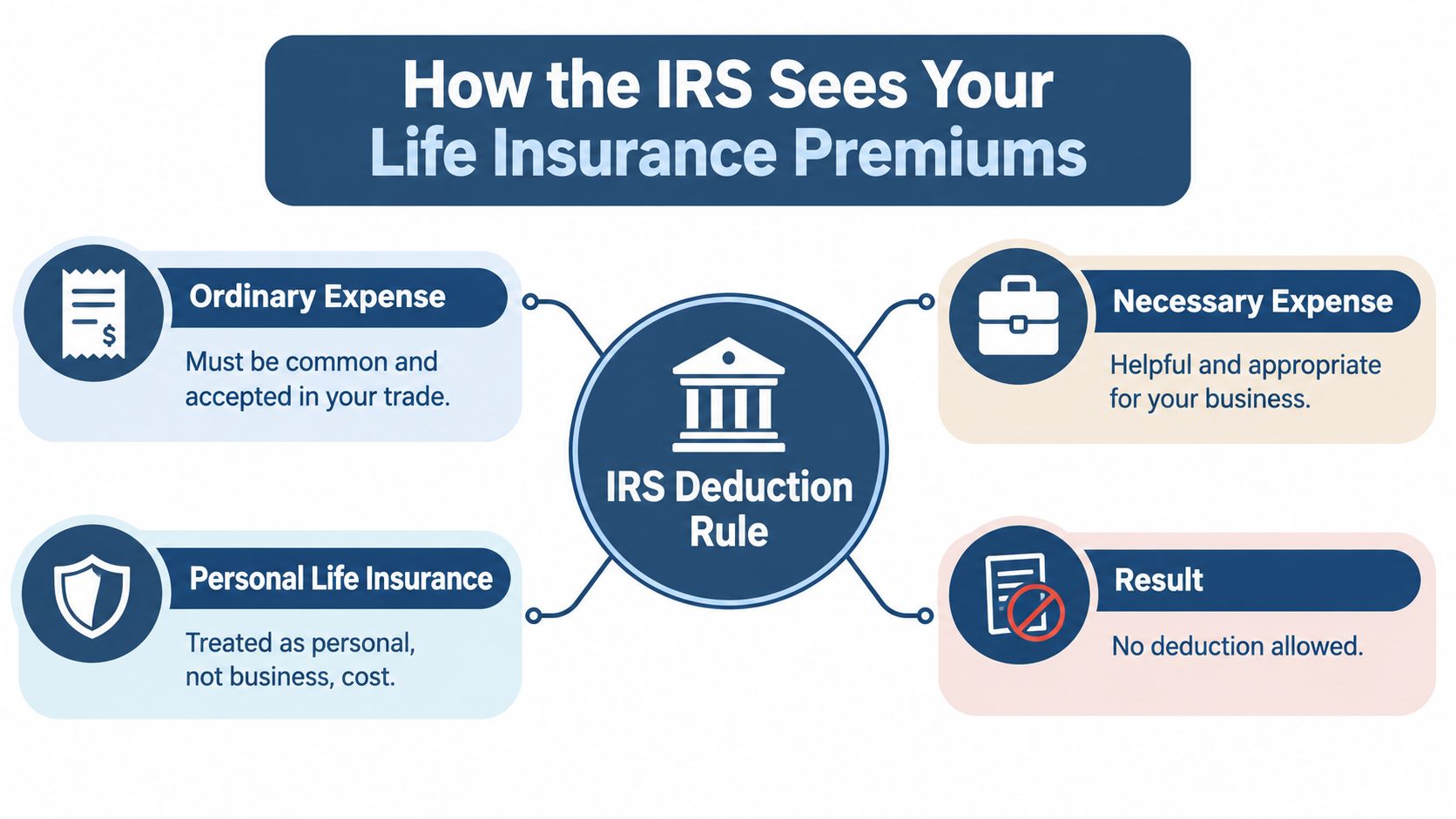
The IRS generally allows deductions for expenses that are ordinary and necessary for carrying on a business. A personally owned life insurance policy can be important, sensible, and financially responsible without becoming an ordinary and necessary business expense.
A simple analogy helps. Groceries may be essential to your household, but you can't deduct them just because you need food to show up for work. Your personal life insurance premium works similarly. It may protect the people who rely on your income, but the economic benefit generally flows to your household rather than to the business.
The account used to make the payment doesn't change that underlying benefit. A sole proprietor who pays from a personal account and a sole proprietor who pays from a business account are generally looking at the same policy purpose if the owner or family is the direct or indirect beneficiary.
The beneficiary test in IRS guidance
The guidance summarized from IRS Publication 334 states that premiums on life insurance contracts issued after June 8, 1997 generally can't be deducted when the taxpayer is directly or indirectly a beneficiary, regardless of who the policy insures. Guardian Life's explanation of the rule highlights why beneficiary status is more important than the label attached to the expense.
That rule prevents a personal protection policy from becoming a business deduction just because the insured person operates through an LLC or corporation. The policy may be connected to the owner's ability to earn income, but the benefit still belongs to the owner's household or another personal beneficiary.
For readers comparing personal coverage options, a state-specific guide such as California life insurance for 2026 can help with insurance questions. It doesn't replace tax advice, but it may help you distinguish the insurance purchase itself from the separate question of whether the premium qualifies as a deduction.
You can also review this overview of life insurance tax treatment before discussing your policy with a tax professional. Keep the two questions separate: whether coverage is appropriate and whether the premium is deductible.
The Beneficiary Rule That Decides Everything
When a self-employed person asks, “Is life insurance tax deductible for self employed taxpayers?”, the most useful answer starts with structure rather than occupation. Being self-employed doesn't automatically disqualify every business-related insurance arrangement, and it doesn't make a personal policy deductible.
Use two questions for each policy.
- Who owns the policy?
- Who receives the financial benefit if the insured person dies?
The owner controls the policy, including many decisions about premiums, beneficiaries, and policy rights. The beneficiary receives the death benefit. Those roles can belong to the same person, the business, an employee's family, or another party.
Direct and indirect benefit
A direct beneficiary is easy to recognize. If you own a policy and name your spouse, child, or estate as beneficiary, the household has a direct interest in the policy.
An indirect beneficiary is less obvious. A business may appear to own the policy, but you could still have an economic interest if the arrangement ultimately protects your personal finances, provides value to your estate, or benefits you through ownership rights. The tax analysis looks beyond the bank account used for premiums.
The important question isn't “Did the business pay?” It's “Who has the beneficial interest in the coverage?”
Consider a consultant whose company pays premiums on a policy that sends proceeds to the consultant's family. The company's payment doesn't turn the policy into ordinary business insurance. The family's protection remains the central economic benefit.
Now compare that with a company purchasing coverage on an employee for a defined business purpose. If the business owns the policy, the arrangement must be examined through its ownership and beneficiary rights. The result can differ because the employee's personal household, rather than the self-employed owner, may hold the relevant benefit.
A structure-first review
Before claiming a deduction, write down the following:
- Owner: Is the policy owned personally, by a sole proprietorship, by an LLC, or by a corporation?
- Insured person: Is the insured person the owner, an employee, or an officer?
- Beneficiary: Does the business receive proceeds, or does a personal beneficiary receive them?
- Purpose: Does the coverage protect a business interest, provide employee compensation, or protect a household?
- Economic benefit: Could the taxpayer benefit directly or indirectly from the policy?
The tax result follows this arrangement, not the job title of the insured person. For broader background on beneficiary treatment, see this guide to whether life insurance beneficiaries pay tax.
When Life Insurance Can Actually Be a Business Expense
The exception is narrower than many business owners expect. A business may be able to treat premiums as a business expense when it buys coverage for employees or certain officers and the business isn't a direct or indirect beneficiary.
That means employee coverage requires more than a company paying the bill. The business should identify who owns the policy, who receives the proceeds, and whether the coverage is part of compensation or an employee benefit. A tax professional can also review whether the arrangement creates taxable compensation or special treatment for an owner-officer.
Compare the policy roles
| Scenario | Policy Owner | Beneficiary | Premiums Deductible? |
|---|---|---|---|
| Personal policy for the self-employed owner | Individual or business structure used by the owner | Family, estate, or another personal beneficiary | Generally no |
| Employee life insurance | Business | Employee's designated personal beneficiary | May be treated as a business expense when the business isn't the beneficiary |
| Business-owned key person policy | Business | Business | Generally not deductible under the beneficiary rule |
| Cross-purchased buy-sell coverage | Individual business partners | The purchasing partner or another personal party | Generally not deductible |
The key person example deserves care. A business may have a legitimate reason to insure an owner or employee whose death could disrupt operations. But when the business owns the policy and receives the proceeds, the business is the beneficiary. That business purpose doesn't automatically create a premium deduction, and the beneficiary rule still needs to be analyzed.
A buy-sell arrangement is also business-related without necessarily producing a premium deduction. Partners may purchase policies on one another to provide funds for ownership transfers after a death. The arrangement can help preserve control and liquidity, but each partner's policy interest and premium treatment remain separate tax questions.
Employee coverage needs careful administration
Employee coverage is the clearest potential exception in the scenarios above, but “potential” matters. The business must not be the direct or indirect beneficiary of the employee policy under the stated rule. The employer may also need to consider whether the coverage is compensation, whether the employee is an officer, and how the arrangement is documented.
Don't assume that a policy is deductible because it appears on a benefits worksheet. A small-business tax deduction guide from HireAccountants can help you organize business expenses, but your accountant should confirm the specific policy structure before you claim the premium.
A useful file for your tax professional includes the policy application, ownership page, beneficiary designation, premium records, business resolution if applicable, and any employee-benefit documents. Those documents show the arrangement instead of relying on a description such as “insurance for the business.”
How Life Insurance Differs From the Health Insurance Deduction
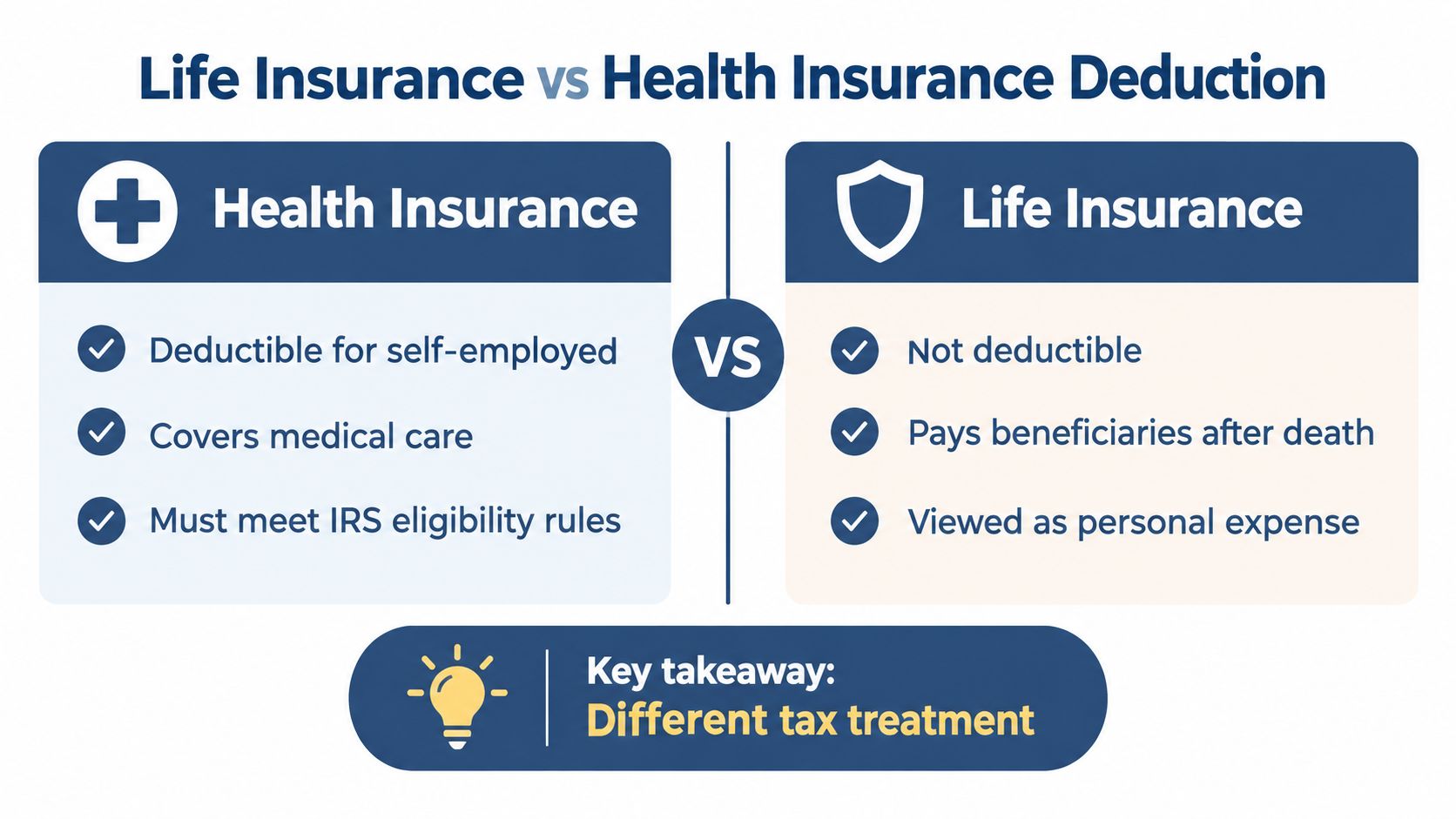
Why can a self-employed person deduct some health insurance premiums but not a personally owned life insurance policy? The answer is the benefit the policy provides and who receives it. Fidelity Life's self-employed insurance explanation also separates the health insurance deduction from the treatment of personal life insurance premiums.
Health insurance pays eligible medical costs for a covered person and may qualify for the self-employed health insurance deduction when IRS requirements are met. Life insurance pays a death benefit to named beneficiaries. That beneficiary relationship usually makes the premium personal, even when the business account pays it.
Eligible self-employed filers can often deduct health insurance premiums under the self-employed health insurance deduction rules. The deduction belongs to the health coverage category. It does not provide a general route for deducting life insurance.
Keep the categories separate
| Insurance type | General treatment for eligible self-employed filers |
|---|---|
| Health insurance | May qualify for the self-employed health insurance deduction if IRS requirements are met |
| Dental insurance | May be included when it meets applicable health insurance rules |
| Qualified long-term care coverage | May receive separate treatment subject to applicable rules and limits |
| Personal life insurance | Generally not deductible |
| Business-paid personal life insurance | Generally remains nondeductible when the taxpayer has a direct or indirect beneficiary interest |
The dividing line is not how necessary the coverage feels. A freelancer may need life insurance to protect a family just as urgently as health insurance. Tax treatment follows the policy's purpose, ownership, and beneficiary arrangement instead.
Keep life insurance premiums off the health insurance deduction worksheet unless a qualified tax professional identifies a different treatment for a specific business structure. A policy's label alone does not determine its tax category. The owner, payer, and beneficiary designation must support the deduction being claimed.
Use one practical test: does the premium pay for medical coverage under the self-employed health insurance rules, or does it pay for a death benefit under a life insurance contract? If it pays for a death benefit, assume a personal deduction is unavailable, then check whether an employee-coverage exception applies.
Real Examples of the Tax Rules in Action
The easiest way to apply the rule is to follow the money and the benefit. Three self-employed situations show why similar premium payments can receive different treatment.

The freelance designer
A freelance designer buys a personally owned term life policy. She pays the premium from the same business account she uses for software, client payments, and office costs. Her spouse or family would receive the benefit if she died.
The premium is generally not deductible. The payment came from business income, but the policy protects her household and has a personal beneficiary structure. The account used to pay doesn't change that result.
Her records should still identify the payment accurately. Treating it as a personal draw or personal expense is different from reducing business income by claiming it as advertising, insurance, or another Schedule C cost.
The sole proprietor with employees
A sole proprietor buys life insurance coverage for employees. The business pays the premiums, and the business isn't named as the beneficiary. The employees or their designated beneficiaries receive the protection.
This arrangement may qualify for business expense treatment because the coverage is provided for employees and the business doesn't receive the policy proceeds. The owner should document the employee-benefit arrangement and confirm the treatment with a tax professional, especially if the coverage includes an officer or an owner-related person.
The important difference isn't that the business paid both policies. It's that the owner's personal policy benefits the owner's household, while the employee policy can be structured as coverage for workers without a business beneficiary interest.
The partners with a buy-sell arrangement
Two business partners use life insurance to support a buy-sell agreement. Each partner owns coverage on the other partner, and the proceeds help fund the purchase of the deceased partner's interest.
The arrangement serves a business continuity purpose, but the premiums are generally not deductible under the personal beneficiary structure described above. The partners should also review ownership, beneficiary designations, transfer provisions, and the tax treatment of any proceeds with their advisers.
A business purpose alone isn't enough. The structure must match the intended economic result, and the paperwork should show who owns each policy and who receives the proceeds.
For an audio explanation of the broader insurance and tax considerations, this video provides additional context:
These examples point to the same practical habit: don't classify the premium by looking only at the business ledger. Review the policy contract and beneficiary designation alongside the payment record.
What Self-Employed Readers Should Take Away
The better planning question isn't only, “Can I deduct my own life insurance?” It's, “What structure supports the business purpose without creating a direct or indirect beneficiary problem or unexpected taxable compensation?”
Keep these points in your working checklist:
- Personal owner coverage: Premiums for your own policy are generally personal and not deductible, even when paid through a business structure.
- Employee coverage: A business may have a deduction when it buys coverage for employees or certain officers and isn't the beneficiary.
- Health versus life: A possible self-employed health insurance deduction doesn't make personal life insurance premiums deductible.
Before filing, ask your tax professional to review the policy owner, insured person, beneficiary, payment source, business purpose, and employee-benefit documents. Those details matter more than whether your business is a sole proprietorship, LLC, or S corporation.
The lack of a premium deduction doesn't make life insurance useless. Coverage can still protect a self-employed household, support dependents, and provide generally income-tax-free death benefits to beneficiaries under the usual rules. This guide to self-employed life insurance can help you organize the coverage questions before you speak with an insurance or tax adviser.
Review the policy structure before you claim the expense. A short conversation with the right professional can help you avoid treating a personal premium as a business deduction while still choosing protection that fits your family and business obligations.
My Policy Quote offers life insurance information and quote resources for self-employed professionals, 1099 contractors, and families comparing coverage. Visit My Policy Quote to review your options, then confirm the tax treatment of your specific ownership and beneficiary structure with a qualified tax professional.