

You're trying to protect your family, replace income, or keep a business afloat if something happens to you. Then an agent mentions a life insurance medical exam, and suddenly the application feels more complicated. You may be wondering whether a nurse will visit your home, whether you'll need to give blood, and whether one imperfect reading could make coverage unaffordable.
The good news is that the exam is usually a short, routine health snapshot, not a pass-or-fail appointment. A key point to consider is that you may not need one at all. No-exam and accelerated underwriting have changed the application process, so the practical question is no longer just what the exam includes. It's whether taking it is worthwhile for your age, coverage needs, health profile, and need for speed.
What a Life Insurance Medical Exam Really Is
Maya, a freelance designer in her late 30s, expected a medical exam to mean a sterile clinic, a waiting room, and a doctor with a clipboard. Her agent explained that a paramedical professional could instead meet her at home, ask health questions, record a few measurements, and collect blood and urine samples. The appointment would fit into an ordinary workday rather than requiring a separate trip to a medical practice.
A paramedical exam is arranged by the life insurance company as part of underwriting. Underwriting is the insurer's process for reviewing information and deciding whether to offer coverage, at what price, and under which risk class. The examiner usually isn't your personal physician, and the visit isn't intended to diagnose or treat a health condition.
What the appointment is designed to do
The examiner may verify your identity, review your application answers, record your height and weight, measure your pulse and blood pressure, and collect samples. Depending on the policy and the carrier's requirements, the insurer may request additional information from your medical records or doctors.
The exam itself often takes about 20 minutes, according to Guardian Life's explanation of the life insurance exam. The insurer generally arranges and pays for it, so you typically won't receive an out-of-pocket bill. You may be able to complete it at home, at work, or at an exam center.
Practical rule: Treat the appointment as information gathering, not a test you need to “pass.”
Applicants commonly worry about three things:
- Needles: A blood sample is usually a brief draw from the arm. If you're uncomfortable with needles, tell the examiner before the visit so they can help you prepare.
- Privacy: Your results go to the underwriting team, not directly to your employer or clients. Ask the carrier how it stores and shares exam information.
- Time away from work: A home appointment can reduce disruption, particularly for self-employed people who lose income when they leave a job site or client meeting.
Some policies require an exam because of the requested face amount, the applicant's age, or the carrier's underwriting rules. Others use an application and outside data instead. By the end of this guide, you'll have a practical way to decide whether to schedule the exam, ask about a waiver, or pursue accelerated underwriting instead.
Why Insurers Still Ask You to Take a Physical
The life insurance exam has deep roots. The National Library of Medicine's historical record of life insurance underwriting traces individual life insurance to 1853, while one major insurer was already requiring a physical examination by 1856. Earlier milestones included physician certificates in 1814 and requests in 1851 for information such as height, weight, chest circumference, and observations of heart and respiration.
An applicant in that era had few standardized records for an insurer to review. A physical examination gave the company another way to compare applicants and estimate risk. That basic purpose remains, even though today's process uses laboratories, electronic records, prescription information, and structured underwriting rules.
A life insurance policy creates a long financial obligation. The carrier may need to pay a death benefit many years after the application, so it needs a dependable picture of the applicant's health rather than relying only on answers typed into a form. Blood pressure, blood chemistry, nicotine markers, and urine findings can reveal information that a questionnaire may not capture.
The information gap
Suppose two applicants both report that they feel healthy. One has well-controlled blood pressure and no concerning lab findings. The other has an unrecognized metabolic issue or a pattern in their results that suggests higher future risk. Their answers may look similar, but their expected claims risk may not be the same.
That difference is why insurers combine self-reported information with independent evidence. The exam doesn't replace your medical history. It gives underwriters another way to verify the application and evaluate information that applicants may not know about themselves.
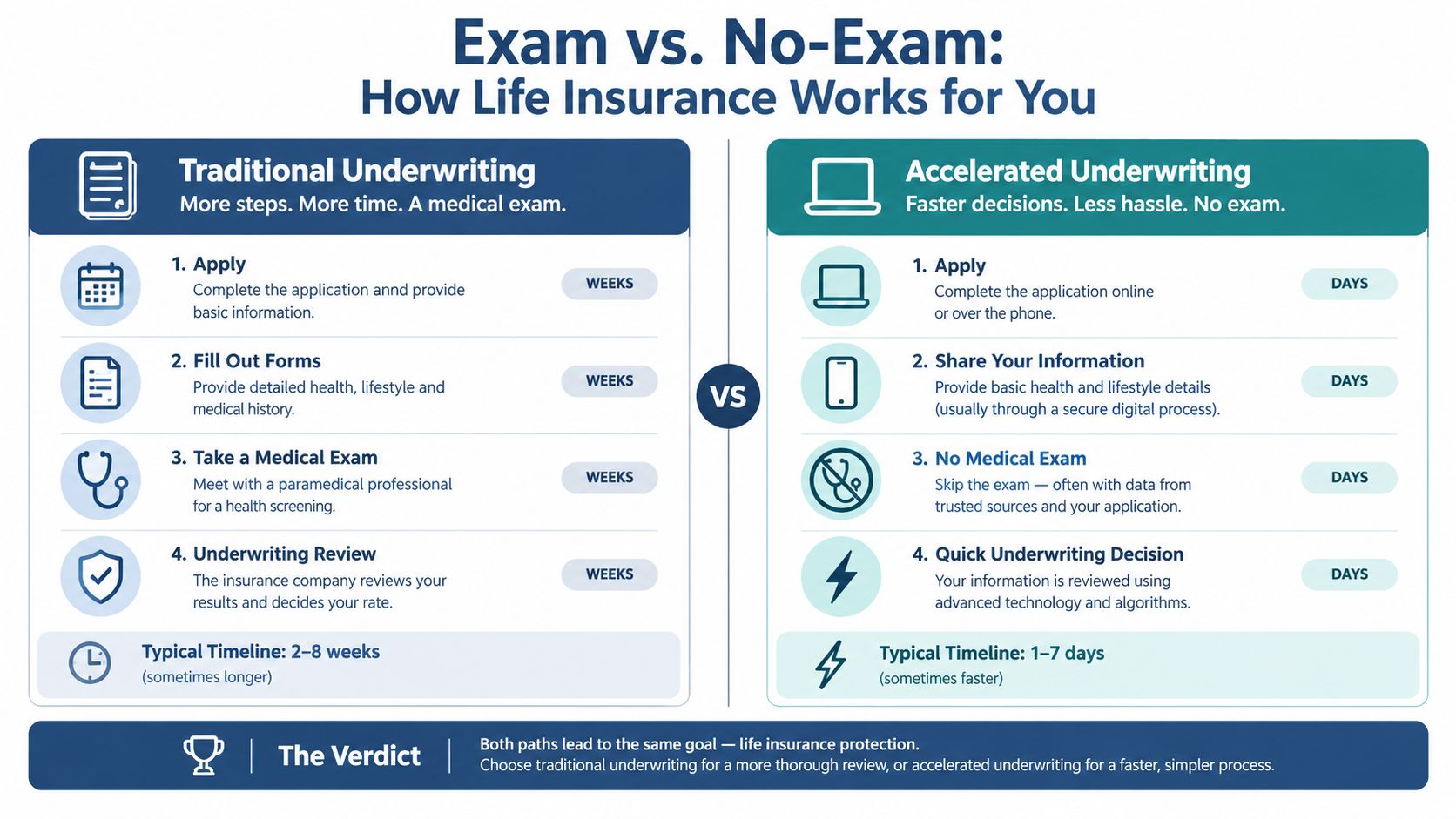
The traditional process still matters for many medically underwritten policies, especially larger ones. Blood and urine tests, height and weight, and blood pressure readings remain common parts of that workflow. Traditional underwriting can take four to six weeks to issue coverage, as Guardian Life describes in its overview.
For a deeper explanation of how the carrier evaluates an application from start to finish, see this guide to the life insurance underwriting process.
The exam is therefore less about judging your current appearance and more about helping the insurer price a long-term promise. That distinction matters when a result is slightly outside a preferred range. A flagged result may lead to a different rate class or a request for records, not an automatic decline.
What Happens During the Exam Step by Step
A life insurance medical exam usually follows a predictable sequence. Knowing the order can make the visit feel less like an unknown appointment and more like a short administrative task.
The opening questions
The paramedical examiner starts by confirming your identity and reviewing information from the application. Expect questions about your doctors, prescriptions, diagnoses, hospital visits, family history, tobacco or nicotine use, and recent symptoms. Answer accurately. Trying to minimize a condition can create a mismatch between your application, exam results, and medical records.
The examiner may ask about a prescription that appears in your history or request clarification about a past procedure. These questions don't necessarily signal a problem. Underwriters need context, and a medication may reflect a temporary issue, a resolved condition, or a diagnosis that requires closer review.
Measurements and vital signs
Next come the basic measurements:
- Height and weight: These help the carrier assess body composition and compare your application with the physical findings.
- Resting pulse: The examiner records your heart rate while you're seated and settled.
- Blood pressure: The reading provides a snapshot of cardiovascular risk. If you're nervous, the examiner may allow you to sit for a moment and repeat it.
- Visual observations: The examiner may note general health cues and ask follow-up questions when something needs clarification.
A blood draw generally follows. The laboratory work can include cholesterol, glucose, HbA1c, nicotine markers, and, depending on the carrier and policy, liver or kidney markers. A urine sample is usually collected in a sterile cup during the same appointment.
The examiner isn't giving you an immediate underwriting decision. Samples go to a laboratory, and the carrier's underwriting team reviews the results alongside your application and other records.
What you need to do beforehand
Follow the carrier's instructions about food, drink, medications, and fasting. Requirements differ by insurer and by the tests ordered, so don't assume that a fasting exam is required or that it's safe to change your usual medication schedule.
Wear clothing that makes an arm blood draw easy and keep a current medication list nearby. After the visit, you can leave without waiting for a verdict. The underwriter will contact you or your agent if more information is needed.
How Your Results Shape Your Rate Class
Insurers don't usually price a policy from one number alone. They combine your application, medical history, age, family history, lifestyle information, and exam results into an overall underwriting picture. A single high reading may lead to a repeat measurement or a closer review rather than deciding the application by itself.
Most carriers use broad rate categories such as preferred plus, preferred, standard, and substandard. The names vary, but the idea is straightforward. Applicants with lower projected risk may receive better pricing, while applicants with more significant or less controlled risks may pay more or face policy limitations.
The measurements that often matter most
Current underwriting guidance identifies blood pressure and metabolic markers as especially decision-sensitive. A blood pressure reading around 135/85 or lower is often associated with the best rates, while higher readings can move an applicant away from a preferred class. Total cholesterol below 300 and a cholesterol-to-HDL ratio of 4.5 or lower are also common preferred-class benchmarks. An HbA1c result above roughly 5.7 to 6.0 can raise a prediabetes flag and affect preferred-rate eligibility. These thresholds are discussed in the Wall Street Journal's guide to preparing for a life insurance medical exam.
For general background on what blood pressure readings mean outside the insurance process, Empire Medical Wellness explains blood pressure in plain language. That resource can help you understand the medical term, but the insurer still applies its own underwriting guidelines.
| Health metric | Preferred range | Standard range | Substandard trigger |
|---|---|---|---|
| Blood pressure | About 135/85 or lower | Above the preferred benchmark, depending on the full profile | Persistent or materially elevated readings |
| Total cholesterol | Below 300 | Higher than the preferred benchmark | A broader unfavorable lipid profile |
| Cholesterol-to-HDL ratio | 4.5 or lower | Above the preferred benchmark | A ratio that remains unfavorable with other risk factors |
| HbA1c | Below the carrier's prediabetes flag range | Around or above 5.7 to 6.0 may prompt review | A result suggesting greater glycemic risk, especially with medical history |
These figures aren't promises of approval or rejection. Carriers interpret them with context. A recent illness, medication change, temporary stress, or an isolated reading can matter differently from a persistent pattern.
For more on the financial side of underwriting, review this explanation of how to calculate life insurance rates. If a result changes your classification, the likely outcome is often re-tiering or additional review rather than an immediate refusal.
No-Exam and Accelerated Underwriting Explained
Traditional underwriting asks the applicant to complete a detailed application and, when required, attend a paramedical exam. Accelerated underwriting takes a different route. The carrier may review application answers alongside prescription histories, medical records, motor vehicle information, industry databases, and other available data. If the profile fits the carrier's rules, the insurer may make a decision without ordering a paramedical visit.
No-exam underwriting is broader in everyday conversation, but it doesn't always mean that the insurer asks no health questions or checks no records. Some products use simplified questions and external data. Others may offer limited coverage with fewer underwriting requirements. Guaranteed issue policies are a separate category and generally rely on very limited health information, often with trade-offs in price, waiting periods, or coverage design.
The shift is substantial. One major insurer reported that less than 20% of its policies were issued without an exam five years earlier, compared with more than 80% today, as reported in Guardian Life's discussion of life insurance exams. Another industry source reports that 47% of consumers would be more likely to buy life insurance without an exam. Together, those figures show why no-exam underwriting is no longer an unusual request.
Comparing the routes
| Traditional underwriting | Accelerated or no-exam underwriting |
|---|---|
| May include blood, urine, measurements, and vital signs | May use application answers and available records instead |
| Can take four to six weeks in traditional cases | May produce a decision much faster when the profile qualifies |
| Can support a detailed assessment for medically underwritten coverage | Can reduce scheduling, privacy, and time burdens |
| May be necessary when the carrier needs direct lab evidence | May be unavailable for certain ages, health profiles, or policy designs |
The trade-off depends on the product. Some no-exam options offer coverage limits ranging from $3 million to $10 million for eligible applicants, according to separate industry coverage summarized in the Wall Street Journal's explanation of no-exam information gathering. Eligibility still depends on the carrier, your answers, and the data it can verify.
If you're comparing life insurance without medical exam options, ask whether the policy is accelerated, simplified issue, or guaranteed issue. Then compare the premium, maximum benefit, exclusions, riders, contestability provisions, and conversion rights. A faster application may be valuable, but speed shouldn't hide the terms.
For a focused comparison of term coverage, see this guide to term life insurance with no medical exam.
How to Prepare in the 48 Hours Before Your Exam
Preparation should improve the accuracy of the appointment, not create a temporary picture that misrepresents your health. Don't stop prescribed medication, change a treatment plan, or attempt an extreme diet without speaking with your clinician and following the carrier's instructions.
The day before
Drink water normally and keep yourself well hydrated. Adequate hydration can make a blood draw and urine collection easier, but excessive water consumption can also be uncomfortable and may affect a sample. Plain water is the safest default unless the examiner gives different instructions.
Avoid alcohol before the appointment. Alcohol can affect some laboratory results and may leave you dehydrated. Choose a light evening meal and avoid an unusually salty or heavy meal if that isn't part of your normal routine.
Get a full night of sleep. Poor rest and work-related stress can make you feel unsettled during the appointment and may affect a resting blood pressure reading.
The morning of the visit
Follow the carrier's specific directions about fasting. Some blood tests may require it, while other applications may not. If you weren't given clear instructions, ask the agent or exam company rather than guessing.
Limit caffeine before the appointment if your examiner permits it. Caffeine can temporarily affect how you feel and may influence a blood pressure reading. Avoid nicotine immediately before the visit, and don't perform strenuous exercise beforehand.
Wear a short-sleeved or loose-fitting top. Keep your identification, medication list, physician details, and relevant medical dates available. These small steps reduce delays and help you answer the questionnaire accurately.

The best preparation is consistency. You're helping the carrier measure your ordinary health, not trying to manufacture a perfect morning.
When Skipping the Exam Actually Makes Sense
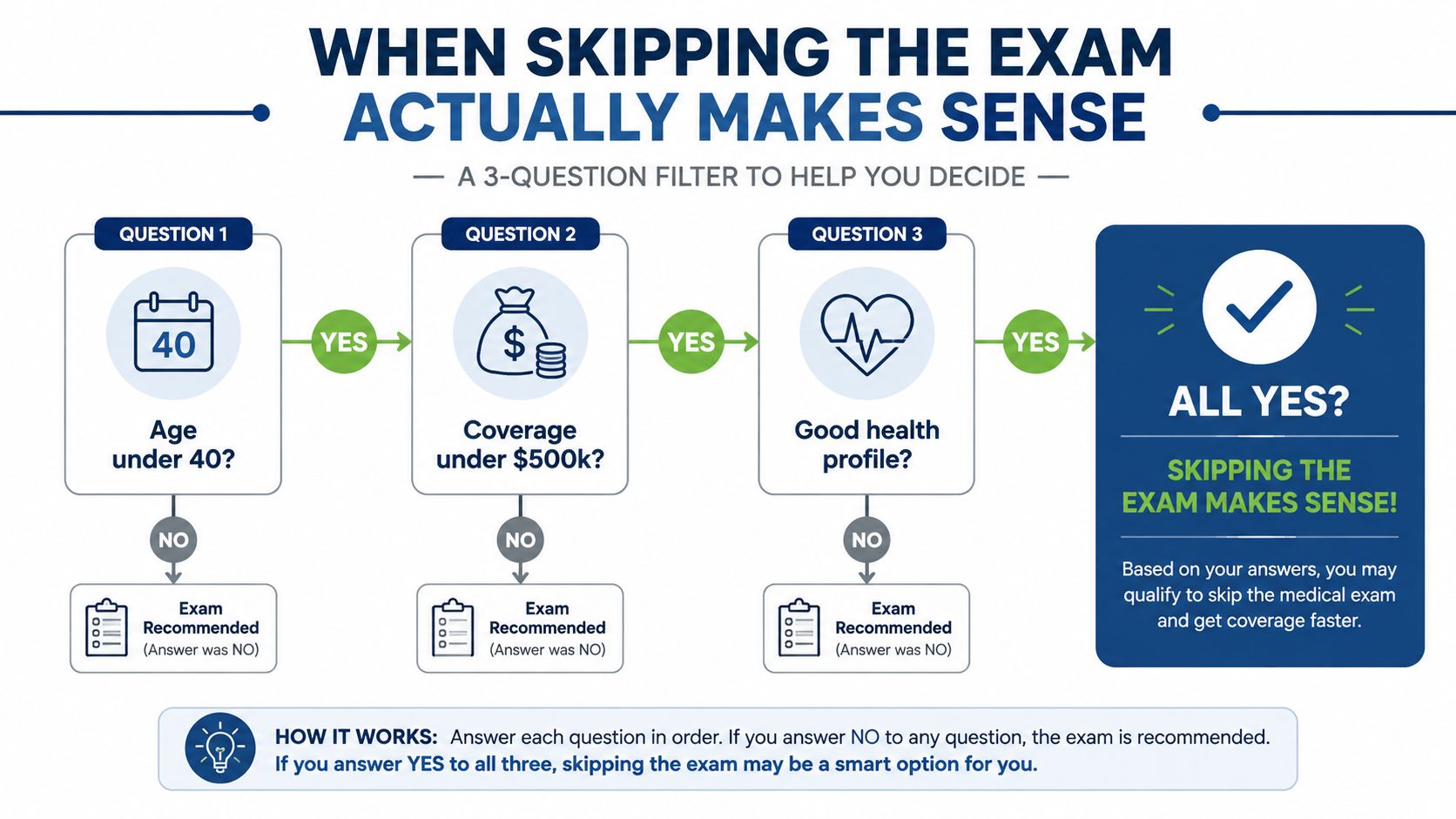
The decision usually comes down to three questions: How old are you? How much coverage do you need? What does your health profile look like? No single answer guarantees an exam waiver, but this filter helps you ask the right questions before agreeing to a traditional appointment.
First, consider age. Younger applicants with straightforward applications are more likely to fit an accelerated underwriting pathway, because the carrier may be able to verify enough information without ordering lab work. Older applicants can still qualify for no-exam coverage, but the available products and underwriting rules may be narrower.
Next, consider the face amount. A modest protection need may fit a simplified application, while a large death benefit may require more evidence. The carrier, not the applicant, makes the final determination. Don't assume that being young or healthy automatically removes the exam requirement for substantial coverage.
Finally, examine the health profile. A clean prescription history, no recent major diagnosis, and consistent application answers can make accelerated review more plausible. Diabetes, heart disease, a recent cancer diagnosis, or an unexplained medical record issue may lead the insurer to request a traditional exam or additional records. That request isn't necessarily a decline. It means the carrier wants more evidence before it prices the risk.
A practical decision rule
- Ask for accelerated underwriting first if you're relatively young, your coverage need is moderate, and your health and prescription history are uncomplicated.
- Accept the exam when the carrier requires deeper evidence because of the face amount, age, or medical history.
- Compare both routes when speed matters, especially if you're self-employed, changing jobs, replacing employer coverage, or facing a deadline connected to a loan or family obligation.
- Read the policy details before choosing convenience, including benefit limits, riders, exclusions, pricing, and whether the policy can be converted later.
No-exam products can be a useful solution, but they aren't a universal shortcut. The carrier may offer less flexibility or place limits on the amount and design of coverage. A traditional exam may take more effort while giving the insurer a fuller basis for pricing.
The right question is not “Can I avoid the exam?” It's “What am I giving up, and what am I gaining, by avoiding it?” If the answer is faster coverage with suitable benefits and acceptable pricing, skipping may make sense. If the exam opens access to better terms or a larger policy, taking it may be the more economical choice.
Practical Questions Applicants Ask Most
Where can the exam happen? In many cases, the examiner can meet you at home, at your workplace, or at a nearby exam center. That flexibility helps applicants who manage client appointments, shift work, childcare, or travel. When the scheduling company contacts you, choose a quiet location where you can answer health questions privately.
Who pays for it? The insurer generally orders and pays for the exam, so applicants typically don't pay an examination fee at the appointment. Confirm the arrangement if someone asks you for payment or if the carrier sends you to a third-party facility.
How long does the decision take? The exam itself is often about 20 minutes, while traditional underwriting may take four to six weeks, according to Guardian Life's life insurance exam guidance. Accelerated underwriting can move faster when the carrier has enough information to decide without a paramedical visit.
What if something flags? The underwriter may request an attending physician statement, additional records, another test, or clarification about a medication. The carrier may also offer coverage at a different rate class. A flagged result doesn't automatically mean you're uninsurable.
Can I reschedule? Contact the exam company as soon as you know you can't attend. Rescheduling is usually easier before the examiner arrives, and you should explain if you're ill, recovering from an unusual workout, or unable to follow the preparation instructions.
What identification should I bring? Keep a government-issued identification document available, along with your application details, medication list, doctor information, and relevant treatment dates. The examiner will tell you if the carrier needs anything else.
Can I see my results? Ask the carrier or exam provider how to request a copy of your report. You can also ask your insurance professional to explain which findings affected the underwriting decision. If you're unsure how to answer a health-history question, use this guide to what a life insurance advisor will ask you.
If you're self-employed or responsible for a family's income, request both options before deciding. Ask whether you qualify for accelerated underwriting, what coverage amount is available without an exam, how the premium compares, and what happens if the carrier later requires medical evidence.
My Policy Quote helps applicants review life insurance options and understand how underwriting requirements, including medical exams, may affect the application. Visit My Policy Quote to compare available paths and start a conversation about coverage that fits your situation.