

You open a quote expecting an unpleasant number and get something that looks like a mistake. The premium is far above your old payroll deduction, the deductible is high, and the explanation says little more than “based on underwriting.” You close the tab, reopen it, and wonder whether the insurer has confused your application with someone else's.
That reaction is reasonable. A high quote can reflect broad market costs, the risk pool you've entered, your personal rating factors, or a simple data error. This guide separates those causes, shows how to audit one quote like a detective, and gives you practical ways to lower the total cost without gutting the protection you'll need when something goes wrong.
That Sticker Shock Moment and What Comes Next
A 42-year-old freelance designer leaves a W-2 job and applies for individual health insurance. Her employer used to cover part of the premium, so the payroll deduction never showed the full cost. After the application, the marketplace displays a monthly price that feels impossible. She checks the household information, searches for a hidden setting, and nearly closes the browser.
That response is common among people moving from employer coverage to individual coverage. The number may be accurate, but it may not be telling you the whole story. A quote can combine the full cost of coverage, the selected plan design, the local market, household income, and the insurer's estimate of future claims.
The first question isn't “How do I find the cheapest quote?” It's “What exactly is this quote pricing?”
Self-employed professionals, 1099 contractors, and early retirees face a particular problem. They generally don't receive an employer contribution, so they see more of the underlying premium than a worker with job-based coverage. KFF reported that average employer-sponsored premiums in the United States reached $9,325 for single coverage and $26,993 for family coverage in 2025, with family premiums rising 6% in one year. Those figures describe employer coverage, but they help explain why coverage can feel dramatically more expensive when the employer portion disappears. KFF's 2025 employer health benefits survey provides the underlying context.
Start by treating the quote as an itemized financial document, not a verdict. Verify the people covered, the income used for subsidy calculations, the deductible, the network, the coverage limits, and every discount or credit. Then decide which parts are market-driven and which parts you can change.
For a broader explanation of how online quotes are generated and what information affects them, review this guide to getting an insurance quote online. The goal isn't to make every quote cheap. It's to make sure you're comparing the right price for the right protection.
The Market Forces Quietly Pushing Every Quote Higher
Some cost increases sit upstream of your application. Insurers pay claims using medical services, prescription drugs, replacement parts, labor, legal defense, and other inputs. When those costs rise across a market, carriers adjust prices even when an individual's health, driving record, or property hasn't changed.
The U.S. Bureau of Labor Statistics reported that its motor-vehicle insurance index rose 2.8% from December 2024 to December 2025, after much larger increases of 20.3% in the 2023 review period and 14.2% in the 2024 review period. The BLS review of the 2025 Consumer Price Index shows why a customer can still receive a high auto quote after a clean year. Insurers price expected future losses, including repairs, medical costs, theft, weather damage, and legal expenses.
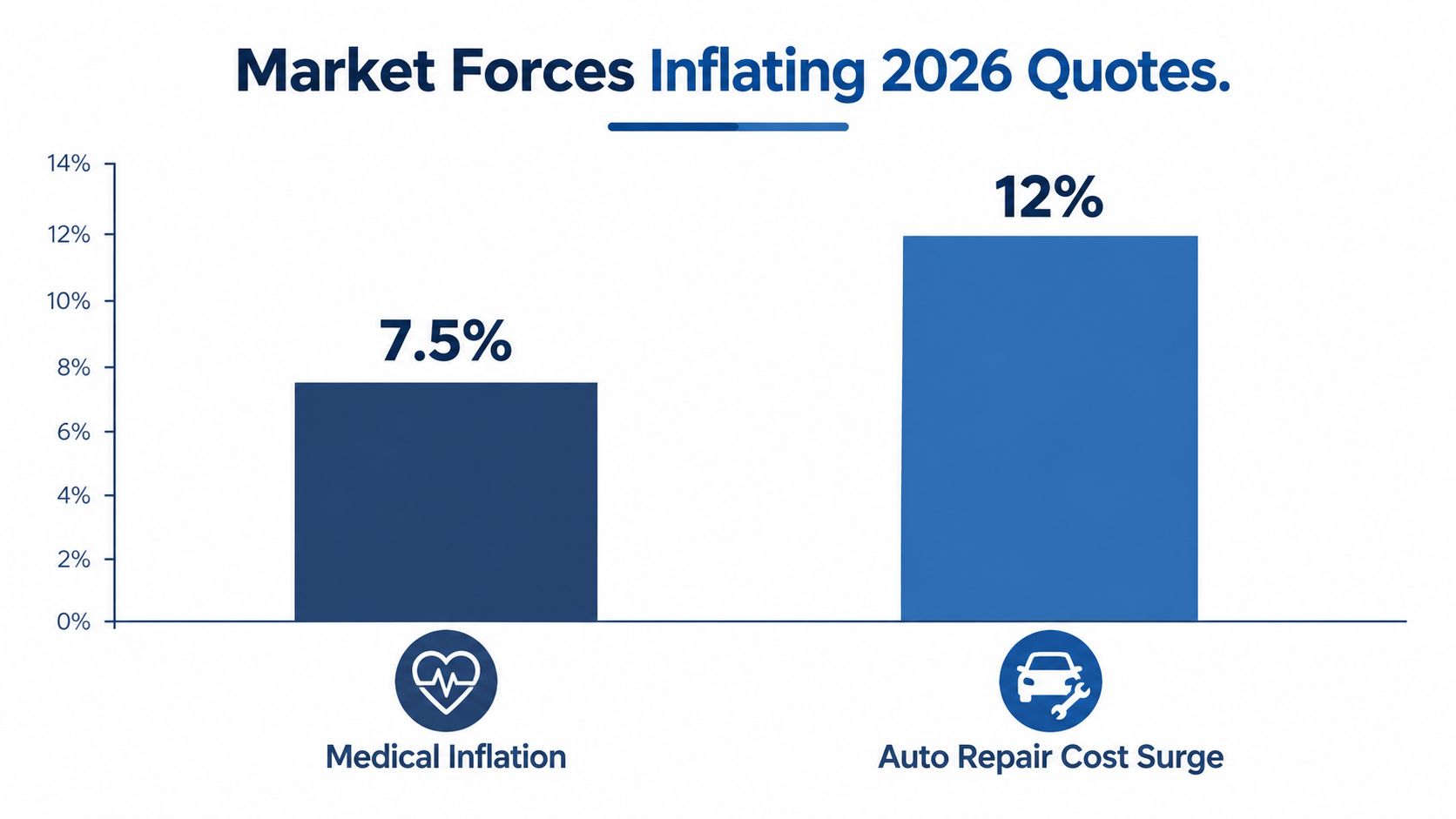
Health coverage has its own pressure points. KFF found that 36% of large employers identified prescription-drug costs as contributing “a great deal” to higher premiums. The same survey found that more than one-third of covered workers were enrolled in plans with individual deductibles of at least $2,000, and that share had increased over time. These figures show how medical spending and plan design affect the broader pool, not just people with expensive diagnoses.
The pool matters before your personal file does
Carriers group applicants by factors such as age, geography, vehicle or property type, claims exposure, and selected coverage. A region with expensive providers, frequent losses, costly repairs, or severe weather can produce higher quotes across the board. In health insurance, federal risk adjustment also accounts for factors including actuarial value, age, and geographic cost.
That's why shopping around sometimes produces several painful quotes. Different insurers use different formulas, but they still face many of the same costs. For commercial operators, a commercial truck insurance 2026 forecast can provide useful context on how vehicle losses and broader operating conditions influence pricing.
You can't negotiate away a market-wide claims bill. You can, however, identify whether your quote is high because of the pool, your selected benefits, or a correctable application detail.
Your Personal Risk Factors and How Insurers Actually Weight Them
Insurers don't treat every detail equally. Territory, prior losses, age, and the amount of protection you select often carry more weight than a minor application preference. Your job is to find the heavy hitters instead of wasting time on small adjustments that barely move the number.
Age affects different policies in different ways. Health premiums generally rise with age because expected utilization and claim severity rise, although the Affordable Care Act generally limits the age-based premium ratio to 3:1 between older and younger adults. For early retirees ages 60 to 64, compare the full benchmark premium with the after-subsidy figure and test more than one metal tier. A lower premium can come with substantially higher deductibles and out-of-pocket exposure. The KFF subsidy calculator helps frame that comparison.
Location can be decisive. Insurers use local claims patterns, provider prices, repair costs, theft, weather exposure, and regional medical spending. A clean driving record won't fully offset a high-cost territory, and a well-maintained home can still be priced in a region with expensive catastrophe losses.
Claims and driving history matter because they help carriers estimate future losses. A speeding ticket, an at-fault collision, a water claim, or repeated small losses may affect the quote differently depending on the insurer and policy type. If you're checking the effect of a citation, this explanation of how much a speeding ticket can raise insurance costs offers useful issue-specific context.
For health coverage, individual-market pricing also reflects tobacco use, household composition, selected benefits, and the risk pool. For property and auto, vehicle trim, garaging address, building age, construction, security features, and replacement cost can change the result. Credit-based insurance scores may affect auto or home pricing where state law permits, but they aren't used identically by every carrier.
| Risk factor | Coverage types | Typical weight | Can the reader change it? |
|---|---|---|---|
| Age | Health, life, auto | Often material | Sometimes, through plan or coverage choices |
| Location | Health, auto, home | Often heavy | Usually only by changing territory |
| Prior claims | Auto, home, health-related underwriting contexts | Often heavy | Only through future loss prevention and time |
| Driving record | Auto | Material | Yes, through safer driving and accurate records |
| Building condition | Home | Material | Yes, through maintenance and upgrades |
| Credit-based insurance score | Auto, home where permitted | Varies by carrier and state | Often, over time |
| Occupation and use | Auto, business, life | Varies | Yes, by reporting use accurately |
| Coverage tier | Most policy types | Directly affects price | Yes |
If you want the technical definition of the process behind these decisions, review what underwriting means in insurance. You don't need to become an actuary. You need to know which inputs deserve a correction, a comparison, or a coverage change.
How Your Coverage Choices Reshape the Price You See
A self-employed consultant can receive three very different quotes without changing her address, health information, or income estimate. The difference may come from the deductible, provider network, coverage tier, or optional benefits rather than a hidden penalty in the application.
The first quote may offer a broad PPO network and a lower deductible. The second may use an EPO network, which can reduce the premium but restrict out-of-network access. The third may add benefits the shopper values, such as vision or fertility coverage, but those additions increase the amount the plan expects to pay.
Compare the tradeoff, not just the monthly number
A richer plan generally pays a larger share of covered claims and commonly carries a higher premium. A higher-deductible plan can reduce the monthly price while transferring more cost to you when you receive care. Narrow-network options may look attractive until your preferred specialist or hospital sits outside the network.
For self-employed and 1099 applicants, the right comparison includes the premium, deductible, coinsurance, provider network, prescription formulary, and maximum out-of-pocket limit. The National Association of Insurance Commissioners identifies the central health-insurance underwriting risk as medical expenses exceeding collected premiums. Its discussion of risk and plan design explains why health insurance underwriting risk affects the price of coverage across the pool.
| Coverage choice | Monthly premium change | Out-of-pocket impact |
|---|---|---|
| Lower deductible | Usually increases the premium | Less cost when covered care occurs |
| Higher deductible | Usually lowers the premium | More cash required before plan payments begin |
| Broad PPO network | Often costs more | More provider flexibility |
| EPO or narrower network | May cost less | Greater need to stay within network |
| Optional benefits | Raises the price when added | Pays for services you may or may not use |
| Higher actuarial value | Usually raises the premium | Plan pays a larger share of covered claims |
Don't cut the deductible and then immediately buy supplemental products that recreate the old monthly cost. That move can leave you with a complicated package and no clear advantage. Calculate the likely annual premium, the maximum out-of-pocket exposure, and the services your household uses.
For a 1099 worker with irregular income, also model the premium under low, typical, and high income estimates. A subsidy can change when projected annual income changes, so the quote should be reviewed alongside tax-credit eligibility and household size. KFF reporting cited by CNBC said marketplace insurers proposed average premium increases of about 26% for 2026, while enhanced premium tax credits were scheduled to expire at the end of 2025. CNBC's open-enrollment guidance explains why subsidy assumptions deserve careful review.
How to Audit a Quote and Catch Costly Mistakes
Treat the quote like a detective treats a file. Don't accept the displayed premium until you can trace each major input to a document, application answer, or coverage selection.
Run this fifteen-minute review
- Read the declarations page. Confirm the named insured, policy period, vehicles, property, limits, deductibles, and listed drivers.
- Verify the address and usage. Check the garaging address, mailing address, occupancy, annual mileage, business use, and vehicle purpose.
- Check household members. Make sure no driver is listed twice and that every required household member is handled correctly.
- Review prior coverage. Confirm the effective dates and whether a lapse was incorrectly recorded.
- Inspect discounts. Look for multi-policy, paid-in-full, safety, claim-free, affiliation, and applicable professional discounts.
- Match the asset. Confirm the vehicle trim, safety equipment, home construction, roof details, replacement-cost assumptions, or business classification.
The most common errors are ordinary data problems. A carrier may double-count a driver, use stale credit information, miss a bundled policy, select the wrong vehicle trim, or treat a short coverage gap as a lapse. Each mistake can distort the quote before an agent evaluates the actual risk.
Ask for a re-run, not a vague explanation.
Use a direct script: “Please confirm every driver, address, mileage figure, vehicle trim, prior coverage date, household member, coverage limit, deductible, and eligible discount on this quote. Please correct any inaccurate field and send me a revised itemized premium.”
Keep the original and revised versions. If the price changes, you'll know which input caused it. This guide to comparing insurance rates can help you keep the comparison consistent across carriers.
Smart Ways to Bring the Number Down Without Underinsuring Yourself
A lower premium can create a larger bill after a claim. Judge every change by its effect on deductibles, exclusions, liability protection, and the losses you would have to pay yourself.
Start with the policy structure, then test each adjustment against your actual finances:
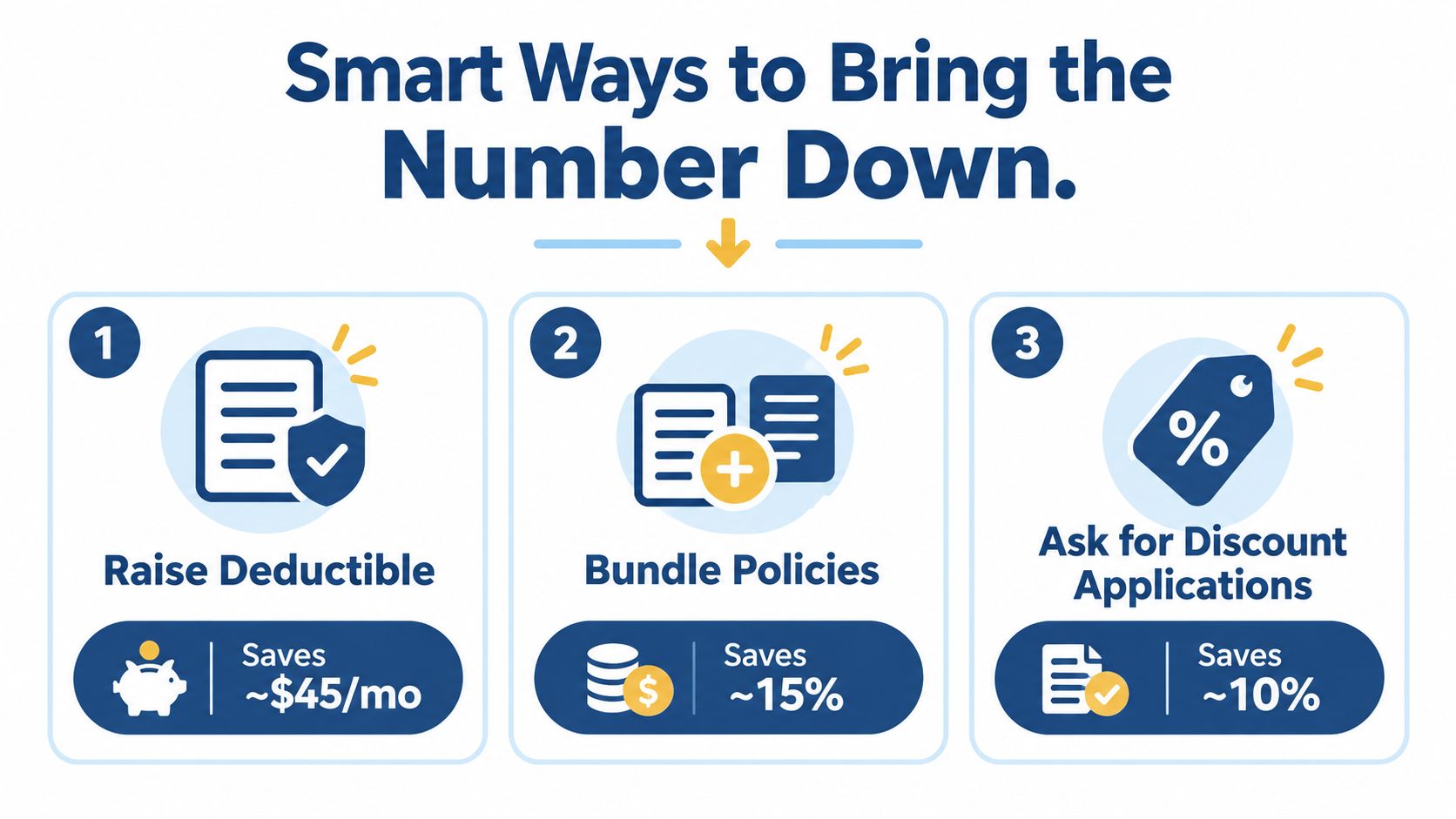
- Raise a deductible carefully. Choose a higher amount only if you could pay it after a loss without using money reserved for rent, payroll, debt payments, or medical care.
- Bundle where the base rates still make sense. Request home and auto totals with and without the multi-policy discount. Keep the bundle only when its coverage and combined price remain competitive.
- Pay annually when practical. Ask whether monthly billing adds fees, then compare the full annual cost instead of focusing on the monthly figure.
- Review limits against real assets. Correct inflated replacement-cost assumptions, but do not cut limits or liability coverage just to make the quote look cheaper.
- Improve credit where permitted. Pay bills on time and challenge reporting errors in states that allow credit-based insurance scoring.
- Ask about affiliations. Professional groups, alumni associations, workplace relationships, safety devices, and claim-free records may qualify for discounts. Ask what proof the insurer requires.
- Right-size life and umbrella coverage. Match protection to dependents, debts, income replacement needs, assets, and realistic liability exposure.
Self-employed workers, 1099 earners, and early retirees need one extra check. Their quote may reflect income, occupation, household structure, or access to a risk pool differently from an employer-sponsored plan. Review whether a subsidy, eligibility rule, or classification changes the number you see before reducing coverage. A cheaper premium is not a win if it removes protection your household or business depends on.
Auto shoppers can review practical safety and driving-related options in this A-1 Driving School insurance guide. Treat every discount as conditional. Confirm its requirements, effective date, and effect on the total premium.
For a detailed breakdown of deductible, bundling, and discount strategies, see this guide on how to reduce insurance premiums. A quote comparison service such as My Policy Quote can help shoppers compare matching coverage through licensed agents, including options for people without employer-sponsored insurance.
Keep uninsured motorist coverage and liability limits aligned with your exposure. Saving on the premium is a poor trade if one serious claim puts your savings, income, home, or business at risk.
Insurance Pricing Myths That Keep People Stuck Overpaying
The first myth is that every insurer uses the same data and reaches the same price. They don't. Carriers use different underwriting rules, risk tolerances, territory definitions, claims models, and treatment of credit or occupation. That difference is your advantage, but only if you compare identical coverage.
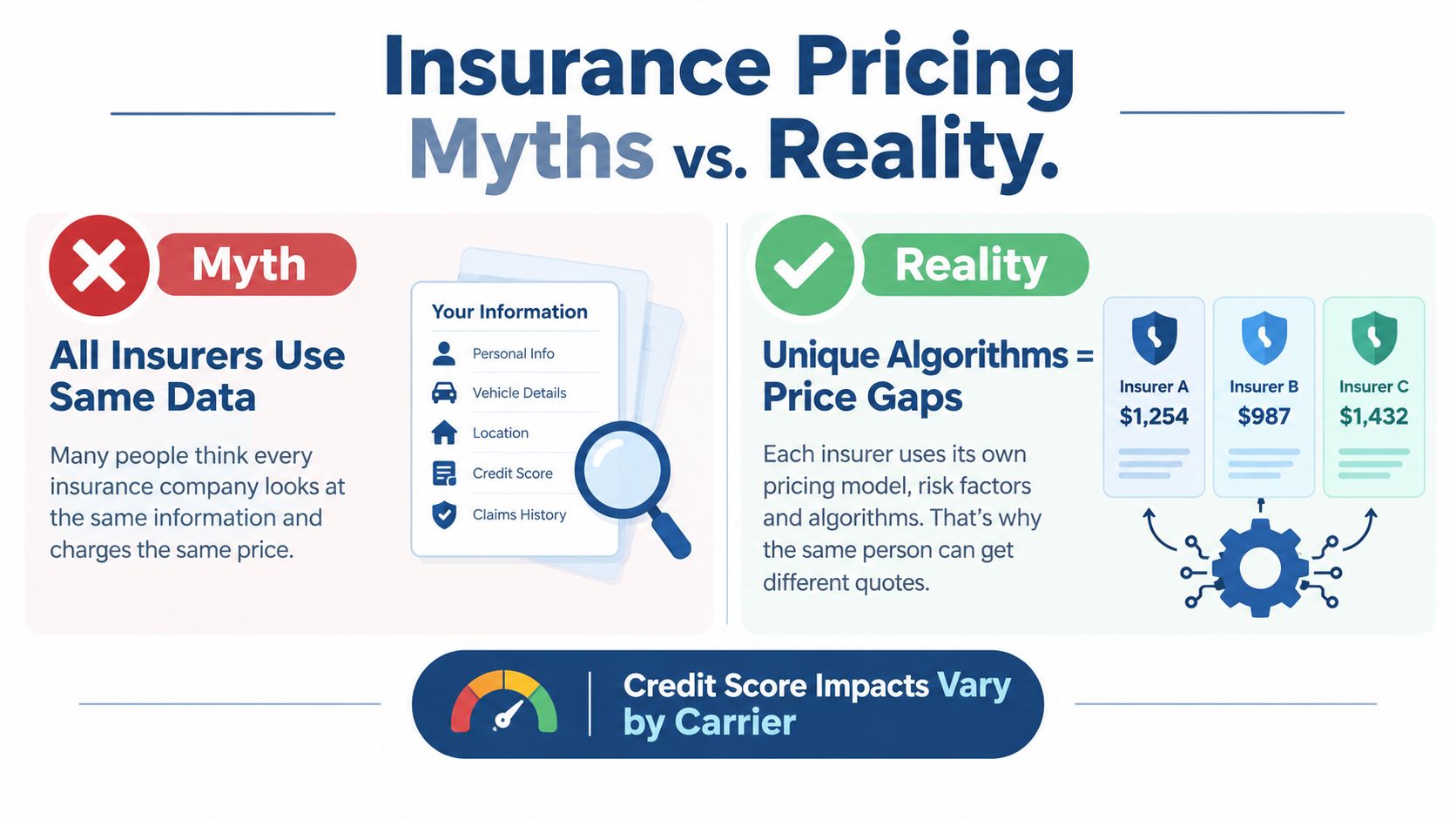
Another myth says a credit-based insurance score barely matters. A more precise picture is this: its effect varies by state and carrier, and where permitted it can influence auto and home pricing. Check the report for errors, but don't assume every insurer will react to it in the same way.
The bundle myth causes a different problem. Combining policies can simplify billing and may reduce the price, but the discount can conceal a weak base rate. Always request the bundled total and the standalone totals. Then compare coverage, exclusions, deductibles, and service quality.
Switching and loyalty aren't automatic answers
Switching carriers doesn't always save money. Loyalty doesn't always earn the best price either. A carrier may become more expensive because its regional loss experience changed, while a new carrier may offer a lower introductory price with different restrictions. Neither “always switch” nor “never switch” is a sound rule.
The comparison must be apples to apples.
The final myth is that the cheapest quote is the best quote. A lower premium may come with a narrower network, a larger deductible, lower limits, more exclusions, or a claims process you dislike. Compare the total annual cost and the protection you really need, not the largest number displayed in bold.
Your 7-Day Plan to Take Control of Your Next Quote
You don't need to spend weeks researching insurance. You need clean information, consistent comparisons, and a short deadline.
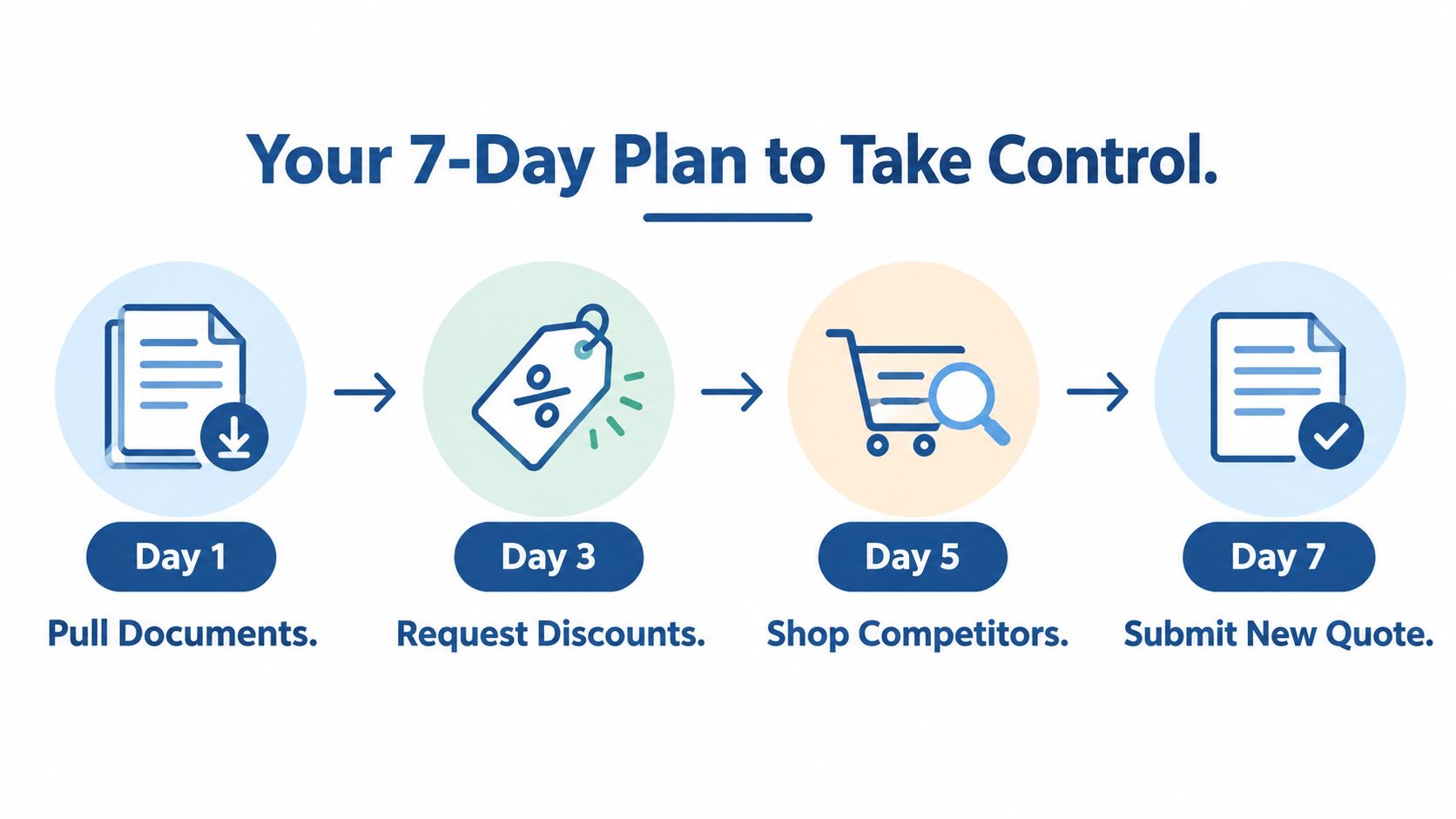
Day 1, gather the file. Put every recent quote, declarations page, renewal notice, application, discount notice, and prior policy document in one folder. Include the information you submitted, not just the final premium.
Day 2, audit the inputs. Check the address, vehicle use, mileage, household members, drivers, coverage dates, vehicle trim, property details, health-plan household size, and projected income. Mark every field that looks outdated or incomplete.
Day 3, call the current carrier. Ask for a line-by-line explanation of the renewal or quote. Request every available discount, fee waiver, payment option, safety credit, affiliation credit, and bundle calculation. Ask for the revised price in writing.
Days 4 and 5, quote competitors. Use the same limits, deductibles, driver list, household information, income assumptions, network preferences, and coverage selections each time. If you change several inputs at once, you won't know what caused the price difference.
Day 6, create an edge. Send the lowest comparable quote to the carrier you prefer and ask whether it can match the coverage and improve the price. Don't ask for a discount without showing the competing terms. Confirm that the alternative quote doesn't remove protection behind your back.
Day 7, choose value. Compare annual premium, deductible, out-of-pocket maximum, limits, exclusions, network, formulary, claims reputation, and financial exposure. Select the policy that fits your budget and risk, then set a reminder for the next annual review.
Use this short video as another practical prompt while reviewing your options:
A high quote isn't a mystery once you separate market costs, risk-pool pricing, personal factors, coverage design, and data errors. Start the seven-day audit today, correct the inputs, and compare equivalent protection before you accept the first number.
My Policy Quote helps shoppers compare insurance quotes from multiple providers through licensed agents, which can make it easier to test whether another insurer offers a better fit for your needs. Visit My Policy Quote with your current quote details and use the comparison to make a decision based on total cost and coverage, not sticker shock alone.