

You're comparing life insurance quotes online because the traditional process sounds like a second job. You don't want to schedule a paramedical visit, lose work for a blood draw, or wait while an insurer requests records from several doctors. That's especially frustrating when you're self-employed, paid by the hour, recently retired, or buying coverage for a family member who can't easily get through a long application.
Life insurance quotes with no medical exam can be a sensible shortcut, but “no exam” is not a complete description of the underwriting. The insurer may skip the physical while still reviewing your answers, prescription history, driving record, insurance history, Medical Information Bureau information, and other electronic data. The right choice depends on what the carrier checks, how much coverage you need, and whether the policy gives you the protection your family requires.
What No Medical Exam Life Insurance Actually Means in 2026
A self-employed applicant may need coverage without taking time away for a paramedical appointment. A pre-Medicare adult may prefer to avoid blood and urine collection. A blue-collar family may need a faster application path. In each case, no medical exam describes what the insurer skips, not how the insurer evaluates risk.
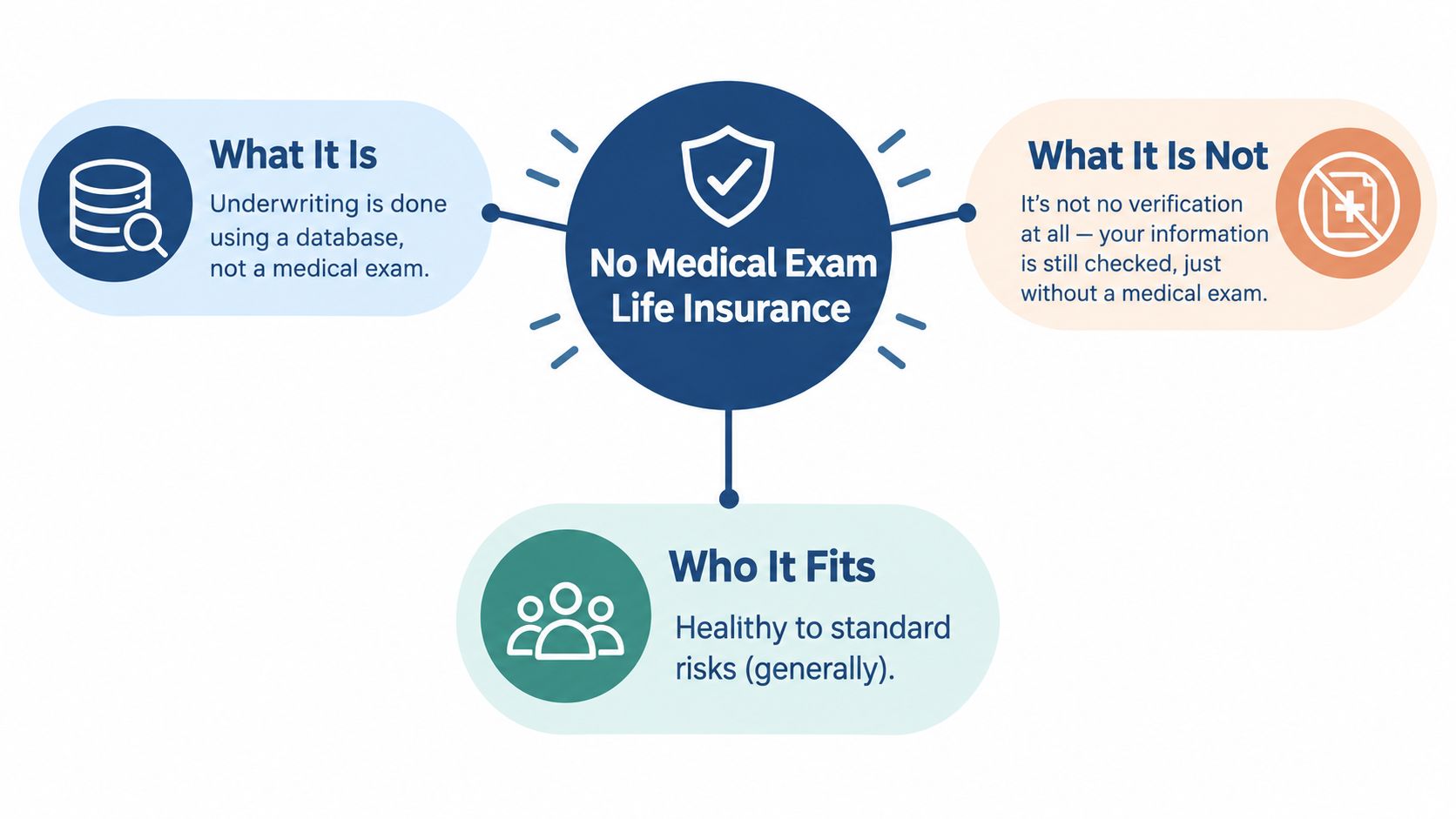
Traditional underwriting may include a paramedical interview, height and weight measurements, blood and urine samples, and additional medical records. A no-exam policy removes some or all of those physical requirements. The insurer still reviews information before approving coverage.
The phrase no medical exam covers three different underwriting models:
- Simplified issue asks health questions but generally avoids a physical exam. The insurer may verify answers through prescription, insurance, driving, identity, and other records.
- Guaranteed issue generally avoids both the health questionnaire and the medical exam. It serves applicants who may not qualify elsewhere, but usually provides less coverage and may include a graded benefit.
- Accelerated underwriting uses application information and external data to decide whether a qualified applicant can skip the paramedical exam. It remains fully underwritten life insurance, not automatic acceptance.
That distinction separates a genuine underwriting option from a marketing label. The Society of Actuaries describes accelerated underwriting as fully underwritten life insurance in which qualified applicants may bypass an exam and fluid collection after meeting defined requirements. One applicant can receive an accelerated decision while another, applying for the same product, is asked for an exam or medical records.
The shortcut still has gates
Carriers can apply age limits, build requirements, health filters, coverage ceilings, and risk-class rules. Treat a quote as preliminary until the insurer confirms that your application fits the advertised path.
LIMRA reported that three out of four life insurers had an automated or accelerated underwriting program, while one in two offered both. Insurers reported an average of three days from a complete application to the medical questionnaire or interview, compared with eight days for traditional underwriting. The average final decision took nine days through automated or accelerated underwriting versus 27 days through traditional processes. These figures come from LIMRA's underwriting overview, and individual results vary.
Ask what evidence the insurer uses instead of an exam. Before comparing carriers, review these pros and cons of no exam policies, then ask whether a flagged record triggers conventional review or an automatic decline.
The Three No Exam Product Types and How They Differ
These products aren't interchangeable. They sit at different points on the underwriting spectrum, and each serves a different buyer.
Simplified issue is the middle-ground option. You answer a health questionnaire, and the carrier may compare those answers with prescription history, motor vehicle information, prior insurance data, and medical or identity records. A clean, consistent application can move quickly, but a serious condition, conflicting record, or coverage request outside the carrier's rules can lead to a decline or a request for more evidence.
Guaranteed issue is the fallback option. The insurer generally doesn't ask health questions or require an exam, so applicants with substantial medical histories may still qualify if they meet the product's eligibility rules. The trade-off is usually a smaller death benefit, higher cost per dollar of coverage, and a graded benefit that limits the payout for certain causes of death during the early policy period.
Accelerated underwriting is aimed at applicants who appear to fit the carrier's preferred risk profile based on application data and electronic records. The carrier may use prescription information, motor vehicle data, FCRA-approved information, medical records, and predictive models. The applicant skips the exam only when the insurer has enough evidence to make a decision within its risk controls.
| Feature | Simplified Issue | Guaranteed Issue | Accelerated Underwriting |
|---|---|---|---|
| Health questions | Yes | Generally no | Yes |
| Physical exam | Usually no | No | Often waived for eligible applicants |
| External data | Commonly used | Less central to eligibility | Central to the decision |
| Medical underwriting | Limited but real | Minimal health underwriting | Full underwriting through data |
| Best fit | Applicants with manageable health histories | Applicants who may not qualify elsewhere | Applicants with relatively favorable, verifiable risk |
| Main trade-off | Possible decline or follow-up evidence | Lower coverage and graded benefits | Strict eligibility and data-based referral rules |
A carrier can also move an accelerated application into traditional underwriting when the available data doesn't establish adequate evidence. The Society of Actuaries identifies application answers, FCRA-approved data, random holdout programs, algorithms, and post-issue audits as important controls in these programs. Before applying, read this explanation of term life insurance with no medical exam and decide whether speed or broader underwriting flexibility matters more.
Cost and Coverage Trade Offs vs Fully Underwritten Policies
No-exam coverage isn't automatically expensive, and fully underwritten coverage isn't automatically the better deal. The price depends on the product, your risk class, the amount of evidence available, the insurer's limits, and the benefits included in the contract.
The actuarial reason for the trade-off is straightforward. When a carrier has less direct medical evidence, it has less precision when sorting risk. It can respond by charging more, limiting the face amount, restricting eligibility, reducing rider availability, or directing some applicants to full underwriting.
The Society of Actuaries reported that insurers in a 2019 survey generally expected mortality on cases with waived requirements to be about 1% to 10% higher than comparable fully underwritten business, with early experience in a similar range. More recent monitoring covering more than 33,000 lives across 30 U.S. accelerated underwriting programs estimated mortality slippage of roughly 12% in one monitoring cohort and 15% in another. The Society of Actuaries monitoring report says an average program may experience approximately 10% to 15% slippage. These are portfolio-level actuarial observations, not predictions of your approval or premium.
| Factor | No Exam Policy | Fully Underwritten Policy |
|---|---|---|
| Application experience | Faster and less disruptive | More medical requirements |
| Evidence | Questions and electronic data | Questions, exam, labs, and records when required |
| Coverage range | Often limited by age, health, and product rules | Usually broader for qualified applicants |
| Pricing flexibility | May include a convenience or risk margin | More precise risk classification |
| Riders | Can be more limited | Often offers a broader menu |
| Best reason to choose it | Speed, access, and convenience | Maximum coverage and pricing flexibility |
A 2025 U.S. consumer survey found that 78% of respondents wouldn't pay more for a no-exam product, while also reporting that no-exam policies commonly involve lower maximum coverage and fewer riders. Those findings appear in the 2025 consumer report on life insurance.
That creates a clear decision. If you need a modest policy quickly and missing work or completing an exam creates a real obstacle, paying for convenience may be reasonable. If you're healthy, need a large death benefit, or want disability income, long-term care, conversion, or other features, compare a fully underwritten policy before accepting a no-exam quote.
Who No Exam Life Insurance Is Built For
No-exam coverage works best when the inconvenience of traditional underwriting is the problem, not when the applicant needs the broadest possible underwriting review.
A self-employed professional or 1099 contractor may value a fast application because there's no human resources department arranging coverage and no paid leave for a medical appointment. A blue-collar worker paid by the hour may face a direct income loss when an in-home visit or lab appointment interrupts a shift. In both cases, simplified issue or accelerated underwriting can be a practical tool if the requested amount fits the carrier's rules.
For an early retiree or pre-Medicare adult, the answer depends on the purpose of the insurance. A smaller final-expense policy may justify simplified issue or guaranteed issue, especially when the buyer prioritizes certainty and doesn't want a prolonged records review. A family helping a parent should compare the benefit period, premium duration, graded-benefit language, and exclusions rather than choosing the first “instant approval” offer.
| Audience Segment | Simplified Issue | Guaranteed Issue | Accelerated Underwriting |
|---|---|---|---|
| Self-employed worker | Strong fit for moderate needs | Usually too limited | Strong fit when data supports eligibility |
| Pre-Medicare adult | Often practical for final expenses | Consider when health blocks alternatives | Possible, but age and health rules matter |
| Blue-collar family | Useful when time away from work is costly | Useful for small final-expense needs | Useful for eligible income-replacement needs |
| Applicant with unstable work coverage | Good starting point | Backup when other routes fail | Good option if records are consistent |
| Applicant seeking a large policy | May be restrictive | Usually poor fit | Worth testing, then compare full underwriting |
No-exam coverage is a poor default for someone who could qualify for highly favorable fully underwritten pricing, needs a substantial death benefit, or wants specialized riders. It can also be a poor fit for a medically complicated applicant who needs a carefully assessed conventional policy rather than a narrow automated screen.
If the goal is burial or funeral funding for a parent, use a comparison process that lays out benefit timing and exclusions clearly. This guide to compare funeral insurance options can help frame that conversation before you request quotes.
What the Underwriting Process Really Looks Like Without an Exam
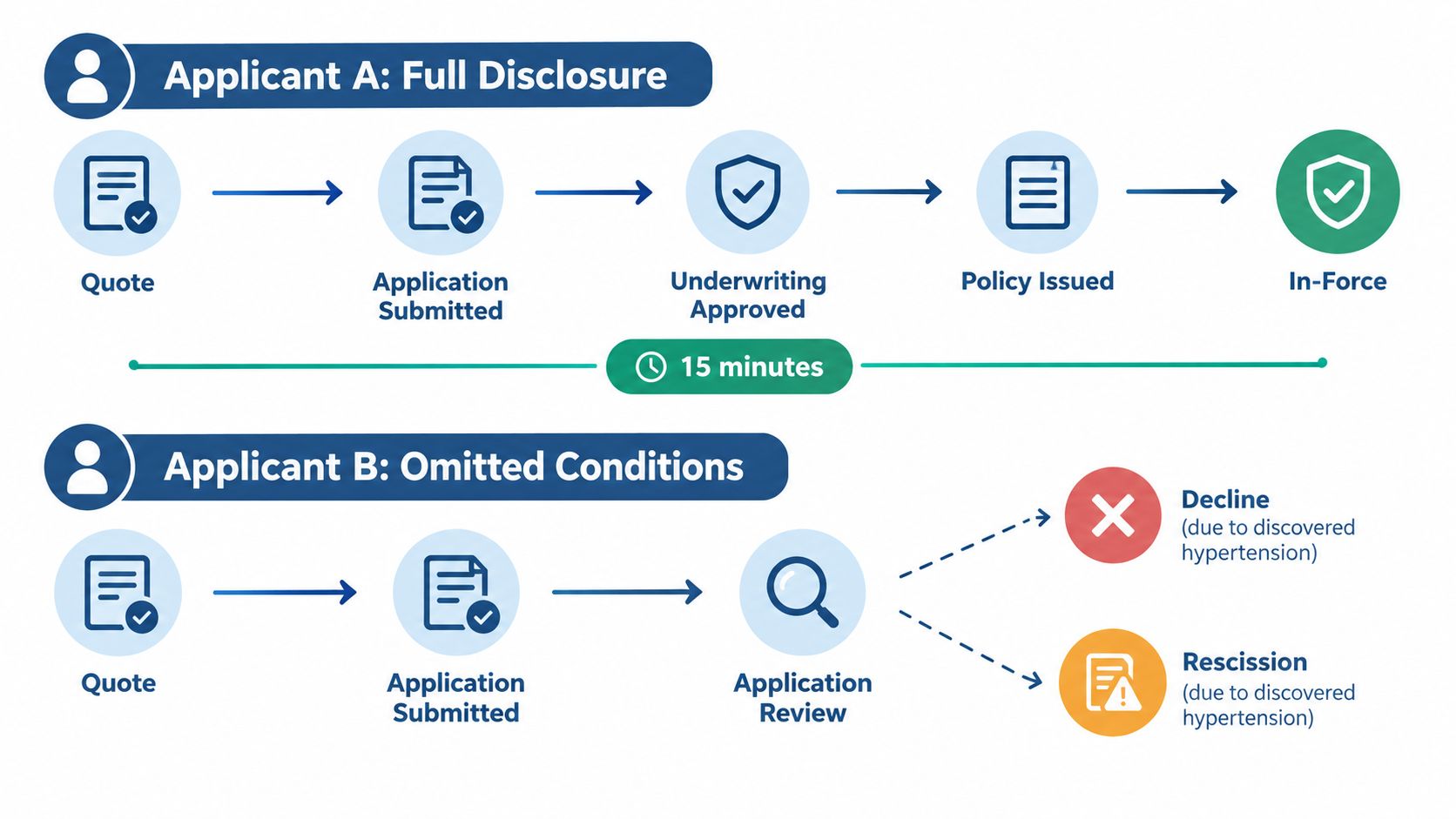
Consider a contractor who completes a digital application after comparing several carriers. The application asks about diagnoses, treatment, medications, tobacco use, driving history, and prior coverage. The applicant answers accurately, the carrier checks electronic data, and the case is approved through simplified issue because the records support the answers.
That process can be quick, but it isn't a promise that every applicant receives the same result. If the prescription database shows a medication the applicant forgot to list, or the Medical Information Bureau contains an inconsistent prior application, the carrier may ask for clarification. A coverage amount outside the accelerated limit can also send the case to an exam, an attending physician statement, or full underwriting.
Now consider a retiree seeking final-expense coverage. A guaranteed-issue application may avoid health questions and a physical exam, but the policy can include a graded benefit. The applicant receives an approval decision without proving good health, yet the beneficiary may not receive the full stated benefit for every cause of death during the early period.
Where the “no exam” promise can change
Carriers can review:
- Prescription history, including medications that suggest a diagnosis not mentioned in the application.
- Motor vehicle records, especially when driving risk affects eligibility.
- Medical Information Bureau data, which can reveal inconsistencies across prior insurance applications.
- Credit-related insurance information, where permitted and used by the carrier.
- Medical records, when the insurer needs confirmation of a condition or treatment.
An application isn't complete just because the website displays an initial offer. Read this explanation of what underwriting in insurance means before you treat a preliminary quote as final approval. Your policy is in force only after the insurer accepts the application and the required premium and delivery conditions are satisfied.
How to Get Accurate Quotes Without an Exam
The fastest way to get a misleading quote is to give incomplete information. A carrier can price the application on the wrong facts, then change the offer when its verification process finds a discrepancy.
Use this checklist before you submit an application:
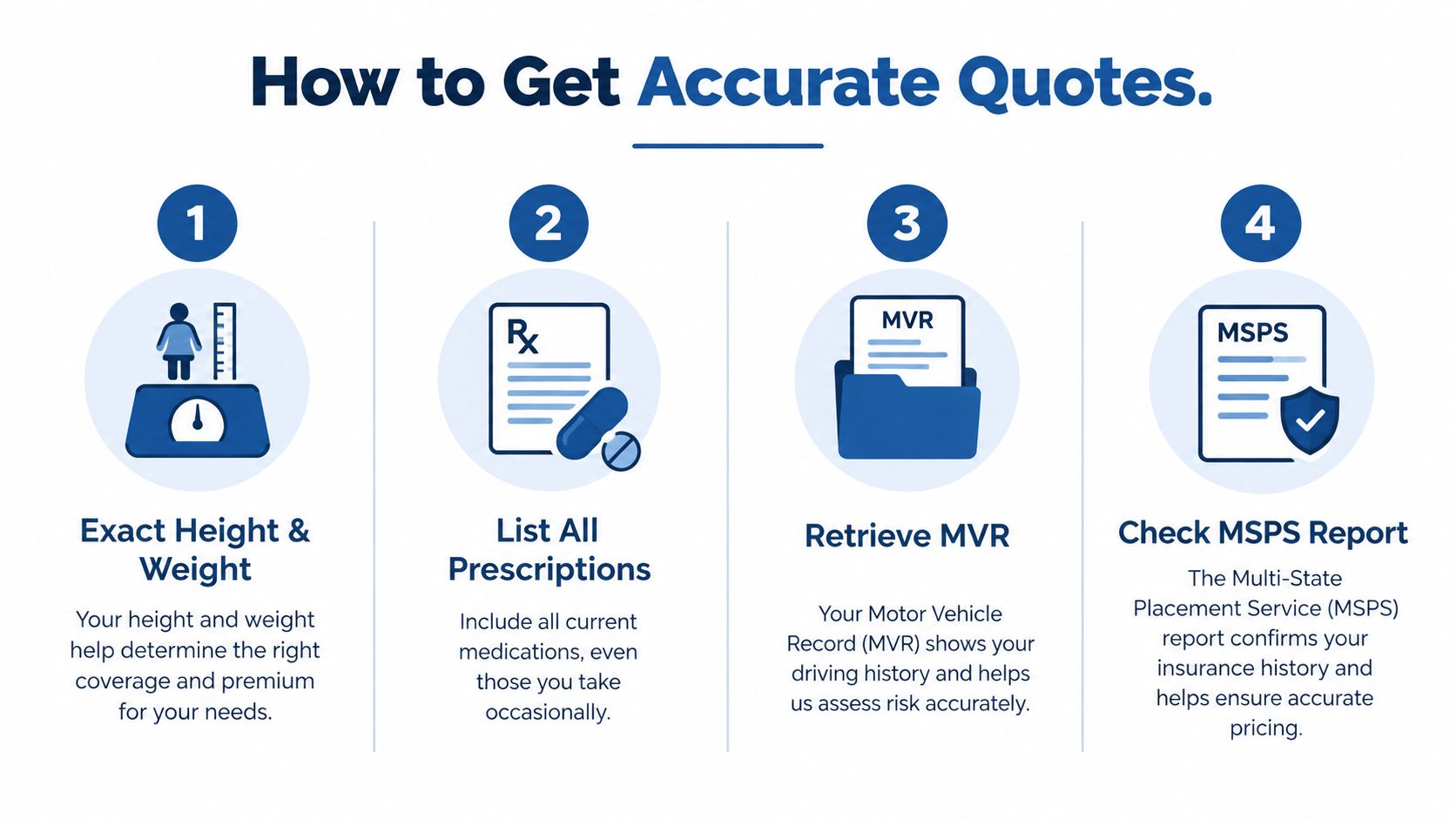
- Confirm height and weight. Use current, accurate information. Don't round aggressively or guess, because build can affect eligibility.
- List every prescription. Include current medications, recent changes, and the condition each medication treats. If you aren't sure about dates or dosage, check with your pharmacy.
- Review medical history. Include diagnoses, surgeries, hospitalizations, and follow-up care. An omitted condition can create a claim problem later.
- Disclose prior insurance activity. A lapse, replacement, decline, or previous application may appear in industry records. Answer the question as written.
- Check driving information. Know what the insurer may see on your motor vehicle record, especially if you have serious violations.
- Ask about outside data. Find out whether the carrier uses prescription, MIB, medical, identity, driving, or credit-related information.
Then ask each carrier the same questions:
- What is the maximum face amount available without an exam for my age and risk profile?
- What causes the application to move from accelerated underwriting to a physical exam or records review?
- If the no-exam route fails, will the carrier consider me through full underwriting?
- Does the policy convert without new evidence of insurability?
- Does the product include a graded benefit, exclusions, or fewer riders?
- What information will the carrier use to verify my answers?
Don't assume that a credit-related check has the same effect as a standard consumer credit application. Ask whether the carrier uses a soft inquiry, a hard inquiry, or a credit-based insurance attribute, and request an explanation before authorizing the application.
An independent comparison platform can organize product differences, but it can't replace honest disclosure or a review of the policy contract. Use the life insurance quote request form to start a structured comparison, then verify the final underwriting terms directly with the carrier.
Which No Exam Path Fits Your Situation
Use the product as a tool, not as a badge of convenience.
If you're self-employed and need meaningful income protection, start with accelerated underwriting and compare it with fully underwritten term insurance. A no-exam route may work when the coverage amount fits the carrier's ceiling and your data is consistent. Move to a paramedical option when the amount is above the limit, the carrier can't verify your history, or the price difference is material.
A pre-Medicare adult focused on final expenses may prefer simplified issue because it avoids the physical while still offering a more direct benefit structure than guaranteed issue. Guaranteed issue becomes more relevant when serious health conditions make other products unavailable, but review the graded-benefit provisions before buying.
For a blue-collar family seeking modest protection, simplified issue can fit when the priority is income replacement or household stability. Accidental death coverage may address a narrow risk, but it shouldn't automatically replace life insurance because it may not cover death from illness.
| Reader Profile | Best No Exam Fit | Why It Works | Override to Full Exam |
|---|---|---|---|
| Self-employed applicant needing substantial coverage | Accelerated underwriting | Limits disruption and can use electronic data | Amount exceeds the carrier ceiling or data triggers review |
| Pre-Medicare adult seeking final expenses | Simplified issue | Balances access with a more complete benefit | Health history makes guaranteed issue more realistic |
| Blue-collar family needing household protection | Simplified issue | Avoids missed work for a paramed visit | Family needs broader riders or a larger benefit |
| Applicant with major health history | Guaranteed issue or conventional review | Offers a fallback when automated rules fail | A full review may uncover a better structured option |
| Healthy buyer seeking the lowest possible price | Fully underwritten comparison | Medical evidence may improve risk classification | Time or access makes the exam impractical |
Applicants with a recent cancer diagnosis, a significant cardiac event, complicated diabetes, or a need for quality-of-life riders should not assume no-exam coverage is the strongest answer. Compare the conventional route before settling for a narrower contract. For permanent coverage questions, this overview of whole life insurance with no exam can help you identify what to ask.
What Most Buyers Never Ask Until It's Too Late
You are a self-employed parent, coverage is finally in place, and a claim is filed years later. The insurer then finds a prescription or diagnosis that was missing from the application. That is when the value of a no-exam policy depends on more than how quickly it was issued.
Answer every health and lifestyle question accurately. A no-exam application can still be checked against prescription records, prior insurance information, motor vehicle data, Medical Information Bureau records, and other sources. If the insurer finds a material misrepresentation during a claim review, the policy's contestability provisions may trigger additional scrutiny.
Before paying the first premium, read the contestability clause, suicide exclusion, graded-benefit language, and replacement provisions. Do not accept an agent's shorthand, such as “full coverage from day one,” unless the contract says so. Guaranteed issue coverage commonly treats early claims differently from simplified issue and accelerated underwriting. Those are not interchangeable products, even though all three may be marketed as no-exam coverage.
Speed deserves a precise question, too. The LIMRA averages cited earlier show why accelerated cases can reach a decision sooner, but they do not guarantee your result. Ask the carrier whether your application is likely to remain on the accelerated track, or whether a record, answer, coverage amount, or follow-up requirement could send it to manual review.
Cost is the next test. LIMRA's 2021 Insurance Barometer research found that 48% of consumers would be more likely to buy life insurance if simplified underwriting were available, while 55% liked avoiding a doctor visit and paramedical examination. Among uninsured Americans, 42% said simplified underwriting would make them more likely to purchase. The LIMRA consumer research confirms that easier access addresses a real barrier. It does not make every no-exam policy a sound financial choice.
If you are healthy and avoiding an exam only for convenience, compare a fully underwritten quote before committing. If an exam means lost wages, delayed protection, or a process you will not complete, a properly matched no-exam policy may be the practical choice.
My Policy Quote offers comparisons for no-exam term, whole-life, simplified-issue, and guaranteed-issue coverage. Visit My Policy Quote to request quotes, compare underwriting requirements, and decide when full underwriting deserves a closer look.