

You leave work at 62 with a retirement budget, an investment account, and a calendar suddenly missing one familiar line item: employer health insurance. Medicare won't begin just because your paycheck stops. You may need to coordinate a Marketplace plan, COBRA, a spouse's coverage, employer retiree benefits, or another private option while your income changes from one month to the next.
That choice isn't only about the monthly premium. Your taxable income can change a subsidy, a coverage change can affect your Medicare enrollment, and dropping one plan before another starts can create an avoidable gap. The right early retirement insurance options strategy treats the years before Medicare as a planned bridge, not an administrative afterthought.
The Pre-65 Insurance Gap: Why Three to Five Years Before Medicare Needs Its Own Budget
Retire at 62, and your employer plan may end before Medicare starts. Retire at 60, and the bridge can last about five years. Medicare's usual age-based eligibility milestone is 65, so the years between leaving work and enrolling require their own coverage plan (Social Security's Medicare eligibility history).
Employer retiree coverage cannot be assumed. KFF found that the share of large firms offering retiree health benefits fell from 66% in 1988 to 28% in 2013. Only 45% of retirees ages 55 to 64 had health benefits from a former employer in 2012, down from 50% in 2009 (KFF analysis of retiree health benefits).
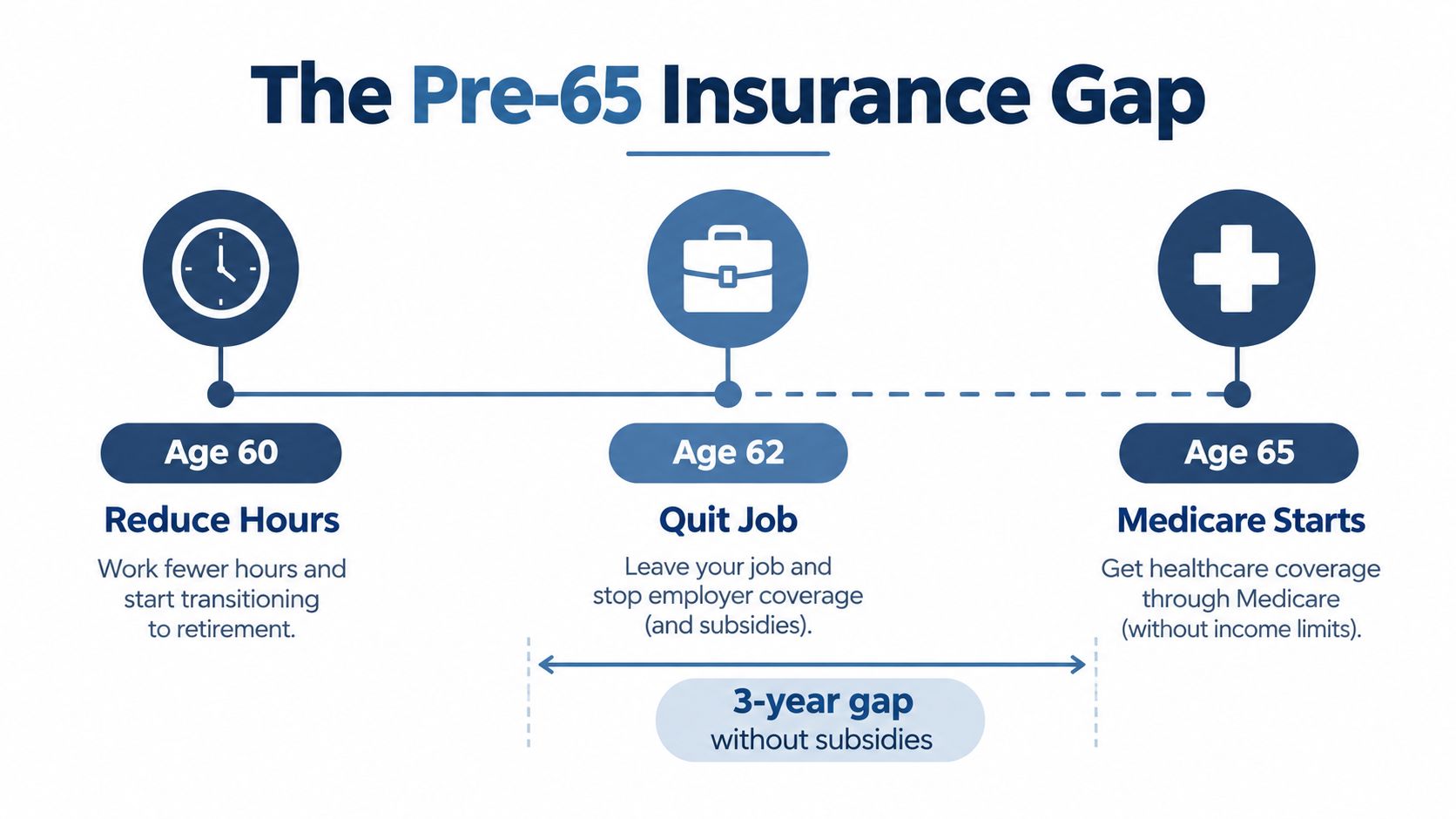
Why the bridge deserves its own budget
Pre-Medicare retirees can cost employer plans more than Medicare-age retirees. Among large employers reporting costs, the average annual health benefit cost was $11,961 per pre-Medicare retiree, compared with $4,716 per Medicare-eligible retiree in 2011–2012 (KFF retiree coverage analysis). Employers may respond by limiting retiree benefits, charging premiums, or changing coverage as Medicare approaches.
For a 62-year-old, choose coverage by checking three things: the premium, access to current doctors and prescriptions, and the transition into Medicare. COBRA, a spouse's plan, a retiree plan, and Marketplace coverage can interact with retirement income, subsidies, and termination dates. A low premium can become expensive if it removes a specialist or creates a coverage gap.
Start with this guide to health insurance before Medicare. Then request the retiree plan documents, COBRA election materials, prescription formulary, provider directory, and exact termination date from your employer. Confirm every benefit in writing before including it in your retirement budget.
Practical rule: Treat the pre-65 years as a separate insurance phase. Price the bridge before you sign your retirement papers.
Why Medicare Is Not an Option Yet
You retire at 62, your employer plan ends, and Medicare still sits three years away. That timing creates a coverage decision, not an automatic transition. Age-based Medicare eligibility generally starts at 65. People under 65 may qualify through certain disabilities, end-stage renal disease, or other conditions, but leaving work alone does not create eligibility (Medicare basics and parts of Medicare).
Use the bridge estimate from the previous section as your starting point. Then focus on how each option ends and how it connects to Medicare, rather than recalculating the gap.
Retirement timing still affects the choice. Someone leaving work well before 65 may value a stable Marketplace arrangement. Someone retiring close to 65 may favor COBRA or an employer retiree plan to preserve a specialist, hospital system, or prescription arrangement that would be difficult to replace. Compare the coverage end date, not just the monthly premium.
Separate eligibility from affordability
Age controls when Medicare becomes available. Household circumstances control the coverage you can use before then. Check whether a spouse is working, whether your former employer offers retiree coverage, whether Marketplace assistance is available, and whether income will come from wages, consulting, withdrawals, investments, or a business.
Medicare's age-based Initial Enrollment Period lasts seven months. It includes the three months before your 65th-birthday month, that birthday month, and the three months afterward. If you turn 65 in June 2027, your window runs from March 1 through September 30, 2027 (CMS Medicare enrollment periods). Put these dates on your calendar before retirement, especially if your income or coverage changes during the year.
Treat Medicare enrollment as a deadline-driven handoff. Confirm when the current plan ends, when the replacement starts, whether prescriptions remain covered, and whether your pre-65 coverage qualifies as active-employment coverage for Medicare timing. COBRA and retiree coverage can affect your decisions, but do not assume either one gives you the same protection as coverage through current employment. Make the bridge end date and Medicare start date fit without uninsured days.
How ACA Marketplace Plans Actually Work for Early Retirees
For many people ages 60 to 64, an ACA Marketplace plan is the most practical bridge. The important point is that the Marketplace doesn't price your subsidy from your old salary. It uses projected annual household income, family size, and coverage circumstances.
The premium tax credit is tied to the second-lowest-cost Silver plan in your area. You can choose Bronze, Silver, or Gold, but the benchmark used to calculate the credit remains the applicable Silver plan. That means a Bronze plan may have a lower monthly premium, while a Gold plan may offer a better deductible and cost-sharing structure after the credit is applied.
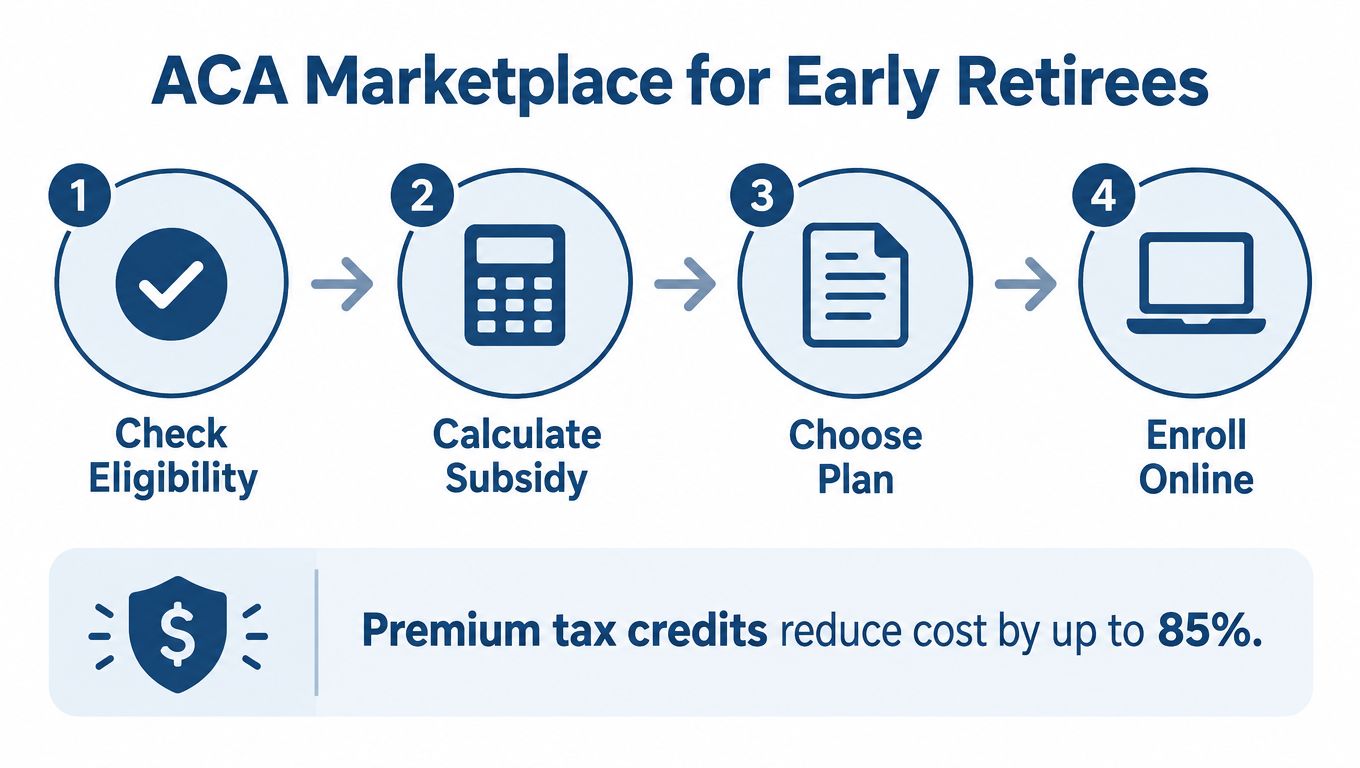
Look beyond the premium
A low premium can be the wrong bargain if you expect regular specialist visits, expensive prescriptions, or planned treatment. Compare the deductible, out-of-pocket maximum, provider network, drug formulary, urgent-care rules, and hospital affiliations. A plan with a higher premium can produce a more manageable total cost if you use care consistently.
For a neutral comparison of insurer capabilities and carrier considerations, review PIA Southern Alliance's carrier analysis. It shouldn't replace checking the specific Marketplace plans available in your county, but it can give you a framework for evaluating network reach, plan structure, and service expectations.
Income requires equal attention. Capital gains, IRA withdrawals, business income, retirement distributions, and a spouse's earnings can change your projected annual household income. Estimate that income before enrolling, update the Marketplace after a meaningful change, and reconcile the estimate on your federal tax return. Underestimating income can lead to a repayment obligation, while overestimating it can leave you paying more than necessary during the year.
My recommendation: Don't choose a Bronze plan solely because the premium looks attractive. Compare the net premium with the likely deductible, prescriptions, doctors, and maximum out-of-pocket exposure.
You can also use this practical explanation of Marketplace health insurance while comparing plan designs. The right selection is the one that fits both your medical needs and your income plan.
COBRA, Spouse Plans, Retiree Coverage, and Short-Term Options Compared
No single option wins for every early retiree. The correct choice depends on how long you need coverage, which doctors you must keep, how predictable your income is, and how much financial exposure you can tolerate.
| Option | Typical Duration | Cost Profile | Medicare Interaction |
|---|---|---|---|
| COBRA | Temporary continuation of the former employer plan | Usually higher because you pay the full plan cost and applicable fee | Doesn't count as current-employment coverage for Part B timing |
| Spouse plan | While the spouse's active employer coverage remains available | Depends on the employee contribution and family rate | Active-employment coverage may support a Medicare Special Enrollment Period |
| Employer retiree coverage | Depends on the employer's plan terms | Can be subsidized or expensive, especially for pre-Medicare adults | Review how the plan coordinates with Medicare |
| Marketplace plan | Until Medicare eligibility, subject to enrollment rules | Net premium depends on projected household income and the benchmark plan | Ends or changes when Medicare begins |
| Short-term plan | Depends on the policy and applicable rules | May have a lower premium, but benefits and exclusions can be narrower | Doesn't replace Medicare enrollment planning |
| Association or CO-OP plan | Depends on membership and plan rules | Varies by organization and coverage design | Review the transition before Medicare eligibility |
When each option makes sense
COBRA is strongest when preserving your existing doctors and prescriptions matters more than minimizing the premium. It can also provide continuity during a short bridge, but don't mistake convenience for value. Compare the total premium, deductible, network, drug coverage, and end date before electing it. This COBRA guide for retirees can help organize that comparison.
A spouse's active employer plan deserves first review if it's available. It may provide familiar group coverage and a simpler transition, but check the family premium, deductible, network, and enrollment trigger. Ask the employer's benefits department for the exact special-enrollment process rather than assuming the change will happen automatically.
Employer retiree coverage can be valuable, especially if it preserves a broad network or offers coordinated prescription benefits. But eligibility alone doesn't automatically make it the best deal. KFF explains that a 63-year-old offered retiree coverage may still look at Marketplace coverage, and eligibility for retiree coverage alone doesn't necessarily eliminate Marketplace subsidies, subject to income and other rules (KFF early retiree Marketplace FAQ).
Short-term, association, and CO-OP plans require the most careful reading. They may look inexpensive, but exclusions, renewability, prescription benefits, preexisting-condition treatment, and provider access can differ sharply from ACA-compliant coverage. I would use them only after confirming exactly what they exclude and how you will replace them.
Coordinating Retirement Income and Subsidy Eligibility
Retirement income rarely arrives like a salary. A self-employed consultant may have a strong quarter followed by a quiet one. A contractor may draw from an IRA in one month, sell investments in another, and delay a business payment until year-end. The Marketplace still needs an annual household income estimate.
Start with the income categories that can affect the projection: business income, capital gains, IRA distributions, interest, dividends, pension income, Social Security, and a spouse's earnings. The relevant question isn't just how much cash enters your checking account. It is how those transactions affect the household income measure used for Marketplace assistance.
Use an income choreography process
Build a full-year estimate. Include income earned before retirement, expected consulting or contract work, planned withdrawals, investment income, and gains you may realize.
Separate spending from taxable income. A withdrawal used to pay a premium can still affect your income estimate. Don't assume that because the money goes directly to healthcare, it has no subsidy consequence.
Model alternatives. Compare the effect of taking a distribution this year, realizing an investment gain, delaying a sale, or using available cash. Your tax professional or financial advisor should review the tax and retirement consequences alongside the insurance impact.
Update after a real change. A business downturn, new contract, large gain, unexpected distribution, or spouse's job change should trigger a review of your Marketplace estimate.

Protect flexibility, not just subsidies
Managing taxable income can help preserve Marketplace assistance, but it isn't automatically wise to minimize income at any cost. Delaying a needed withdrawal may affect your cash reserve, tax bracket, investment plan, or ability to handle an emergency. The goal is coordination, not gaming the system.
If you plan to work part time or receive disability-related income, review the rules with a qualified professional. This overview of part-time work and SSDI limits may be useful when work and benefits overlap. For the subsidy mechanics themselves, use this explanation of what a premium tax credit is.
Keep a running income worksheet. Record the estimate you submitted, the assumptions behind it, later changes, and the documents supporting your final income. That file gives your tax preparer and insurance advisor something concrete to review instead of forcing everyone to reconstruct the year from memory.
Building a Bridge Strategy That Avoids Gaps and Penalties
At 62, a bridge plan can change several times in one year. Consider a retiree who leaves work on June 30, has $45,000 in IRA withdrawals, and can join a spouse's active employer plan. The right choice depends on the spouse plan's effective date, COBRA's continuation terms, Marketplace eligibility, provider access, and whether the withdrawals change projected household income.
Use this 12-month sequence:
- June 30: Employer coverage ends. Request the exact termination date and compare the spouse plan, COBRA, Marketplace plans, and any retiree coverage before making an election.
- July 1: If the spouse plan starts immediately and covers the preferred doctors and prescriptions, use it as the first option. If it starts later, elect COBRA or select a Marketplace plan that begins July 1. Confirm the start date in writing before ending existing coverage.
- August: Add the planned $45,000 IRA withdrawal to the household income estimate. If the Marketplace application used a lower figure, update it promptly. The withdrawal can affect premium assistance and the amount reconciled on the tax return.
- October: Recheck the plan after any additional withdrawal, investment gain, contract payment, or change in the spouse's employment. A new income projection can change the Marketplace comparison, so do not judge the plan by its original premium alone.
- June 30 of the following year: Review whether the spouse plan remains active, whether COBRA is ending, and whether a Marketplace renewal creates a better fit. Keep coverage continuous while comparing replacement options.
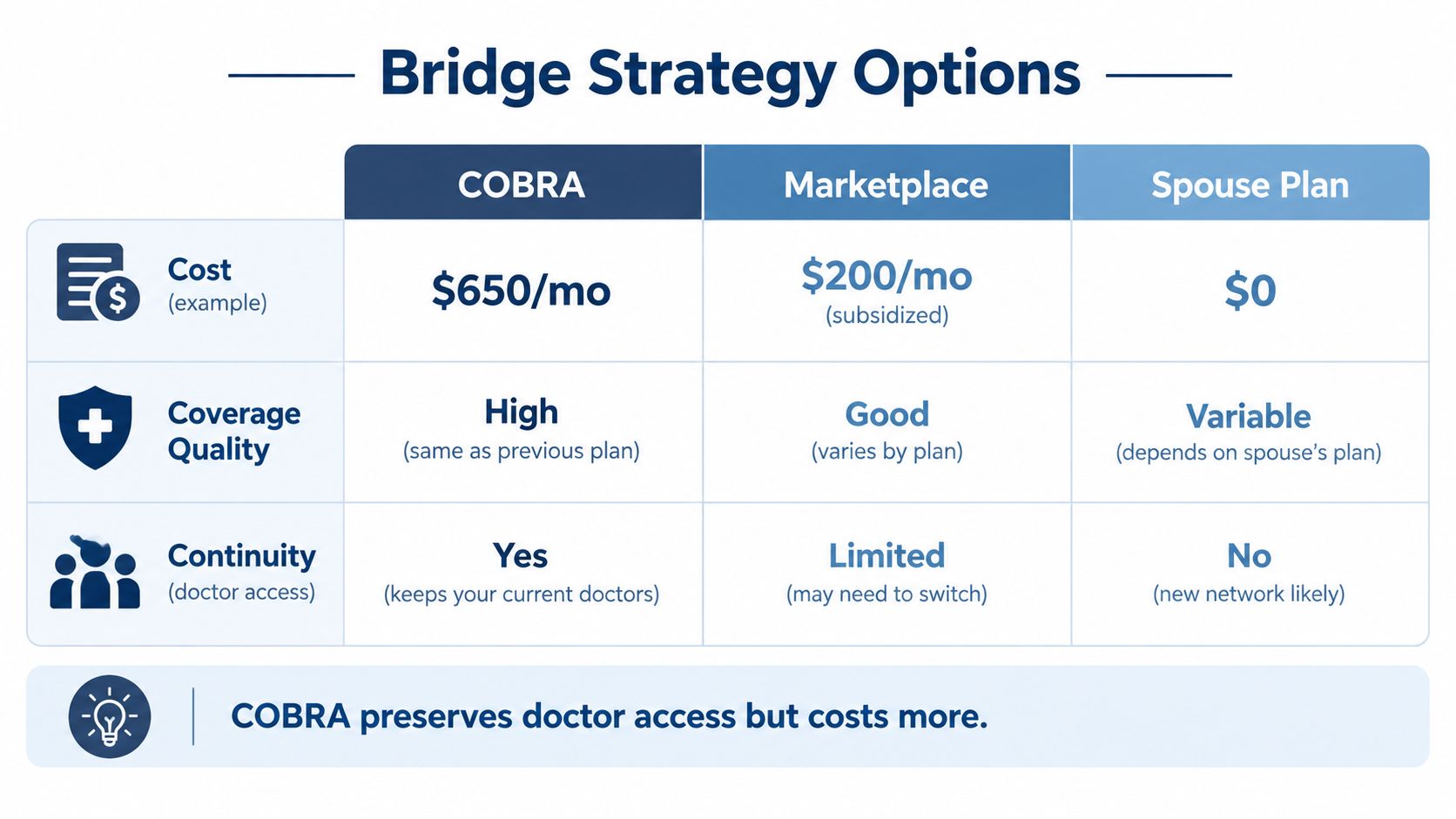
COBRA often wins when keeping the same doctors, prescriptions, and deductible matters more than minimizing premiums. A spouse plan may be simpler if its enrollment window and effective date line up with retirement. A Marketplace plan deserves a close look when retirement lowers household income, but the $45,000 withdrawal must be included in the annual estimate.
Use the Department of Labor's COBRA health coverage guidance to confirm election and continuation rules. Treat Medicare as a separate deadline, not an automatic extension of the bridge plan. COBRA or retiree coverage does not replace the need to review Medicare enrollment when eligibility arrives.
The safest handoff is boring: one plan stays active until the next plan's effective date is confirmed, and every income change is reflected in the coverage decision.
Enrollment Steps and Deadlines You Should Put on the Calendar
Start your checklist at least several weeks before retirement, not after the final paycheck. Ask the employer for the coverage end date, COBRA election information, retiree plan documents, and spouse-plan enrollment instructions.
Your practical calendar
- Before leaving work: Estimate annual household income and list every expected withdrawal, gain, contract payment, and spouse income source.
- At loss of coverage: Compare COBRA, the Marketplace, spouse coverage, retiree benefits, and any private alternative. Confirm the replacement effective date before ending existing coverage.
- After enrollment: Keep your Marketplace income estimate current. Report changes that could materially alter annual household income.
- Approaching 65: Mark the Medicare Initial Enrollment Period, which spans seven months around your 65th-birthday month. Don't rely on COBRA or retiree coverage as a substitute for current-employment coverage.
- Before the first Medicare month: Confirm Part A and Part B decisions, prescription coverage, provider access, and the end date of your pre-Medicare plan.
For a 62-year-old, the immediate action is simple: collect the documents, build the income estimate, and compare total annual exposure rather than monthly premiums alone. If your income is irregular or your medical needs are complex, have an insurance advisor and tax professional review the plan before you submit an enrollment application.
My Policy Quote helps early retirees compare pre-Medicare options such as Marketplace plans, COBRA, private plans, and short-term medical coverage with licensed-agent support. Visit My Policy Quote to compare your bridge options and build a coverage timeline before retirement ends your employer plan.