
For most people, the magic number for ACA Marketplace plans is January 15th. If you get health insurance through your job, you're likely looking at a fall deadline. And for Medicare, the big date is December 7th.
Miss these windows, and you could be locked out of coverage for an entire year unless you have a qualifying life event.
Your Guide to Health Insurance Enrollment Deadlines
Think of open enrollment like a limited-time sale for your health. It’s that one specific time of year when the doors to health insurance swing wide open, letting you sign up, switch plans, or make adjustments. Once that period ends, those doors slam shut, and your options shrink dramatically.
Knowing when open enrollment for health insurance ends is the first step toward getting the peace of mind you deserve.
To really get why these dates are so important, you first need to understand What Is Open Enrollment For Health Insurance. It’s your one big chance to act each year, but every type of coverage plays by a different set of rules. We break down the basics in our guide that explains what open enrollment means.
Key Deadlines At A Glance
Let’s be honest—the dates can get confusing, especially if you're trying to figure out more than one type of insurance. Your deadline is different whether you’re a freelancer buying your own plan, an employee picking benefits at work, or a retiree navigating Medicare.
This timeline gives you a bird's-eye view of the main enrollment seasons.
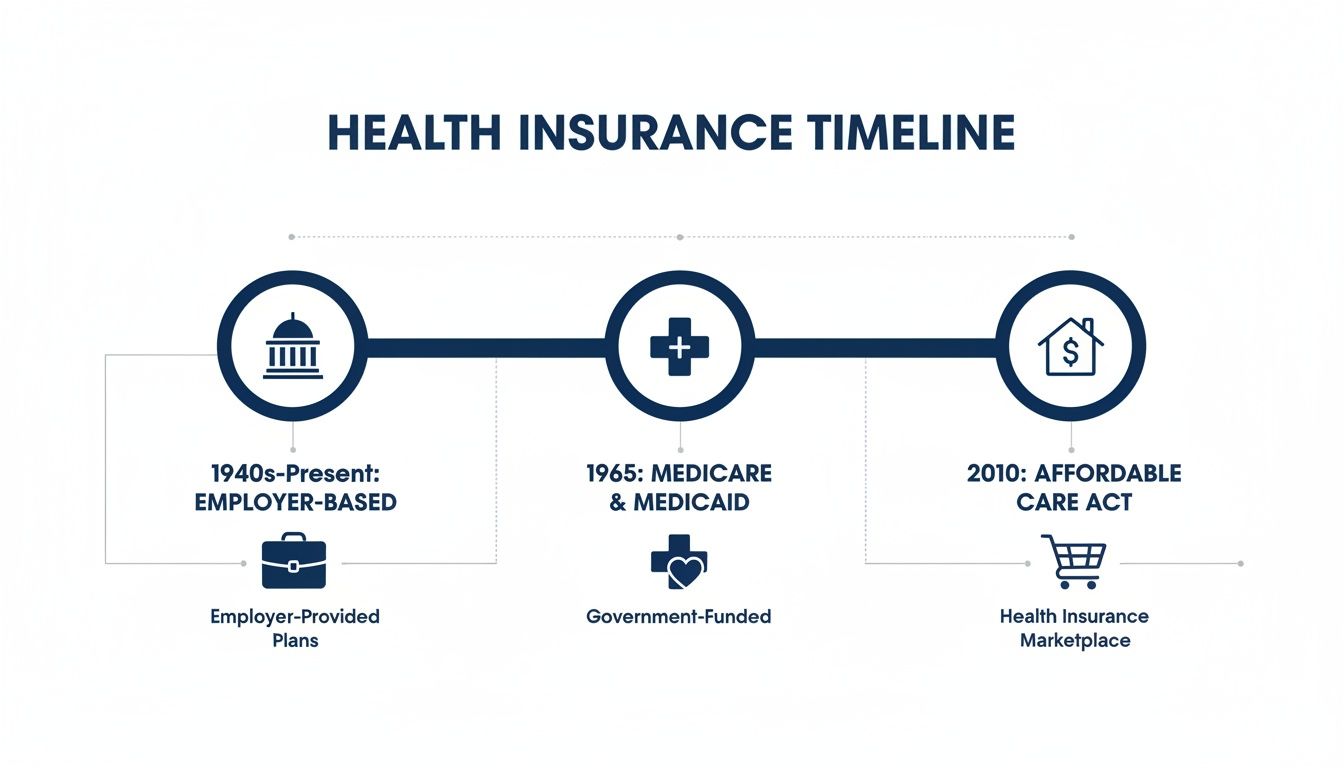
As you can see, these windows don’t always line up. That's exactly why you need to know which timeline applies to you.
To make it even simpler, here's a quick summary table. Think of it as a cheat sheet for the most important dates to circle on your calendar. Use it to quickly pinpoint the enrollment window that matches your situation.
Key Health Insurance Open Enrollment Deadlines at a Glance
This table summarizes the typical enrollment periods for major health insurance types, helping you quickly identify the window relevant to your situation.
| Insurance Type | Typical Open Enrollment Period | Coverage Start Date (If Enrolled by Deadline) |
|---|---|---|
| ACA Marketplace | November 1 – January 15 | January 1 (if enrolled by Dec 15) or February 1 |
| Employer-Sponsored | Varies (often 2-4 weeks in the Fall) | Typically January 1 of the following year |
| Medicare (AEP) | October 15 – December 7 | January 1 of the following year |
Remember, missing these dates is more than just an inconvenience—it can leave you financially exposed. Without coverage, a single trip to the emergency room could spiral into overwhelming debt. This guide will walk you through each deadline in detail, so you're ready to make the right choice.
Navigating ACA Marketplace Enrollment Deadlines
If you're self-employed, part of the gig economy, or don't get health insurance through a job, the Affordable Care Act (ACA) Marketplace is your go-to for coverage. Knowing its deadlines isn't just a good idea—it's absolutely essential for protecting your health and your wallet.
The national timeline can seem a little confusing, but it’s actually pretty simple once you break it down. Think of it like booking a flight. There's an early-bird option that gets you covered on the first day of the year, and a standard option that gets you covered a month later. Both get you to the same destination—health coverage—but the timing makes all the difference.

The Two-Part Departure: The National ACA Timeline
For most states using the federal HealthCare.gov platform, open enrollment works with a two-stage deadline. This is where most of the confusion happens, so let's clear it up.
-
The First Deadline for January 1st Coverage: The first key date to circle on your calendar is December 15th. If you enroll in a plan by this date, your health coverage kicks in bright and early on January 1st. This is the goal because it prevents any gaps between the old year and the new one.
-
The Final Deadline for February 1st Coverage: The absolute last day to enroll is January 15th. If you sign up between December 16th and January 15th, your coverage won't start until February 1st. This means you’ll be completely uninsured for all of January.
Key Takeaway: While the final day to sign up is January 15th, the date you really want to remember is December 15th. Hitting this earlier deadline means you get seamless health coverage from day one of the new year, avoiding any risky gaps.
These dates have a massive impact. For 2026 coverage, the ACA Marketplace open enrollment began on November 1, 2025. The deadline to get coverage starting January 1, 2026, is December 15, 2025. You can still enroll until January 15, 2026, but your plan won't start until February 1.
The Centers for Medicare & Medicaid Services (CMS) reported that 22.8 million consumers signed up by early 2026, a number that shows just how vital these deadlines are for so many families. You can see the full breakdown in the official CMS snapshot.
State-Run Marketplaces: The Exceptions to the Rule
Now, here’s where things can get a little tricky. Not every state uses the federal HealthCare.gov platform. A handful of states and the District of Columbia run their own health insurance marketplaces, and they play by their own rules.
These states have the flexibility to set their own deadlines, and many of them extend their open enrollment periods to give residents more time. This is a critical detail, because when open enrollment for health insurance ends can change dramatically based on where you live.
Here are a few states that usually offer longer enrollment windows:
- California: Often extends its deadline to the end of January.
- New York: Frequently has one of the longest enrollment periods in the country.
- Colorado: Also tends to give residents extra time past the federal cutoff.
- Massachusetts: Another state that typically sets its own later deadline.
Because these dates can shift from year to year, never assume your state's deadline is the same as the federal one. The smartest move is to always check the specific dates for your location on your state’s official health insurance marketplace website.
Making Your Deadline Work for You
Knowing the dates is step one, but taking action is what truly matters. The application process involves gathering documents and making big decisions about your health needs and budget, so the earlier you start, the less stressful it will be. If you're wondering what comes next, our guide on how to apply for health insurance walks you through the entire process.
Waiting until the last minute—especially near that final January 15th cutoff—not only risks a gap in your coverage but also increases the chance of making a rushed decision you might regret. By aiming for the December 15th deadline, you give yourself the gift of continuous coverage and, more importantly, peace of mind.
Understanding Your Employer-Sponsored Health Plan Timeline
While the ACA Marketplace runs on a well-known national schedule, employer-sponsored health insurance plays by a completely different set of rules. Think of it as a private, company-only sign-up event—your one annual shot to pick or change your health benefits through your job.
This enrollment window is set entirely by your employer, not the government. Most companies hold this event in the fall, usually during October or November, for coverage that kicks in on January 1st of the next year.
Here’s the part that catches most people off guard: the timeline is often incredibly short. Unlike the months-long ACA period, your employer’s open enrollment might only last for two or three weeks. If you miss that brief window, the consequences can be significant.
Finding Your Company's Key Dates
So, where do you find these crucial dates? Your company’s Human Resources (HR) department is your go-to source. They’ll announce the open enrollment period well ahead of time, typically through a few different channels.
Be on the lookout for:
- Company-wide emails: This is the most common way employers share open enrollment dates, deadlines, and any plan changes.
- Internal portals or intranets: Many companies have a dedicated benefits page on their employee website with all the timelines and documents you need.
- Team meetings or webinars: Your employer might host informational sessions to explain your options and answer questions live.
Because these windows are so tight, it’s vital to mark your calendar the moment the dates are announced. This is one time when procrastination can really cost you.
The biggest mistake you can make is assuming you have plenty of time. A two-week employer open enrollment window closes fast, and if you miss it, you generally have to wait a full year for another chance to get coverage through your job.
What Happens If You Miss Your Employer's Deadline
Missing your employer's open enrollment deadline is a big deal. In most cases, if you don’t enroll or make changes during that specific period, you’re locked out of coverage for the entire next year.
That means you’ll have to wait until next fall to sign up again unless you experience a Qualifying Life Event (QLE), like getting married or having a baby. Without a QLE, you can't get on your company's plan until the next cycle. To get a better feel for how these plans operate, you can learn more about what employer-sponsored health insurance is and why its rules are so different.
The New Hire Exception: A Critical Lifeline
There is one major exception to this rigid annual schedule: starting a new job. When you’re hired, you don’t have to wait for the company-wide open enrollment to get insured.
Instead, starting a new job triggers a special enrollment opportunity just for you. You typically have 30 to 60 days from your start date to look over the benefits package and enroll in a health plan.
This is a critical detail for anyone changing jobs. If you don't make your selections within this initial window, you’ll miss your chance and have to wait until the next annual open enrollment period. Make it a priority to confirm this deadline with HR on your first day so you don’t accidentally miss out on essential coverage. This new-hire window is your one and only shot to get covered outside of the company’s normal timeline.
Making Sense of Medicare Open Enrollment
For anyone nearing retirement, Medicare isn't just another health plan—it's a major life event. But let’s be honest, its different enrollment periods can feel like trying to solve a puzzle without all the pieces. Getting these dates right is so important, because one small mistake can lead to lifelong penalties or getting locked into the wrong coverage for a whole year.
Unlike the one-size-fits-all dates for Marketplace plans, Medicare has a few different sign-up windows, and each one has a specific job. The key is knowing the difference between your first chance to sign up and the annual periods for making changes.

Your First Chance: The Initial Enrollment Period
Your first real introduction to Medicare is your Initial Enrollment Period (IEP). Think of it as your personal, one-time-only grand opening for Medicare benefits. It’s a seven-month window that’s directly tied to your 65th birthday.
Your IEP is made up of:
- The three months before your 65th birthday month
- The month you actually turn 65
- The three months after your 65th birthday month
Missing this window can be a costly mistake. If you don't sign up for Medicare Part B (medical insurance) when you're first eligible, you could get hit with a late enrollment penalty that sticks with you for as long as you have Part B. That penalty just keeps growing the longer you wait, which makes your IEP an incredibly important deadline.
The Annual Refresh: The AEP
Once your initial window closes, your main opportunity to tweak your coverage happens once a year during the Medicare Annual Election Period (AEP). You’ll often hear this called Medicare Open Enrollment, and it’s when the question of when open enrollment for health insurance ends becomes a hot topic for seniors.
The Medicare Annual Election Period runs from October 15th to December 7th every single year. Any changes you make will kick in on January 1st of the next year.
The AEP is your time to step back, look at your healthcare needs, and make sure your plan is still the right fit. Health plans can change their costs, benefits, and even which doctors are in their network each year. What worked perfectly for you last year might not be the best option for next year.
During this window, you can:
- Switch from Original Medicare (Parts A and B) to a Medicare Advantage Plan (Part C)
- Drop a Medicare Advantage Plan and go back to Original Medicare
- Switch from one Medicare Advantage Plan to another
- Join, drop, or switch a Medicare Part D prescription drug plan
Think of the AEP as your annual check-up for your coverage. It’s essential.
A Second Chance Window: Medicare Advantage Open Enrollment
Just to add one more layer, there's another important period to know: the Medicare Advantage Open Enrollment Period (MA OEP). This one runs from January 1st to March 31st each year.
This period is only for people who are already in a Medicare Advantage Plan. It’s not for making just any change; it’s more like a "do-over" window if you're not happy with the plan you chose during the fall AEP.
During the MA OEP, you can make one of two specific moves:
- Switch from your current Medicare Advantage Plan to a different one.
- Drop your Medicare Advantage Plan and return to Original Medicare (you’ll also get a chance to sign up for a Part D drug plan).
What you can’t do is switch from Original Medicare into a Medicare Advantage Plan during this time. That’s what the AEP from October to December is for. Knowing how each of these periods works keeps you in the driver’s seat of your own health coverage.
What to Do If You Miss the Open Enrollment Deadline
It’s that sinking feeling in the pit of your stomach—you just realized the open enrollment deadline passed. Your mind starts racing. Am I uninsured for the whole year? What if I get sick?
Take a deep breath. It’s a stressful spot to be in, for sure, but you might not be out of luck just yet. While the main window has closed, there’s a built-in safety net for people who go through major life changes. And right now, it’s your most important lifeline.
This isn’t some secret trick; it’s a formal process called a Special Enrollment Period (SEP). Think of open enrollment as the main train that everyone boards at the same time each year. An SEP is like a special, unscheduled stop just for you, but you need a valid ticket to get on—and that ticket is a Qualifying Life Event (QLE).
Unlocking a Special Enrollment Period
A Qualifying Life Event is just what it sounds like: a big change in your life that lets you sign up for a new health plan outside of the usual dates. These rules exist because life doesn’t always follow a neat, predictable calendar.
So, what actually counts as a QLE? Here are a few of the most common triggers:
- Changes in Your Household: Getting married, having a baby, adopting a child, or going through a divorce are all major life shifts that can open the door to an SEP.
- Losing Your Health Coverage: This is a big one. If you lost your job-based insurance because you were laid off, quit, or your hours were cut, you get a new chance to enroll. It also applies if you aged off your parent's plan at 26 or lost your Medicaid eligibility.
- A Change of Scenery: Moving to a new ZIP code or county can trigger an SEP, especially if your new home has different health plan options available.
Here’s the catch: you have to act fast. Most of these life events give you just a 60-day window from the date they happen to pick a new plan. If you miss that 60-day deadline, you’ll probably have to wait for the next open enrollment. Understanding if you qualify is everything, and our detailed guide on the Special Enrollment Period (SEP) can help you figure out your next steps.
Common Qualifying Life Events for a Special Enrollment Period
If you experience one of these events, you may be eligible to enroll in a health plan outside of the standard Open Enrollment period. This table outlines the event and the typical window you have to act.
| Qualifying Life Event (QLE) | Typical Enrollment Window | Who It Applies To |
|---|---|---|
| Losing Job-Based Coverage | 60 days from loss of coverage | Anyone who lost their health plan due to job change, layoff, or reduced hours. |
| Getting Married | 60 days from the marriage date | Newly married couples looking to get on a shared plan or enroll for the first time. |
| Having or Adopting a Baby | 60 days from the birth/adoption | New parents who need to add a dependent to their coverage or get a new family plan. |
| Moving to a New Area | 60 days from the move | Individuals or families who have moved to a different ZIP code with new plan options. |
It's always smart to double-check your specific situation, as documentation is usually required to prove your QLE.
Exploring Other Coverage Avenues
What happens if you check the list and don't have a Qualifying Life Event? Don't panic. You still have a couple of other paths to explore, though they aren't direct replacements for a comprehensive health plan.
One of the most important options is Medicaid or the Children's Health Insurance Program (CHIP). Unlike marketplace plans, these government programs don’t have an open enrollment period. You can apply and enroll at any time of the year. Eligibility is mainly based on your income, so if your earnings have recently dropped, this is definitely something to look into right away.
Another option you might come across is short-term health insurance. These plans can bridge a gap in coverage, and you can buy them pretty much anytime. But—and this is a big but—they come with serious limitations.
Important Consideration: Short-term plans are not ACA-compliant. That means they don't have to cover pre-existing conditions or the ten essential health benefits, like maternity care, mental health services, or prescriptions. Think of them as a temporary patch, not a long-term solution.
After missing the deadline, your best first step is to carefully review the list of Qualifying Life Events. If you think one applies to you, gather your documents and act quickly. That 60-day clock starts ticking right away.
How to Never Miss a Health Insurance Deadline Again
Trying to keep track of health insurance deadlines can feel like a high-stakes guessing game. You’ve got federal cutoffs, state-specific extensions, and totally different rules for Medicare and your job’s plan. It’s enough to make anyone feel overwhelmed.
But what if you had someone in your corner, making sure you never missed a critical date?
Working with an insurance advisor at My Policy Quote turns that confusing mess into a simple, clear path forward. Forget setting a dozen calendar reminders and just hoping you got it right. Instead, you get a real person who understands your life and gives you support that’s actually built for you.
This isn’t just about circling a date on a calendar. It’s about making sure you know the rules that apply to you and your unique situation.
Your Personal Deadline Strategy
An expert can help you build a clear plan, taking all the guesswork out of enrollment. This is especially true if your work life isn't a typical 9-to-5 or if you're getting close to retirement.
Here’s how we make a real difference:
- For Freelancers & Gig Workers: We keep an eye on ACA deadlines, including your state’s specific end date, so you don't have to. We’ll also help you find a plan that works with an income that goes up and down.
- For Early Retirees: The move from private insurance to Medicare can be tricky. We guide you through it, ensuring you hit your Initial Enrollment Period to avoid penalties that can last a lifetime.
- For Families: Life changes fast. We’ll help you figure out if a major event, like having a baby, makes you eligible for a Special Enrollment Period outside of the usual window.
Partnering with an advisor isn't just about buying a policy; it's about building a safety net. It means having an expert on your side who makes sure you get the right coverage at the right time, year after year.
Instead of trying to figure out complicated rules all by yourself, you get a trusted advocate who has your back. At My Policy Quote, our goal is to get rid of the stress and confusion. We want to give you the clarity and peace of mind that comes from knowing your health is protected.
Still Have Questions About Enrollment Deadlines?
Even with a calendar right in front of you, figuring out the specifics can be tricky. Let’s clear up some of the most common questions so you can make your move with total confidence.
Can I Change My Health Insurance Plan After Open Enrollment Ends?
Generally, no. Once that window closes, your plan is locked in for the year. Your next chance to make a change will be during the next open enrollment period.
But life happens. The one big exception is if you experience a Qualifying Life Event (QLE). Think major life shifts—getting married, having a baby, or losing your job-based coverage. These events trigger a Special Enrollment Period, giving you a fresh 60-day window to pick a new plan.
What Happens If I Enroll Between December 16 and January 15?
This is a detail that trips a lot of people up, but it's absolutely critical. If you enroll in an ACA Marketplace plan by the December 15 deadline, your coverage kicks in on January 1. It’s a clean, seamless start to the new year.
But if you wait and enroll between December 16 and the final deadline of January 15, your coverage won’t begin until February 1. That creates a one-month gap where you're completely uninsured. It’s a risky move, which is why hitting that earlier deadline is always the safer bet.
Key Insight: Aiming for the December 15 deadline isn’t just a good idea—it’s the best way to prevent a dangerous gap in your health coverage and make sure you’re protected from day one.
Do I Have to Re-Enroll in My Health Plan Every Year?
Technically, most plans will auto-renew. But letting that happen without a second thought is a huge mistake. It’s always smarter to actively review your options every single year.
Why? Because insurance companies change the fine print all the time. Your costs could go up, your favorite doctor might suddenly be out-of-network, or key benefits could be different. Plus, your own life has probably changed, too. Open enrollment is your one designated time to shop around and make sure your plan still fits your health and your wallet. Don't just let an old plan roll over.
Navigating these dates can feel like a lot, but you don't have to do it alone. The experts at My Policy Quote are here to give you personalized guidance and make sure you find the right plan at the right time. Explore your options with us today.