
When you hear the acronyms HDHP and CDHP thrown around, it's easy to think they're the same thing. Many employers even use the terms interchangeably, which only adds to the confusion. But there's a key difference, and understanding it is the first step to choosing the right plan for your wallet and your well-being.
Here’s the simplest way to think about it: An HDHP is a specific product, like a hammer. A CDHP, on the other hand, is the entire strategy—the toolbox designed to give you more control over how you pay for healthcare.
So, What’s the Real Difference?
Let's break it down. A High-Deductible Health Plan (HDHP) is almost always a component of a Consumer-Driven Health Plan (CDHP). But a CDHP isn't always just an HDHP.
Think of it this way: a square is always a rectangle, but not all rectangles are squares. An HDHP is a specific type of plan that fits into the broader CDHP philosophy.
The whole idea behind a CDHP is to put you in the driver's seat. It's built on a simple foundation: pair a high-deductible insurance plan with a personal health savings account and give you the tools to make smarter choices. It’s all about making you an active "consumer" of your own healthcare.
Getting to Know the Plans
A High-Deductible Health Plan (HDHP) isn't just a name; it has to meet specific guidelines set by the IRS. To qualify, a plan must have a deductible that meets a certain minimum annual amount, and its out-of-pocket maximum can't go over a set limit. You can dive deeper into the nuts and bolts in our guide on what is a high-deductible health plan. The biggest perk? It lets you open and contribute to a powerful, tax-advantaged Health Savings Account (HSA).
A Consumer-Driven Health Plan (CDHP) is the big-picture approach. It’s any plan that combines a high-deductible insurance policy with a tax-advantaged savings account. Most of the time, that means an HDHP paired with an HSA. But a CDHP could also use an employer-funded Health Reimbursement Arrangement (HRA) or a Flexible Spending Account (FSA) instead.
The core distinction is one of scope. An HDHP is a specific insurance product with government-defined rules. A CDHP is a broader philosophy that gives you financial tools and puts you in charge of your healthcare spending.
To make it even clearer, here’s a quick side-by-side look.
| Feature | High-Deductible Health Plan (HDHP) | Consumer-Driven Health Plan (CDHP) |
|---|---|---|
| Concept | A specific insurance plan with a high deductible and low premiums. | A broad healthcare strategy focused on giving you more control over costs. |
| Primary Goal | Lower your monthly premium while protecting you from major medical events. | Give you direct financial control and incentives to shop for healthcare wisely. |
| Associated Account | Almost always paired with a Health Savings Account (HSA). | Can be paired with an HSA, HRA, or FSA. |
| Flexibility | Has to follow strict IRS rules for deductibles and out-of-pocket limits. | More of an approach; the exact setup can vary depending on your employer. |
Comparing the Financial Mechanics of Each Plan
Definitions are one thing, but the real difference between an HDHP and a CDHP shows up on your bank statement. How these plans work day-to-day, with real dollars and cents, is what truly matters for you and your family. It all boils down to a simple trade-off: paying less upfront each month in exchange for potentially higher costs when you actually need care.
An HDHP is designed around a low monthly premium. That's the fixed amount you pay just to keep your coverage active. To get that lower monthly bill, you agree to a higher deductible—the amount you have to pay out-of-pocket for medical services before your insurance company starts chipping in.
While many CDHPs are also high-deductible plans, the term is broader. A CDHP might be structured differently, especially when it comes to how an employer helps out. The trick is to look at the whole financial picture, not just one piece of it.
Premiums, Deductibles, and Out-of-Pocket Maximums
The relationship between your premium and your deductible is a constant balancing act. With a classic HDHP, you save money every month with that low premium. But if you have an unexpected illness or accident, you're on the hook for a pretty large sum before your benefits kick in.
This model has exploded in popularity. Back in 2006, only about 4% of Americans had an HDHP. Fast forward to 2016, and that number jumped to nearly 40% of insured individuals. Employers drove this shift to manage rising healthcare costs, and the powerful Health Savings Account (HSA) made it an attractive option for many.
On the other hand, some broader CDHPs (that aren't technically HDHPs) might have slightly higher premiums. In return, they can offer more predictable costs, like a fixed copay for a doctor's visit even before you've hit your deductible. In either case, the out-of-pocket maximum is your financial safety net. It’s the absolute most you’ll have to spend on covered, in-network care for the year.
This infographic breaks down the core concepts, showing how the broader CDHP strategy compares to the specific HDHP product.
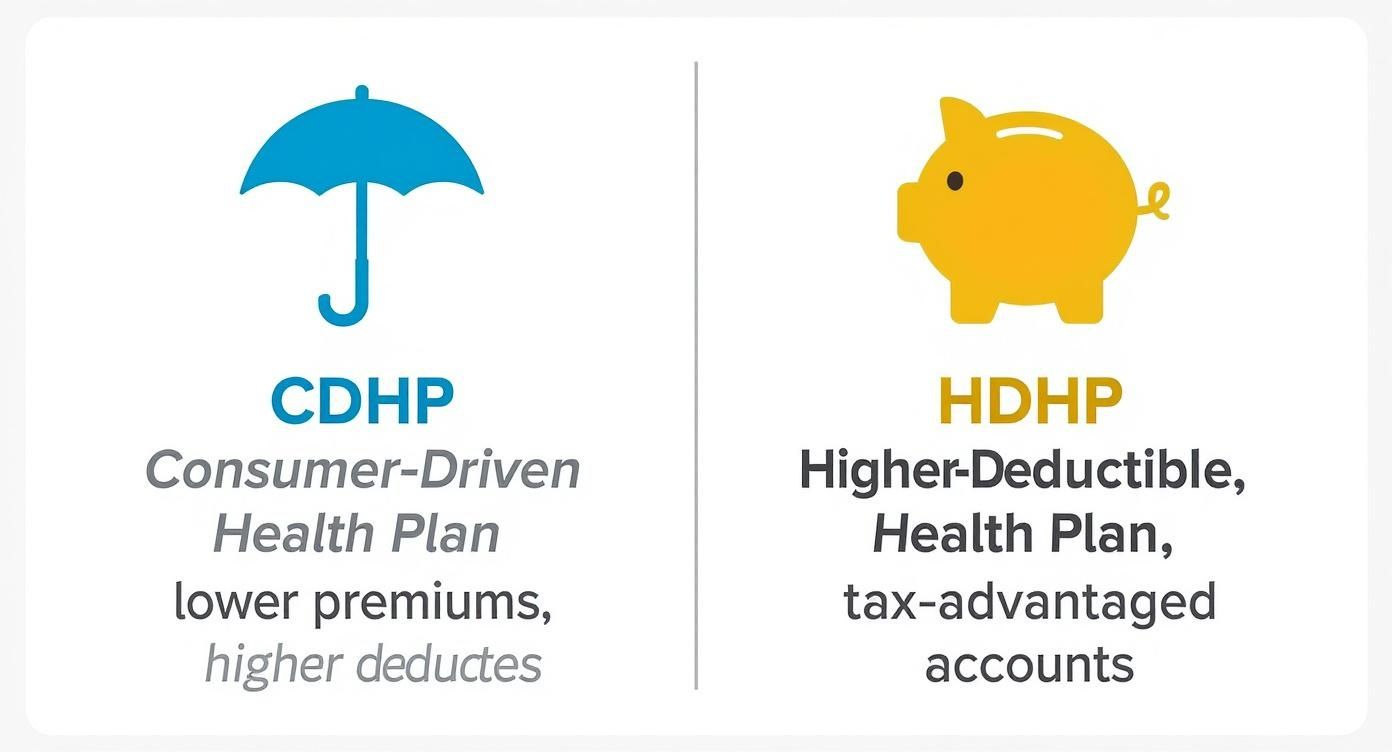
Think of it this way: a CDHP is the overall strategy of giving you more control (the umbrella), while an HDHP is a specific tool designed to help you save (the piggy bank).
To make this even clearer, here's a side-by-side look at the key features.
HDHP vs CDHP Key Feature Comparison
This table offers a direct, at-a-glance comparison of the defining features and financial components of a typical HDHP/HSA combo versus a broader CDHP that might use an HRA.
| Feature | High-Deductible Health Plan (HDHP) | Consumer-Driven Health Plan (CDHP – General) |
|---|---|---|
| Primary Goal | Lower monthly premiums, encourage saving for medical costs. | Empower consumers with more control and cost awareness. |
| Typical Premium | Low. | Can be low to moderate, depending on the structure. |
| Deductible Level | High (must meet federal minimums). | Usually high, but can be more varied. |
| Savings/Spending Account | Health Savings Account (HSA). You own the account. | Can be an HSA, HRA, or FSA. |
| Account Ownership | You own the HSA; it’s your money and goes with you. | HRA is owned by the employer; you lose funds if you leave. |
| Tax Advantages | Triple-tax advantage with an HSA (tax-free in, grows tax-free, tax-free out). | Varies by account. HRA funds are tax-free but employer-owned. |
As you can see, the specific type of savings or reimbursement account attached to the plan is a major differentiator.
The Role of Savings and Reimbursement Accounts
The savings account is what makes these plans run, but they are not all the same. This is where you need to pay close attention when comparing an HDHP vs a CDHP.
- Health Savings Account (HSA): This is the star of the show for qualified HDHPs. It’s a triple-tax-advantaged beast: your contributions are pre-tax, the money grows tax-free, and you can pull it out tax-free for qualified medical expenses. The best part? You own the account. The money is yours to keep, forever. It goes with you if you change jobs and rolls over year after year, turning into a powerful long-term investment for your health.
- Health Reimbursement Arrangement (HRA): You'll often find these paired with other CDHP models. An HRA is owned and funded only by your employer. You can use the funds tax-free for medical costs, which is great, but you usually lose whatever is left in the account if you leave your job. Your employer also decides what expenses are even eligible.
The key differentiator is ownership and portability. An HSA is your personal asset that builds long-term wealth. An HRA is an employer-provided benefit that helps with immediate costs but offers no lasting value if you switch jobs.
Getting a handle on the small but crucial differences between these accounts is everything. We dive deeper in our complete guide comparing the HRA and HSA.
Network Flexibility and Employer Contributions
Most HDHPs and CDHPs use PPO (Preferred Provider Organization) networks. This gives you the freedom to see doctors both in and out of your network, though you’ll always pay a lot less if you stick with in-network providers. It's a huge plus compared to more restrictive HMO plans.
The final piece of the money puzzle is employer contributions. Many companies will put money into your HSA or HRA to encourage you to pick these plans. A generous employer contribution can "seed" your HSA, helping you cover a large chunk of that high deductible and making the HDHP a much more comfortable choice. When you're weighing your options, always look at what your employer is willing to put in—it's a critical part of the plan's total value.
Calculating the Real-World Cost for Your Family

Choosing a health plan isn't just a numbers game on a spreadsheet. It’s about how those numbers—premiums, deductibles, out-of-pocket costs—actually play out in your family’s life and budget. The right choice truly depends on your specific health needs and what your finances can handle.
For a young, healthy family, an HDHP often looks like a clear winner. The low monthly premiums keep more cash in your pocket. Plus, any money you put into an HSA can grow into a nice little nest egg. But there's a catch: this strategy only works if you can genuinely afford to pay that high deductible if an emergency pops up.
This is the big question you have to ask yourself. Can your family’s budget take a sudden hit of several thousand dollars without causing a major financial headache?
Gauging Your Financial Risk Tolerance
At its core, this decision is all about how much financial risk you’re comfortable with. An HDHP puts more of the initial financial responsibility squarely on your shoulders. Until you meet that deductible, you’re paying 100% of the costs for most services.
When you’re trying to figure out the real-world cost, it's crucial to know what you’ll pay for common things before your insurance kicks in. For example, understanding the cost of an eye exam without insurance matters because those "small" expenses can pile up fast.
On the other hand, a CDHP paired with a Health Reimbursement Arrangement (HRA) can soften that initial financial blow. Since your employer funds the HRA, you have a pot of money to pull from for early medical bills, which immediately reduces your out-of-pocket stress.
Key Insight: This isn’t just about saving on monthly premiums. It’s a balancing act. You need to weigh those monthly savings against the risk of high, upfront costs and be honest about whether your family can manage it.
This isn’t just a theoretical problem; it has a real impact, especially for families dealing with ongoing health conditions. For them, an HDHP can create a tough financial situation.
The Financial Burden for Families with Chronic Conditions
If your household is managing something like diabetes, asthma, or a heart condition, the low premium of an HDHP can be misleading. These families have predictable, recurring costs—specialist visits, prescriptions, regular tests. With an HDHP, every single one of those bills has to be paid out-of-pocket until that high deductible is finally met, creating a constant cash flow challenge.
The research backs this up. One study found that 48% of families with chronic conditions on an HDHP reported a significant financial burden from healthcare, like struggling to pay their medical bills. That's more than double the rate for families on more traditional plans. It shows just how stressful those out-of-pocket costs can become for the people who need care the most.
Let's look at a couple of quick scenarios to see how this works in real life.
-
Scenario 1: The Young, Healthy Couple (HDHP/HSA)
- Their Year: They have their annual physicals (covered as preventive care) and one unexpected trip to urgent care.
- Their Cost: They pay the full $250 for the urgent care visit but enjoy low premiums all year. Their employer also contributes $1,000 to their HSA, which they don’t even touch, letting it grow.
- The Result: They save a lot on premiums and build up their health savings for the future.
-
Scenario 2: The Family with an Asthmatic Child (CDHP/HRA)
- Their Year: They have regular checkups, appointments with a specialist, and multiple prescriptions for inhalers.
- Their Cost: The employer-funded HRA covers the first several copays and prescription costs. This prevents them from facing a huge out-of-pocket bill at the start of the year, making their budget far more predictable.
- The Result: Their premium might be a bit higher than an HDHP, but the upfront financial help from the HRA gives them much-needed stability.
Ultimately, figuring out the true cost means looking past the sticker price. You have to sit down and honestly map out what you expect your family's medical needs to be over the next year. Our guide on how to compare health insurance plans can walk you through that process step-by-step.
How Your Health Plan Shapes Your Medical Decisions
The numbers on a health insurance summary—premiums, deductibles, out-of-pocket maximums—are only part of the story. Your choice between an HDHP and a different type of CDHP can fundamentally change how you interact with the healthcare system. It influences when you decide to see a doctor and what care you ultimately feel is "worth it."
This decision goes way beyond your wallet. It directly impacts your well-being.
At the heart of it is a well-documented phenomenon known as cost-related care avoidance. When you're staring down a high upfront deductible, it's natural to hesitate before seeking medical attention for something that seems minor, hoping it just goes away on its own. This creates a really tough trade-off: are the savings from lower monthly premiums worth the risk of delaying care you might actually need?
For someone with a high-deductible plan, a sore throat isn't just a nuisance; it's a financial calculation. Is it worth a potential $150 urgent care bill, or should you just wait it out? You start doing this mental math for everything, from specialist visits to prescription refills.
The Real-World Impact on Your Health Habits
The whole idea behind consumer-driven health plans is to make us smarter healthcare shoppers. But a ton of research shows it can sometimes lead to skipping essential care, not just the unnecessary stuff. This is especially true for people managing chronic illnesses who need consistent medical attention to stay healthy.
Studies consistently find that being enrolled in an HDHP is linked to using fewer recommended medical services. One major study followed over 340,000 adults with chronic conditions and found that those in HDHPs were 4.7 percentage points less likely to get the care they needed—including clinic visits and medications—compared to people in more traditional plans. You can read the full research about these findings on JAMA Network Open.
This highlights a serious risk. Putting off care for a chronic condition like diabetes or hypertension doesn't make the problem disappear. It often allows it to get worse, leading to more complicated and expensive treatments down the road. A small issue that could have been managed with a $20 prescription might snowball into a condition requiring a costly emergency room visit.
The Critical Question: Is your plan encouraging you to be a savvy healthcare shopper, or is it making you avoid the doctor altogether? The answer really depends on your personal health situation and financial stability.
Looking at a Plan Beyond Its Price Tag
When you're comparing an HDHP vs CDHP, you have to think about how it might impact your own health-seeking behavior. It’s not just about what happens after you meet your deductible; it’s about the financial hurdle you have to clear just to get to that point.
Consider these more personal factors when you're making your choice:
- Your Personal Hesitation Threshold: Be honest with yourself. How likely are you to skip a doctor's visit to avoid a $200 bill? Knowing your comfort level with paying for care upfront is key.
- The Nature of Your Health Needs: If you have predictable, recurring medical needs (like maintenance meds or therapy), a plan with fixed copays might give you the budget stability to make sure you never miss a dose or an appointment.
- The Role of Coinsurance: Even after you hit your deductible, you'll still be on the hook for a percentage of the costs. It's so important to understand what coinsurance means in health insurance to get a realistic picture of your total annual expenses.
Choosing the right plan means finding one that supports, rather than discourages, you from taking care of yourself. For a healthy person, the financial incentives of an HDHP can work out perfectly. But for someone with ongoing health concerns, the psychological and financial barrier of a high deductible might pose a genuine threat to their long-term health.
The best plan is the one that empowers you to get the care you need, when you need it, without causing you sleepless nights over the bills.
Matching Your Personal Health Needs to the Right Plan

The best health plan isn't found on a spreadsheet. It’s the one that fits your actual life. The HDHP vs. CDHP debate isn’t about which plan is better in a vacuum, but which one is better for you. That means taking an honest look at your health, your budget, and how you feel about risk.
To help you see things clearly, we’ve sketched out a few common scenarios. By walking through how these plans work for different people, you can find the path that makes the most sense for you and your family.
The Healthy Saver
Think of someone young, with no chronic health issues, who really only sees a doctor for their annual check-up. Their main goal is to keep monthly expenses as low as possible while building up savings for whatever life throws their way. For them, an HDHP combined with an HSA can be an absolute game-changer.
The low monthly premium is an immediate financial relief. Since they barely use medical services, they probably won’t even meet their high deductible most years. And in this case, that's a good thing.
Here’s why this setup is so powerful for them:
- Triple Tax Advantage: Every dollar they put into an HSA lowers their taxable income. That money can then be invested to grow tax-free and withdrawn tax-free for medical costs. It turns their health plan into a long-term investment tool.
- Smart Spending: They naturally become more mindful of healthcare costs. If a small issue pops up, they’re more likely to shop around, reinforcing that consumer-driven mindset.
- Building for the Future: That HSA money doesn't disappear. It rolls over year after year, creating a safety net for future medical needs or even for retirement after age 65.
The biggest risk here is a sudden, major medical event. But with good health and a growing savings account, they're often in a solid position to handle the deductible if that day comes.
The Growing Family
Now, picture a family with young kids. Their healthcare needs look completely different. They know they'll have frequent, predictable costs—well-child visits, the inevitable trips to the pediatrician for a cough or fever, and maybe an antibiotic for an ear infection.
For this family, the high out-of-pocket costs of an HDHP can be a real strain on the budget. Having to pay for every single doctor’s visit until a $6,000 family deductible is met can feel overwhelming.
A different CDHP model might be a much better fit, like one with fixed copays for office visits or an employer-funded HRA. This gives them predictability, which is gold when you're managing a family budget. Sure, the premium might be a bit higher than a basic HDHP, but knowing that a trip to the pediatrician is always a predictable $40 copay offers priceless peace of mind.
For families, it’s all about predictable cash flow. An HRA-backed CDHP can soak up those small but frequent medical bills, preventing the budget stress a high-deductible plan can create.
The Individual with Ongoing Health Needs
Finally, consider someone managing a chronic condition like diabetes, asthma, or heart disease. They have consistent, ongoing medical needs—regular specialist appointments, maintenance medications, and routine lab work. For them, healthcare costs aren't a possibility; they are a certainty.
This is where a traditional HDHP/HSA plan often falls short. They will almost definitely hit their deductible every single year, which means facing a large, guaranteed expense right at the start of the plan year. This can create a massive financial barrier to getting the care they need.
A CDHP with lower deductibles and predictable copays is almost always the better choice. It ensures they can afford the continuous care their condition requires without financial anxiety. The slightly higher premium is a small price to pay for stability and uninterrupted access to their doctors and prescriptions. In this situation, the goal isn't to save for the distant future in an HSA; it's about managing the real cost of care, right now.
Okay, let's get this rewritten to sound like a seasoned expert guiding you through the final steps. Here is the revised section:
Making the Final Call: A Practical Framework
Getting stuck in the HDHP vs. CDHP debate is easy, but the best way forward is to tune out the noise and focus on what matters: your life. The right plan isn’t about industry trends—it’s about what fits your family’s health needs, your budget, and how much financial risk you’re comfortable with.
Let’s get practical. Start by looking at the last 12 months. How many times did you see a doctor? Fill a prescription? End up at urgent care? This isn't just history; it's the most realistic baseline you have for what next year might look like.
Now, turn those visits into real dollars. Take the plan summaries for each option and run the numbers. Calculate your total potential cost, adding up the premiums, the full deductible, and your out-of-pocket maximum. This one figure—your worst-case scenario cost—is the most honest way to compare your options side-by-side.
Key Questions to Guide Your Choice
With that number in mind, let's dig a little deeper. Answering these questions honestly will make the right path much clearer.
- How healthy is your savings account? If a medical emergency hit you on January 1st, could you comfortably write a check for the entire HDHP deductible without breaking a sweat?
- Is your employer helping out? A generous employer contribution to an HSA or HRA can be a game-changer. It dramatically lowers your real deductible and makes a high-deductible plan feel much less intimidating.
- What does the year ahead look like? Are you planning for a major life event, like a surgery or the birth of a child? When you know big medical bills are coming, a plan with a lower deductible often provides more peace of mind and predictable costs.
The choice really boils down to this: An HDHP is a powerful tool if you can afford the deductible and want to use an HSA for long-term, tax-free growth. On the other hand, a different CDHP model, maybe one with an HRA, is usually the smarter move if you need predictable costs and immediate help covering medical bills.
At the end of the day, this decision is deeply personal. By methodically working through your health needs, calculating your total financial exposure, and being honest about your risk tolerance, you can choose a plan that delivers real security and value for you and your family.
Common Questions, Clear Answers
Diving into the world of health plans can feel like learning a new language. It's totally normal to have questions. Here, we'll break down some of the most common things people ask when weighing HDHP and CDHP options, so you can move forward with confidence.
Can I Have An HDHP Without An HSA?
Technically, yes. You can be enrolled in a plan with a high deductible that isn't officially "HSA-qualified." This usually happens if the plan covers a few services (beyond the basics like preventive care) before you’ve hit your deductible.
But let's be real—the main draw of an HDHP for most people is that powerful, tax-advantaged Health Savings Account (HSA). Without the ability to contribute to an HSA, an HDHP is just a plan with a low monthly premium and a high out-of-pocket threshold.
Is A Bigger Employer HRA Contribution Always The Best Deal?
Not always. A big upfront contribution from your employer to a Health Reimbursement Arrangement (HRA) is definitely a nice perk for covering immediate costs. But it's so important to look at the long-term picture when comparing it to an HDHP.
HRA funds belong to your employer, which means if you leave your job, that money usually stays behind. HSA funds, on the other hand, are 100% yours. You can invest that money, watch it grow, and take it with you no matter where you go. A CDHP with a big HRA might be great for a year you know you'll have high medical bills, but an HDHP with an HSA almost always wins for long-term financial health and flexibility.
The key difference is ownership. Think of an HSA as part of your personal savings and investment plan. An HRA is more like a temporary benefit your employer provides.
What If I Never Meet My Deductible In An HDHP?
If you don't hit your deductible for the year, you'll pay for your non-preventive medical care out-of-pocket until you do. The good news is that federally required preventive care—like your annual physical and certain health screenings—is typically covered at 100% before your deductible even comes into play.
For a lot of healthy people, not meeting the deductible is actually a win. You've enjoyed much lower monthly premiums all year long, and every dollar you put into your HSA is still there, growing tax-free for a day you might actually need it.
Feeling ready to make a choice? Having all the facts makes all the difference. The team at My Policy Quote is here to help you compare plans side-by-side and find the perfect fit for you and your family.