

Say you're 63 and an offer arrives for a small whole life policy. The payment looks manageable, and the brochure says your family could use the money for burial costs. But your spouse still relies on your earnings, and there's a mortgage payment every month.
The question isn't just whether you can afford the policy. It's whether the money would cover what your family needs, and whether you could keep paying after work slows down.
Which Policy Fits After Age 60
Life insurance choices after 60
| Policy | How long it lasts | Premium pattern | Health screening | Fits when | Main watch-out |
|---|---|---|---|---|---|
| Level-premium whole life | Lifetime if required premiums are paid | Generally level throughout the payment period | Full or simplified underwriting | The need won't expire, such as final expenses or an inheritance | Higher cost than term; accessing cash value can weaken protection |
| Limited-payment whole life | Lifetime after required payments are completed | Higher payments over a shorter contractual period | Usually full or simplified underwriting | You can pay more while income is stronger | A steep payment can strain retirement savings |
| Level term life | A fixed period stated in the contract | Level during the selected term | Usually a medical-history review; an exam may be required | A mortgage or income gap has an end date | Protection can end while you're still living |
| Final-expense whole life | Lifetime if required premiums are paid | Usually level on a small benefit | Simplified or guaranteed issue | Burial and small last bills are the entire job | A manageable payment can hide a large coverage gap |
| Guaranteed-issue whole life | Lifetime if required premiums are paid | Usually level, with a high cost per dollar of coverage | No health questions | Serious health problems block other choices | Low limits and restricted early benefits |
These categories overlap. Final expense describes a policy's intended purpose, while guaranteed issue describes how someone qualifies. A final-expense policy may use either simplified health questions or guaranteed acceptance.
Match the contract to the job
Choose level-premium whole life when your family's need won't expire and you can sustain the payment. Choose limited-payment whole life when you realistically have more room in today's budget than you'll have after retirement.
Term is often the better tool for a debt or earnings gap with a clear ending. Final-expense coverage fits when funeral arrangements and small remaining bills really are the whole obligation, not just the easiest expenses to picture.
Guaranteed issue is a fallback when health closes the other doors. Don't select it merely because the application looks simpler.
Practical rule: Choose the job first, the coverage amount second, and the application method third.
Compare more than the monthly payment
Whole life generally costs more than term, and buying coverage later generally costs more than buying it younger. Those comparisons concern the price of a new policy, not an automatic annual increase in an existing level-premium contract.
For a broader shortlist, this guide to life insurance choices for seniors can help organize the options before you request quotes.
Federal employees and retirees have another comparison to make before changing existing benefits. Federal Benefits Sherpa's guide to weighing FEGLI against private insurance provides context for that decision.
Keep your likely policy type in mind, but don't judge its promise by the death benefit alone. The cash-value provisions and required payment schedule matter too.
How Whole Life Works for a Lifetime
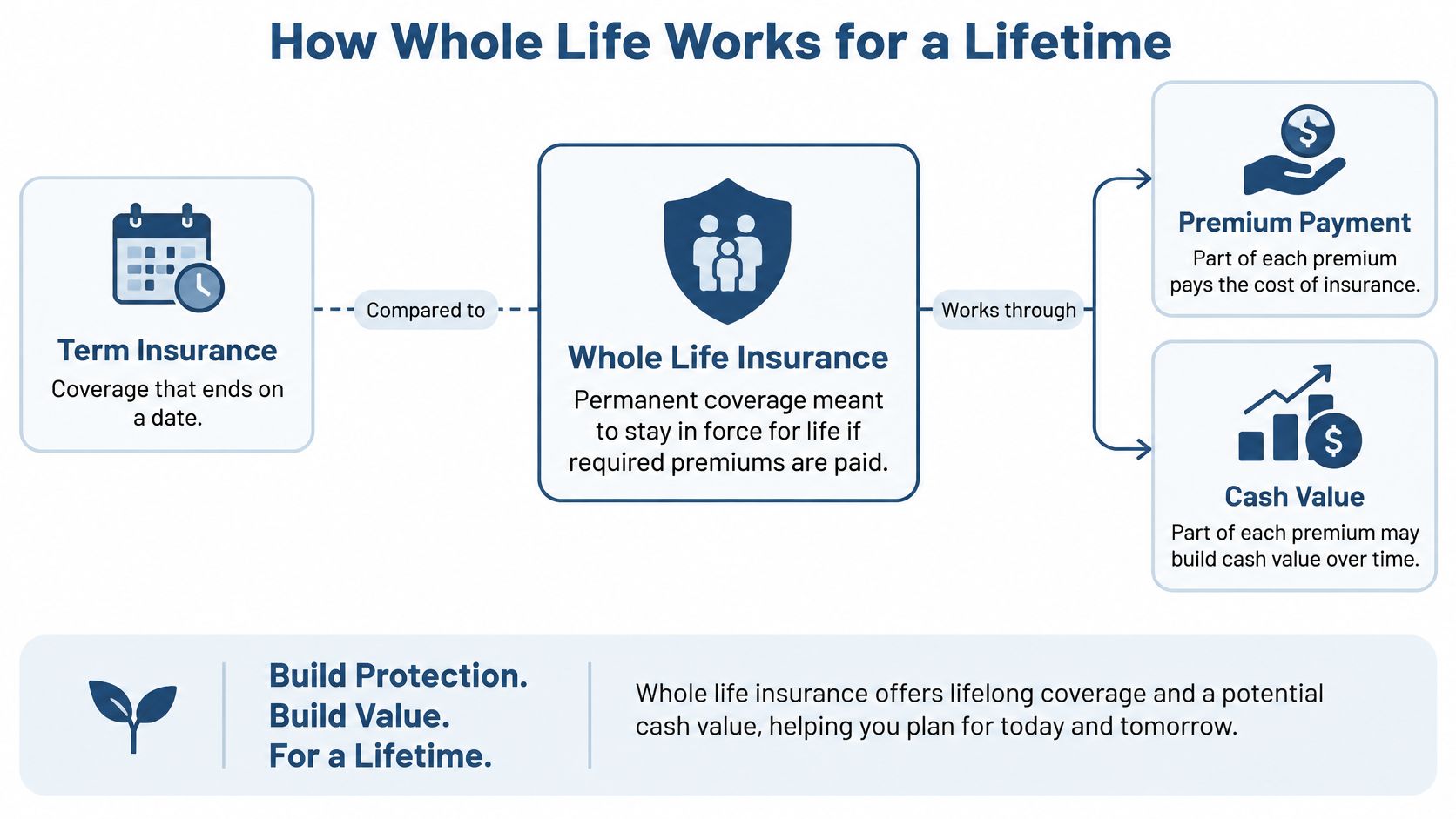
Whole life combines protection for your beneficiary with value you may be able to access while living. Those features belong to the same contract, so using one can affect the other.
The National Association of Insurance Commissioners consumer guide describes whole life as permanent coverage intended to remain in force for life if required premiums are paid, with cash value accumulating on a tax-deferred basis after applicable expenses and insurance charges.
Start with the premium
Your premium doesn't all become savings. The insurer uses money to cover insurance costs and policy expenses, while the contract builds cash value according to its terms.
With ordinary level-premium whole life, payments generally remain consistent through life or until cash value equals the face amount. Face amount means the policy's stated insurance amount, before adjustments such as outstanding loans.
Limited-payment whole life shortens the premium-paying period. It requires larger payments because the policy must build sufficient value sooner, not because the insurer is giving you the same promise at a discount.
That distinction matters when retirement income will be lower than working income. Finishing payments earlier may be useful, but only if the larger bill doesn't force you to spend savings needed for housing, healthcare, or emergencies.
Then consider access to cash value
Say a homeowner borrows against available cash value to pay for a roof repair. The repair is finished, but the policy loan remains an obligation under the contract.
If the homeowner dies without repaying it, the beneficiary generally receives the death benefit reduced by the outstanding loan and applicable interest. The family shouldn't plan around the original face amount as though no borrowing occurred.
Withdrawals can also reduce what remains for beneficiaries. If loans or withdrawals leave insufficient value to support the policy, coverage can lapse.
- Ask about loan interest. Get the rate terms and an illustration showing what happens if you make no repayments.
- Check the available amount. Cash value isn't necessarily equal to the premiums you've paid.
- Request an updated projection. Have the insurer show the effect on both future coverage and the beneficiary's payment.
Cash value is part of the insurance plan, not a separate emergency fund with no effect on your family's protection.
For someone buying whole life insurance for seniors over 60, permanence can address a lasting obligation. But a lifelong promise only helps when the required payments remain manageable.
Premiums, Longevity, and the Illustration Test
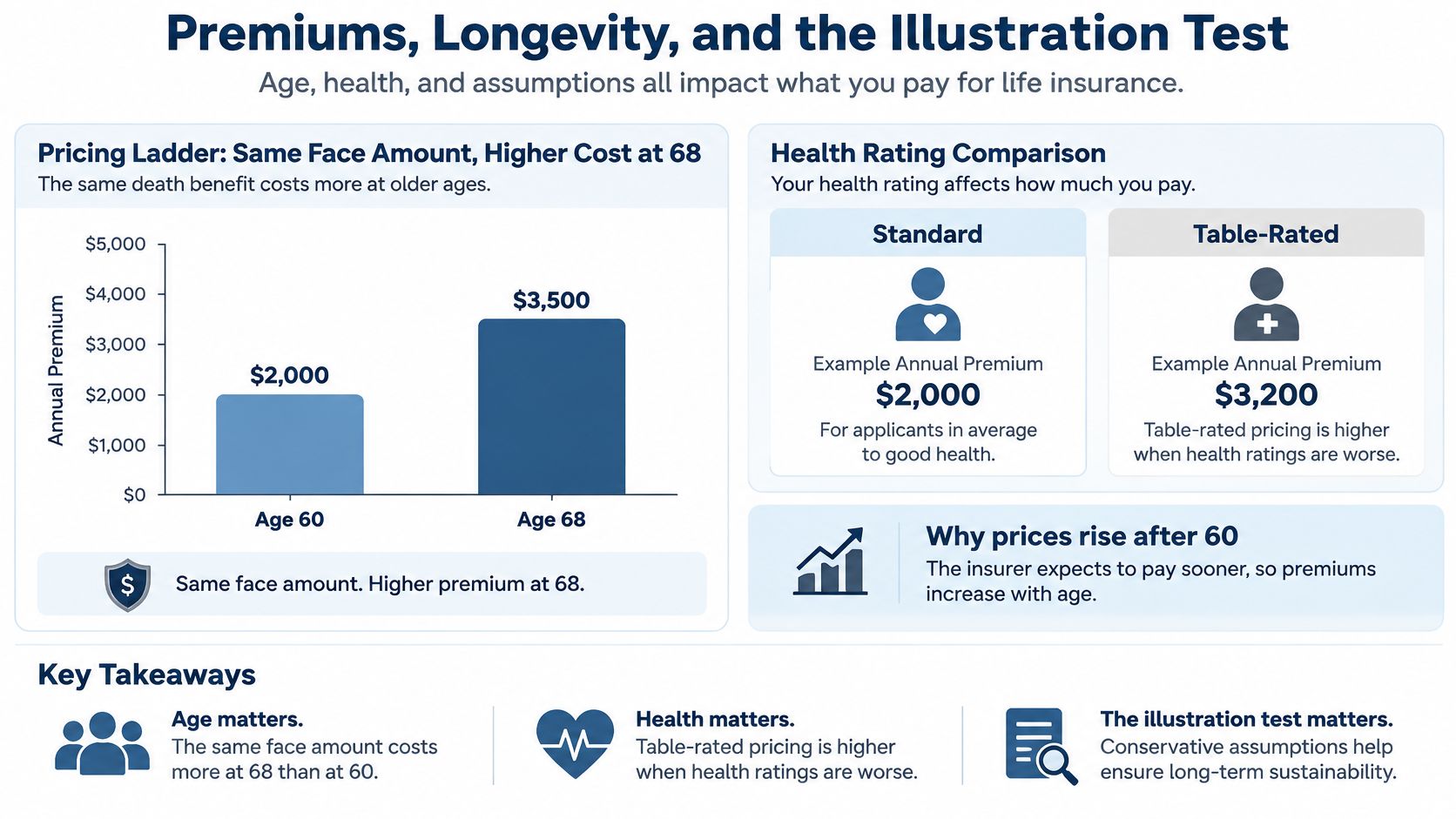
Insurers price a new policy partly around how soon they expect to pay a claim. An older applicant generally faces a higher price for the same benefit, and a less favorable health assessment can increase that price further.
A table rating is an insurer's pricing adjustment for additional health risk. It isn't the same as being declined, but it can change whether a policy fits your budget.
Plan for a long payment horizon
The U.S. Centers for Disease Control and Prevention life-expectancy series reports that life expectancy at age 65 was 19.7 additional years in 2024, approximately 18.1 years for men and 21.0 years for women.
These are population averages, not a personal forecast. Your health, circumstances, and family history won't follow an average on command.
The practical question is whether your payment plan works across a long retirement. A premium that fits while you're taking regular contracting jobs may feel different after you reduce your hours or stop working.
Ask how the insurer determines your application age, too. This explanation of attained age versus issue age can help you distinguish pricing terminology from the premium guarantees in the contract.
Read the illustration before accepting the quote
A policy illustration shows how premiums, death benefits, and cash values develop under stated assumptions. Treat it as a comparison document, not a promise that every column will occur.
- Use your actual application details. Request the illustration for your age, proposed benefit, health classification, and payment schedule. A sample for a healthier applicant isn't your offer.
- Separate guarantees from projections. Identify the guaranteed death benefit and cash value. Dividends or other non-guaranteed assumptions shouldn't fund an essential family obligation.
- Compare cumulative premiums with protection. Find when total premiums paid approach the guaranteed death benefit, if they do. That's a cost checkpoint, not an investment return calculation or proof that keeping coverage is pointless.
- Confirm when required payments stop. Ask what happens if your earnings fall before that date and whether the policy has contractual options that could preserve reduced coverage.
For self-employed buyers, test the payment against a slow season rather than a strong month. For early retirees, include healthcare and household costs before deciding what remains for insurance.
A late lapse can leave you shopping again with an older application age and a changed medical history. Don't assume replacing lost coverage will be straightforward.
How Much Coverage Is Actually Enough
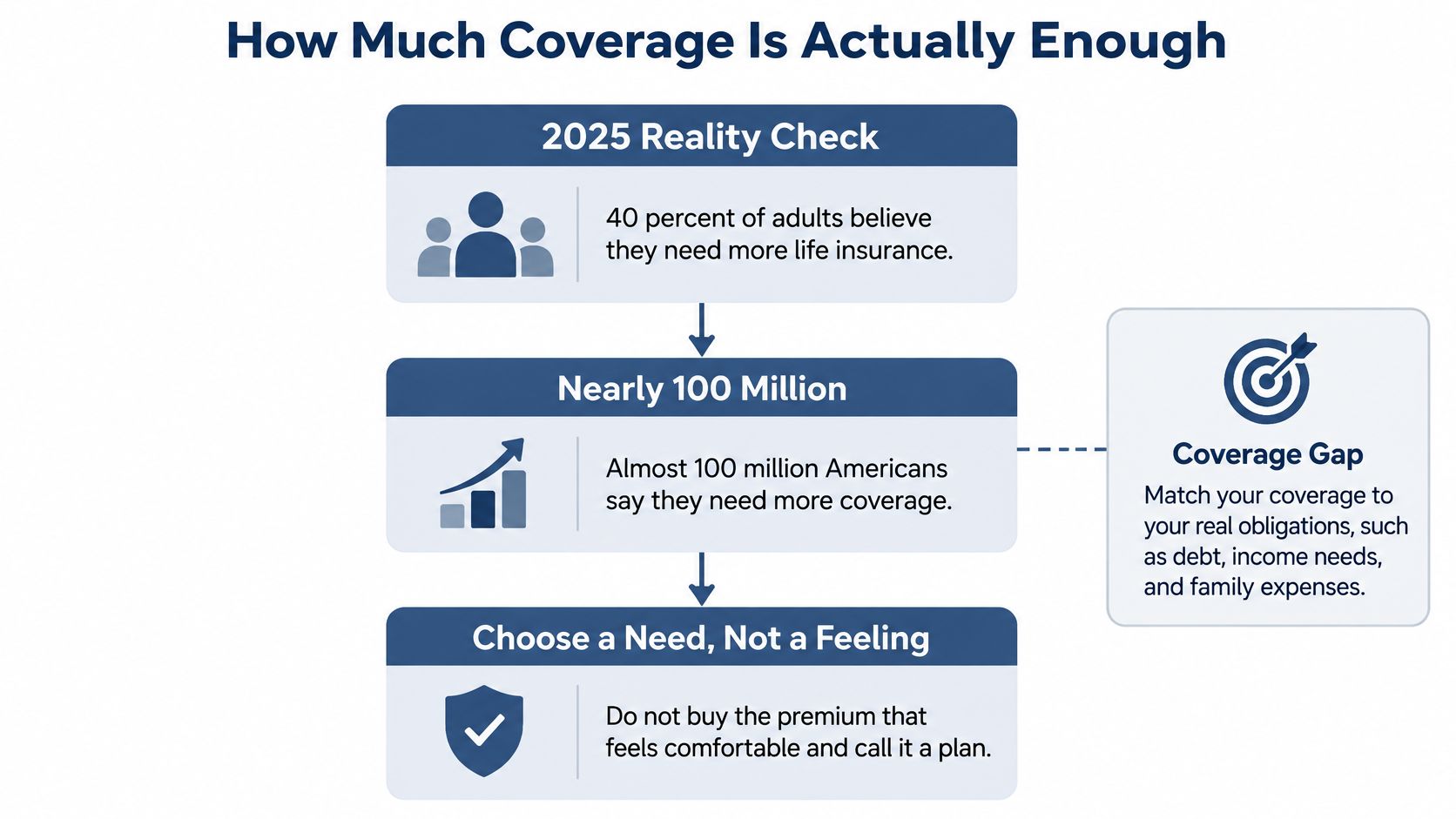
A funeral-sized policy can be affordable and still leave your spouse exposed. Paying for arrangements doesn't pay the next mortgage bill, replace earnings, or cover help you previously provided without charge.
The LIMRA life insurance facts document reports that 40% of U.S. adults believe they need more life insurance, nearly 100 million people, and 40% say their loved ones would be barely or not at all financially secure after the primary earner's death.
Build the bills before choosing the benefit
Start by pricing your preferred funeral arrangements locally. Add likely last medical bills, then compare that subtotal with the policy you're considering.
Build the remaining needs separately:
- Debt protection. List the mortgage and other balances you want the benefit to address. Identify which payments the surviving household would still need to make.
- Household support. Estimate the gap between a survivor's reliable income and basic expenses. Choose a support period that reflects their situation.
- Business and caregiving obligations. Include business commitments and the cost of replacing unpaid care, transportation, or household work.
- Inheritance. Keep an optional gift separate from essential bills so it doesn't crowd out necessary protection.
Don't count the same expense twice. If the plan pays off the mortgage, adjust the survivor's ongoing housing budget accordingly.
Separate permanent needs from temporary ones
Consider a hypothetical buyer offered a small final-expense policy while a substantial mortgage remains. The policy may handle arrangements well, but calling it complete family protection would disguise the mortgage gap.
A larger whole life policy might cover more of the need. Another possibility is a smaller permanent policy paired with term coverage for the debt's remaining duration, provided the buyer qualifies.
If paying for care while alive is the main concern, separate that problem from funeral funding. Velma's overview of hybrid life and long-term care plans offers context for comparing products designed around both purposes.
Budget check: If the adequate benefit costs too much, change the coverage strategy openly. Don't quietly shrink the benefit and assume the original problem is solved.
Use this paper calculation: final bills + selected debts + survivor income gap + other obligations + optional legacy − resources available for those purposes.
Prepare a basic-needs version and a more comfortable version to establish a coverage range. This guide to estimating life insurance needs at retirement age can help organize the calculation.
Revisit local funeral prices and household expenses over time. A fixed face amount won't automatically keep pace with rising bills.
No Exam Coverage Versus Full Underwriting
No medical exam is an access feature, not proof of a better policy. You still need to know what the insurer asks, how much protection it offers, and when the full benefit becomes payable.
Underwriting paths for whole life after 60
| Path | Health questions | Benefit timing | Typical limits and price | Best use |
|---|---|---|---|---|
| Fully underwritten | Detailed medical history; an exam may be required | Full stated benefit when coverage takes effect, subject to contract terms | More room for larger benefits; favorable health can earn better pricing | You can qualify and want to compare coverage per premium dollar |
| Simplified issue | Short health questionnaire, usually no exam | May offer immediate full coverage; check restrictions | Smaller benefit choices and potentially higher pricing than a favorable fully underwritten offer | Your health fits the insurer's abbreviated rules |
| Guaranteed issue | No health questions | Often restricted illness benefits during an initial graded period | Low face limits and high cost per dollar | Health prevents other coverage |
Find out what easier approval costs
Simplified applications may ask about diagnoses, treatment, medication use, hospital stays, and daily functioning. Answer the exact question asked, including its stated look-back period, rather than assuming a controlled condition doesn't count.
A graded death benefit restricts what the insurer pays during an initial period. For an illness-related death, the contract may return premiums plus specified interest instead of paying the face amount; accidental-death treatment may differ.
Ask the agent to point to the benefit schedule, exclusions, and effective date in the actual contract. This guide to whole life insurance without a medical exam can help distinguish no-exam coverage from no-health-questions coverage.
Check usefulness while you're alive
A 2025 survey discussed by Corebridge Financial found that 84% of respondents considered long-term-care funding features valuable, while only 37% had estimated total funeral and end-of-life expenses.
Interest in care funding doesn't mean a particular policy provides it. A chronic-illness or long-term-care rider must be included, and you must meet its eligibility conditions.
- Benefit access. Ask which diagnoses or functional limitations qualify and what documentation is required.
- Family protection. Have the insurer show how using a living benefit changes the remaining death benefit.
- Exit costs and taxes. Review surrender charges and consult a qualified tax professional before accessing cash value.
Compare full underwriting when your health makes it realistic. Consider simplified issue when its health rules fit, and reserve guaranteed issue for a genuine health barrier.
Term may serve a temporary income gap better. A final-expense policy may be sufficient for a narrow burial need, while a care-oriented product deserves consideration when care funding is the main objective.
A Couple at 65 Walks Through the Choice
Consider a hypothetical couple: Pat, 65, is self-employed and easing toward retirement. Jordan, 66, receives a modest pension but couldn't comfortably run the household without Pat's income.
Their decision starts with statements and bills, not an application.

The easy application misses the bigger bill
In this example, they owe about $80,000 on the house, with nine years remaining. They set a hypothetical funeral budget of $12,000, subject to local quotes, and would like to leave a modest gift if it doesn't strain their finances.
The first offer they consider is a hypothetical $15,000 guaranteed-issue policy. It appears to address their funeral target, but it doesn't solve the mortgage balance or Jordan's loss of household income.
They put that offer aside rather than treating easy approval as the deciding factor. Pat prepares a medication list and medical history so an agent can assess other underwriting paths.
They compare a split plan with a larger permanent policy
Their next hypothetical proposal combines a small level-premium whole life policy for final expenses with a ten-year term policy aimed at the mortgage. Before settling on its amount, they also calculate Jordan's living-cost gap instead of assuming mortgage protection solves everything.
They compare that proposal with a larger whole life policy. Pat could pursue it if health permits and the guaranteed premium fits, but the couple tests the payment against a slow work year.
A shortened payment schedule looks attractive until they place it beside Medicare-related costs, household bills, and emergency savings. They won't drain their cash reserve just to finish insurance payments sooner.
Keep the couple's separate needs in mind while considering the coverage discussion.
Their choice follows the actual offers
For this scenario, assume Pat qualifies for the split plan at a sustainable price. They choose it after adjusting the temporary benefit to reflect both the mortgage and the agreed household support gap.
If Pat's medical history prevented full underwriting, they'd evaluate simplified issue for the permanent piece and keep the term proposal only if available. They wouldn't pretend an unavailable policy was part of their plan.
They treat an inheritance as optional. The number they refuse to guess is future non-guaranteed cash value: neither Jordan's housing budget nor their premium plan relies on it.
Choose a Policy You Can Keep
Buy the smallest contract that covers the bills and that you can pay during a bad year. The easiest application isn't necessarily the most useful protection.
The NAIC guide to choosing life insurance supports comparing guaranteed benefits, cash values, payment duration, and cumulative premiums rather than relying on the monthly price or non-guaranteed projections.
Put the decision in writing
- List the obligations. Write down funeral costs, debt, and a spouse's living-cost gap. Mark which needs last for life and which end on a date.
- Set a premium ceiling. Use income you can rely on, including a self-employed slow season or an early-retirement healthcare budget.
- Compare payment schedules. Request lifetime-pay and shorter-pay illustrations at the same face amount. Read the guaranteed columns first.
- Choose a realistic health path. Ask whether full or simplified underwriting is available before accepting guaranteed issue because it's convenient.
- Protect existing coverage. Don't cancel an old policy before the new contract is confirmed in force and you've compared replacement costs and restrictions.
- Prepare the beneficiary. Check the designation and tell that person where to find the policy and claim instructions.
For help comparing carrier quotes with a licensed agent, My Policy Quote is one option alongside an independent insurance agency or your existing insurer. That assistance can be useful if you're self-employed or retiring without workplace coverage.
The payment you can maintain matters more than the benefit you can afford only while everything goes well.
Choose a promise your household can keep, not a policy that disappears when the budget tightens.
Common Questions About Whole Life After 60
Is whole life worth it after 60?
It can be when the need lasts for life and the payment is sustainable. A temporary obligation may fit term better.
Will my premium rise as I get older?
A new policy generally costs more at an older application age. That doesn't mean an existing guaranteed level premium rises each birthday.
Can I stop paying premiums?
Only if your contract permits it without losing the protection you need. Ask about paid-up options before stopping payments.
Does a policy loan cost anything?
Yes. Review loan interest and request the resulting beneficiary amount before borrowing.
What happens if I die during a graded period?
The cause of death and contract schedule determine payment. Don't assume your beneficiary receives the advertised face amount immediately.
Is no exam always better?
No. Compare the actual benefit, price, and restrictions, not just the application process.
Should I replace my old policy?
Only after comparing both contracts and confirming the replacement is in force. Existing coverage may have valuable terms.
Can accessing cash value create taxes?
It can. Ask a qualified tax professional before withdrawing, borrowing heavily, or surrendering coverage.
For a separate legal concern, the Law Office of Bryan Fagan – Kingwood TX Lawyers discusses protecting family assets before nursing home care. Insurance selection doesn't replace individualized elder-law advice.
My Policy Quote offers access to licensed agents and quotes from multiple carriers, including permanent and final-expense options. Bring your family's needs estimate, medication list, and premium ceiling to My Policy Quote to compare coverage amounts, payment schedules, and underwriting paths.