

You've finished a client project, paid your business expenses, and opened a health insurance quote that looks manageable until you notice the deductible. Another plan costs more each month, but your doctor accepts it and your prescriptions look cheaper. Which one can your business afford?
For self-employed health insurance in Florida, the useful comparison isn't just the monthly premium. It's what you'll pay over the whole year, how much you could owe during a difficult medical year, and whether your income estimate will hold up when you file your taxes.
Florida Coverage Routes at a Glance
Start with the ACA Marketplace if you don't have job-based coverage, then compare alternatives that fit your circumstances. These routes aren't interchangeable, particularly when you need treatment for an existing condition.
Florida coverage routes for self-employed people
| Option | Best fit | Cost help | Pre-existing conditions | Enrollment timing |
|---|---|---|---|---|
| ACA Marketplace through HealthCare.gov | Independent workers without qualifying job-based coverage | Income-based premium tax credits | Covered | Open enrollment or qualifying special enrollment |
| Florida Medicaid | People meeting Florida's income and eligibility categories | Free or low-cost coverage | Covered | Applications accepted year-round |
| COBRA | Someone recently leaving an employer plan | Generally paid entirely by the enrollee | Existing plan protections continue | Follow the election deadline in your notice |
| Short-term limited-duration plan | A temporary coverage gap | No Marketplace subsidy | May be excluded or grounds for denial | Insurer application rules and duration restrictions |
| Association or group plan | Members of a qualifying trade or professional group | Ask for the group's actual contribution | Confirm ACA compliance | Association and plan enrollment rules |
| Catastrophic plan | Applicants meeting age or exemption requirements | No premium tax credit | Covered under ACA rules | Marketplace enrollment rules apply |
| Direct-to-carrier ACA plan off exchange | Someone comparing unsubsidized comprehensive coverage | No Marketplace subsidy | Covered if ACA-compliant | Open enrollment or qualifying special enrollment |
The Marketplace isn't a niche option: 4,735,415 Floridians selected plans during the 2025 Open Enrollment Period, according to CMS's national enrollment snapshot. Plan selection, however, isn't proof that someone paid the initial premium and activated coverage.
Check the traps before comparing prices
- Medicaid eligibility: Florida hasn't expanded Medicaid. Very low income alone generally doesn't qualify a working-age adult without dependent children, although other eligibility categories can apply.
- COBRA deadlines: Read the election notice immediately. Don't assume you can return to your former employer's plan whenever you want.
- Association coverage: Ask whether the actual policy is ACA-compliant major medical insurance, rather than assuming association membership guarantees broad benefits.
Short-term policies also deserve careful reading. They aren't required to provide the same essential health benefits as ACA coverage, so a low quote can represent substantially narrower protection.
For ongoing counseling, Wald Behavioral Health's guide to insurance coverage for online therapy offers useful context for questions about telehealth benefits and provider participation.
Match your income, medical needs, and employer-coverage history to a route before shopping by price. Someone leaving an employer plan needs a different comparison from someone launching a business without prior coverage.
What Your Real Annual Cost Looks Like
Expected annual cost equals annual net premiums plus expected out-of-pocket medical spending. Don't automatically add the entire deductible again: deductible payments are part of out-of-pocket spending, not a separate bill on top of it.
For a difficult medical year, use a second calculation: annual net premiums plus the plan's in-network out-of-pocket maximum. Then allow separately for services the plan excludes and charges that don't count toward that maximum.
Keep your income records beside your plan comparison rather than treating these as separate projects.

Estimate profit before estimating assistance
The Marketplace uses projected annual household income and household size, not just your gross invoices; HealthCare.gov's self-employed coverage guide also explains why earnings changes can affect assistance and require application updates.
Begin with your expected business receipts and subtract legitimate business expenses. Then account for other income included in the household calculation, such as a spouse's wages. Your business profit is the starting point for many contractors, not necessarily the finished household-income figure.
Say a freelance designer signs a large contract but must purchase materials and hire outside help to complete it. Reporting the full contract payment as profit overstates what the business earned. Reporting only the designer's personal withdrawals can understate it, because owner draws aren't the same thing as deductible expenses.
Use your bookkeeping ledger, recent tax return, and signed contracts together. Last year's return gives you a baseline, while current records show whether that baseline still makes sense.
Practical rule: Estimate the income you reasonably expect, not the income that produces the premium you want.
Understand the subsidy cliff
Premium tax credits lower the amount eligible households pay for Marketplace insurance. The credit calculation uses a benchmark Silver plan, but that doesn't mean you must buy that particular plan or that every available plan will cost the same.
The enhanced credits expired at the end of 2025, restoring the 400% federal poverty level subsidy cliff; the Bradford Informed Guidance explanation also reports CMS's projection that the average after-credit premium for the lowest-cost HealthCare.gov plan would reach $50 monthly in 2026, up $13, with credits covering 91% of that plan's premium for eligible enrollees.
Those are averages and projections, not your quote. Your county, household details, available plans, and eligibility determination still control your result.
A cliff differs from a gradual reduction in assistance. When a household crosses the applicable income boundary, it can lose eligibility for the credit rather than merely paying slightly more. That makes a late-year contract, a spouse's raise, or unexpectedly strong business profit important to review before assuming your existing premium will remain affordable.
Don't use a remembered dollar threshold from another coverage year. The poverty guidelines used for eligibility and the rules governing assistance must match the year you're buying coverage.
Compare households without inventing quotes
A single freelancer expecting moderate net profit should first check whether assistance makes a Marketplace plan affordable. The next question is whether the resulting premium leaves enough cash for routine care and the deductible.
An older single contractor above the applicable subsidy boundary faces a different problem: the quoted premium may be entirely their responsibility. That person should compare Marketplace and off-exchange choices without assuming a tax credit will appear later.
A self-employed couple with children needs a household-level assessment. The adults and children may receive different eligibility results, and the family's combined income matters more than either parent's business revenue alone.
Sample self-employed scenarios in Florida
| Scenario | What drives the cost | Monthly net premium |
|---|---|---|
| Single freelancer | Income-based assistance and the local Silver benchmark | Selected plan premium minus the credit confirmed on HealthCare.gov |
| Single contractor above the applicable poverty-line ceiling | Ineligibility for a premium tax credit | Full quoted premium, confirmed on HealthCare.gov |
| Self-employed couple with children | Household size, combined income, and each member's eligibility | Total premiums for the household's selected coverage after approved assistance |
The right number in this table is an application result, not a statewide estimate.
Before deciding, watch with your own application questions in mind.
Build a usable annual comparison
For a worked comparison, take one freelancer's actual quote. Multiply the net monthly premium by the months of coverage, then add expected prescription payments, office visits, and other covered care. If you include an anticipated procedure, use the insurer's estimated member responsibility, not the provider's full billed charge.
For rehabilitation outside your benefits or network, MedAmerica Rehab Center's explanation of rehab costs in Deerfield Beach can help you identify cash-price questions to ask. Don't count an uncovered expense as though it will necessarily reduce your plan's deductible.
Record both the expected annual total and the high-use annual exposure. A plan can win the first comparison and lose the second.
At each quarterly bookkeeping review:
- Compare profit: Check year-to-date net earnings against your original forecast.
- Revise the remaining months: Include likely contracts, seasonal slowdowns, and expected expenses.
- Update the application: Report meaningful changes instead of waiting until tax preparation.
- Save the evidence: Keep the ledger and assumptions supporting the revised estimate.
Overestimating income can reduce advance assistance. Underestimating it can leave you with excess advance credits to reconcile at tax time.
Bronze, Silver or Gold for Your Cash Flow
Lower premiums usually mean accepting more spending when you use care. That trade can work for a healthy freelancer with savings, but it can strain someone who needs regular appointments and has uneven monthly revenue.
Metal tiers describe how plans divide covered costs across a standard population. They don't promise that an insurer will pay the same share of your individual bills, and they don't rank the quality of your doctors.
Metal tiers and cost-sharing reductions
| Metal tier | Typical share of costs covered | Trade-off |
|---|---|---|
| Bronze | Lower standard share | Often lower premiums with greater point-of-care exposure |
| Silver | Intermediate standard share, increased for qualifying cost-sharing reductions | The tier to examine for income-based deductible and copay savings |
| Gold | Higher standard share than ordinary Silver | Higher premiums may buy more manageable treatment costs |
| Platinum | Highest standard share | Often higher premiums and lower member cost sharing, where available |
Let your care needs decide
Cost-sharing reductions are different from premium tax credits. For eligible consumers, they improve a Silver plan's deductible, copayments, and other cost sharing. Choosing Bronze because its premium looks cheaper can mean passing up those additional Silver benefits.
A freelancer who rarely needs treatment might reasonably choose Bronze if they can fund the potential bills. Someone managing ongoing prescriptions, preparing for surgery, or expecting maternity care should compare Silver and Gold using the services they're likely to need.
Cost pressure can disrupt coverage: a KFF follow-up survey of Marketplace enrollees found that 9% of former 2025 enrollees were uninsured and 28% had switched Marketplace plans, with cost a major reason. Those findings describe the surveyed population, not a Florida-only result.
A premium you can afford isn't enough if you can't afford to use the coverage.
Before selecting a plan, complete these checks:
- Confirm clinicians and facilities: Verify the exact plan network with both the insurer and the provider, including the hospital where a specialist operates.
- Check every prescription: Look up the drug, dosage, tier, pharmacy rules, and any prior authorization requirements.
- Calculate high-use exposure: Compare premiums and the applicable out-of-pocket maximum, while keeping excluded and out-of-network expenses separate.
If you consider changing plans during the year, ask what happens to deductible progress, existing authorizations, and scheduled care. A cheaper replacement can create expensive interruptions.
Tax Deductions and HSAs That Lower Your Bill
Tax benefits can reduce the cost of qualifying health spending, but they don't make premiums free. Treat the deduction and an HSA as planning tools, not reasons to buy coverage you can't comfortably fund.
Follow the tax forms in order
Start with the business results on Schedule C or Schedule F, as applicable. The IRS draft instructions for Form 7206 explain that the self-employed health insurance deduction is an above-the-line adjustment, limited by qualifying earned income from the business, with Form 7206 used when required and the deduction reported on Schedule 1.
That differs from an itemized medical deduction. You don't need to itemize to claim the self-employed adjustment, but you do need to meet its eligibility and business-plan requirements.
Tax treatment of health costs for self-employed Floridians
| Tax item | Who qualifies | Where it is reported | Main error to avoid |
|---|---|---|---|
| Self-employed health insurance deduction | Eligible self-employed taxpayers with supporting business earnings | Schedule 1, using Form 7206 when required | Deducting premiums already covered by credits |
| Premium tax credit | Eligible Marketplace enrollees | Federal premium tax credit reconciliation with the income tax return | Ignoring excess advance assistance |
| HSA contributions | People meeting current HSA eligibility rules | HSA reporting with the federal return | Assuming a high deductible alone establishes eligibility |
| Itemized medical expenses | Eligible taxpayers who itemize | Schedule A | Counting expenses already deducted elsewhere |
The interaction most likely to cause confusion is premium assistance plus the insurance deduction. You can't deduct the sticker premium when a tax credit paid part of it. The final credit and deduction require coordination, so give your preparer the complete insurance records rather than only bank withdrawals.
The guide to the self-employed health insurance deduction offers additional context for that conversation. Ask specifically about months when an employer-subsidized plan was available through you or your spouse.
Verify HSA eligibility before contributing
An HSA can provide tax advantages for eligible contributions, growth, and qualified medical withdrawals. Confirm eligibility under current rules, including the plan designation and any other coverage you hold, rather than assuming every Bronze or high-deductible policy qualifies.
For therapy expenses, Be Your Best Self & Thrive Counseling, PLLC's guide to understanding superbills for therapy explains documentation you may encounter. A superbill isn't a guarantee of insurance reimbursement or tax deductibility.
Keep a filing folder containing:
- Premium records: Gross charges and payments.
- Credit records: Advance credits and final reconciled assistance.
- Business records: Income supporting the deduction.
- Coverage records: Covered people, policy months, and employer-plan eligibility.
How to Apply for Coverage Step by Step
Prepare the financial estimate and medical checklist before opening the application. That makes it easier to distinguish an eligibility question from a plan-shopping question.
This visual provides a useful preparation sequence.
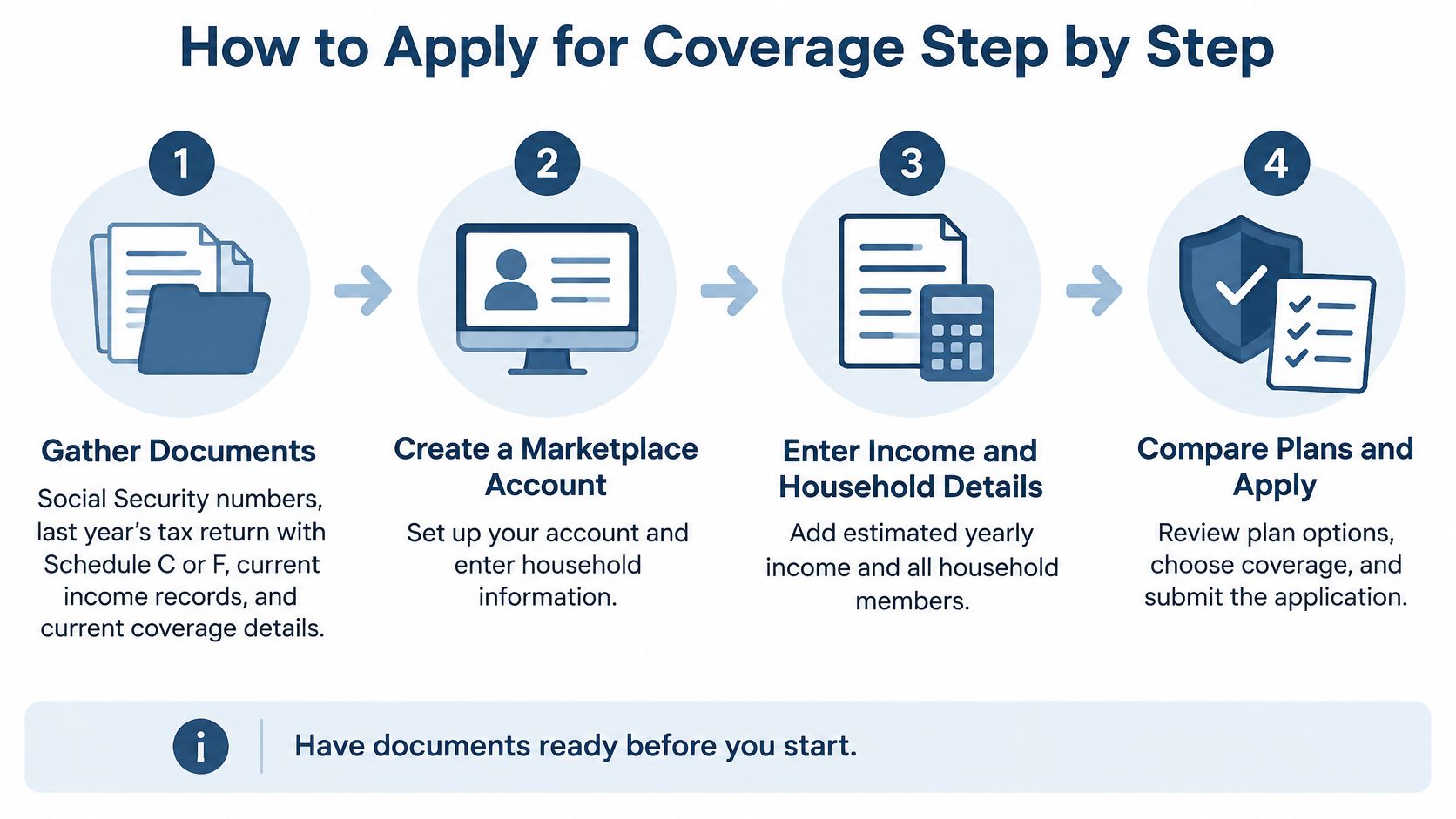
Prepare, apply, and activate
Gather household and business documents. Collect Social Security numbers where applicable, your recent tax return with the relevant business schedule, current income records, and existing policy information. Having these together reduces mismatches between the application and your records.
Create your HealthCare.gov account and select Florida as your state. Enter household members and tax-household information carefully, because the people listed on the application affect the eligibility assessment even when not everyone needs coverage.
Enter your projected income. Use a documented annual forecast rather than copying your best month or your gross deposits. Keep a short note explaining assumptions such as a contract ending or a new client starting.
Compare the actual plan documents, not only the search-results cards. Read the Summary of Benefits and Coverage, provider directory, and drug formulary so you understand what you're buying.
Confirm your enrollment opportunity. Apply during open enrollment or establish eligibility for a special enrollment period, such as after losing qualifying coverage. Follow the deadline and documentation instructions associated with your circumstances rather than assuming every life change has identical rules.
Pay the initial premium according to the insurer's instructions. An application confirmation alone doesn't establish that your policy is active, so verify receipt and the effective date before relying on benefits.
Save your coverage documents. Download the enrollment confirmation, member identification information, benefit summary, and insurer contact details. Check that the covered household members and selected plan match your intention.
Put a recurring income review on your calendar. Compare your forecast with current bookkeeping and report relevant changes promptly, keeping copies of application updates.
The health insurance application guide can help you organize the process if you're applying without assistance.
Before canceling existing coverage: Confirm the new policy's activation and effective date with the insurer.
The most common practical failures to guard against are an unpaid initial premium and an income estimate that drifts away from actual earnings. The first can prevent coverage from starting; the second can create an avoidable subsidy problem even while the policy remains active.
Decide Whether a Florida Broker Is Worth Hiring
Get help when your eligibility or medical needs make a simple price comparison unreliable. If your household is straightforward and you're comfortable reading benefits documents, enrolling yourself can be reasonable. Complicated income, competing employer offers, or ongoing treatment justify a closer review.
Certified application counselors and navigators provide free enrollment assistance. Licensed brokers can also help compare coverage and are typically compensated by insurers, but you should ask whether there's any direct charge before proceeding.
Know what the adviser represents
A broker may work with only certain insurers. Ask which carriers they represent, whether they can assist with Marketplace enrollment, and whether the recommendation includes ACA-compliant major medical coverage.
The overview of health insurance brokers can help you prepare questions before an appointment. Don't treat an insurance license as a substitute for tax advice when your business structure or deduction calculation is complicated.
Useful questions include:
- Market access: Which available insurers won't appear in your comparison?
- Coverage type: Is this insurance, short-term coverage, or a supplemental policy?
- Medical fit: Can you verify my exact doctors and medications against the proposed plan?
- Follow-up support: Who helps if the application requires documents or the insurer hasn't activated coverage?
Bring help in when the details intersect
Multiple contract clients don't automatically make enrollment complicated, but irregular profit and an S-corporation can create questions worth separating between an enrollment adviser and a tax professional. The same applies when income changes sharply during the year.
A household with dependents, a child needing specialist care, or a preferred physician outside a proposed network needs more than a premium quote. Ask the adviser to explain the practical consequences of each recommendation, including continuity of treatment.
An employer offer through a spouse also deserves careful review. Don't decline it on the assumption that Marketplace assistance will necessarily replace it, and don't assume the offer affects every family member identically.
This week, prepare a single shopping file containing your income forecast, doctors, prescriptions, and current coverage details. Whether you apply yourself, use a navigator, or consult a broker, insist on a comparison you can explain in plain language: what you pay to keep the policy, what you pay to use it, and what remains outside its protection.
My Policy Quote offers personalized health insurance quotes through licensed agents for individuals and families, including self-employed Floridians. Visit My Policy Quote with your household income estimate, doctor list, and prescriptions to compare current coverage options by annual cost and medical fit, not just the monthly premium.