

A 2026 comparison priced $10,000 of guaranteed-issue coverage for a 70-year-old man at $99.18 a month, versus $69.78 for simplified issue, about 42% more for the same benefit. Guaranteed issue can make sense when other insurers won't approve you, but first check whether you can qualify for coverage that costs less or pays more promptly.
Maybe you're self-employed, buying coverage after a diagnosis, or trying to spare your family a funeral bill. You want to know whether “guaranteed” means your application will be accepted, what your family would receive, and whether the premium fits your budget. The answer depends not just on approval, but on the benefit schedule and what other policies you might qualify for.
What Guaranteed Issue Whole Life Costs in 2026
For a 70-year-old man seeking $10,000, one 2026 comparison lists guaranteed issue at $99.18 a month and simplified issue at $69.78 a month. That's a $29.40 monthly gap, or $352.80 over a year, for the same face amount. Over a two-year graded period, the difference adds up to about $705.60. Insurance Geek's 2026 comparison provides this example, but it isn't a personalized quote.
| Policy type | Underwriting | Example monthly premium | Benefit size | Natural-death payout |
|---|---|---|---|---|
| Guaranteed issue whole life | No exam; few eligibility questions | $99.18 for a 70-year-old man with $10,000 coverage | Commonly capped around $50,000 | Graded; often a return of premiums at first |
| Simplified issue whole life | Short health questions or a phone interview | $69.78 for the same $10,000 example | Often higher than guaranteed issue; carrier-specific | Often the full benefit if approved |
| Fully underwritten whole life | Medical exam and health history | No example premium available here | Can reach income-replacement and mortgage size | Full face amount, subject to contestability |
The table shows why the lowest premium isn't the only thing to compare. Guaranteed issue avoids a medical exam and detailed health questions, so it may be available to someone turned down elsewhere. Simplified issue asks about health, and a carrier may decline you, but people who qualify can get a lower premium in this example. Fully underwritten coverage asks for more health information, often including an exam and medical records, and may offer a larger benefit to applicants who qualify.
Whole life is permanent coverage with level premiums under the policy terms. That doesn't mean every option has the same price or payout design: guaranteed-issue coverage generally costs more per dollar of benefit because the insurer has less information to assess applicants' health. Its natural-death benefit may also be limited early on.
Match the policy to the bill
A benefit cap matters as much as the monthly cost. A policy with a maximum commonly around $50,000 is generally too small to replace income, clear a large mortgage, or support several dependents. It may fit a funeral and a modest cushion for final bills instead.
Check the total cost, not just the monthly payment. Ask for the premiums over the period when the natural-death benefit is limited, then compare that total with what another policy would cost. The extra $705.60 in this example only buys value if simplified issue would reject you or its terms don't meet your need.
Age, sex, tobacco use, state, and insurer can change a premium, so treat these figures as a benchmark, not a quote. If you can answer health questions, ask for simplified-issue and fully underwritten prices before choosing guaranteed issue. For another way to frame the comparison, see this guide to how much life insurance costs.
How Guaranteed Issue Works and Who Qualifies
Think of guaranteed issue as a door that stays open to many people who might not pass a medical screening. Applicants generally don't take a medical or paramedical exam or answer detailed health questions, although the insurer may ask a few eligibility questions. The Society of Actuaries' report on preneed mortality explains the actuarial challenge: insurers need to estimate claims when people who might be declined or charged more after medical underwriting can qualify without that screening.
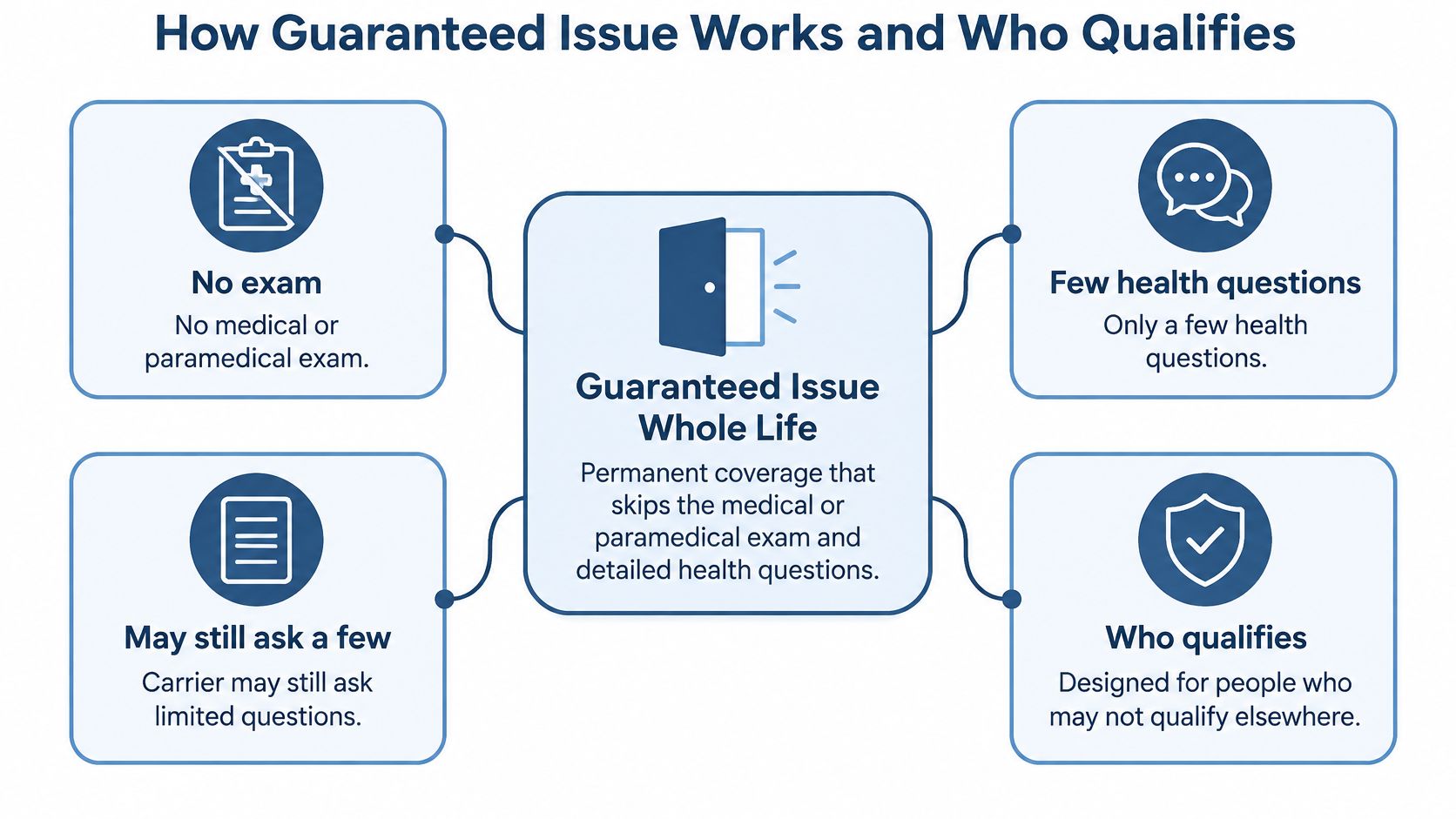
That open door doesn't mean every policy is the same. The insurer may still set eligibility rules based on age, residence, and the amount of coverage requested. A carrier may also ask about specific situations, so read the application rather than assuming “guaranteed issue” means no conditions at all.
Term insurance works differently: it covers you for a set period and can expire. Fully underwritten whole life is also permanent, but the insurer reviews health information to price and approve your application. Guaranteed issue accepts more uncertainty, and that uncertainty affects premiums, benefit amounts, and early payouts.
Why broad access comes with trade-offs
The insurer can't sort applicants as closely by health when it skips detailed underwriting. The Society of Actuaries' research found that mortality is especially high in the first policy year and falls substantially in the second. That pattern helps explain why guaranteed-issue policies commonly combine higher premiums, smaller face amounts, and a graded benefit at the start.
Some older adults, people with a history of heart disease or cancer, people with diabetes or obesity, and families without life insurance through work may find this type of policy worth considering. But eligibility isn't automatically open to everyone in every situation. Check the issue-age range and coverage limits, and ask whether the insurer restricts applications from people receiving hospice care or living with a terminal diagnosis.
Practical rule: A diagnosis isn't the same as a decline. Find out whether another policy will consider your health before you assume guaranteed issue is your only option.
This coverage is most suited to a modest final expense or a small bill cushion when other applications have failed. It's a poor fit for a large mortgage or ongoing income support if the amount available can't cover that need. Cash value may be low or absent early on, and surrender charges or a policy loan can leave your beneficiaries with less than the stated face amount.
For a plain-language explanation of how insurers evaluate applications, use this guide to underwriting in insurance.
Graded Benefits During the Waiting Period
The waiting period is part of what you're paying for, not a minor clause. Premiums can stay level while the policy remains in force, but the full natural-death benefit may not be payable during the initial graded period. The Florida Department of Financial Services' life insurance guide explains that early benefits may be limited to premiums paid before they increase to the full amount.
| Situation | Natural death | Accidental death | What to verify |
|---|---|---|---|
| During the graded period | Commonly a return of premiums, sometimes with stated interest | Often the full face amount | The year-by-year schedule and accident definition |
| After the graded period ends | Full death benefit | Full death benefit | The exact date full benefits begin |
| Loan outstanding | Face amount minus loan and accrued interest | Face amount minus loan and accrued interest | Whether borrowing against a small policy's cash value is worthwhile |
A return-of-premium design can mean your family receives much less than the face amount if you die naturally during the graded period. Accidental death may qualify for the full benefit, but the contract's definition and exclusions control. Don't assume every insurer uses the same length of waiting period or the same formula.
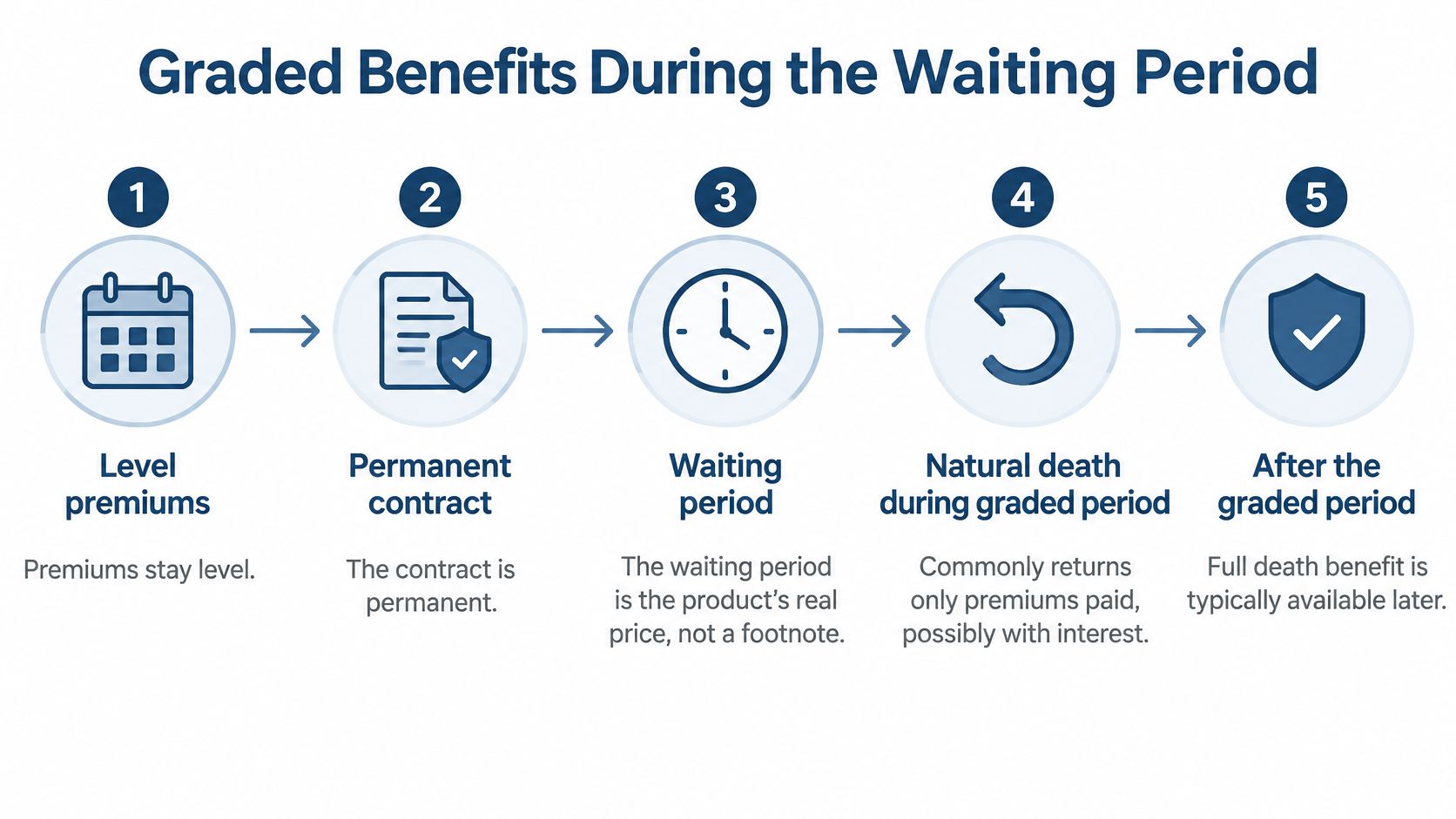
Illustration, not a quote: Say your premium is $80 a month and you've paid for eight months. That's $640 in premiums. If you die naturally while the graded provision applies, the policy could return about that amount instead of paying a $10,000 face amount, depending on its contract.
Read the contract before you apply
A policy loan can reduce the eventual payout, even if the policy's face amount is described as guaranteed. If the insurer subtracts the loan and accrued interest from the death benefit, your beneficiary receives less. Check whether borrowing from a small policy is useful, especially when the cash value starts low and the loan could cut into money intended for final expenses.
Before you pay, look for the natural-death benefit schedule, the accident definition, exclusions, contestability clause, guaranteed cash-value figures, surrender charges, and loan rules. Early claims may also be reviewed if an answer on the application was inaccurate. The contract, not a general description of the product, sets the benefit.
Burial Coverage and Other Real Uses
Rita is 72 and was declined after a heart procedure. She wants to leave enough for funeral expenses and a small cushion for final bills. Guaranteed issue may be a practical option if other coverage isn't available, as long as her daughter understands that an early natural-death claim might return premiums rather than pay the full face amount.

In a 2024 U.S. life insurance sales dataset, guaranteed-issue policies made up 15% of reported policies and had an average face amount of $9,786, according to Beinsure's coverage of the sales figures. That's a useful scale for thinking about final expenses, not proof that a policy of that size will cover every family's costs or suit every buyer.
Rita's verdict: Choose a modest policy only after comparing alternatives, and make sure her daughter knows what the graded benefit could pay.
Marcus is 61, self-employed, and has diabetes. He thinks no insurer will consider him, but a diagnosis alone doesn't establish that. He should ask about simplified issue first, then see whether fully underwritten coverage is worth applying for before accepting a higher guaranteed-issue premium.
Marcus's verdict: Price policies that ask health questions before choosing one that doesn't.
Helen is 68 and wants $150,000 to help clear her mortgage. A smaller final-expense policy can't replace coverage sized for that debt. She can look into term or underwritten permanent insurance for the mortgage, or separate the problem into a small burial policy and another plan for the remaining balance.
Helen's verdict: Don't use a small guaranteed-issue policy as a stand-in for mortgage protection.
Parents may also consider a modest policy for an adult child with significant health problems, but the purpose should be a defined burial expense, not financial support for the whole family. To compare burial coverage with other life insurance, read this guide to burial insurance versus life insurance.
If you're discussing the choice with relatives, this video offers another way to think through final-expense planning.
Cheaper Policies to Try Before You Buy
A guaranteed-issue policy removes health questions, but that certainty can cost more for each dollar of coverage. The Society of Actuaries reports that actuaries often model simplified-issue mortality as 31% to 60% higher than fully underwritten mortality in early policy durations. The report also explains that simplified-issue policies can differ in their health questions, age limits, benefit caps, and policy duration. Those details affect both approval and price. Read the Society of Actuaries' report on simplified-issue underwriting.
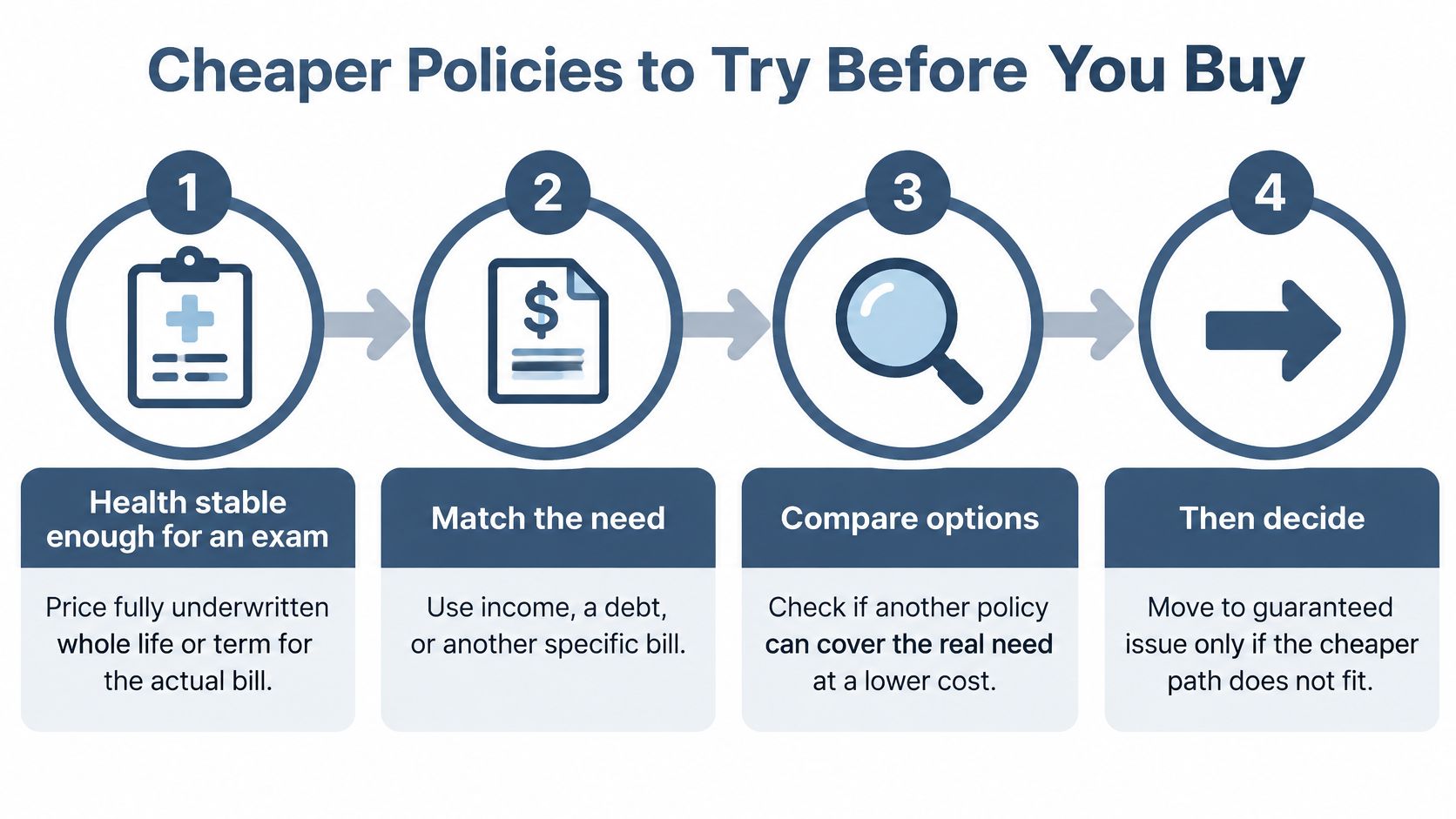
Try options from most screening to least
Start with full underwriting. If you're willing to complete an exam and records review, compare term or fully underwritten whole life for the expense you need to cover, such as a mortgage, income support, or final expenses. Choose a benefit that matches that need.
Try simplified issue next. If you prefer to avoid an exam but can answer health questions, request a simplified-issue quote. A questionnaire or phone interview gives the insurer more information to assess your application, though approval is not guaranteed.
Consider guaranteed issue if the other routes are unrealistic. If you've been declined or can't answer health questions, compare guaranteed-issue coverage for a specific final-expense need. Check the graded-benefit period before deciding whether the premium makes sense.
A diagnosis alone doesn't necessarily rule out full or simplified underwriting. Ask what options are available, then compare each premium with the amount and timing of the benefit. Guaranteed issue trades that screening for greater approval certainty, so the key question is whether the extra cost is worth it compared with the coverage you might qualify for elsewhere.
Compare the real need, not the sales label. A policy helps only if its benefit can cover the expense when your family needs the money, and you can keep paying the premium.
For a broader comparison of how term and whole life premiums differ, read this guide to term versus whole life insurance costs. Insurance professionals who need help with follow-up can also learn how to turn life insurance leads into appointments.
Choose the least expensive policy you can qualify for that pays the needed benefit when your family would need it.
Compare Quotes Before You Lock In a Policy
Make the purchase a deliberate choice, not a reaction to a rejection. Before you apply, write down the bill you want to cover and compare policies that could realistically pay it.
- Name the expense. Write down a funeral, a specific debt, or another bill. Don't buy a larger face amount unless you have a separate need it can meet.
- List your details. Note your age, tobacco status, state, and which health questions you can answer truthfully.
- Request quotes in order. Compare fully underwritten coverage first, simplified issue second, and guaranteed issue last.
- Check the early benefit. Read the natural-death schedule and accidental-death definition before comparing monthly premiums.
- Review the contract costs. Check exclusions, contestability, cash value, surrender charges, and whether a loan would help or reduce the benefit.
- Prepare your beneficiary. Name a primary beneficiary and a backup, then explain what an early claim could pay.
A comparison service can help you review available quote types, but use the same face amount and purpose when you compare them. If you manage several offers, Exerta's practical guide to offer management provides a way to keep their terms organized.
Buy guaranteed issue when it's the only application likely to be approved and its benefit matches a real bill. Otherwise, don't pay extra for a guarantee you don't need.
My Policy Quote offers life-insurance quote requests and comparisons through licensed agents, including help asking about guaranteed-issue and other coverage options. Share the bill you need covered and the health questions you can answer, then visit My Policy Quote to compare your next steps.