

You're sitting at the kitchen table with a quote on your laptop, a mortgage statement beside it, and a number someone online told you to buy. Ten times your salary. Maybe twelve. The premium looks manageable, but you don't know if the policy would keep your spouse in the house, cover childcare, or survive a bad year at work. That uncertainty is the problem. Coverage amount life insurance isn't a salary trick. It's a cash-flow decision, and you need to build it from what your household owes and spends.
Why the 10x Salary Shortcut Usually Fails
I tell families to stop starting with salary. Start with the bills that don't stop when a paycheck does. Rent or mortgage, utilities, food, childcare, car payments, health insurance, and debt minimums keep arriving. A multiple doesn't know if you have three young kids or none, a large mortgage or a paid-off house, two incomes or one.
That's why the shortcut creates two opposite mistakes. A young single-income family can buy what looks like a large policy and still run short once housing and years of essentials are added up. A couple near retirement with adult children and little debt can overbuy income replacement they don't need and waste premium dollars that should go to savings or debt payoff.
The Gap Is a Calculation Problem
In January 2024, 51% of U.S. consumers reported owning life insurance, down from 63% in 2011, while 42% of American adults, approximately 102 million people, said they needed life insurance or additional coverage, the highest level recorded in the study's history, according to the LIMRA and Life Happens 2024 life insurance fact sheet. Read that carefully. Plenty of people already own something. They still know it isn't enough.
Ownership isn't adequacy. A policy through work counts as ownership, even if it disappears after a job change. A small personal policy counts too, even if it wouldn't cover the mortgage. The headline number on the declaration page tells you nothing until you compare it with obligations.
My rule at the table: Coverage amount equals survivor obligations minus dependable resources, tested against bad years, not your best year.
What a Multiple Cannot See
- Income stability: A commission earner or 1099 contractor doesn't have one clean salary to multiply.
- Unpaid labor: A spouse who handles childcare, bookkeeping, or caregiving creates replacement costs even without a W-2.
- Debt structure: Two households earning the same amount can carry completely different mortgage and consumer debt loads.
- Time horizon: A newborn needs support far longer than a teenager headed to graduation.
Use a multiple only as a rough first guess if you must. Don't sign an application based on it. Build the number from obligations, years of support, and resources you can count on when employment changes. That's slower by an hour. It's also the difference between a policy that sounds impressive and one that works.
The Needs-Based Calculation Method
Do this on one page before you request quotes. Write actual balances, not guesses rounded down to feel better. If you don't know a payoff amount, pull the statement.
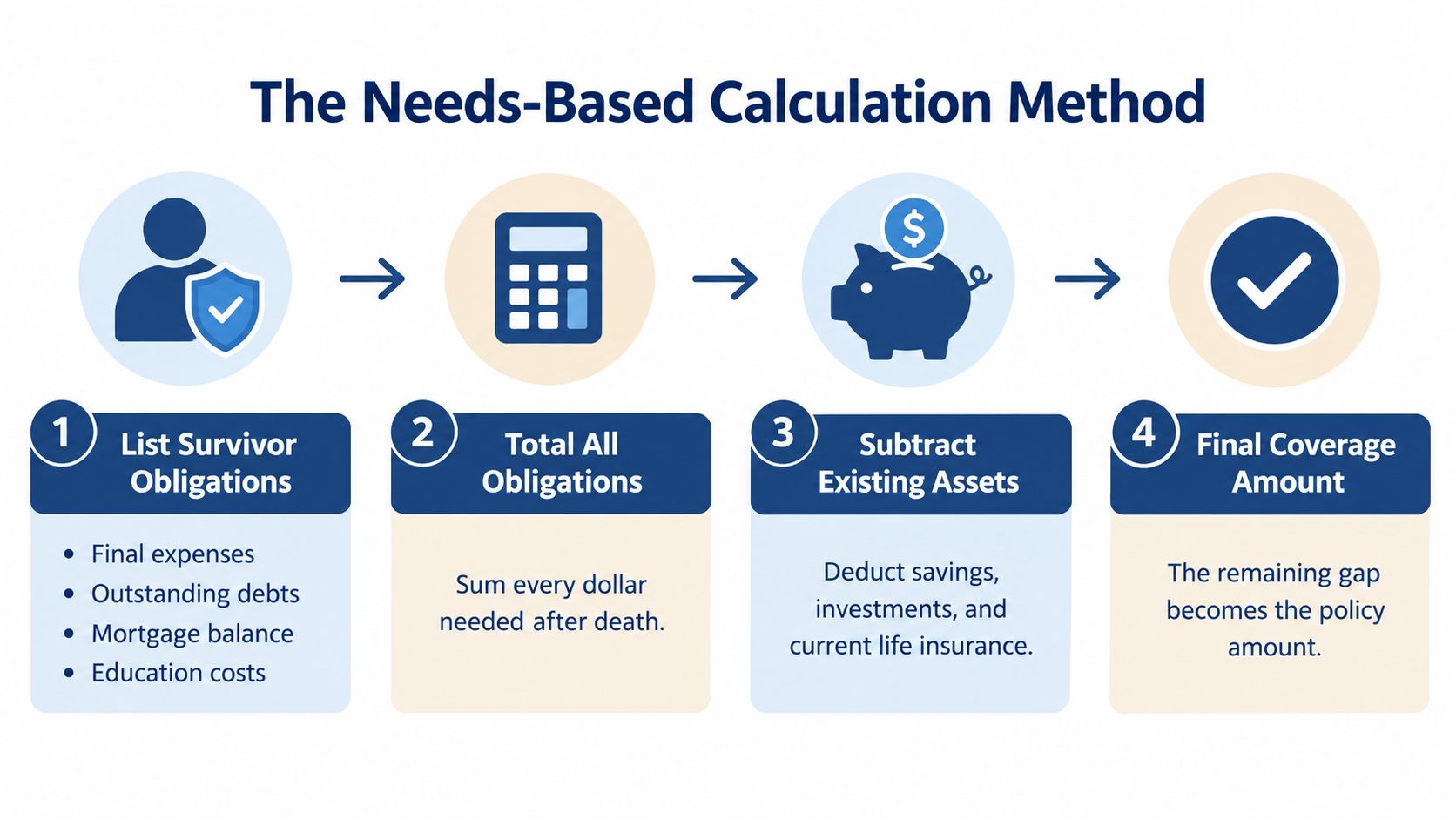
Step One List Every Survivor Obligation
- Immediate costs: Final expenses and any cash needed in the first weeks.
- Debts: Mortgage balance, auto loans, credit cards, and personal obligations. If you're unsure how benefits interact with housing and other borrowing, read the explanation of whether life insurance covers debts like mortgages and loans.
- Future commitments: Education funding, dependent care, and business liabilities.
- Ongoing living costs: The annual household income or services that must be replaced, and for how many years.
The replacement period matters as much as the annual amount. Count the years until your youngest dependent can reasonably be independent, or until a surviving spouse reaches retirement. Don't automatically cut support at age eighteen if your family plan includes education help beyond that.
| Add to Coverage Need | Subtract from Coverage Need |
|---|---|
| Mortgage and consumer debts | Liquid savings you would actually use |
| Final expenses | Personally owned life insurance already in force |
| Education and dependent care | Vested survivor benefits |
| Annual income and unpaid services to replace | Only portable employer coverage expected to continue |
For example, picture a household with a mortgage, other debts, two young children, and income to replace until the youngest is grown. The mortgage is an immediate liability if your goal is a paid-off house. The income piece is annual essentials multiplied across the replacement period, then adjusted later for returns and inflation. Add education only if you'd fund it in life. This produces a range, not false precision.
Step Two Subtract Only Dependable Resources
Liquid savings count. Money you'll need for near-term taxes or a business payroll doesn't count twice. Personally owned insurance counts because you control it. Employer coverage counts only for the portion that's portable and expected to continue.
Families with minor children also need the legal side lined up, because who manages money for a child affects how a benefit is used. Texas families can review Texas guardianship and life insurance policies to understand that connection before naming beneficiaries.
Context helps here. The median face value of in-force U.S. household life insurance policies reached $150,000 in 2022, compared with $61,000 in 1998, even as the share of households owning life insurance fell from 72% in 1970 to 56% in 2022, according to the ACLI 2025 Fact Book on household ownership. A median is not a recommendation. Your total could be far above it and still be right.
Finish with the gap. Obligations minus dependable resources is your starting coverage amount. Quote that amount, then adjust it. Don't let a quote tool reverse the process by selling you whatever fits a preset premium.
Income Replacement Multiples and Where They Break
A multiple is a compressed assumption. When someone says buy ten times income, they're really saying your family needs roughly a decade of that income, with investment returns and spending changes doing quiet work in the background. Change the years, the spending, or the debts, and the multiple should change too. Many individuals never make that translation.
That's why I use multiples as a sanity check, not an answer. If the multiple-based figure doesn't cover your debts plus a solid block of essential living costs, it's too low for your situation. If it dwarfs every obligation you listed and leaves a large surplus with no purpose, ask what you're insuring.
Households Where the Math Collapses
Large mortgages break the model because housing debt isn't proportional to salary in many markets. A family can earn a good income and still carry a balance that consumes much of a multiple-based benefit on day one. The survivor then has a house, but too little cash left for years of living costs.
Very young children break it in another way. The replacement period is long, childcare costs are immediate, and a surviving parent may need to cut hours. A standard multiple assumes the surviving household keeps functioning at the same earning capacity. Real families often can't, at least not at first.
Pre-retirement couples break it in the opposite direction. With no minor dependents and a short bridge to retirement income, replacing many years of full salary can be unnecessary. Their real need may be final expenses, a remaining mortgage, or protecting a spouse who would lose part of household retirement income.
Irregular earners get the worst result. A contractor's best year overstates dependable cash flow, while a slow year understates the value of the business and unpaid work behind it. If you're weighing this tradeoff, the overview of life insurance designed for income replacement is useful background, but still run your own obligations list.
Don't ask which multiple is correct. Ask how many years of which expenses you're replacing, after debts are paid.
That question exposes weak advice fast. If an agent can't show the years and expenses behind the recommendation, you're looking at a sales shortcut, not planning.
Worked Examples for Three Real Households
Different households should land in different places, even with similar incomes. These are illustrative examples using the same obligations-minus-resources method. The point is how the inputs move the answer.

Household One Dual Income With Young Children
Two parents work full time, carry a substantial mortgage, and have two young children. If one parent dies, the survivor still has income, but not enough to keep the house, pay childcare, and maintain essentials without help. The calculation includes the mortgage, remaining debts, several years of the lost income, and education funding, minus savings and personal coverage already owned.
Their need lands high relative to one salary because the replacement period is long and both incomes are already committed to housing and care. Cutting the amount to match a generic multiple would force a housing move or a sharp lifestyle cut during grief. For this family, I would not trim the income block first. I'd look at term length and premium structure.
Household Two Self-Employed Contractor
A self-employed HVAC contractor earns variable income, has no employer benefits, and relies on a spouse who manages scheduling, books, and the household. There's also a business partner and a buy-sell obligation. Replacing only taxable income misses the cost of hired help, lost health benefits, and keeping the business stable long enough to sell or wind down.
I would build this in layers. Household debts and living costs come first. Business continuation and buy-sell funding come next, ideally with the ownership and beneficiary structure matched to the agreement. The spouse's unpaid work gets a real dollar line. Families often underinsure that role badly, which is why the guide to life insurance for a stay-at-home parent is worth reading even when the spouse also helps in the business.
The final range depends on whether business costs are insured separately. That's correct. A single blended number hides who the money is for.
Household Three Pre-Retirement Couple
A couple in their early sixties has adult children, a nearly paid-off home, and retirement savings. They don't need long-term income replacement for dependents. They need enough to cover final expenses, clear remaining debt, and give the survivor breathing room if household retirement income drops.
Their sensible amount is much smaller. Spending heavily to maximising the face amount would crowd out cash reserves and retirement flexibility. Here, a modest policy with a clear purpose beats a large policy bought from habit.
Same method. Three answers. That's how coverage planning should work.
Adjusting for Inflation, Returns, and Existing Assets
Your first total is nominal. It adds up future years as if a dollar later buys what a dollar buys today. Now make it realistic. State your assumptions instead of burying them.
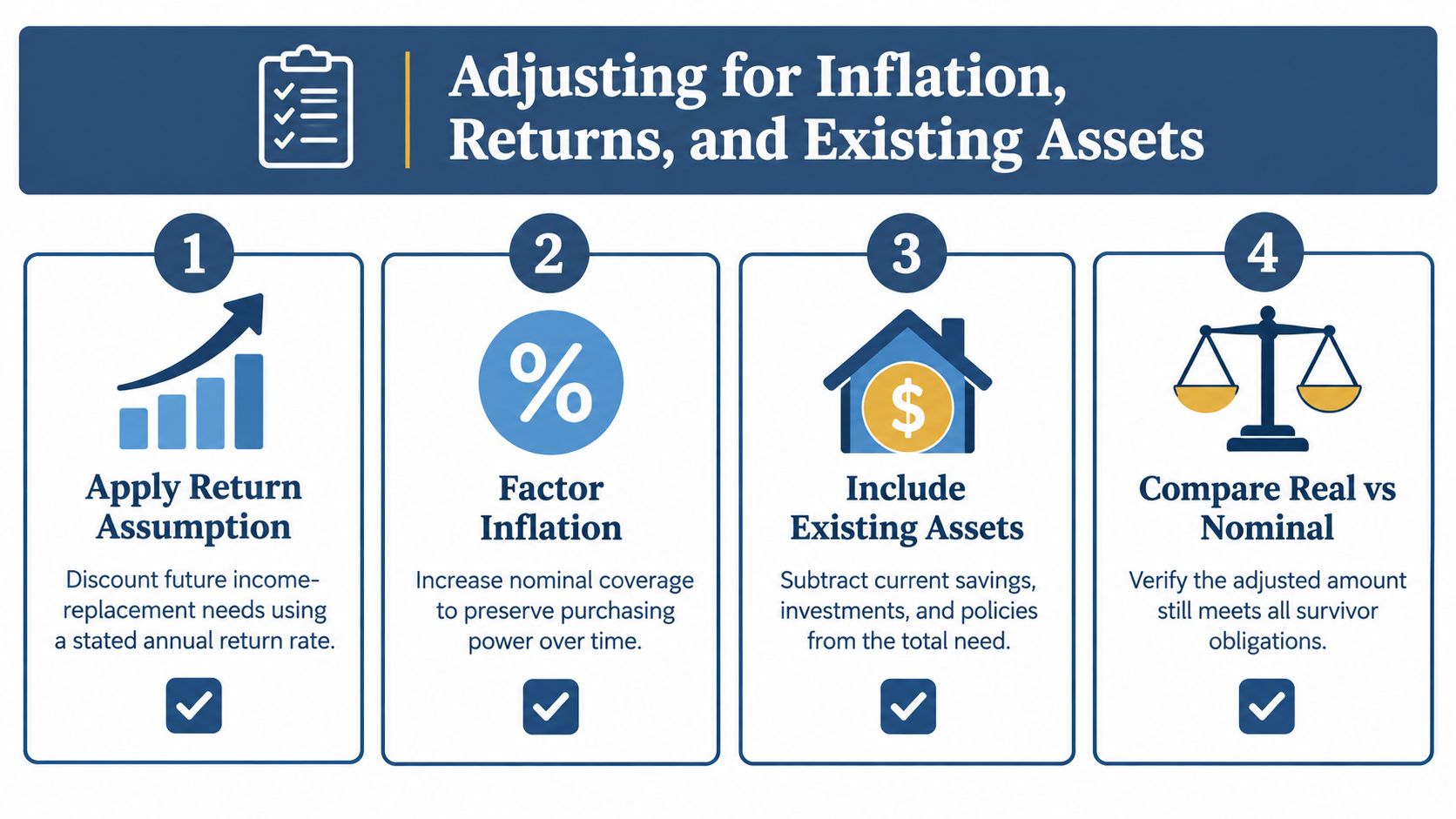
Model Returns and Inflation Separately
If the death benefit will be invested and drawn over time, future income needs can be discounted using a stated return assumption. Inflation pushes the other way, raising the nominal cost of housing, food, care, and education. Netting them casually without writing either down is how families end up short while believing they were conservative.
Be modest with returns. A survivor managing grief, kids, and a household shouldn't need aggressive investing to make the plan work. Then stress test the result with higher inflation and lower returns. If the plan only works under cheerful assumptions, increase coverage, increase savings, or cut an obligation you're choosing to fund.
- Spouse earning capacity: Count future earnings only at a level the survivor can realistically sustain with dependents at home.
- Survivor benefits: Include vested benefits you can verify, not amounts you assume will appear.
- Emergency savings: Cash reserves reduce the income block because they buy time without forcing asset sales.
- Illiquid assets: Don't subtract home equity unless the plan is to sell or borrow against the home.
A smaller policy paired with real emergency savings can outperform a larger policy in a household with no cash cushion. The savings handle immediate disruption. The insurance handles the long gap.
Treat Group Coverage as Temporary Until Proven Otherwise
Check portability and conversion terms while you're still employed, including deadlines and cost after separation. Don't subtract the full employer benefit from your need if leaving the job ends it. Pre-retirees should also test whether life insurance is still needed after retirement against pension, savings, and spouse income rather than renewing by default.
Blended households need extra care because assets and obligations may be intended for different children or a current spouse. Coordinating beneficiaries with estate planning for blended families helps ensure the amount you calculated reaches the people it was calculated for.
The Lean, Baseline, and Resilience Framework
Most families don't need one perfect number. They need a range with the trade-offs named. I use three tiers when premium budget is a real constraint, which it usually is.
Lean covers immediate obligations, clears major debts, and funds a shorter block of essentials. This tier fits households with strong savings, low fixed costs, and a survivor who can keep earning at a similar level. It's a floor for temporary affordability, not my preferred endpoint for young families.
Baseline covers debts and a longer income replacement period tied to dependents or a spouse reaching retirement. Most working families should aim for this first. If you can afford baseline with a term that matches the obligation period, buy it before you chase optional legacy goals.
Resilience adds buffers. It assumes the survivor earns less for a while, inflation runs hotter, health coverage must be replaced, or a business needs time and cash to transition. Self-employed and single-income households usually belong closer to this tier because they have fewer backup systems.
Coverage tied to employment may be lost or reduced when a worker changes jobs, retires, or becomes self-employed, which is why the needs-based method subtracts only the portion of employer coverage that is portable and expected to continue rather than the full stated benefit, a distinction reflected in the Society of Actuaries individual mortality research topics. Put non-portable group coverage outside all three tiers, or treat it as a temporary bonus.
Buying the largest face amount you can qualify for isn't discipline. Buying the tier that protects the plan without starving savings is discipline.
Sometimes the rational move is baseline coverage plus aggressive debt payoff, then a review in a few years. A policy you keep beats a larger policy you lapse. Choose the tier carefully, write down what it does not cover, and revisit it when income, debt, or dependents change.
Common Questions About Coverage Amount
How often should you revisit the amount? Review it after marriage, a birth or adoption, a new mortgage, a job change, a business change, a diagnosis, or retirement. Outside those triggers, check beneficiaries and balances regularly and recalculate when the inputs have moved enough to change the tier.
What term length fits? Match the term to the obligation. Income replacement for young children usually needs a longer term than a small remaining mortgage or a short bridge to retirement. Don't buy a short term because it's cheaper if the need clearly runs longer.
Term or permanent? For pure income replacement and debt protection, term usually gives the required amount at a workable premium. Permanent coverage fits specific legacy, estate, or business continuation goals that don't expire, not a general fear of term ending.
What happens during a career change? Assume employer coverage changes until HR proves otherwise in writing. Ask about portability, conversion, deadlines, and post-employment cost before you resign or retire. Then fill any gap with coverage you own.
Run your own obligations-minus-resources calculation, choose your lean, baseline, or resilience tier, and then compare real quotes for that amount at My Policy Quote. Bring your mortgage balance, debts, replacement years, and existing portable coverage to the quote process so you're pricing the protection your household needs, not a generic salary multiple.