

If you're sitting at the kitchen table tonight, looking at a mortgage statement, a stack of daycare flyers, and one decent life insurance policy on the working spouse, you're already doing the math most families avoid. The hard part isn't understanding that the paycheck matters. It's seeing that the person at home is also holding up a real part of the household economy, and that loss would force the family to buy services it currently receives for free.
A life insurance for stay at home parent decision gets clearer when you stop treating unpaid care as “no income” and start treating it as a replacement-cost liability. That shift matters because the surviving parent may suddenly need paid childcare, meal prep, transportation help, cleaning, and coordination support all at once. For many households, the question isn't whether the stay-at-home parent has value. It's how much cash the family would need to keep daily life functioning if that work vanished overnight.
The Coverage Gap Most Families Miss
The family in this kind of conversation usually feels well prepared. The working spouse has a clean $500,000 policy, the premium fits the budget, and everyone assumes the box is checked. Then you ask one simple question, who would do the school run, make lunch, manage pickups, and keep the whole week from falling apart if the stay-at-home parent died tomorrow?
That's where the gap shows up. A policy on the breadwinner replaces salary, but it doesn't pay for the labor that made that salary possible in the first place. A surviving parent may need to buy childcare, transportation help, meal prep, tutoring, household management, and other daily services, and those costs arrive immediately, not years later.

The numbers backing that reality are sobering. A 2023 U.S. Department of Labor readout, based on Urban Institute research, estimated that unpaid caregiving reduces a mother's lifetime earnings by 15% and creates an average employment-related cost of about $295,000 in 2021 dollars U.S. Department of Labor readout. That isn't a universal household number, because families differ, but it does prove the loss is financially real.
Practical rule: if a job would cost money to replace after a death, it belongs in the insurance conversation.
That's the mental shift that matters. A stay-at-home parent isn't a zero-value line item. They're the reason the household can run without outsourcing everything, and the rest of this guide turns that idea into a coverage amount you can use.
Why a Stay at Home Parent Has Real Economic Value
The easiest way to understand this is to think like the U.S. Bureau of Economic Analysis, which counts household production through the “third-person” test. If someone outside the family could be paid to do the task, it has economic value. That covers childcare, cooking, cleaning, shopping, gardening, and household repairs, and it also fits the daily coordination work that keeps a family moving BEA household production framework.
That framing lines up with how families already live. Federal Reserve analysis found that among U.S. households with children under 13, 44% used some form of unpaid childcare, and in households with one working and one non-working parent, 37% used unpaid childcare while only 11% used paid childcare Federal Reserve care work analysis. In other words, lots of families already depend on informal care networks instead of a market service, which is why the replacement bill can be so easy to miss.
A simple way to think about it is this, no paycheck doesn't mean no economic loss. It means the loss shows up as an expense instead of lost wages. If the family already uses paid childcare, the median cost was about $960 per month, rising to about $1,400 per month for 20 or more hours weekly, and more than half of users spent at least 50% as much on childcare as on housing Federal Reserve childcare cost analysis.
If you want a quick local reality check, it helps to compare what nearby care costs. A practical place to start is to compare home daycare weekly rates and see how much a real replacement budget might run in your area.
A broader labor estimate makes the point even more clearly. One U.S. household-production estimate found that including unpaid domestic work would have increased measured GDP by 26% in 2010 household production estimate. That doesn't tell you what your family needs, but it does show the scale of the work being replaced.
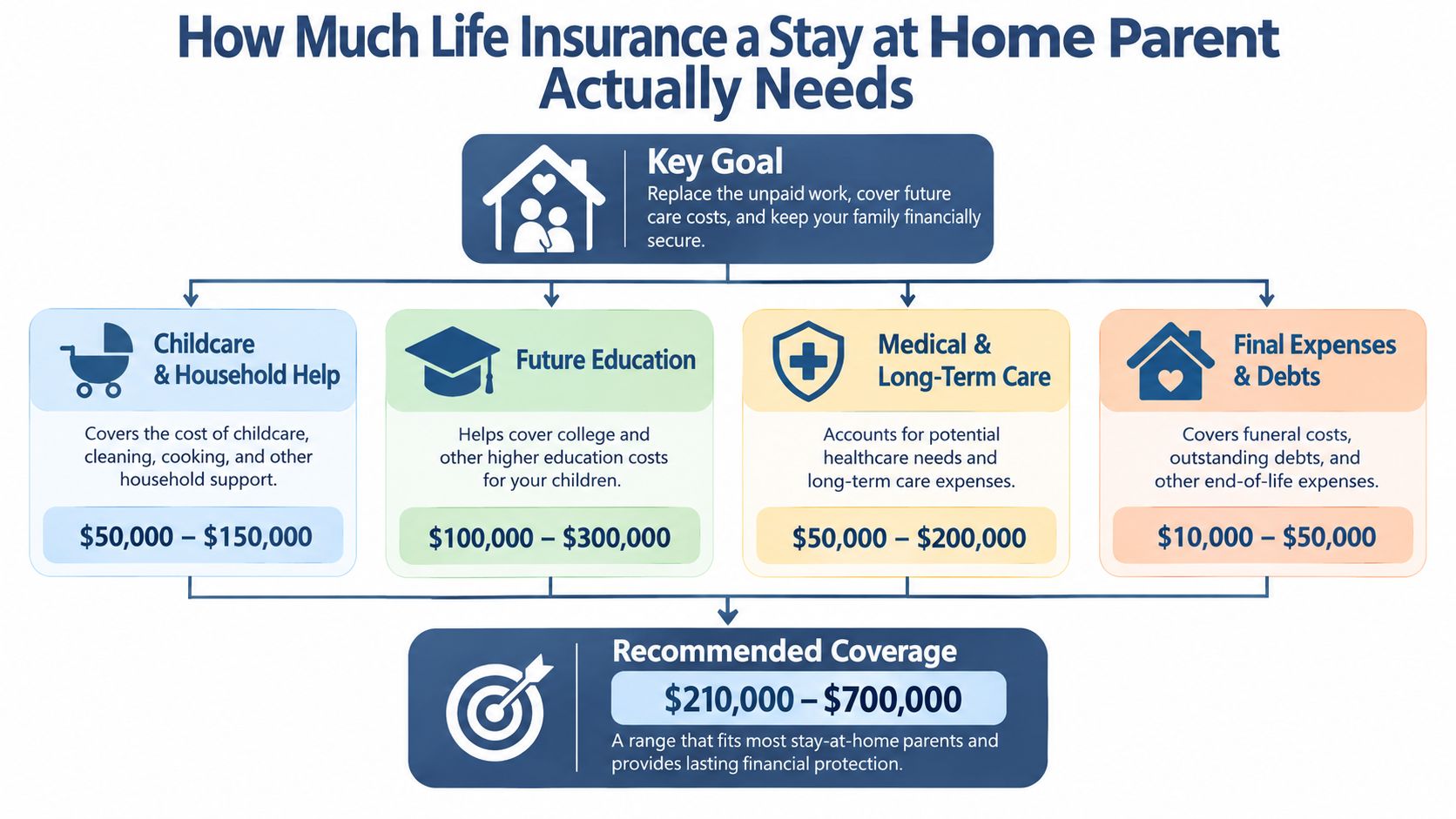
How Much Life Insurance a Stay at Home Parent Actually Needs
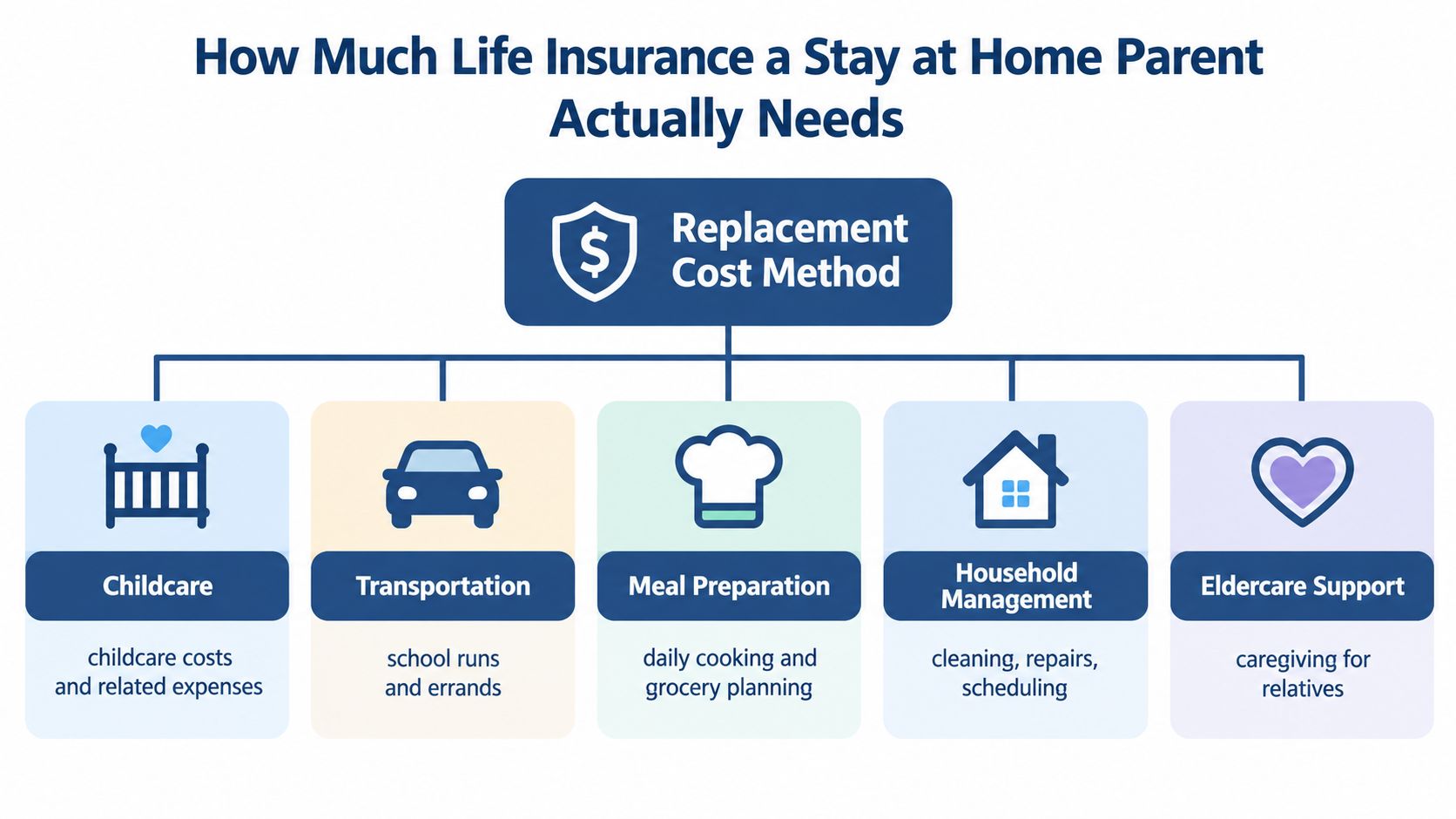
The cleanest method is the replacement-cost approach. Start with the services the stay-at-home parent provides, price them locally, and multiply by the number of years those services would still be needed. That usually means childcare, transportation, meal preparation, household administration, laundry, tutoring, and care coordination, plus any special support a child needs.
Here's the logic in plain terms. If a family would need a daycare, a cleaner, an after-school driver, and extra meal support after a death, those costs should be added up separately. Then you adjust for how many years the youngest child is still dependent, because the expense is usually heaviest when children are small and then changes as they age.
A simple worksheet can keep this honest:
| Service Category | Typical Annual Cost | Local Adjustment | Notes |
|---|---|---|---|
| Childcare | Varies by age and hours | Price it locally | Often the largest line item |
| Transportation | Varies by commute and school schedule | Price school runs and errands | Include fuel or paid help |
| Meal Preparation | Varies by family size | Price grocery planning and prep help | Busy weeks often cost more |
| Household Management | Varies by home size | Price cleaning and coordination help | Covers cleaning and scheduling |
| Tutoring and school support | Varies by need | Price by subject and frequency | More relevant as children age |
A useful way to think about the number is to build it in layers. First, estimate the yearly cost to replace the parent's work during the years when children are young. Then add one-time transition costs, such as temporary help, training a new caregiver, or shifting routines. After that, subtract anything already available, like savings or reliable family support.
For families who want a broader calculator to test assumptions, work out the right cover using a separate planning lens and compare the result with your replacement-cost estimate.
Good planning rule: don't use a national salary benchmark for a stay-at-home parent. Use local service prices, because you're buying real help in a real market.
If you prefer a structured worksheet, this life insurance needs calculator can help organize the moving parts without turning the process into a spreadsheet project.
Term Life vs Whole Life for Family Budgets
For most young families, term life matches the need better because the risk is concentrated during the years children depend most on daily care. The policy is built to cover a defined period, which lines up neatly with childcare years, school logistics, and the years when one parent's unpaid work carries the biggest replacement cost.
Whole life can make sense, but it solves a different problem. It provides permanent coverage and builds cash value, which can appeal to families with lifelong dependents, estate-planning goals, or a strong preference for coverage that never expires as long as premiums are paid. The trade-off is cost, which can push it out of reach for parents who are also paying a mortgage, saving for college, and managing a tight monthly budget.
Here's a simple side-by-side view.
| Feature | Term Life | Whole Life |
|---|---|---|
| Coverage period | Set term | Lifetime, if premiums are paid |
| Monthly cost | Usually lower | Usually higher |
| Best fit | Child-rearing years | Long-term planning, lifelong dependents |
| Cash value | No | Yes |
| Budget flexibility | Easier to fit | Harder to fit |
If your budget is tight, a mixed strategy can work better than forcing everything into one policy. A larger term policy can protect the years when childcare and household replacement costs are highest, while a smaller permanent policy can cover final expenses or long-term planning. That keeps the family from overpaying for permanence it may not need right now.
A separate guide on insurance term vs whole life can help if you're deciding between simplicity and permanence. The key question is still the same: how long would your family need replacement help if the stay-at-home parent were gone?
Riders and Options That Matter Most
The best riders are the ones that solve a real family problem, not the ones that look impressive in a brochure. For stay-at-home-parent coverage, the most useful add-ons are the ones that protect the policy itself, make room for future changes, or soften a serious medical event.
The first one to look at is waiver of premium. If the working spouse dies or becomes disabled and money gets tight, this rider can keep the policy in force without premiums becoming another crisis. That matters because the policy is supposed to protect the household, not create another bill the family can't manage.
A child rider can also be practical. It adds coverage for children under one policy and can be simpler than buying separate coverage for each child. Families with multiple children often like the simplicity, especially when they're already managing a lot of paperwork.

The other two riders that matter are accelerated death benefit and guaranteed insurability. Accelerated benefits can let a terminally ill insured access part of the death benefit early, while guaranteed insurability can make it easier to add coverage later without new underwriting. That can help if the family's needs grow, or if another child arrives and the replacement-cost math changes.
Not every rider deserves a dollar of premium. Accidental-death riders, for example, are often less useful for this audience than riders that protect cash flow or preserve future flexibility.
The scale of the work being replaced explains why these details matter. A 2010 U.S. household-production estimate found that including unpaid domestic work would have increased measured GDP by 26%, which shows how much labor sits behind ordinary family life household production estimate. If that labor disappears, the rider mix should help the policy still do its job.
For a related look at how family policies can be structured, see spouse term rider options.
Insuring the Stay at Home Parent Too
A lot of families only insure the paycheck, then assume the caregiver doesn't need separate coverage because there's no salary to replace. That's too narrow. The more useful question is whether the surviving parent would suddenly need a large cash reserve to buy care, stabilize routines, and keep working without everything collapsing at once.
That's where the contrarian part comes in. LIMRA's 2025 industry factbook reports that 40% of American adults believe they need more life insurance, which tells you undercoverage is already common even before you think about the stay-at-home parent LIMRA factbook. A family can own a policy and still be underinsured if it only covers the visible paycheck.
For a lot of households, a modest policy on the caregiver can be the more urgent buy. A term policy on the stay-at-home parent can help fund the immediate replacement costs that hit in the first weeks and months after a death, when help has to be hired fast and routines are already breaking down. If grandparents currently help with childcare, that support can't be assumed after a death, so the plan should be built as if informal help might disappear overnight.
A practical way to prioritize under a tight budget is simple:
- Protect the caregiving gap first. If the family would need outside care immediately, cover that cost before adding extra coverage to the breadwinner.
- Match coverage to the youngest child's needs. The need is highest when children are small, so the term period should reflect that horizon.
- Treat unpaid family help as uncertain. Grandparent care is valuable, but it can't be counted on as permanent replacement capacity.
- Keep the policy affordable enough to keep. A smaller policy you can hold for years is better than a larger one you may have to drop.
For families trying to balance both adults' protection, life insurance for parents is a helpful comparison point. The best answer is usually not “only one policy,” it's “which policy solves the biggest cash problem first?”
Practical Buying Tips for Busy Parents
Start with the simplest question, can you document the household role clearly? If you're the stay-at-home parent, be ready to explain childcare duties, school logistics, meal planning, transportation, and any special caregiving responsibilities. Underwriting doesn't need a paycheck to understand value, but it does need a clear picture of the family's risks.
Then decide whether you want fully underwritten or simplified-issue coverage. Fully underwritten policies usually take more time because they involve health questions and sometimes a medical exam. Simplified-issue policies can move faster, which helps when life is busy, but they may cost more or offer less coverage.
Compare quotes on the same terms so you're not mixing apples and oranges. Check the coverage amount, the term length, rider costs, and whether premiums can change later. Ask the broker these five things: what happens if health changes, what riders matter here, how the policy handles missed payments, whether both spouses should be insured, and what documents will be needed before approval.
A quick checklist helps:
- Gather household records. Birth certificates, mortgage statements, and basic income documents make the process smoother.
- Write down caregiving duties. A plain list often helps more than a vague description.
- Ask about conversion options. This matters if you might want permanent coverage later.
- Confirm underwriting timing. Knowing the timeline keeps the policy search realistic.
- Review both adults together. Coverage should match the whole household's dependence, not just one paycheck.
If you want a place to compare options, My Policy Quote helps people compare life insurance policies from multiple providers through licensed agents, which can be useful when the goal is to match coverage to a family's actual replacement costs. For many busy parents, that kind of comparison turns a confusing afternoon into a decision they can finally finish.
If you're ready to size coverage around the work your household depends on, visit My Policy Quote and compare options with the help of licensed agents who understand family coverage. A conversation now can help you protect the childcare, routines, and daily support that keep your home running.