

You're sitting with two quotes for the same death benefit, and one premium is comfortably inside your budget while the other looks like a car payment. Your first instinct is to pick the cheaper one, then wonder what you're missing. That hesitation is justified, because term vs whole life insurance cost isn't a simple price contest. You're comparing two different financial jobs, and the cheaper premium today doesn't always deliver the cheaper protection over the years you need it.
Why Cost Feels More Complicated Than Expected
Most buyers start with a sensible question. Why would anyone pay substantially more each month for the same face amount? The answer isn't that one buyer is getting a bargain and the other is overpaying. They're buying different durations of protection, different rights inside the contract, and different exposure to future price changes.
Term insurance asks you to pay mainly for mortality protection during a defined period. If you die during that period, your beneficiaries receive the death benefit. If you outlive it, coverage generally ends without cash value. That's why term usually delivers more death benefit protection per premium dollar at purchase. You're not funding a reserve designed to support a lifetime claim.
Whole life insurance spreads a much larger obligation across your premiums. It's designed to stay in force for life if required premiums are paid, and part of what you pay supports a cash value component after insurance costs and expenses. That permanence is the product. It's also the reason affordability has to be tested differently, because a premium that's manageable during your peak earning years still has to remain manageable in retirement.
The Better Question to Carry Into Every Quote
Don't ask only which policy costs less this month. Ask what each premium dollar buys, how long that protection lasts, and what happens when your needs outlast the contract.
- Protection achieved per dollar: Does the death benefit replace income, clear debts, and cover final expenses, or does a low premium reflect too little coverage?
- Duration risk: Will the need end on a predictable date, or could it persist for life?
- Renewal exposure: What will replacement coverage cost if you're older or your health has changed when a term ends?
- Sustainability: Can you keep paying without crowding out savings, debt repayment, or essential spending?
A low premium for inadequate coverage isn't a saving. It's a smaller payment toward an unfinished job.
That framing changes the decision. Term can be the efficient tool for a temporary, large exposure. Whole life can be the disciplined tool for a permanent, defined obligation. The mistake is judging either one by the opening premium alone, without pricing the years after purchase and the cost of falling short.
Overview of Two Different Cost Models
Term and whole life don't price the same promise, so comparing their premiums without defining the promise leads you astray. One rents protection for a selected stretch of your life. The other is structured to keep protection in place for your entire lifetime while building an internal reserve.
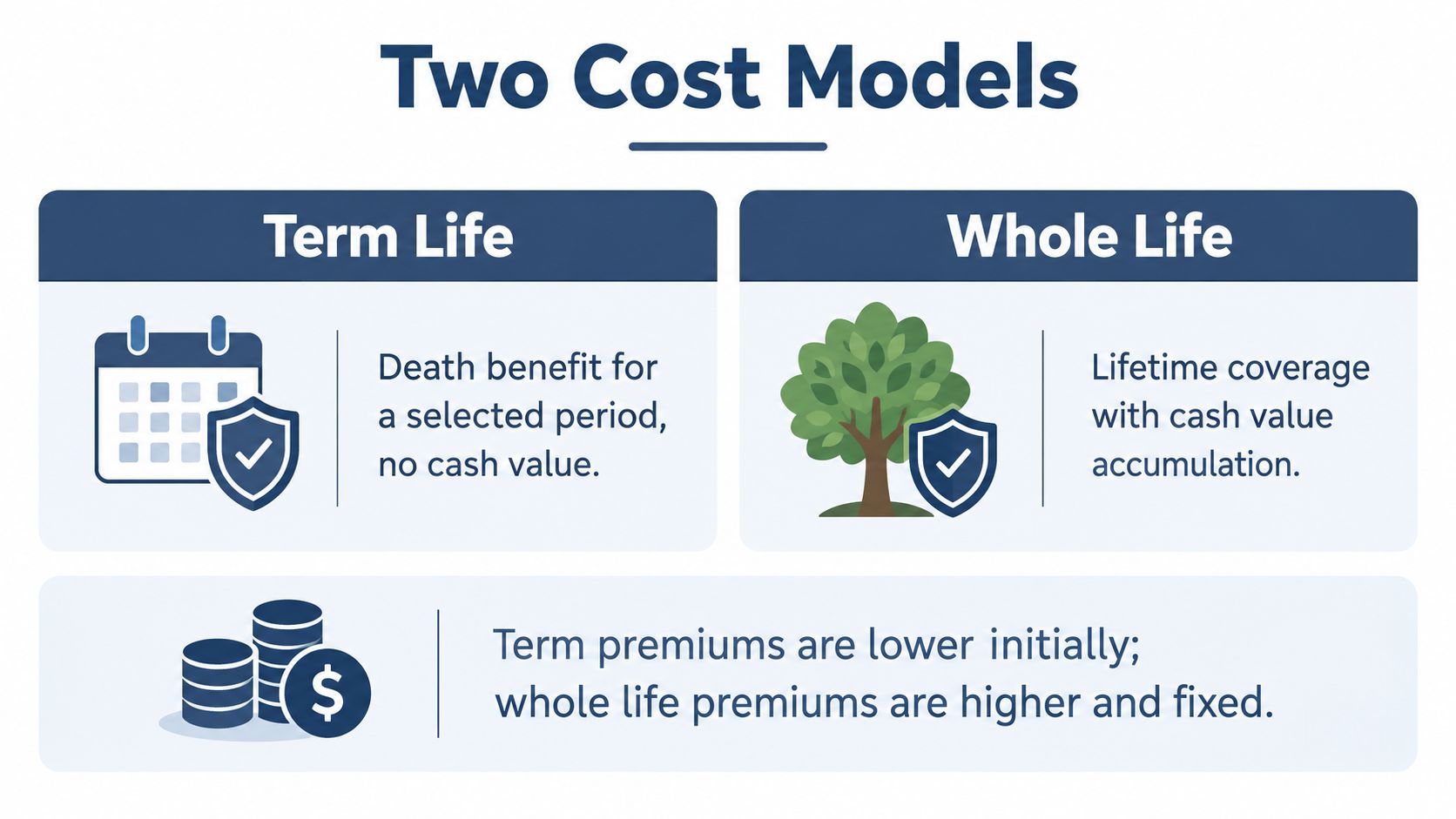
With term, your premium primarily buys the insurer's promise to pay if death occurs during the covered period. There's typically no cash value to borrow against, surrender, or carry forward when the period ends. That simplicity keeps the initial cost lower, especially for younger, healthy applicants. It also means the value of the policy is concentrated entirely in the years when your family faces the greatest loss if your income stops.
Whole life works differently. Premiums are generally scheduled at a level amount and support three things at once: the death benefit, policy expenses, and the cash value reserve. Cash value is what's left from premiums after applicable insurance charges and expenses, and its growth and accessibility depend on the contract. You may be able to borrow against it, but loans, surrender terms, and charges affect what you can use and what remains payable later.
Whole life's higher premium is not simply an added investment return. It finances permanent coverage, policy expenses, and a cash value reserve whose performance and accessibility depend on contract terms.
Two Jobs, Two Budgets
Think of term as protection matched to obligations with an end date, such as years when children depend on your earnings or a mortgage remains outstanding. Think of whole life as protection matched to obligations that don't expire, such as final expenses, a legacy you want guaranteed regardless of timing, or support for someone who'll need help for life.
That distinction also prevents a common misreading. Whole life isn't term coverage plus a free savings account. The cash value feature is funded by your higher premium, grows under contract rules, and may build slowly in early years before accelerating later. Term isn't inferior because it lacks that feature. It's deliberately stripped down so more of each dollar goes toward the temporary death benefit.
Once you see the models clearly, the price gap stops looking arbitrary. You're choosing between concentrated, temporary protection and permanent protection bundled with a reserve. Neither model is universally better. Each becomes expensive when it's assigned to the wrong job, kept for the wrong duration, or bought in an amount that doesn't match the underlying need.
Pricing Drivers Behind Every Quote
Two applicants can sit down on the same afternoon, request the same death benefit, and receive quotes that look unrelated. Neither quote is necessarily wrong. Insurers price the person and the contract together, so a premium pulled from an illustration means little until you know who it describes and what it includes.
Your Profile Sets the Baseline
Every quote begins with mortality risk, then layers adjustments on top. Age comes first because the probability of a claim rises each year you wait to apply. Health history and exam results place you in an underwriting class, which functions as the insurer's risk rating for your file. Tobacco status can push you into a different pricing category entirely, while the coverage amount scales the payout the insurer stands behind. As the NAIC consumer guidance on life insurance pricing factors explains, these variables interact rather than stack neatly, which is why identical face amounts produce different numbers across applicants and across companies.
A concrete case shows the spread. A healthy applicant in their thirties and an applicant in their fifties with managed blood pressure can request the same benefit and receive quotes separated by a wide margin. The gap is the pricing math doing exactly what it was designed to do.
Contract Design Shifts the Number
Personal risk is only half the quote. A longer selected term extends the insurer's exposure, since a thirty-year period commits the company to hold your rate far longer than a ten-year period. Riders, conversion rights, and guarantees change what the contract delivers, and insurers weigh expenses differently, so two carriers can price the same applicant well apart from each other.
Premium timing matters beneath the surface too. How a policy ages determines whether your cost stays fixed or climbs later, which is why the difference between attained age and issue age pricing deserves attention before you assume a level number today predicts a level number decades from now.
Whole life quotes add another layer. The premium funds permanent protection, policy expenses, and the cash value reserve in proportions set by contract terms, so request an illustration that separates them before comparing prices.
Discipline ties these drivers together: match face amounts, payment schedules, and applicant assumptions before judging any gap. Anyone used to weighing credit costs will recognize the method, since a guide to comparing business loan offers applies the same principle of evaluating the full obligation and its terms rather than the figure that catches your eye. A quote only counts as evidence when the inputs match.
Compare Premiums Coverage and Cash Value
A useful comparison uses consistent criteria, not a generic list of advantages. Put the same face amount on both sides, then judge each policy by purpose, duration, premium burden, cash value, renewal exposure, and whether you can sustain the payment. The table below keeps those criteria separate so a single attractive feature doesn't hide a weakness elsewhere.
| Comparison criterion | Term life insurance | Whole life insurance |
|---|---|---|
| Primary purpose | Temporary income replacement and debt protection | Permanent protection, final expenses, legacy, or cash accumulation |
| Expected duration | A selected period | Designed for your entire lifetime if premiums are paid |
| Initial premium burden | Usually lower for the same face amount | Substantially higher at the beginning |
| Death benefit economics | More temporary protection per premium dollar | Less initial protection per premium dollar, but no scheduled expiry |
| Cash value | Typically none | Builds under contract terms after charges and expenses |
| Renewal exposure | Replacement or renewal at older ages can cost substantially more | Level premium structure avoids rebuying coverage later |
| Affordability risk | Low early cost, possible coverage cliff later | Higher ongoing commitment that must survive budget changes |
| End of contract | Generally ends without cash value | Remains in force while required premiums continue |
Term generally wins on initial protection per dollar because you're buying a defined window of coverage without funding a reserve. For a family whose main risk is losing a breadwinner's income while children are dependent and debts are high, that efficiency lets you buy a death benefit large enough to matter. A smaller whole life policy bought instead, only because it feels more permanent, can leave the central income risk underfunded.
Whole life combines permanent protection with tax deferred cash value accumulation that's subject to contract charges and growth patterns. Growth can be slow in early policy years and accelerate later, so judging the policy by its early surrender value gives you an incomplete picture. Judging it only by projected non guaranteed values gives you an equally incomplete one. If you're weighing that trade off, a clear explanation of how whole life insurance works in practice helps you separate guarantees from illustrations before cost enters the discussion.
Where Each Option Quietly Becomes Expensive
A lower premium isn't automatically economical if it creates a coverage gap. Paying little for a death benefit that wouldn't clear the mortgage or support dependents means your family still absorbs most of the loss. The policy performed as written, but the amount was wrong from the start.
A higher premium isn't automatically better either. If whole life payments strain your budget, you may reduce other savings, carry debt longer, or lapse the policy after funding its most expensive early years. In that case you paid for permanence you didn't keep.
Protection achieved per dollar beats premium per month as a decision rule. Price the outcome your family receives, not just the payment you make.
The disciplined conclusion is conditional. Term suits large, temporary exposure where duration can be estimated. Whole life suits smaller or clearly permanent exposure where lifelong payment is realistic and the contract's guaranteed values support the goal. Your budget, health, dependents, and existing coverage decide which condition describes you.
Compare Sample Premiums Over Time
Run $250,000 of death benefit through both contracts for the same buyer and the cost gap stops being abstract. A consumer market comparison estimated that a healthy, nonsmoking 40-year-old man could pay less than $20 per month for a 20-year, $250,000 term policy, versus roughly $216 per month for a whole life policy at the same face amount, and the NAIC consumer guide to life insurance costs explains how insurers price these product types differently. That gap of at least $196 monthly annualizes to at least $2,352.
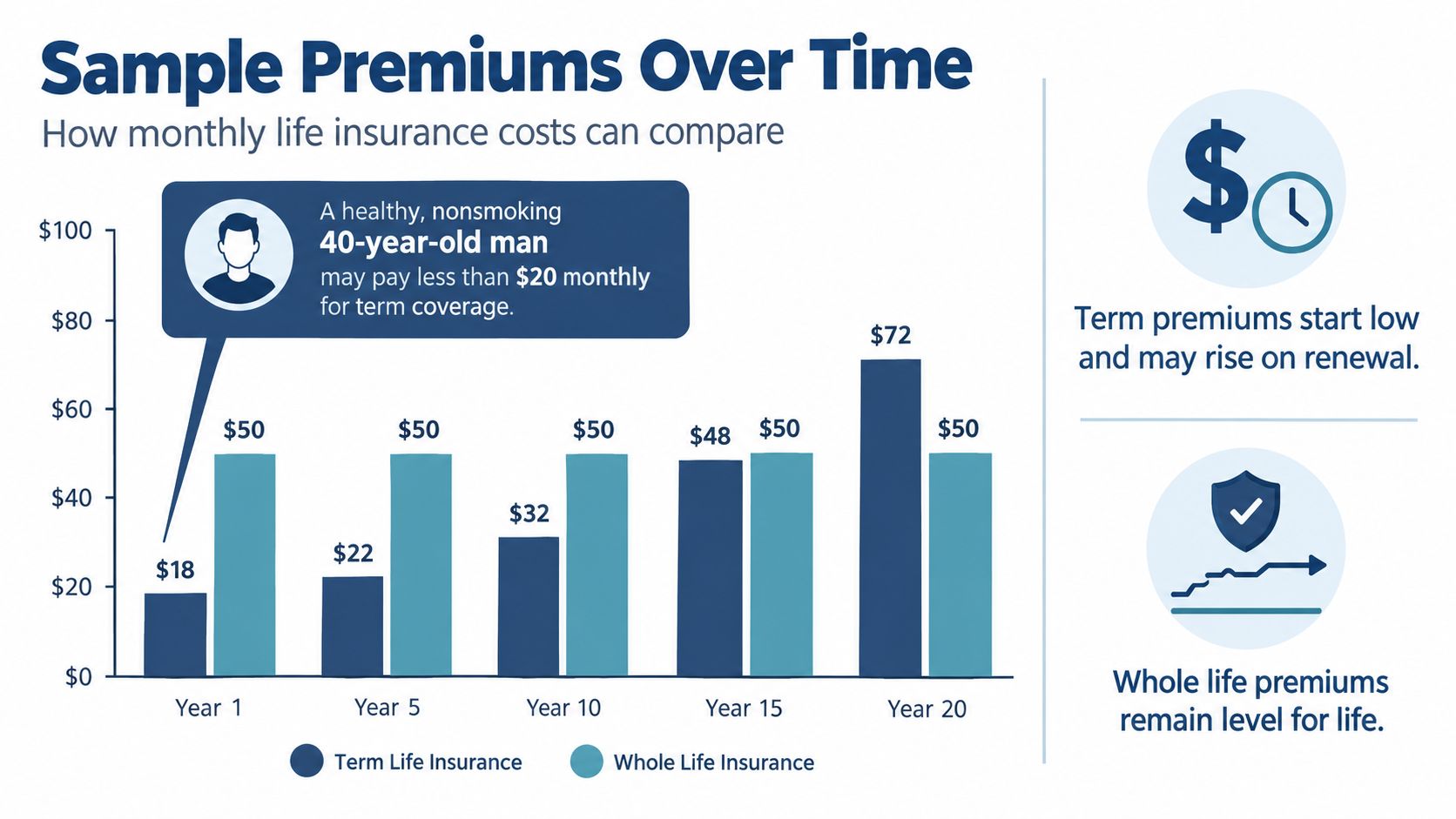
Extend that example across the full term and the comparison shifts from monthly payment to lifetime cost:
| Illustrative path | Monthly premium | Paid over 20 years | What remains at year 20 |
|---|---|---|---|
| Term, $250,000, 20-year duration | Under $20 | Under $4,800 | No cash value, coverage ends |
| Whole life, $250,000 | About $216 | About $51,840 | Continuing benefit plus cash value, if premiums stayed current |
Roughly $47,000 separates the two paths in this worked example. Measured by coverage delivered per dollar spent, the term path provides the same $250,000 benefit during those years for a fraction of the outlay. Measured by what survives the payment period, the whole life path accumulates something term never offers, provided the premium stays affordable for decades. Both measurements are accurate. The example just makes their prices visible.
What the Annual Difference Could Do Instead
An extra $2,352 a year has alternative uses worth naming before the premium is chosen: debt reduction, emergency reserves, retirement contributions. Whole life is a deliberate purchase of permanence and cash accumulation, and its premium is rational when those features are the actual goal. When the motivating reason is discomfort with coverage that expires, the price buys reassurance more than protection.
Age shifts the arithmetic as well. As a second illustration, an average near $160 per year has been cited for a healthy 30-year-old buying the same 20-year, $250,000 term coverage. At that starting point, a whole life premium many times larger needs justification grounded in contract guarantees, because the coverage-per-dollar gap widens further.
Treat every figure here as an illustration for sizing the gap. Only an underwritten quote reflects your risk class, and age, health, tobacco use, coverage amount, payment schedule, and insurer can each move the result materially. Sample numbers also sit in time. Any term you outlive ends at a renewal cliff priced on your older age and current health, so a cheap decade can still lead into an expensive lifetime.
Understand Break-Even and Coverage Duration
A crossover birthday is the wrong unit of analysis. Break-even is a comparison of protection achieved per dollar and lifetime cost across a stated horizon: the death benefit available while the need exists, plus whatever contractual rights remain when that need ends.
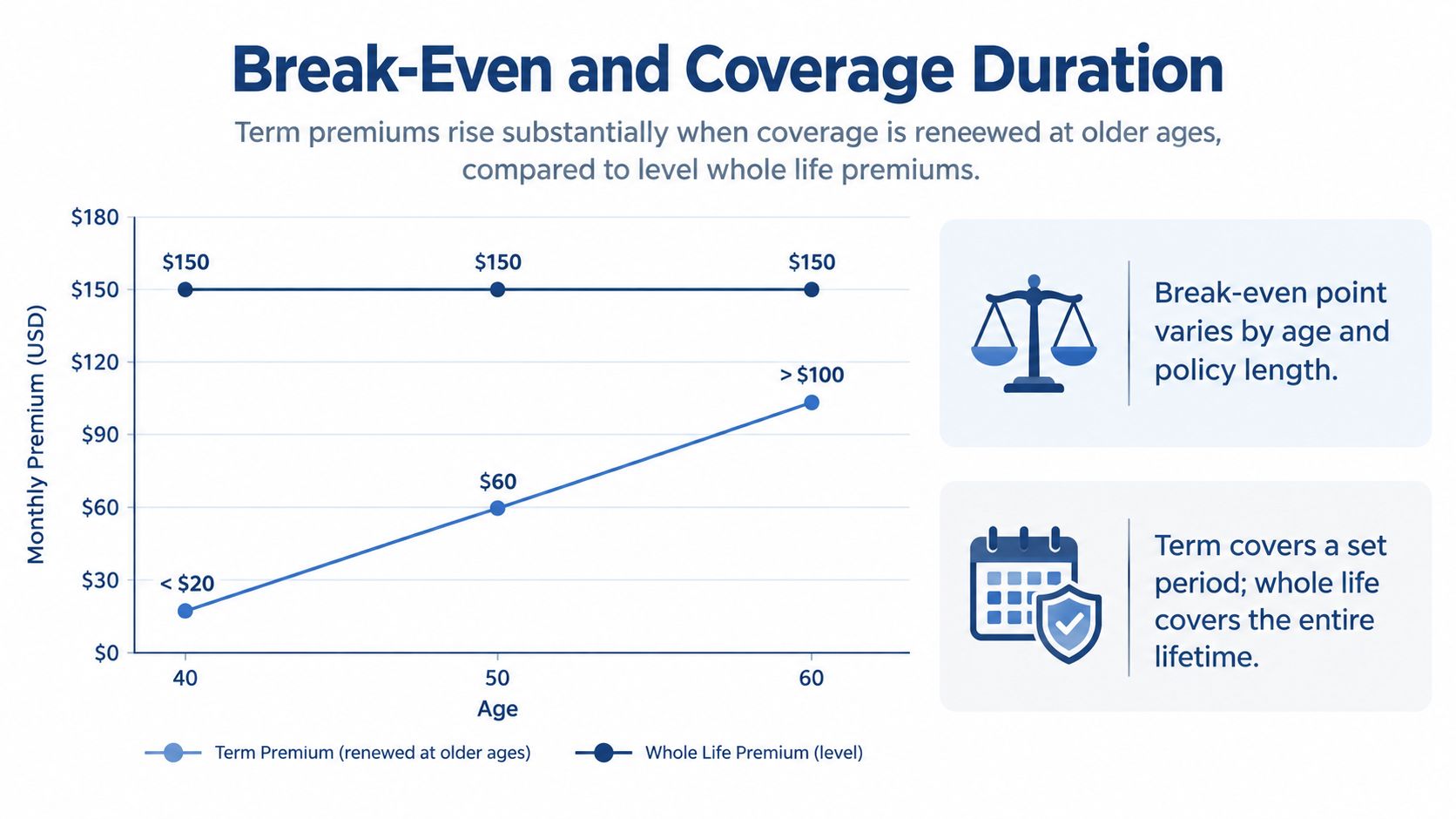
Force both contracts onto the same calendar before comparing them. For term, include the realistic follow-on step after the level period: renewal, conversion where the contract permits, or a new purchase if age and health still allow it. For whole life, use the scheduled premium and the guaranteed values, with dividends treated as uncertain and loans or surrender charges counted as reductions rather than footnotes.
Three measurements usually reveal which path is expensive. During the obligation, term generally delivers more immediate death benefit for the same outlay, so the bigger hazard is buying too little coverage because the larger permanent premium feels safer. After the obligation, the ledger changes: term may leave no continuing coverage and no cash value, while whole life may leave coverage plus cash value whose usefulness is bounded by guarantees, expenses, surrender terms, and any loan balance. Between those endpoints sits failure risk, which differs by design.
The term plan fails at the renewal wall if the next price is unaffordable or insurability has deteriorated. The whole life plan fails earlier if its premium squeezes the face amount, drains liquidity, or cannot be carried long enough for later guarantees to matter. That is why what happens at the end of a term life policy belongs in the first buying decision, because the options available then depend on provisions written years earlier and on health that cannot be promised now.
Estimate duration first. If the obligation has a credible end, permanent pricing must justify itself through survivors' needs, estate goals, or guarantees you would still value after the temporary risk disappears. If the obligation may not end, the cheap starting premium can be the down payment on repeated repricing.
Choose by Life Stage and Financial Goal
Your situation decides which cost model fits, because the same premium means different things to a contractor with no employer coverage and a retiree protecting a spouse. Start with the people below, then adjust for your own face amount, budget, health, dependents, and existing coverage.

Self employed professionals and contractors often carry the full income replacement burden themselves. There's no employer sponsored safety net behind the household, so a large temporary death benefit during working years usually deserves priority. Term's efficiency helps you buy enough protection while income is variable, though you'll still need a plan for what happens when that period ends.
Working families without coverage through work face a similar arithmetic. Only 56% of U.S. households had some life insurance in 2022, with 45.6% owning term coverage and 16.9% holding cash value coverage, and the median face value was $150,000, as the MoneyGeek analysis of the U.S. life insurance coverage divide reports. Those overlapping categories show that many households hold something, but not necessarily enough. A modest premium that leaves a mortgage and years of income uncovered is the expensive mistake, even though it looks frugal each month.
Adults approaching retirement, including pre Medicare households and people in their early sixties, should look hardest at renewal risk. Term premiums increase as applicants get older, so a policy expiring near retirement can leave you choosing between sharply higher payments and no coverage while a spouse still depends on you. Parents supporting adult children, and Medicare clients considering coverage for a spouse or younger family member, face a version of the same question. Is the obligation temporary help, or is it lifelong?
The short video below walks through how those life stage questions change the cost comparison in practice.
When Layering Beats Picking a Side
A layered strategy combines a smaller permanent policy for final expenses or a legacy with larger term coverage for the high exposure years. The term layer handles income replacement while debts and dependents peak. The permanent layer stays after the term drops away. Reading about which type of life insurance fits different decades of life can help you map those layers to your current age rather than copying someone else's structure.
Advisors guiding clients through these scenarios need the reasoning documented, not just the recommendation. Tools that let you transcribe client calls for finance can help preserve the goals, assumptions, and affordability checks behind a layered recommendation, so the file shows why duration and face amount were chosen. That record matters when a client later asks why coverage was structured in two pieces instead of one.
None of these scenarios is a product recommendation by itself. They're conditional matches between an obligation's duration and a contract's design. When the obligation has a clear end, term usually carries it most efficiently. When it doesn't, permanent coverage or a layered structure deserves serious pricing. What you shouldn't do is buy a small permanent policy for a large temporary risk, or a large temporary policy for a risk you know will outlive it.
Make a Final Cost and Coverage Decision
Turn the analysis into a buying process you can repeat with any quote. The sequence matters, because pricing a policy before sizing the need almost guarantees you'll anchor on the premium instead of the protection.
Start by estimating the death benefit your household requires. Add income replacement for the years dependents would need support, debts you'd want cleared, final expenses, and any legacy amount you intend to guarantee. Subtract savings and existing coverage that would be available. The remainder is your protection gap, and it's the number every quote should be tested against.
Compare on Identical Terms
Next, compare term, whole life, and any layered option across the same coverage period and payment schedule. Use the same face amount where the comparison is meant to be direct, and state plainly where a layered option intentionally uses different amounts for different jobs. Annualize the premiums, total them across the horizon, and write down what remains in force at the end of that horizon under each path.
For whole life, review the guaranteed cash value schedule, surrender value, death benefit, loan provisions, and internal rate of return rather than focusing on a projected non guaranteed balance. Ask how expenses and insurance charges affect early values, and what an outstanding loan would do to the amount your beneficiaries receive. For a healthy 30 year old, a 20-year, $250,000 term policy has been illustrated at roughly $160 annually, according to the NAIC life insurance roadmap for consumers, which gives you a benchmark for judging whether a larger whole life premium fits your budget and priorities.
- Size the need first: Income, debts, dependents, final expenses, and legacy goals.
- Match the inputs: Same face amount, horizon, and payment schedule for direct comparisons.
- Read the guarantees: Cash value schedule, surrender value, and loan terms before illustrations.
- Stress test affordability: Test the premium against retirement income, not just today's salary.
- Plan the term exit: Know whether you'll renew, convert if available, replace, or let coverage end.
Life events can change those inputs after purchase, including separation or court ordered support obligations. If that's part of your situation, reviewing divorce life insurance guidance before you finalize ownership and beneficiary choices can prevent a policy that no longer matches your legal obligations. Beneficiary designations and ownership deserve the same care as the premium.
Finally, compare multiple actual quotes and ask the agent or advisor to disclose every variable that can change your result. Ask what's guaranteed, what isn't, and what happens if you stop paying earlier than planned. If an answer relies on projected values, ask to see the guaranteed column beside it. You'll make a calmer decision once duration, protection per dollar, and long term affordability are on one page, because at that point you're no longer choosing between two premiums. You're choosing between two clearly priced plans for the same family obligation.
Ready to see what your own numbers look like instead of illustrations? Visit My Policy Quote to compare term and whole life quotes side by side using matching coverage amounts and payment schedules, so you can judge protection per dollar before you commit. Bring your protection gap, your time horizon, and a premium you could still afford in retirement, and use the comparison to pick the structure that fits all three.