

“No medical exam” sounds like the easy, cheap route. That advice is incomplete. In whole life insurance, skipping the paramedical visit usually means the insurer is replacing the exam with data checks, health questions, or a graded benefit, not abandoning underwriting.
The choice is among accelerated underwriting, simplified issue, and guaranteed issue. Those tiers can differ sharply in eligibility, coverage, approval, premiums, cash value, and what your beneficiaries receive after an early claim. The cheapest application process can produce the most expensive policy.
Why No Medical Exam Does Not Mean No Underwriting
A medical exam is only one part of traditional underwriting. When an insurer removes the nurse visit, blood draw, and fluid collection, it still needs to estimate the likelihood and timing of a claim. It may review your application answers, prescription history, motor-vehicle records, and other permitted databases.
That makes “no exam” a marketing umbrella, not a single product. Accelerated underwriting uses automated models and external data to make a decision without a physical exam. Simplified issue usually asks health questions and checks records, but avoids the full paramedical process. Guaranteed issue generally asks little or nothing about your health, then manages risk through smaller benefits, higher premiums, or a graded death benefit.
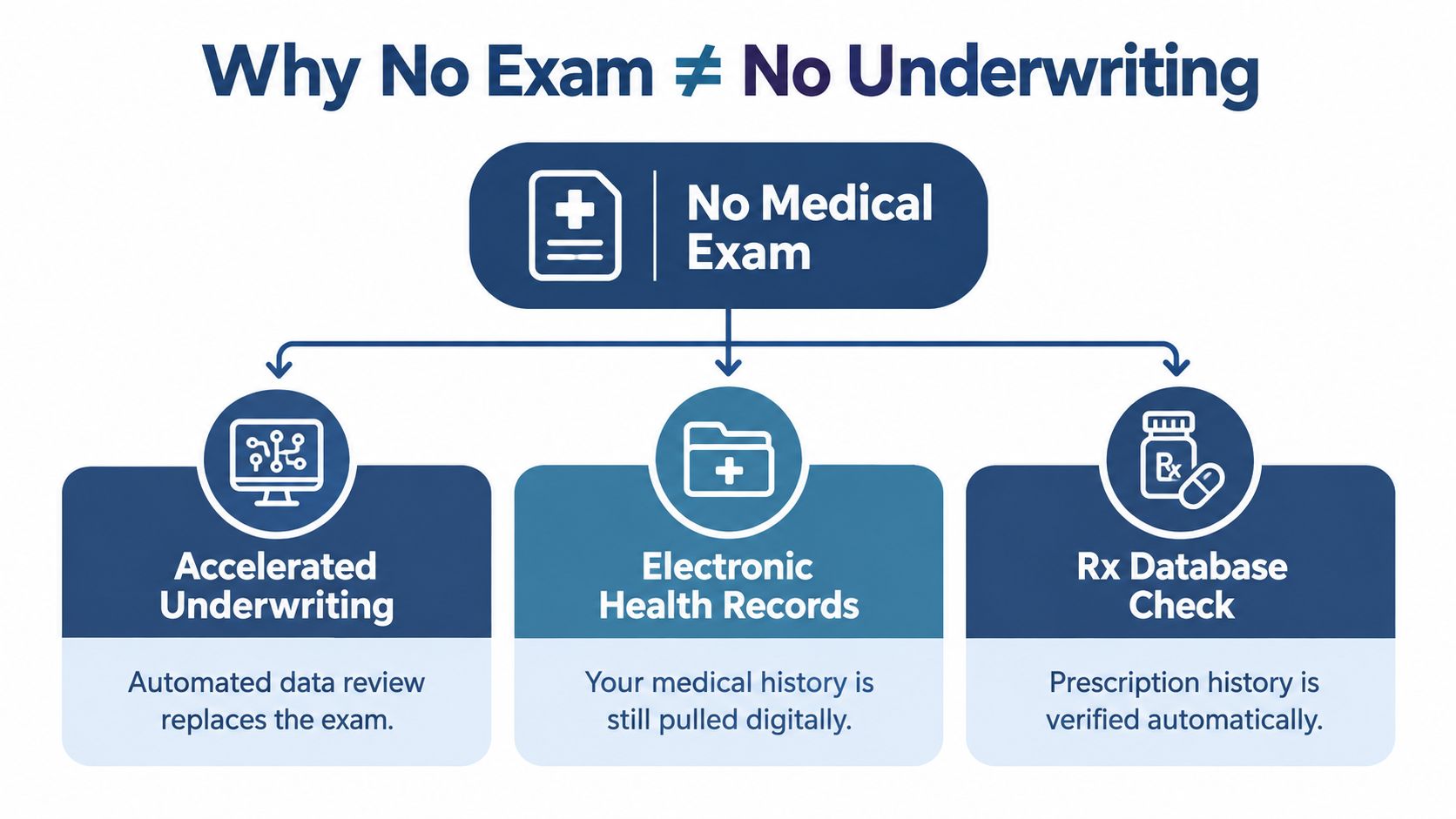
The three underwriting tiers
Accelerated underwriting is usually the first option worth testing if you're reasonably healthy. The insurer may use your answers, prescription records, driving information, and other application data to decide whether it can issue coverage without ordering an exam. A mismatch can lead to more questions, manual review, a rating, or a request for additional evidence.
Simplified issue sits between accelerated underwriting and guaranteed acceptance. You still disclose meaningful health information, but the insurer may accept a broader range of conditions without requiring fluids or a paramedical appointment. Eligibility varies considerably by carrier.
Guaranteed issue removes most medical friction, but it doesn't remove the economic consequences of risk. The insurer commonly limits the death benefit, charges more per dollar of coverage, and restricts natural-death benefits during an initial period.
Practical rule: Ask which underwriting tier you're actually buying. “No medical exam” alone tells you almost nothing about the policy's value.
If you want the mechanics of the traditional process and its alternatives, compare this explanation of a life insurance medical exam. The important point is simple: your real decision isn't whether underwriting exists. It's which form of friction you prefer, and what that choice costs over the policy's life.
What Replaces the Exam at Each Tier
The replacement process depends on the tier. You may never see a nurse, yet your insurer can still build a detailed risk profile from information already available.
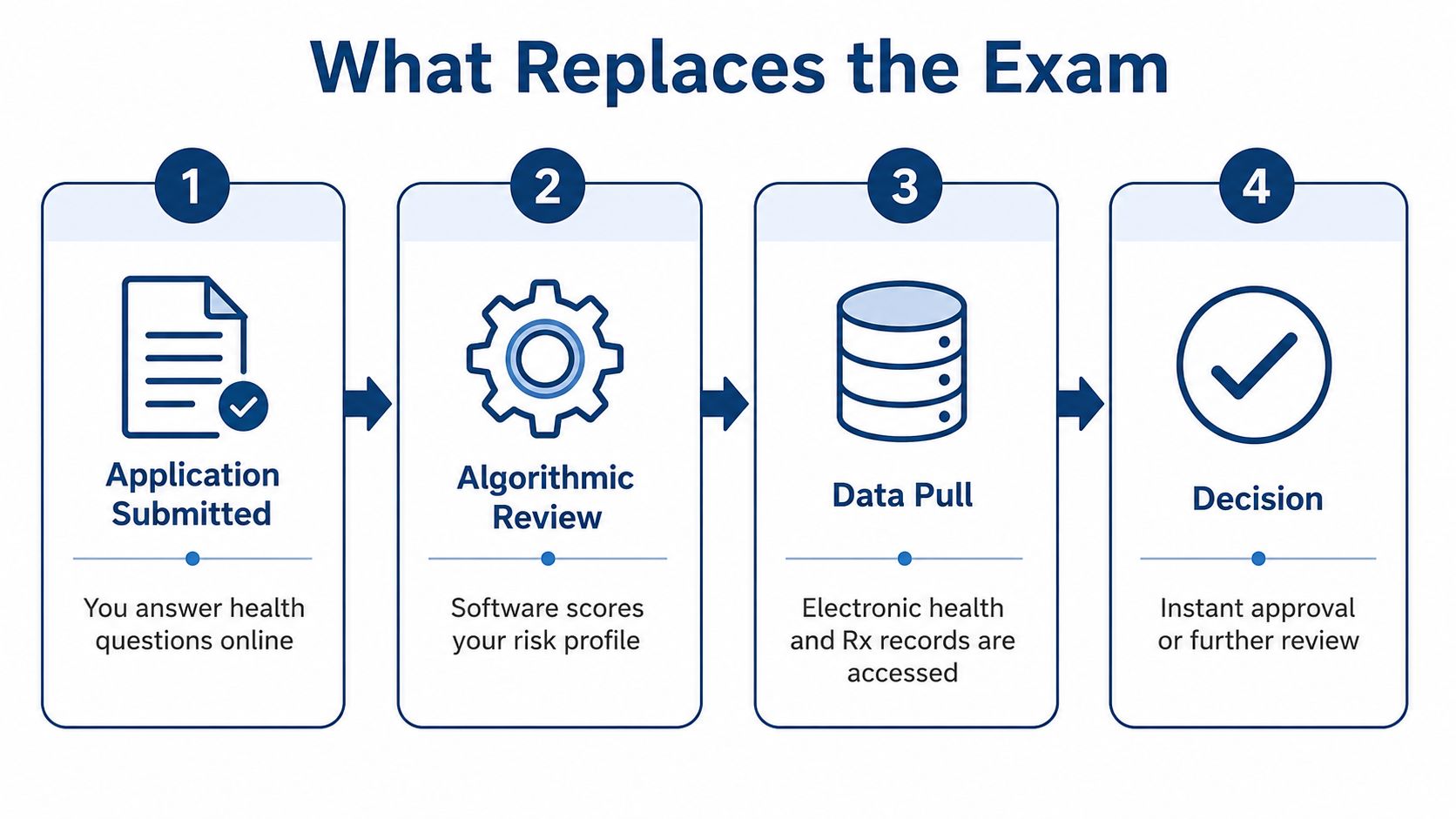
Accelerated underwriting
You start with an electronic application. The questions may cover diagnoses, medications, tobacco use, recent treatment, driving history, and other factors relevant to mortality risk. An automated system then compares your answers with prescription information, motor-vehicle records, identity data, and other permissible sources.
The Society of Actuaries found that insurers considered application data and FCRA-approved data among the stronger mortality predictors in accelerated-underwriting programs. Its research also reported that mortality assumptions for cases where underwriting requirements were waived were typically about 1% to 10% higher than comparable fully underwritten business, reflecting the uncertainty created by skipping some evidence (Society of Actuaries accelerated-underwriting research).
A clean match can produce a quick decision. An inconsistency, such as a medication appearing in prescription data but not in your application, can send the case to manual review. The insurer may ask for records or reclassify the application.
Simplified issue
Simplified issue generally relies more heavily on a health questionnaire. You may answer detailed questions about chronic conditions, surgeries, hospitalizations, medications, and recent care. The insurer can also review prescription history, driving information, and industry databases such as the Medical Information Bureau, commonly known as the MIB.
This isn't guaranteed acceptance. A condition may be acceptable with one carrier and outside another carrier's rules. Answer every question accurately. A vague or overly optimistic answer can create a verification problem later, even if the application initially appears easy.
Guaranteed issue
Guaranteed issue usually removes health questions and medical examinations. Eligibility is based mainly on the insurer's age and product rules. The insurer accepts greater uncertainty by narrowing the benefit design rather than assessing each applicant's medical risk in detail.
That structure can be appropriate when other applications have failed. It isn't automatically appropriate for someone who could qualify for accelerated or simplified issue. For that person, guaranteed issue may exchange a short application for a higher long-term cost and less favorable early protection.
For a broader comparison of products that avoid an exam, see this guide to term life insurance with no medical exam. Term and whole life serve different goals, but the underwriting distinction remains the same.
Simplified Issue vs Guaranteed Issue Side by Side
Simplified issue is usually the better first attempt for an applicant who can answer health questions and has a manageable medical history. Guaranteed issue is the fallback for applicants who need acceptance despite serious health circumstances or repeated underwriting barriers.
| Feature | Simplified Issue | Guaranteed Issue |
|---|---|---|
| Medical exam | Usually not required | Not required |
| Health questions | Yes, often detailed | Usually none |
| External data | Prescription, driving, and other permitted records may be reviewed | Limited medical underwriting, depending on the insurer |
| Coverage size | Usually more than guaranteed issue, but below many fully underwritten options | Usually modest and intended for final expenses |
| Premium per dollar | Generally lower than guaranteed issue for an accepted applicant | Generally higher because the insurer accepts more unknown risk |
| Full death benefit | Often available from the start, subject to policy terms | Commonly restricted by a graded-benefit period for natural death |
| Typical approval path | Automated decision or additional review | Acceptance if product eligibility rules are met |
| Best fit | Applicants with conditions that may still qualify | Applicants who can't qualify through medical underwriting |
Guaranteed-issue policies commonly use a two- to three-year graded-benefit period for natural death, according to the consumer comparison cited in the supplied research. The precise contract controls what beneficiaries receive, so don't rely on a sales phrase such as “guaranteed acceptance.” Read the actual benefit provision.
Simplified issue can provide immediate full coverage, but it doesn't guarantee approval. Carriers use different questions and underwriting rules. Even an application with “no” answers throughout can receive scrutiny if prescription or public-record data points in another direction.
For a plain-language explanation of this product category, review what guaranteed-issue life insurance means. The right row in the table is the one that matches your health, purpose, budget, and need for immediate protection.
How Age and Data Gaps Set the Premium
Age sets the baseline for permanent life insurance pricing. The insurer must collect enough premium to fund the future death benefit and maintain the policy, while accounting for the possibility of an earlier claim. Skipping an exam does not remove that risk. It changes how the carrier prices it.
The CDC reported U.S. life expectancy at birth of 78.4 years in 2023, up from 77.5 years in 2022. It reported 75.8 years for males and 81.1 years for females, a five-year difference, along with 3,090,964 U.S. resident deaths and an age-adjusted death rate of 750.5 deaths per 100,000 people in 2023. The rate was down 6.0% from 2022 (CDC 2023 life expectancy and mortality data).
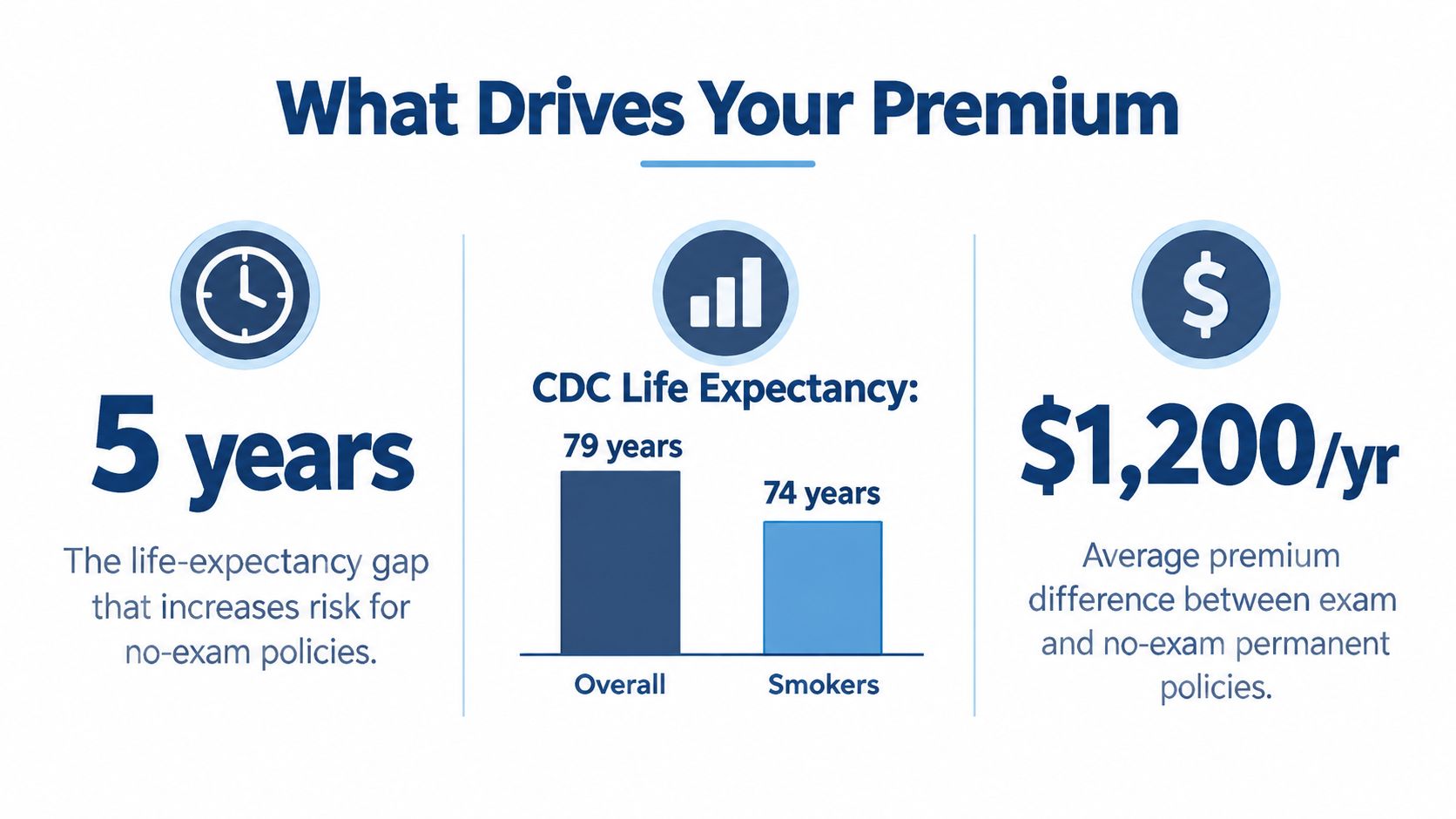
Why age changes the deal
A younger applicant gives the insurer more time to collect premiums before a likely claim. An older applicant gives it less time. That shorter payment window can raise the premium, reduce the face amount, or do both.
The product tier also matters. An accelerated-underwriting applicant may receive pricing closer to traditionally underwritten coverage. Simplified issue usually costs more because the carrier has less individual health information. Guaranteed issue charges the highest convenience premium because acceptance depends on eligibility rather than medical qualification.
Consider a $25,000 guaranteed-issue policy at age 68. If the required premiums paid over the expected holding period approach the $25,000 death benefit, the buyer is paying heavily for acceptance and permanent coverage. The policy may still serve a final-expense purpose, but it is a poor substitute for broader income protection.
No-exam whole life is therefore commonly suited to final expenses, a modest legacy, or a limited debt balance. Permanent coverage doesn't automatically mean affordable coverage, and cash value does not erase a high premium.
What to compare in the illustration
Review the guaranteed face amount, premium duration, guaranteed cash value, surrender charges, and any graded-benefit terms. Add the premiums you realistically expect to pay, then compare that total with the guaranteed death benefit and cash value. If those figures are close, buy only when the policy's protection solves a specific need.
Who Each Option Is Actually Built For
A 1099 contractor in their mid-40s with managed blood pressure shouldn't jump straight to guaranteed issue. The sensible opening move is accelerated underwriting, followed by simplified issue if the automated process can't offer terms. Irregular income makes predictable premiums important, but it also makes overpaying for guaranteed acceptance a poor choice.

A pre-Medicare adult in their early 60s whose spouse still works may need a small permanent benefit for burial costs and a modest legacy. Simplified issue is worth testing first if the applicant can answer health questions. Guaranteed issue may make sense when significant health history blocks the other routes, but the graded benefit must fit the expected need.
A blue-collar parent in their 30s without employer-sponsored life insurance may be tempted by guaranteed acceptance for final expenses. That can solve a narrow problem, but it may leave the family exposed to lost income or debt. The parent should first ask whether accelerated underwriting or simplified issue can provide more useful protection.
The same logic helps an advisor whose client was recently declined for fully underwritten coverage. A decline is a reason to reassess the underwriting tier, not proof that guaranteed issue is the only answer.
The decision should reflect the actual purpose of the money, not the emotional relief of seeing “approved.” This short video offers another way to think about the application process and product fit.
The Hidden Price of Convenience
Convenience is useful. It isn't free, and it isn't always valuable enough to buy.
A 2025 U.S. consumer survey reported that 78% of respondents would not pay extra for a no-medical-exam product. The same survey associated these products with lower coverage limits and fewer riders (2025 life insurance consumer survey). That result challenges the sales pitch that avoiding an exam automatically justifies a higher premium.
Speed is also becoming less distinctive. Industry underwriting research reported that three out of four surveyed life insurers had an automated or accelerated program, with average final decisions of nine days versus 27 days for traditional underwriting. Those figures mean an online accelerated application can narrow the time gap without forcing you into guaranteed issue.
The SOA's research also estimated average mortality slippage of roughly 10% to 15% in the accelerated-underwriting programs it examined (SOA accelerated-underwriting Delphi study). That isn't a consumer discount or a guaranteed price increase. It explains why insurers monitor these programs closely and why a policy that skips an exam still requires careful risk selection.
“No exam” is a process feature. It isn't a financial objective.
The biggest mistake is buying a small graded-benefit policy for final expenses while leaving income replacement, debt, or dependent-care needs uncovered. A guaranteed-issue policy can be rational for a narrow final-expense goal. It is usually the wrong tool for a family that needs meaningful protection against the loss of earnings.
A Practical Decision Checklist Before You Apply
Use this checklist before accepting a quote.
Identify the underwriting tier. Ask the agent or carrier to state whether the policy uses accelerated underwriting, simplified issue, or guaranteed issue. Don't accept “no exam” as a complete answer.
Match every health answer to your records. Review medications, diagnoses, treatment dates, and prescription history before submitting the application. Inconsistencies can cause delays, manual review, a rating, or a decline.
Calculate the cost per dollar of coverage. Divide the total premiums you expect to pay during your planned holding period by the guaranteed death benefit. Compare that result across tiers, not just across monthly payments.
Test the break-even risk. Ask whether cumulative premiums could approach or exceed the death benefit. This matters especially for older buyers purchasing modest final-expense coverage.
Read the guaranteed values. The illustration should show guaranteed cash values, the guaranteed death benefit, premium duration, surrender charges, riders, and any graded-benefit rules.
Watch for three warning signs:
- An unrealistic budget: The premium only works if your income remains perfectly stable.
- A poorly timed graded period: The restricted-benefit period extends through the period when your family most needs protection.
- Missing guarantees: The illustration emphasizes projected values but doesn't clearly show guaranteed values.
A quote is only a starting point. You can use no-medical-exam life insurance quotes to compare options, but the contract illustration is what deserves your attention before you apply.
Matching the Policy to Your Actual Goal
For final expenses under about $25,000, a graded-benefit guaranteed-issue policy can fit applicants in their 60s or 70s with significant health histories. Accept the waiting-period rules, and confirm that the premiums remain sustainable for the intended holding period.
A modest legacy, small mortgage payoff, or guaranteed insurability for an adult child usually points first to simplified issue. It asks more health questions, yet access to immediate full coverage and better value per dollar may justify that extra underwriting.
Income replacement requires a different answer. No-exam whole life is almost certainly the wrong tool for a substantial financial obligation. A small permanent policy may cover burial costs while leaving the household unable to replace earnings, service debt, or fund ongoing care. Consider term coverage or fully underwritten permanent insurance when the protection need is large.
Ask, “What must this money accomplish, and which underwriting tier delivers that protection at a sustainable cost?” Bring two illustrations from different tiers to the comparison. Let the guaranteed values, not the sales pitch, decide.
My Policy Quote discusses and compares whole life insurance options, including guaranteed-issue coverage that avoids medical underwriting exams. Visit My Policy Quote to compare the available route with your goal, budget, and underwriting situation before you commit.