

A burial insurance policy is a small whole-life policy: you pay premiums for life, and after you die, the insurer pays a cash death benefit to your named beneficiary. That beneficiary can use the money for funeral costs, medical bills, debts, transportation, or other final expenses.
A reported median U.S. funeral cost is $8,300 for a funeral with viewing and burial, compared with $6,280 for a funeral with cremation, and those figures may exclude items such as a burial plot, headstone, flowers, or a reception (reported funeral-cost benchmarks). That's why choosing a policy isn't only about finding a low monthly premium. You also need to understand who receives the money, when the full benefit becomes available, how much coverage your family needs, and whether the policy could affect Medicaid eligibility.
How Burial Insurance Works: The Basic Mechanics
Burial insurance, also called final-expense insurance, works like a modest permanent life-insurance policy. You apply, the insurer reviews your eligibility, and you pay the premium required by the contract. If the policy stays active when you die, the insurer pays its stated death benefit to the person or organization named as beneficiary. For a broader explanation, read what final-expense insurance means.
The money usually goes to the beneficiary, rather than directly to a funeral home. That gives the recipient room to pay burial or cremation costs, unpaid medical bills, relatives' transportation, debts, or other final expenses. A funeral-home pre-need contract works differently because it may restrict funds to specified goods or services.
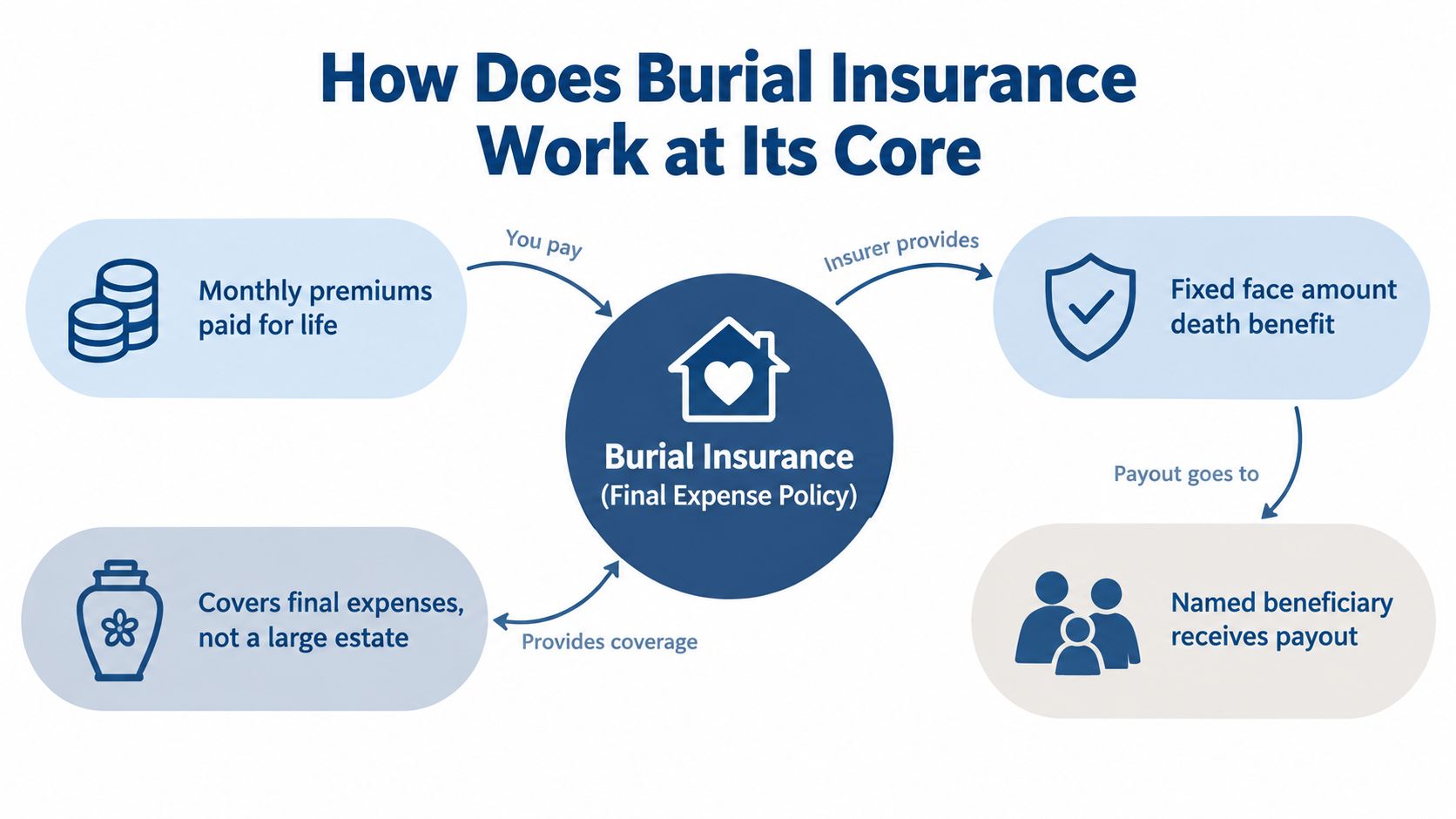
For a first-time buyer in their 60s, the policy is a fixed cash promise. You keep it active by paying premiums, then your beneficiary receives money after your death, subject to exclusions, waiting provisions, and claim requirements. The coverage is intended for final obligations, not years of income replacement or a large estate.
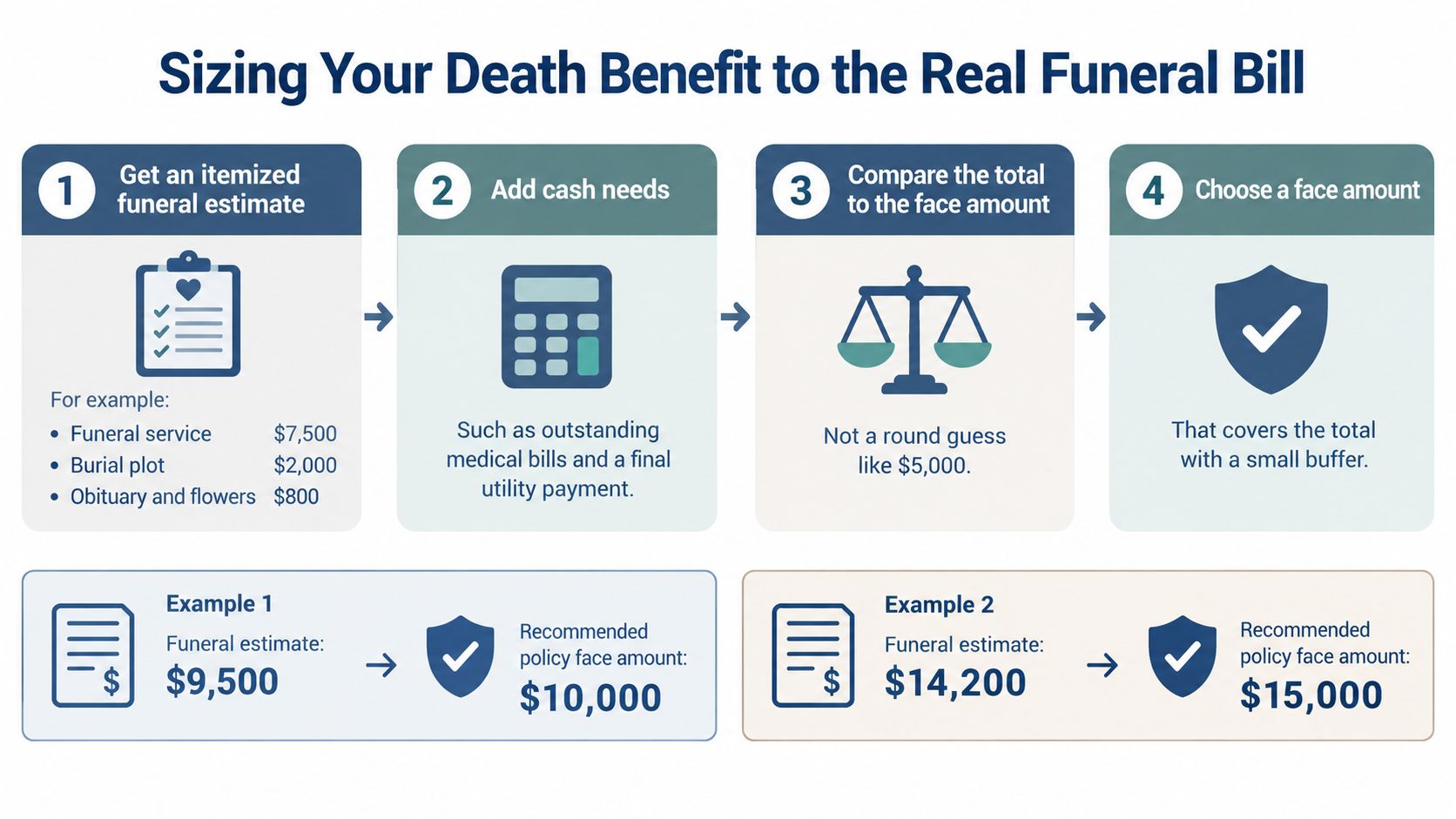
Practical rule: Start with the funeral plan, add other expected bills, and compare that total with the policy's face amount. A round benefit may leave your family short.
Because the beneficiary, rather than the estate, usually receives the proceeds, most policies skip probate entirely. State rules and the beneficiary designation control the outcome, so confirm both. The Law Office of Bryan Fagan probate guidance explains how life-insurance proceeds may interact with probate, with the policy and applicable state law governing the result.
The Moving Parts of a Burial Insurance Policy
Read a burial policy as four connected pieces. Each one answers a practical question: What do I pay, what will the insurer pay, who receives it, and who controls the contract?
The premium
The premium is the amount you pay to keep the policy active. Burial insurance is commonly structured with premiums intended to continue for life. Many policies offer a level premium, meaning the scheduled payment is designed not to increase just because you grow older, but you must confirm that feature in the contract.
Affordability matters more than a tempting quote. The National Association of Insurance Commissioners advises consumers to consider how much coverage their families need, how long coverage should last, and what premium they can afford (NAIC life-insurance consumer guidance).
The face amount
The face amount is the stated death benefit. If the policy is active and the claim qualifies for the full benefit, that's the amount the insurer generally pays, subject to the contract. The face amount should be compared with an itemized funeral estimate and other final obligations, not selected by habit.
The beneficiary
The beneficiary receives the proceeds. Because the beneficiary usually controls the cash, they can allocate it among funeral charges, cremation, medical expenses, debts, or transportation. Keep the designation current, especially after a divorce, remarriage, or family change.
The owner and insured
The insured is the person whose death triggers the claim. The owner controls policy decisions, such as changing beneficiaries or requesting certain contract actions. In some family arrangements, an adult child may own and pay for a policy covering a parent, but the insurer and applicable state rules determine what's permitted.
Some whole-life policies also build cash value. Cash value is not the same as the death benefit. It may be available through loans, withdrawals, or surrender, depending on the contract, and using it can reduce protection or create other consequences. If a family is considering more complex ownership or trust planning, an explainer on irrevocable life-insurance trusts may help clarify why ownership deserves careful attention.
Burial insurance is a fixed-price promise only when the policy stays active and its conditions are understood.
When you receive a policy illustration, locate the premium, face amount, owner, insured, beneficiary, cash-value schedule, exclusions, and any graded-benefit language. Those entries tell you far more than the advertisement.
Simplified Issue Versus Guaranteed Issue
The underwriting route determines how the insurer decides whether to accept you. Simplified issue usually avoids a traditional medical exam but still asks health questions and may use other risk information. Guaranteed issue generally doesn't use health information to decide acceptance, which can make it available after serious health problems.
The trade-off is important. Guaranteed-issue policies commonly have lower benefit limits, age or eligibility restrictions, and a graded benefit for some non-accidental deaths during an initial period (NAIC consumer guide to life insurance).
| Feature | Simplified Issue | Guaranteed Issue |
|---|---|---|
| Medical exam | May not require one | Generally not required |
| Health questions | Usually asked | Generally not used to determine acceptance |
| Best fit | Applicants who can answer health questions favorably | Applicants with serious conditions who may not qualify elsewhere |
| Approval | Depends on health and risk information | Acceptance is generally available if eligibility rules are met |
| Common trade-off | Health history may limit approval or affect price | Lower limits, eligibility restrictions, and graded benefits are common |
A healthier applicant may find simplified issue more suitable because it can offer a stronger benefit structure than a guaranteed-issue fallback. But don't assume a policy is simplified issue merely because no nurse visits your home. Read the application questions and underwriting disclosures.
Guaranteed issue can be valuable when other options aren't available. It shouldn't automatically be your first choice if you could qualify for coverage with a more favorable early-death provision. The right comparison is not just the monthly price. Check the full benefit schedule, total premium commitment, and exclusions.
For a plain-language explanation of the second path, review guaranteed-issue life insurance. Then ask the agent to show you both options side by side, using the same coverage goal.
Waiting Periods and Graded Benefits Explained
A graded death benefit means the beneficiary may not receive the full face amount if the insured dies from a covered natural cause during an initial period. The policy might return premiums with interest, pay a percentage of the face amount, or follow another schedule. The exact result must come from the contract, not from a general sales description.
Insurers use these provisions to manage the risk of accepting applicants with significant health conditions without full medical underwriting. The arrangement can make coverage available, but it changes what the family can expect during the early years.
A simple timeline
Suppose a policy states that natural-death benefits are graded during the first part of the contract. If the insured dies shortly after the policy begins, the beneficiary might receive the amount specified in the early-benefit clause rather than the full face amount. If death occurs after the graded period ends, the full stated benefit may become payable, assuming the policy is active and the claim meets the contract terms.
Accidental-death treatment may differ from natural-death treatment. Some contracts pay the full benefit for accidental death during an initial period, while others use different rules. Never infer the result from the phrase “guaranteed issue.” Read the actual schedule.
A contestability clause is separate from a graded benefit. It generally gives the insurer rights to review material application information during a stated period. If the application contains an important misrepresentation, the claim could face scrutiny. Answer health questions accurately, even when a condition feels embarrassing or unrelated.
For an additional perspective on immediate-benefit products, see life insurance with no waiting period. “No waiting period” still doesn't erase exclusions, application accuracy requirements, or other policy conditions.
Clauses to read before signing
- Graded-benefit schedule: Identify exactly what the beneficiary receives after an early natural death.
- Accidental-death language: Check whether accidental death receives different treatment.
- Contestability provision: Understand how the insurer may review application answers.
- Exclusions: Look for circumstances that limit or exclude payment.
- Beneficiary rules: Confirm who receives the money and whether changes are allowed.
- Premium and lapse provisions: Learn what happens after a missed payment.
A policy can be active and still pay less than its advertised face amount if an early-death provision applies.
Sizing Your Death Benefit to the Actual Funeral Bill
A reported U.S. median cost is $8,300 for viewing and burial and $6,280 for viewing and cremation, according to these funeral-cost benchmarks. Treat those figures as starting points, not final invoices. Local prices and family choices can change the amount your beneficiary must pay.
Request an itemized estimate from a funeral home or cremation provider. Ask which services are included, then list expenses outside the main package, such as cemetery charges, a plot, a headstone, flowers, reception costs, transportation, unpaid medical care, and household bills. Your target death benefit is the total expected cost minus money already set aside.
A burial example
Suppose the family chooses viewing and burial. Start with the $8,300 median burial cost. Add a $2,000 plot, a $1,500 headstone, and $1,200 in unpaid medical bills. The estimated need reaches $13,000, before any additional transportation, flowers, or reception costs. A $10,000 policy would leave the beneficiary with a gap of about $3,000, while a smaller policy would leave more of the bill unpaid.
The provider's estimate is like the first line of a household budget. It names the main purchase, but not every expense around it. Write each extra cost down rather than assuming the policy's face amount will cover it.
Oregon's 2025 administrative rule permits up to $6,000 in certain circumstances for a “plain and decent” funeral and disposition. It also requires deductions for prepaid trusts, designated life insurance, set-aside funds, or burial insurance (Oregon administrative rule). This limit is not a national funeral price. It does show why a $5,000 policy may fall short for one arrangement, while a larger policy may cost more than another family needs.
A cremation example
For cremation, begin with the provider's written estimate. Add the urn, memorial service, travel, unpaid medical bills, and other final obligations the beneficiary will handle. Direct disposition may require less coverage than cremation followed by a gathering, transportation, and a permanent memorial.
Use this four-step method:
- Request an itemized estimate.
- Add non-funeral final expenses.
- Subtract money already reserved for those bills.
- Choose a face amount that covers the remaining need without creating an unaffordable premium.
Allow for inflation if the funeral occurs years after purchase. A fixed death benefit may cover less later, but excess coverage can also strain the household budget.
Premiums, Lapses, and the Medicaid Complication
A policy that lapses can eliminate future protection or reduce available value according to the contract. That makes premium affordability a planning issue, especially for self-employed workers, contractors, early retirees, and households with irregular income.
The Society of Actuaries' U.S. persistency study, covering guaranteed-issue and simplified-issue life policies from 40 insurers, reported average policy lapse of 4.4% and face-amount lapse of 6.1%. The study reported average lapse of 4.5% for policies issued in the 60s versus 1.8% for issue ages 70 and older (Society of Actuaries persistency study). These figures don't predict what will happen to your policy, but they show why payment design deserves attention.
Before buying, ask:
- Payment stress test: Can you maintain the premium if income drops?
- Grace period: How long can a payment be late before coverage is at risk?
- Automatic premium loan: Does the policy borrow from cash value, if available?
- Reduced paid-up insurance: Can the contract preserve a smaller benefit?
- Reinstatement: What must you do to restore coverage after a lapse?
- Total cost: How do cumulative premiums compare with the death benefit?
Why Medicaid treatment is different
“Burial insurance” is a marketing label, not a guarantee that Medicaid will ignore the policy. Treatment can depend on ownership, beneficiary arrangements, cash-surrender value, face amount, state rules, and whether proceeds are restricted to funeral expenses.
Ohio's current Medicaid rule defines burial insurance as a contract whose proceeds can't be used for purposes other than burial expenses and treats it as a burial fund. New York guidance allows burial funds, life insurance, and irrevocable funeral agreements to be aggregated toward a $1,500 exclusion (Ohio Medicaid burial-insurance rule). These examples demonstrate why one state's treatment shouldn't be applied automatically in another.
An ordinary policy paying cash to a beneficiary may be more flexible than a restricted burial arrangement, but it may receive different treatment for means-tested benefits. Families dealing with Medicaid or estate recovery can also review guidance on protecting inheritances for Texas families, while remembering that legal and benefits rules depend on jurisdiction. Medicaid qualification guidance can help identify questions to ask, but your state agency or qualified benefits professional should confirm the answer before you buy, transfer, or change coverage.
Your Burial Insurance Buyer Checklist
Take this checklist to an agent, insurer, or quote comparison:
- Confirm the purpose: Decide whether the policy will fund funeral costs only or also provide cash for medical bills, debts, and transportation.
- Price the plan: Obtain an itemized burial or cremation estimate instead of choosing a round face amount.
- Compare underwriting: Ask whether you qualify for simplified issue before considering guaranteed issue.
- Read early benefits: Identify graded-benefit, accidental-death, exclusion, and contestability provisions.
- Protect the payment: Test the premium against dependable income and ask about missed-payment options.
- Review ownership: Confirm the insured, owner, premium payer, and beneficiary.
- Check Medicaid rules: If benefits matter, ask the relevant state agency how ownership, cash value, and burial restrictions are treated.
- Compare the commitment: Consider cumulative premiums, the death benefit, and whether the policy remains affordable over time.
A well-sized policy can give a working family or adult child helping a parent a dependable source of cash at a difficult moment. It isn't automatically the biggest policy or the policy with the lowest advertised premium. It's the contract whose benefit, payment structure, waiting provisions, and eligibility treatment match the family's actual situation.
My Policy Quote offers life-insurance quote comparisons and connects shoppers with licensed insurance agents, including options for whole-life, simplified-issue, and guaranteed-issue coverage. Visit My Policy Quote to compare burial-insurance possibilities against your funeral estimate and ask informed questions about premiums, waiting periods, beneficiaries, and Medicaid considerations.