

You retire at 62, hand back your laptop, and expect the next chapter to feel lighter. Then payroll explains that your employer health plan ends with your employment. Medicare is still years away, your spouse may have a different plan, and a premium quote arrives that looks more like a mortgage payment than a routine household bill.
That moment is common because Medicare generally begins at 65, while the median retirement age in the United States is 62. The result is a multi-year coverage bridge that demands more than a quick comparison of monthly premiums. Your retirement date, household income, investment withdrawals, medical needs, tax strategy, and enrollment dates all affect the actual cost of early retirement medical coverage.
The right question isn't just, “Which plan is cheapest?” It's, “How do we protect the household from a coverage gap and preserve the most affordable path to Medicare?”
The Reality of the Pre-Medicare Gap
Consider a professional leaving work at 61 after decades on an employer plan. The paycheck stops, employer-sponsored coverage ends or becomes expensive, and the household suddenly has to make decisions it previously delegated to a benefits department. A spouse's plan might be available, COBRA might preserve familiar doctors, or an ACA Marketplace plan might offer financial assistance. None of those options works automatically.
The years before Medicare are a financial bridge, not a shopping trip. A plan with a low premium can expose you to a deductible and network restrictions that don't fit your medical needs. A familiar employer plan can cost far more than an ACA policy. A retirement withdrawal that looks harmless in a budget can also affect household income used for Marketplace assistance.
Broker's advice: Set the coverage strategy before you set the retirement date. The two decisions are financially connected.
The health insurance before Medicare guide can help organize the basic options, but your household still needs a personalized timeline. Start by identifying the exact last day of active coverage, the date any continuation option becomes available, and the first day a new policy can begin.
Medical risk also changes as people age. Someone planning for ordinary doctor visits may later need help with prescriptions, specialist care, or long-term support. Medicare eligibility doesn't automatically solve every future care question, so families thinking about cognitive decline should also review this practical Medicare dementia guide while building a broader retirement plan.
The bridge has four moving parts
Your decision should account for:
- Coverage timing: Losing job-based coverage generally creates an ACA Special Enrollment Period, but the effective date must be coordinated carefully.
- Household income: Marketplace assistance depends on projected household income, not just the salary you earned before retirement.
- Medical usage: A plan's deductible, drug coverage, specialist network, and out-of-pocket exposure can matter more than its premium.
- Medicare handoff: Your temporary policy must carry you to Medicare eligibility without an avoidable gap or rushed transition.
The emotional mistake is assuming retirement makes health insurance simpler. In practice, leaving work removes a subsidized group arrangement and transfers the decision to you. Treat the bridge as a planned liability, reserve money for it, and review the strategy whenever income or household circumstances change.
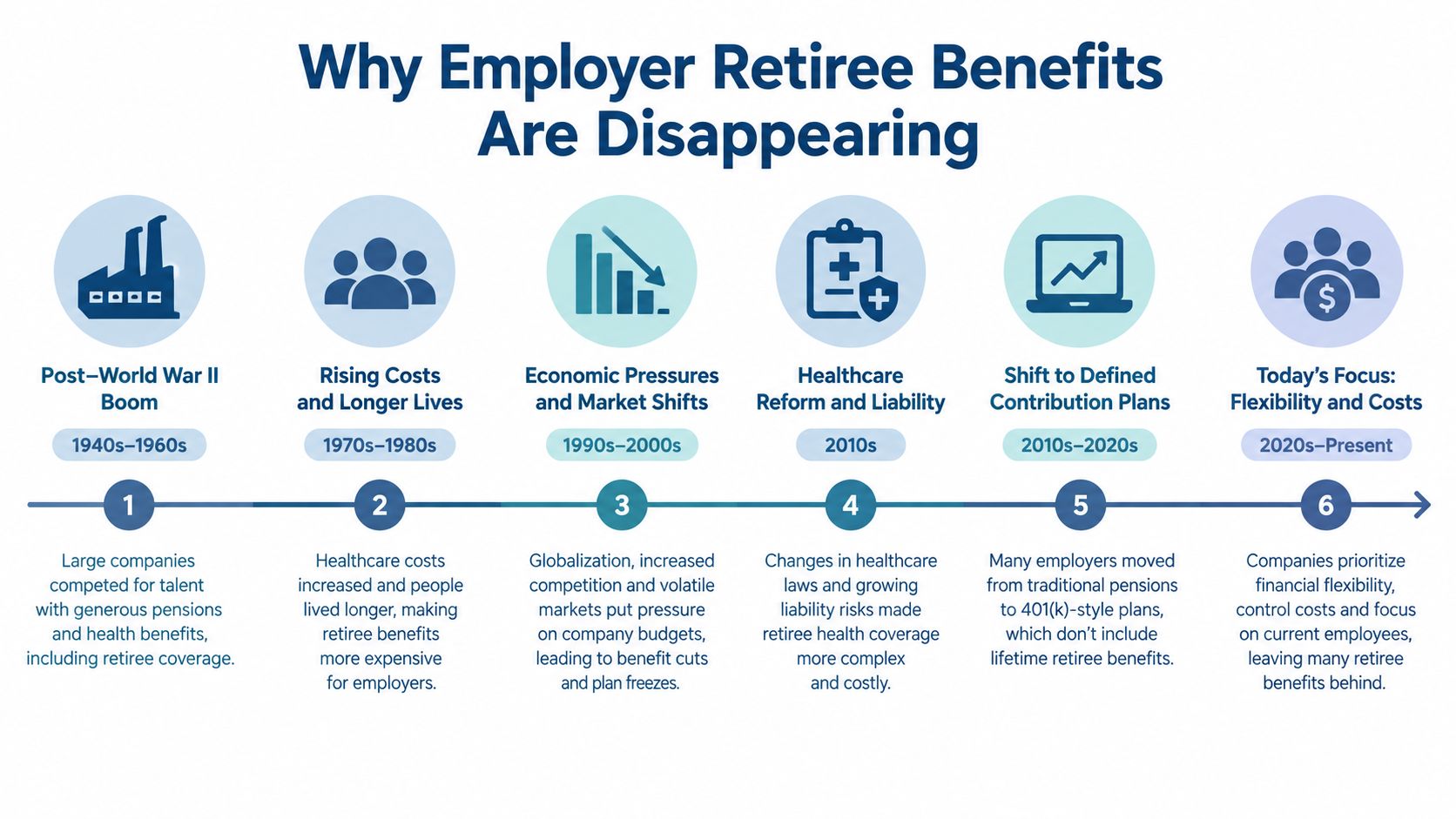
Why Employer Retiree Benefits Are Disappearing
You leave work at 61 expecting your former employer to cover the years before Medicare. Then the benefits administrator confirms that retiree coverage is limited, expensive, or unavailable to your spouse. Build your bridge on verified terms, not on an assumption that a past employer will continue subsidizing the household.
Employer retiree coverage has become less dependable, and plans that remain available may require retirees to pay a substantial share of the premium. The shift affects more than plan selection. It determines how much income your household can draw, whether you preserve Marketplace assistance, and how you fund coverage until Medicare.
The historical change is substantial. The share of large employers offering retiree health coverage fell from 66% in 1988 to 29% in 2013. By 2012, only 45% of retirees ages 55–64 had health benefits from a former employer, according to AARP's overview of retirement health considerations.
The responsibility moved to the retiree
Before ACA reforms, people in their late 50s and early 60s faced an individual market where insurers could charge more because of age or health status, or deny coverage altogether. A serious diagnosis or expensive prescription could make early retirement financially dangerous.
The Affordable Care Act created a more structured individual market. Its Early Retiree Reinsurance Program also supported employers that continued coverage for early retirees age 55 and older who were not yet eligible for Medicare. The program provided $5 billion in financial assistance. CMS reported reimbursements connected to 1,622 plans, with survey responses indicating coverage for 26 million enrolled individuals, including almost 2.6 million early retirees, as described in the Centers for Medicare & Medicaid Services program history.
This history explains the present responsibility. The system moved away from a heavily underwritten individual market toward employer plans, public marketplaces, and federal support. The cost did not disappear. Retirees now have to coordinate coverage, income, and enrollment decisions themselves.
Reviewing whether employers are required to offer health insurance can clarify legal obligations, but availability alone does not make a benefit useful. Ask the benefits administrator for the retiree premium, employer contribution formula, network rules, prescription coverage, eligibility conditions, and Medicare coordination terms.
Never count an unconfirmed benefit
A benefits booklet that mentions “retiree medical” may describe limited access rather than fully paid insurance. Contributions can change, enrollment may be restricted to certain employee groups, and the plan may coordinate with Medicare in ways that provide no help during the pre-Medicare years.
Get the terms in writing before resigning:
- Does the plan cover retirees under 65?
- What premium would the household pay?
- Can a spouse join or remain covered?
- Which doctors and hospitals participate?
- Does coverage end or change at Medicare eligibility?
Until those answers are documented, treat employer retiree coverage as a possibility, not an asset. Allocate retirement income around coverage you can confirm, and preserve flexibility for the years before Medicare.
Evaluating Your Core Coverage Vehicles
Four coverage vehicles usually deserve attention: an ACA Marketplace plan, COBRA, a spouse's employer plan, and private short-term medical coverage. They aren't interchangeable. The best choice depends heavily on enrollment timing, subsidy eligibility, provider access, and the length of the bridge.
| Coverage Type | Subsidy Eligible | Network Flexibility | Best Used For |
|---|---|---|---|
| ACA Marketplace plan | Potentially, based on household income | Depends on plan and area | A multi-year bridge with possible premium assistance |
| COBRA continuation | Generally not through Marketplace premium assistance for the same coverage | Preserves the employer plan's network | Keeping current doctors during a short transition |
| Spouse's employer coverage | Usually not Marketplace assistance when affordable employer coverage is available | Depends on the spouse's plan | A household with a working spouse and suitable group benefits |
| Private short-term medical plan | Generally no ACA premium assistance | Often more limited and policy-specific | A temporary solution where exclusions and limitations are acceptable |
Losing job-based coverage triggers a Special Enrollment Period for ACA Marketplace plans. COBRA may extend employer coverage for up to 18 months, but the interaction becomes complicated when retirement occurs near open enrollment, as explained in this early-retirement coverage analysis.
ACA Marketplace plans
For those who need coverage for several years, start with the Marketplace. ACA-compliant plans can't reject you because of medical history, and projected household income may qualify you for premium tax credits. Apply through the Marketplace if you want financial assistance. Buying directly from an insurer generally won't provide that assistance.
Don't estimate income casually. Include expected wages before retirement, severance, consulting income, investment income, capital gains, pensions, and other relevant household income. Then compare the benchmark Silver plan with the plan you want, because the tax credit is tied to the second-lowest-cost Silver plan in your area, not necessarily your selected policy.
COBRA
COBRA's main advantage is continuity. You may keep the same doctors, hospitals, formulary, and deductible structure. Its weakness is cost, because you generally take on the employer's share of the premium as well as the administrative charge.
COBRA can make sense when you are close to Medicare or in the middle of treatment and changing networks would create disruption. It deserves a side-by-side quote against Marketplace coverage before you elect it.
Spouse coverage
A working spouse's group plan may be the cleanest bridge, but check the employee contribution for family coverage, the network, prescription rules, and the plan's special enrollment deadline. Don't assume the spouse's plan is cheaper merely because the employee-only premium is affordable.
The plan's affordability and coverage terms can also affect Marketplace assistance. Compare the total household cost, not just the added spouse premium.
Short-term plans
Short-term medical coverage can look attractive because the premium may be lower, but exclusions, underwriting, limited benefits, and renewal rules can create serious exposure. I wouldn't use it as the default bridge for a 60-to-64-year-old with meaningful medical needs. Treat it as a narrow temporary tool, not a substitute for full coverage.
The video below may help you frame the comparison before collecting quotes.
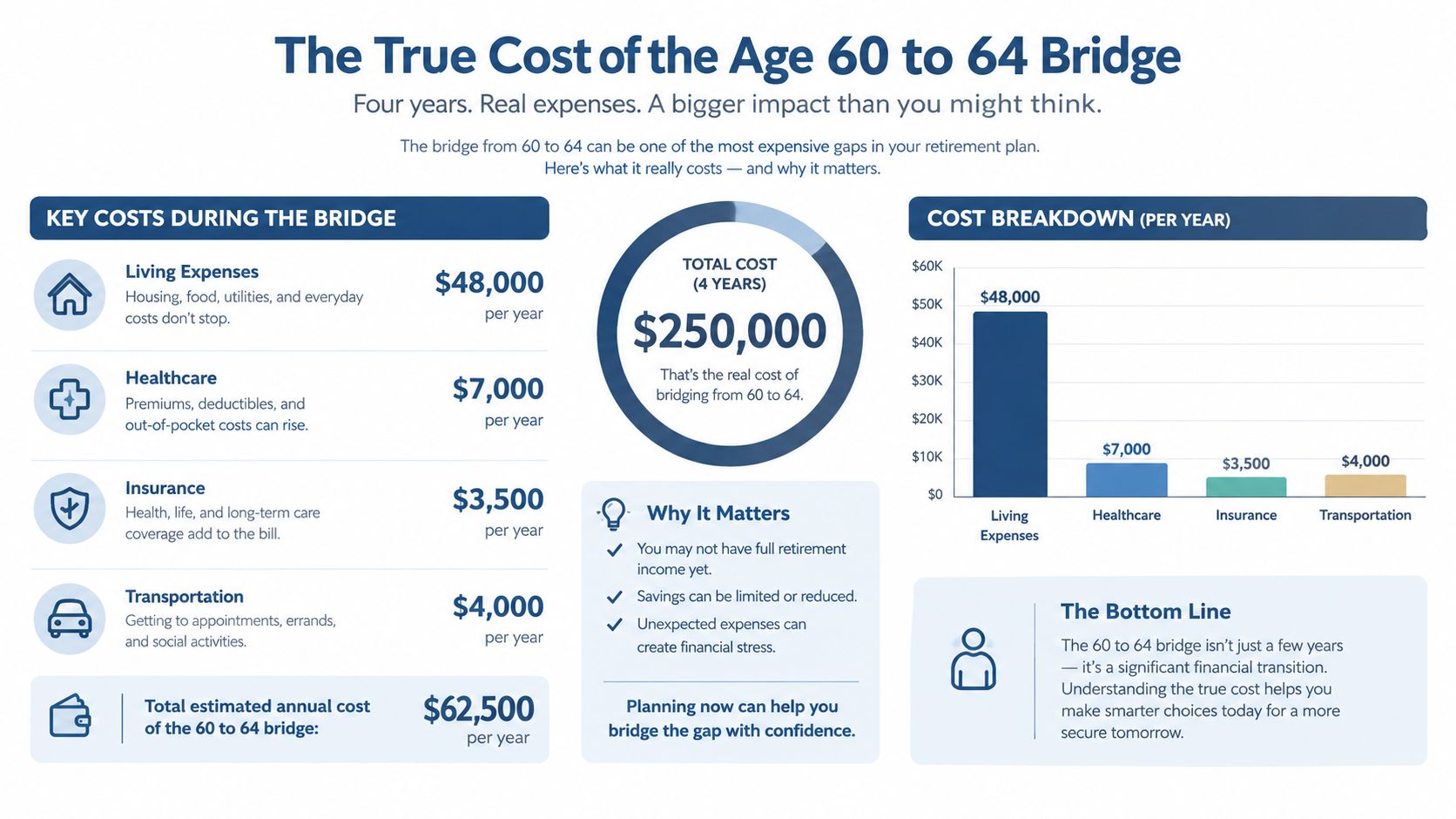
The True Cost of the Age 60 to 64 Bridge
Retiring at 60 can leave a household funding health coverage for years before Medicare begins. The premium rises with age even when health stays the same. Federal ACA age-rating rules increase benchmark premiums as an enrollee approaches Medicare eligibility, so the retirement date and income plan directly affect the bridge cost.
A planning example using a $625 benchmark Silver premium for a 40-year-old indicates about $1,405 per month at age 62 and about $1,467 per month at age 64, before subsidies, according to this early-retirement health insurance cost analysis. Treat those figures as planning estimates, not fixed quotes. The important point is that a two-year delay can raise gross premiums when age-rated pricing meets unchanged household income.
Sticker price isn't the full decision
For a 60-year-old in 2026, the national average annual unsubsidized premium is $11,625 for the lowest-cost Bronze plan, $15,914 for the benchmark Silver plan, and $15,672 for the lowest-cost Gold plan, according to HealthInsurance.org's early-retirement coverage guide.
Those figures make a low-premium plan look attractive, but Bronze coverage can shift more costs to the household when care is needed. Gold may suit someone expecting regular treatment, while Silver can matter when Marketplace assistance is tied to its benchmark position. Compare annual premiums, deductible exposure, prescriptions, networks, and subsidy eligibility together.
Financial rule: Rank plans by total annual household exposure, not premium alone.
Income planning often determines the subsidy outcome. The Marketplace uses projected household income for the coverage year, so taxable withdrawals, realized gains, consulting revenue, and retirement contributions can affect assistance. Set a withdrawal schedule before enrolling, and coordinate major asset sales or business income with a tax professional who understands Marketplace calculations. An unexpected capital gain can change the coverage budget.
Employer retiree coverage may still leave a substantial bill. Plans cited in 2025 covered about 40% of the cost of pre-Medicare insurance on average, while a typical 64-year-old retiree could face roughly $8,600 in annual premiums despite employer coverage, according to the Mercer-Vanguard analysis of the bridge to Medicare.
Review early retirement health insurance costs before setting a retirement date. Coordinate medical premiums with survivor and income-protection planning. A review of life insurance over 60 can help identify whether the surviving spouse could continue paying for coverage and care.
Strategies for Common Retiree Personas
Your bridge strategy should follow the household's income pattern, employment status, and actual employer contribution. Select a workable approach, then test it against plan documents, provider access, prescription needs, and projected taxable income.
The self-employed 1099 professional
A contractor faces income volatility, so begin with a full-year projection rather than relying on last year's tax return. Separate signed revenue from uncertain contracts, then include investment income, capital gains, business deductions, and retirement contributions.
The objective is sound income planning, not careless manipulation. Time legitimate contracts, deductible contributions, and withdrawals with a tax professional who understands Marketplace calculations. Recheck the projection after a major client change, asset sale, or business expense.
Set aside cash for months when revenue falls short. Then choose a Marketplace plan that keeps your doctors and prescriptions accessible. A low premium does not protect the retirement budget if deductibles, coinsurance, or out-of-network bills are too high.
The corporate retiree aged 60 to 64
Ask for the employer's retiree plan documents before treating the benefit as valuable. Confirm the employer contribution, premium schedule, provider network, drug coverage, enrollment deadline, and coordination rules before Medicare begins.
Employer assistance can cover only part of the pre-Medicare bill. For a 64-year-old household, the remaining annual premium may still be substantial, so compare the employer option with an ACA Marketplace quote after accounting for possible tax credits. The right comparison is the cost of the entire bridge, not the size of the stated employer benefit.
Protect a specialist relationship or hospital system if the retiree plan is the only option that preserves it. If the contribution is modest and access is limited, a Marketplace policy may provide the more practical bridge. Confirm eligibility and enrollment timing before declining employer coverage, because a later change may not create an immediate replacement opportunity.
The working-class family with unstable job coverage
Preventing a coverage gap comes first. Collect termination dates, spouse-plan rules, COBRA paperwork, and Marketplace documents before employment ends. Keep cash available for the first premium, deductible exposure, and claims incurred while eligibility is processed.
Build the application around the household's expected annual income, including changing wages and withdrawals. If that estimate changes materially, update the Marketplace application rather than waiting for tax filing to reveal a subsidy mismatch.
Choose coverage that keeps pediatric care, primary care, hospitals, and prescriptions available. A policy with a low monthly premium can strain the household when routine care or an unexpected admission triggers high cost sharing. An insurance professional can compare employer coverage, COBRA, and Marketplace options using the family's actual providers and budget.
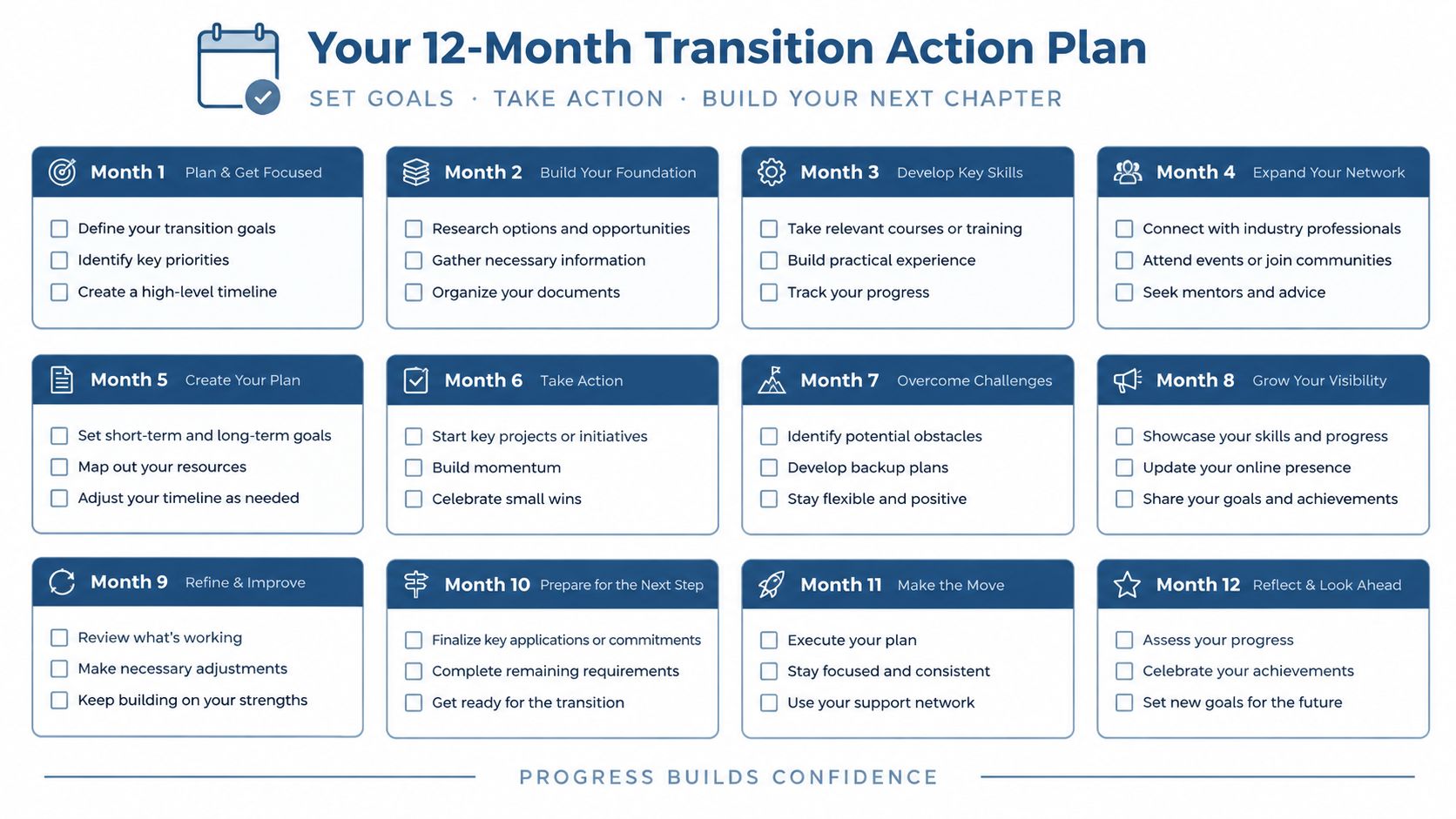
Your 12-Month Transition Action Plan
A successful transition starts before the resignation letter. Use a calendar, store every notice, and assign one household member responsibility for deadlines.
Twelve months before retirement
Ask human resources for the Summary Plan Description, retiree coverage rules, COBRA estimate, spouse enrollment rules, prescription information, and the exact termination date. Build a household income forecast that includes wages earned before retirement, severance, pensions, investment income, and planned withdrawals.
List every provider and medication that must remain accessible. Use that list to test employer, spouse, COBRA, and Marketplace networks.
Three months before retirement
Obtain written quotes rather than relying on online examples. Compare total annual exposure, not just premiums. Decide whether the household needs continuity through COBRA, a spouse plan, or a Marketplace policy.
Prepare the documents needed for a Marketplace application and review how to apply for health insurance. If income is uncertain, create a conservative estimate and a process for updating it.
During the final month
Confirm the last day of active coverage and the effective date of replacement coverage. Ask exactly when the Special Enrollment Period begins, when the application must be submitted, and whether the new policy starts immediately after employer coverage ends.
Keep the COBRA election materials. Don't discard them just because you prefer the Marketplace. COBRA can serve as a fallback if enrollment or effective dates create a problem.
After employment ends
Verify that the first premium was paid and the policy is active. Check the member portal, primary-care assignment, prescriptions, and claims process. Store confirmation numbers and notices in one folder.
Review the income estimate after the first retirement year begins. If consulting work, gains, withdrawals, or household employment changes, update the application rather than allowing the original estimate to drift.
Navigating Complex Coverage Questions
Retiring in November creates a timing problem, not an automatic coverage failure. The loss of job-based insurance can trigger a Special Enrollment Period, but you still need to coordinate the employer termination date, application date, effective date, and first premium. If the household is also near open enrollment, compare both paths instead of assuming one enrollment window controls everything.
COBRA can be useful as a continuity tool, especially when an active treatment plan depends on the current network. It can also be an expensive reflex. Request the total premium, compare it with Marketplace alternatives, and decide whether preserving the existing plan justifies the added cost.
Capital gains can change the answer
A sale of investments can increase household income used in the Marketplace calculation even if the money is earmarked for retirement. The same applies to consulting revenue, pension income, and other taxable sources. Before selling an asset or taking a large distribution, ask how it may affect the current year's coverage assistance and whether the change should be reported.
Don't make a tax move solely to chase a premium credit. Evaluate taxes, cash flow, medical exposure, and long-term retirement needs together.
High deductible doesn't mean no strategy
Some retirees consider paying routine care directly while holding a high-deductible policy for major events. That can work for a financially prepared household with predictable medical needs, but it doesn't eliminate the need to evaluate prescriptions, negotiated rates, network rules, preventive care, and maximum out-of-pocket exposure.
Use the plan documents, not a sales label, to determine what the policy covers. If a chronic condition, specialist, or recurring medication is central to your care, price that usage before selecting the lower premium.
The best bridge is the one your household can keep active, afford during a bad medical year, and transition cleanly into Medicare. Plan the coverage, income, and deadlines as one system.
My Policy Quote offers guidance for comparing pre-Medicare health insurance options, including ACA Marketplace and COBRA-related choices, so you can evaluate the bridge in the context of your household rather than a single premium. Visit My Policy Quote to review your options and start organizing coverage before you leave work.