
If you miss ACA Open Enrollment, which runs from November 1 to January 15, you generally can't enroll in a Marketplace plan until the next annual window unless a qualifying life event gives you a Special Enrollment Period. After January 15, coverage is generally available only through a qualifying life event or an alternative program for which you qualify.
It's February, your tax documents are scattered across the kitchen table, and you suddenly realize you never selected health insurance. The panic is understandable, but missing the deadline doesn't mean you should stop looking for solutions. Your next step is to determine whether you have a hidden enrollment path, existing coverage that renewed automatically, or eligibility for a year-round public program.
What Happens If You Miss Open Enrollment
Start by separating the type of coverage you missed. ACA Marketplace rules, employer benefit rules, and Medicare enrollment rules aren't interchangeable, and using the wrong rule can lead to a costly delay.
For an ACA Marketplace plan, the basic rule is straightforward. Open Enrollment runs from November 1 through January 15 in the United States, and after January 15 you generally can't start or change a private Marketplace plan until the next annual window unless you qualify for a Special Enrollment Period. Most qualifying events provide a 60-day enrollment window, while job-based plans must provide at least a 30-day Special Enrollment Period in applicable situations. Healthcare.gov explains the qualifying events and enrollment windows.
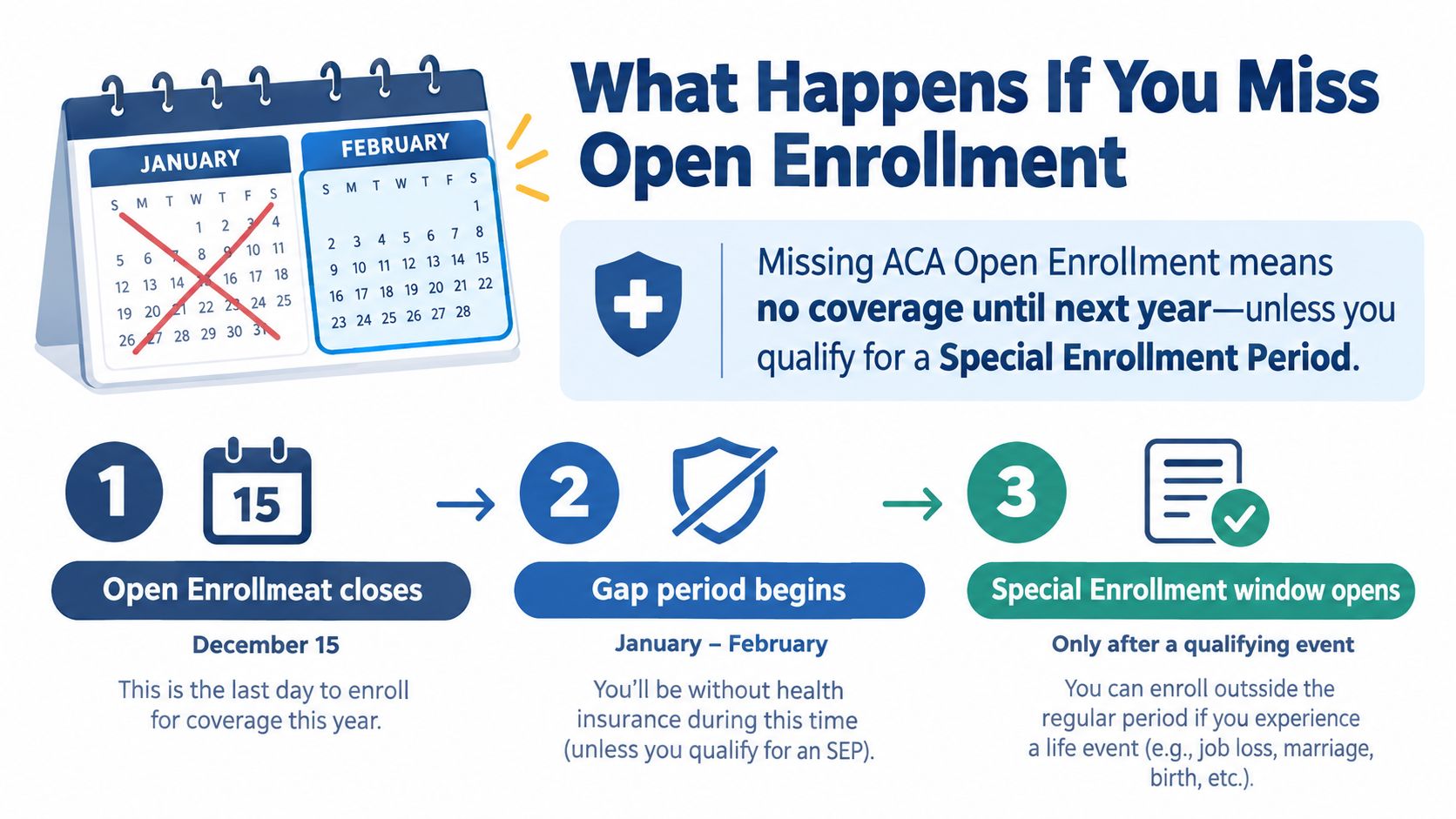
That rule applies most directly to someone who doesn't currently have Marketplace coverage and forgot to enroll. Missing the deadline by a few days usually doesn't create an exception by itself. You need a qualifying event, such as losing other coverage, moving, getting married, or having a baby.
First check whether you already have coverage
People often assume they're uninsured when their existing plan renewed automatically. An employer plan may roll over your current elections, and an existing Marketplace plan may renew if the insurer still offers it. That renewal might not reflect the coverage you would have chosen, but it can prevent an immediate gap.
Contact your employer's benefits team or insurer and ask three direct questions:
- Is my current plan active?
- Did my coverage renew automatically?
- Did my premium, network, deductible, or benefits change?
Independent benefits guidance notes that some employer coverage can roll over automatically, while missed employer enrollment may prevent you from making new elections for the plan year. MetLife's explanation of missed open enrollment is useful because it distinguishes between being unable to change benefits and having no coverage at all.
Then check year-round programs
Medicaid and CHIP can provide an alternative route when you meet the applicable eligibility rules. These programs don't follow the same annual Marketplace enrollment restriction, so apply rather than assuming you must wait.
If you're uninsured today, don't wait for the next calendar reminder. Confirm your current status, check for a qualifying event, and apply for any public program that may fit your household. The worst response is treating “missed Open Enrollment” as a final answer when it's only the starting point for the investigation.
Finding Your Hidden Path Through Special Enrollment
A Special Enrollment Period, or SEP, is the main way to obtain or change ACA Marketplace coverage outside the annual window. The event matters, but the clock and documentation matter just as much.
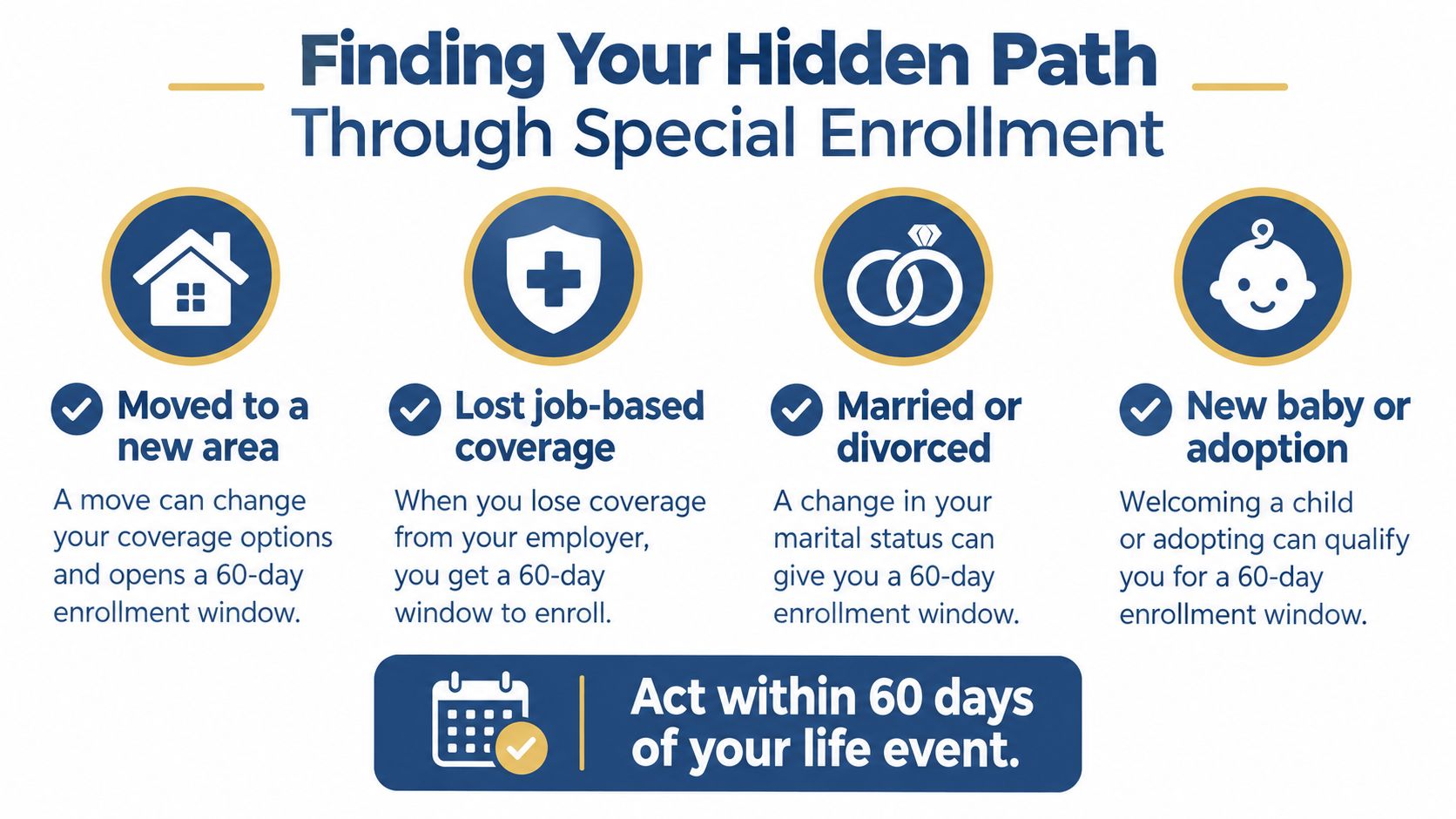
Common triggers include losing job-based insurance, losing coverage through a parent or another source, moving to a new area, marriage, divorce, having a baby, or adoption. The event must fit the applicable Marketplace rules, and the enrollment period is limited. For most SEP types, you generally have 60 days before or after the qualifying life event to select a plan. Healthcare.gov's Special Enrollment Period guidance describes the events and timing.
Use the event, not the missed deadline, as your starting point
Losing coverage because you forgot to enroll generally doesn't create an SEP. Losing other qualifying coverage may. That distinction is critical for people leaving a job, aging off a parent's plan, losing Medicaid eligibility, or ending COBRA.
Moving also requires care. A move may qualify when it places you outside your previous coverage area, but changing addresses within the same service area may not be enough. Marriage and the arrival of a child usually create a clearer route, but you still need to submit the application within the permitted window.
If you're unsure whether your situation qualifies, review this practical guide to what is a qualifying event for health insurance. Treat the review as urgent, not theoretical.
Build the evidence file immediately
Documentation is often the main obstacle. A Marketplace or insurer may ask for proof of the event, the date it occurred, and the coverage that ended. Examples can include an employer termination notice, a letter showing loss of benefits, proof of a move, a marriage certificate, or records relating to a new child.
Take these steps as soon as the event happens:
- Write down the event date. Use the date coverage ended or the qualifying change occurred, not the date you remembered it.
- Request written confirmation. Ask the employer, insurer, agency, or court for a document that identifies the event and effective date.
- Submit the application promptly. Don't wait until the final days of the SEP window.
- Save every confirmation. Keep application numbers, uploaded files, emails, and call notes together.
- Respond to verification requests. A pending documentation request can delay the result even when you're otherwise eligible.
Practical rule: Eligibility opens the door, but timely proof gets you through it.
If an employer didn't notify you clearly about the loss of coverage, ask for the benefits record in writing and contact the Marketplace or plan administrator. Don't rely on a verbal explanation when a coverage gap is at stake.
The Real Cost of Being Uninsured
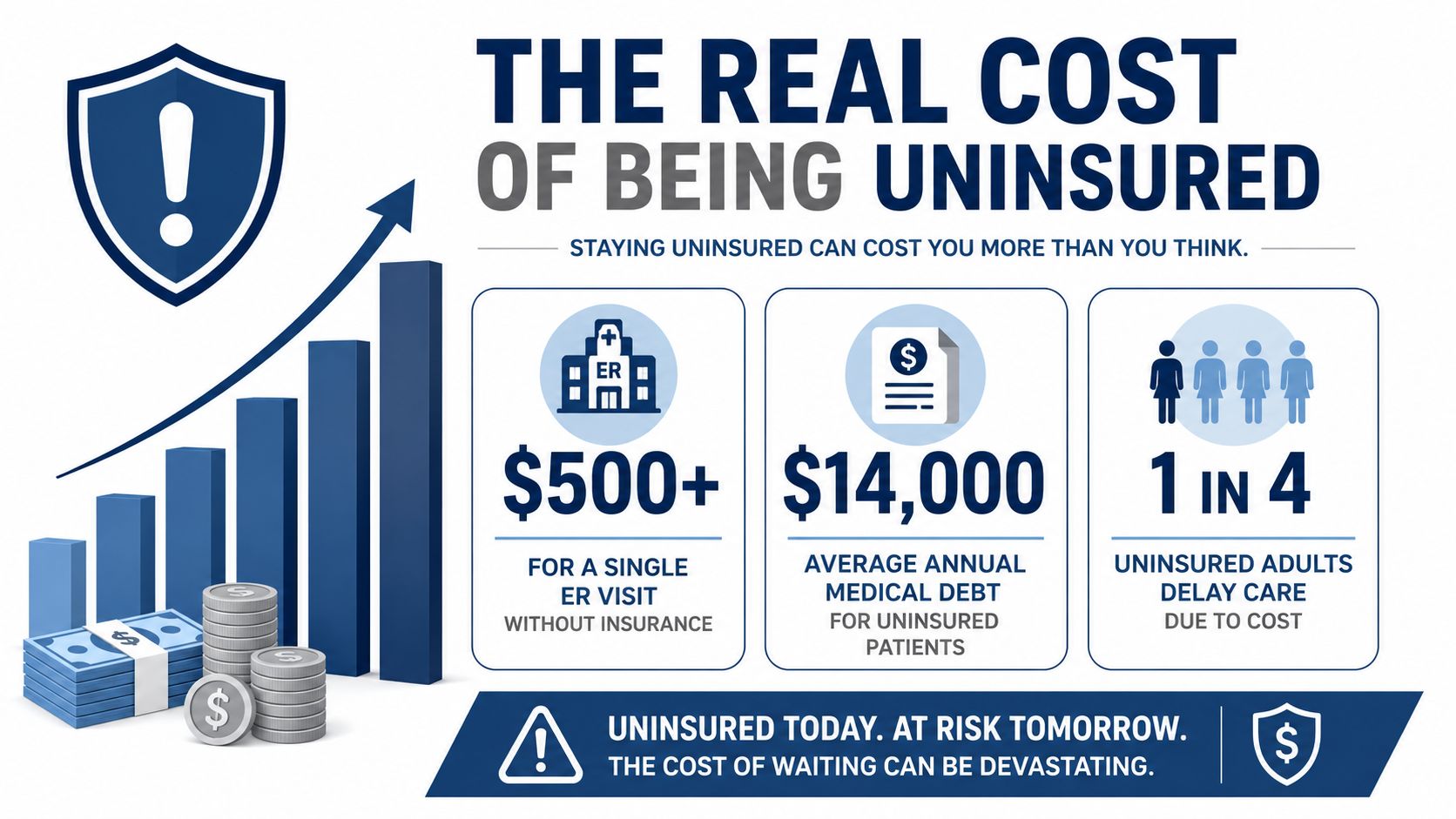
The immediate risk isn't just that you can't show an insurance card. It's that every medical decision during the gap becomes a personal financial decision.
Without active coverage, you may postpone a doctor's visit, skip a prescription, or delay testing because you don't know what the bill will be. A routine problem can become harder to manage, and an unexpected emergency can create claims that no later plan will automatically pay retroactively.
That's why “wait until the next enrollment window” is incomplete advice. First determine whether your existing plan renewed, whether an SEP applies, and whether Medicaid or CHIP is available. If none of those paths works, assess interim protection rather than assuming the risk is harmless.
Think in terms of exposure
An uninsured person carries the full responsibility for covered and uncovered medical expenses, subject to the terms of whatever alternative arrangement they obtain. That exposure can affect rent, savings, credit, and a family's ability to handle ordinary expenses.
Coverage also affects access. A private plan may include hospital care, physician services, prescriptions, preventive services, and network protections, but the exact benefits depend on the policy. For a useful overview of what private health insurance covers, compare the listed benefits with the exclusions, waiting rules, network, and cost-sharing structure of any plan you're considering.
Don't confuse a gap with a solution
Paying cash for one appointment doesn't solve the broader problem. Neither does assuming that a future Marketplace plan will cover a condition that began before its effective date. A later enrollment opportunity may protect you going forward, but it won't automatically erase bills incurred while you had no active policy.
The practical response is to create a short-term safety plan:
- Confirm active coverage today. Ask for the effective date and member information.
- Call providers before nonurgent care. Request self-pay pricing and payment arrangements where appropriate.
- Reserve emergency care for emergencies. Don't delay urgent treatment because of cost concerns.
- Apply for public programs immediately. Medicaid or CHIP may be available when Marketplace enrollment is closed.
- Track every deadline. A missed verification request can turn a possible SEP into a delayed application.
A coverage gap deserves attention even if you're healthy. Insurance protects against events you can't predict, not only conditions you already know about.
Short-Term and Interim Coverage Options
Interim coverage can be useful, but it isn't automatically equivalent to an ACA Marketplace plan. Choose it as a bridge with a defined purpose, and read the exclusions before paying the first premium.
| Option | When it may fit | Main limitation |
|---|---|---|
| Medicaid or CHIP | You meet the program's eligibility requirements | Eligibility and benefits are determined under program rules |
| Employer continuation coverage | You recently lost job-based coverage and need continuity | Premium responsibility and election rules can make it difficult to maintain |
| Short-term insurance | You need temporary protection and can pass the plan's eligibility requirements | Benefits, exclusions, and underwriting may be more limited than ACA coverage |
| Marketplace SEP plan | You experienced a qualifying event and can document it | The application window is time-limited and proof may be required |
Public coverage deserves the first look
Medicaid and CHIP are frequently overlooked because people associate health insurance enrollment with the annual Marketplace calendar. If your household may qualify, submit an application rather than waiting. Eligibility can depend on household circumstances and state administration, so use the official application route for your location.
Continuation coverage can preserve continuity
If you recently lost employer coverage, ask the former employer or plan administrator about continuation rights and election deadlines. This route may help preserve access to the same doctors and plan network, which can matter if you're in treatment or managing prescriptions.
Short-term insurance requires more scrutiny. Ask whether the policy excludes pre-existing conditions, limits specific services, excludes prescriptions, or uses medical underwriting. Confirm the effective date, renewal terms, exclusions, and cancellation rules in writing.
For a focused overview of short-term health insurance, use the information to prepare questions, not as a substitute for reading the actual policy.
Compare the policy to your real needs
Someone who needs only a bridge to an expected employer plan may weigh options differently from a self-employed person with no predictable enrollment date. Check your doctors, prescriptions, planned procedures, hospital preferences, and ability to pay claims before selecting a temporary policy.
If you're comparing regional individual coverage, resources such as compare individual plans in Kansas can help you identify the questions that matter in your state. Don't buy based on a low premium alone. A cheaper policy with major exclusions may leave you carrying the exact risk you were trying to transfer.
CMS guidance emphasizes that SEPs are tied to qualifying events, may require proof, and operate within a limited timeframe. CMS guidance on Special Enrollment Periods reinforces the practical lesson: document first, apply quickly, and verify the result.
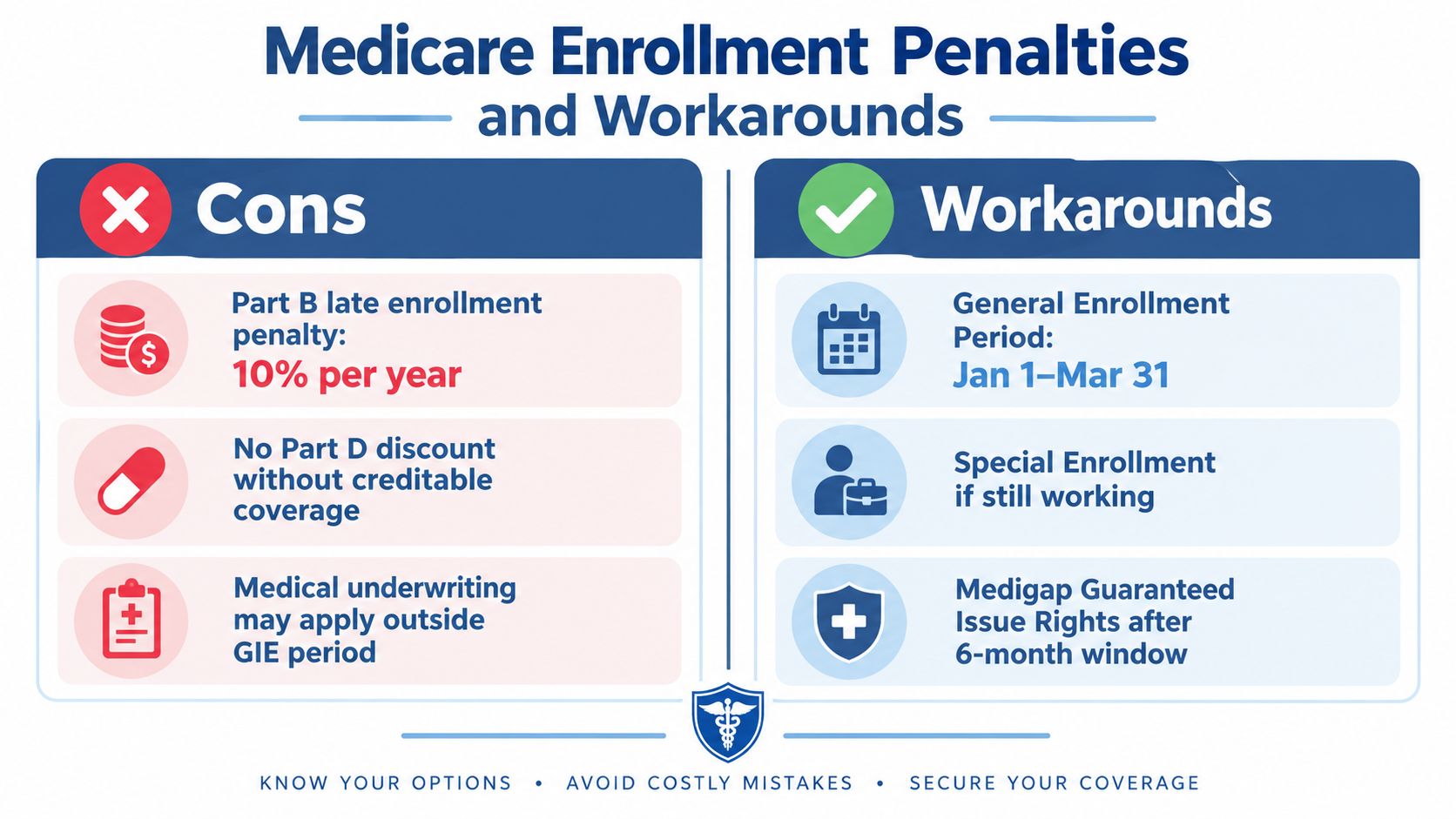
Medicare Enrollment Penalties and Workarounds
Medicare has its own enrollment calendar, and missing one window doesn't always mean the same thing as missing another. If you're already enrolled in Medicare and miss the Annual Enrollment Period, you'll usually remain in your current plan for another year if that plan remains available.
The Medicare Annual Enrollment Period runs from October 15 through December 7. Missing it can limit your ability to switch Medicare Advantage or prescription coverage during that cycle. AARP's Medicare enrollment guidance explains the consequences of missing the annual window and the importance of prescription coverage.
Separate Part B and Part D decisions
Part B late enrollment can create a lasting premium consequence. AARP notes a penalty of 10% for each full 12 months a person went without Part B after first becoming eligible, and that penalty can apply for life. Don't assume an employer plan is automatically sufficient. Ask whether your coverage is creditable and whether your employment status creates a valid Special Enrollment Period.
Part D has a separate concern. Going without creditable prescription coverage can trigger a late-enrollment penalty that lasts for life. Keep written proof of creditable coverage, including notices from an employer or plan administrator.
Read more about what is creditable coverage before deciding that a non-Medicare prescription arrangement is enough.
Use the correct recovery route
People aging into Medicare receive a seven-month Initial Enrollment Period that begins three months before the month they turn 65. If they miss that path, the General Enrollment Period runs from January through March, with coverage generally beginning later. Late-enrollment penalties may apply when enrollment is delayed.
A qualifying employer plan may provide a Special Enrollment Period for someone who continues working, while Medicare also recognizes certain exceptional circumstances involving emergencies or disasters. Gather employment and coverage records, contact Social Security or Medicare, and ask which enrollment route applies before submitting an assumption-based application.
If you miss Medicare's Annual Enrollment Period but your current plan remains available, review the plan's notice and maintain necessary premiums while you wait for the next opportunity. If the plan is ending or your circumstances changed, contact Medicare promptly because another election right may apply.
Your Action Plan by Audience Type
Different households miss enrollment for different reasons, so use the playbook that matches your situation.
Self-employed professionals and 1099 contractors
Check HealthCare.gov or your state Marketplace for SEP eligibility, then review Medicaid eligibility if your income has changed. Keep tax, income, household, and prior-coverage documents ready. If no SEP applies, compare interim coverage carefully and set recurring calendar reminders before the next annual window.
Working-class families with unstable schedules
Ask whether an employer plan renewed automatically before assuming everyone is uninsured. Check each family member separately, especially children who may qualify for CHIP. If a job ended or hours changed and coverage was lost, request the employer's written coverage termination notice immediately.
Early retirees approaching Medicare
Coordinate the end of employer coverage with Medicare eligibility rather than waiting for a card or assuming enrollment is automatic. Confirm whether current prescription coverage is creditable, preserve every notice, and ask about a Special Enrollment Period if you're still covered through active employment.
Parents covering adult children
Find out when the child's current coverage ends and document that date. Losing coverage can create an SEP, but the application still needs to be filed within the applicable window. If the child has no job-based option, review Marketplace, Medicaid, CHIP where applicable, and carefully evaluated interim coverage.
For people without employer coverage, this guide to getting health insurance without a job can help organize the next conversation. My Policy Quote offers guidance for comparing individual and Medicare-related insurance options, including situations involving missed deadlines and qualifying events.
My Policy Quote can help you organize your options after a missed deadline, from checking for a Special Enrollment Period to comparing individual coverage paths. Visit My Policy Quote with your coverage status, event dates, and available documents ready so you can take the next practical step.