

“No exam” is the most misleading phrase in life insurance marketing. It sounds like the insurer asks nothing, checks nothing, and approves everyone. In reality, whole life insurance no exam usually removes the nurse visit, needles, urine sample, and bloodwork, but it doesn't remove underwriting. The carrier replaces clinical testing with databases, application answers, algorithms, and sometimes a phone interview.
That distinction determines whether the policy is affordable, whether you qualify, and whether the coverage fits your family's needs. No-exam whole life can be a smart solution for permanent final-expense protection, but it can also be an expensive mistake for a healthy applicant who needs substantial coverage. The right decision starts with identifying the underwriting path behind the sales label.
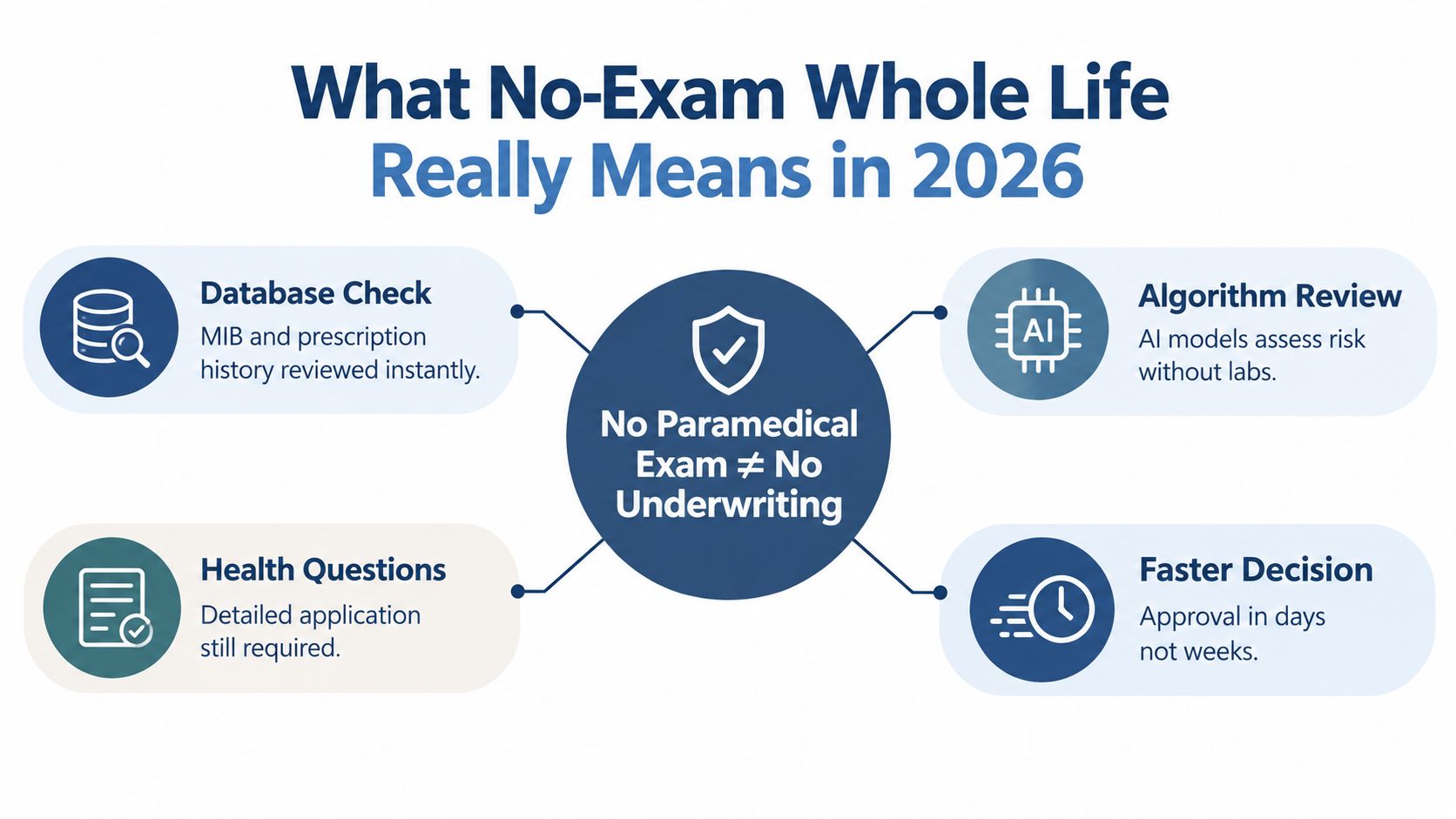
What No-Exam Whole Life Really Means in 2026
“No exam” describes the evidence an insurer collects, not the scrutiny it applies. In 2026, carriers increasingly use prescription records, motor-vehicle reports, MIB records, credit records, public records, and other data to estimate mortality risk instead of depending entirely on bloodwork and laboratory results, as explained in this coverage of information gathering for no-exam life insurance.
The change is significant. A 2026 Wall Street Journal report found that less than 20% of Banner Life policies were issued without a medical exam five years earlier, compared with more than 80% now. The report also noted that qualified applicants may sometimes obtain face amounts from $3 million to $10 million without an exam. No-exam underwriting has therefore expanded beyond small final-expense policies in some markets, although that does not mean every applicant can qualify for large coverage. (Money)
What the policy still does
Whole life insurance remains a permanent contract. You pay premiums under the policy terms, and the insurer provides a guaranteed death benefit while the policy stays in force. The policy may also build cash value over time. No-exam whole life doesn't change the basic mechanics of whole life. It changes the evidence the carrier reviews before issuing coverage and setting the premium.
Cash value requires realistic expectations. Early growth is usually slow, and simplified-issue or guaranteed-issue policies often provide less flexibility than traditionally underwritten contracts. These policies fit buyers seeking dependable permanent protection, not applicants pursuing rapid accumulation or aggressive access to policy value.
What “no exam” removes
Applicants usually avoid the paramedical appointment, blood draw, urine collection, and nurse visit. Digital applications can shorten the process, but the insurer may still verify answers through external records and request more information. Inconsistencies can delay or stop approval.
Convenience also affects pricing. Whole life represented 23.4% of the no-exam life insurance market, valued at $4.37 billion in 2025 and projected to reach $6.89 billion by 2033, according to MoneyGeek's analysis of no-medical-exam life insurance. That growth reflects demand for easier applications, not proof that no-exam coverage is the best value. Healthy applicants seeking substantial protection should compare fully underwritten options before accepting the higher cost.
Practical rule: Treat “no exam” as “different evidence,” not “no underwriting.”
Declines still happen. Prescription patterns, prior applications recorded by MIB, serious driving issues, inconsistent answers, and recent medical events can trigger a decline or further review. Read the carrier's questions carefully, then provide accurate medication and treatment details. For a broader explanation of life insurance without a medical exam, review how insurers replace the physical exam with application data and record checks.
The Three Underwriting Paths Behind No-Exam Policies
A quote labeled “no exam” can describe three very different products. Ask the agent or carrier to name the underwriting category before comparing premiums.
Accelerated underwriting
Accelerated underwriting uses predictive models and extensive third-party data to evaluate applicants without a routine paramedical exam. The application still includes meaningful health questions, and the carrier may review prescription history, MIB information, driving records, and other available records.
This is generally the strongest no-exam option for applicants in good health. It can offer pricing closer to traditional underwriting and, in some markets, much larger coverage than final-expense products. The tradeoff is data scrutiny. A clean application that conflicts with prescription or industry records may be referred for further review.
Simplified issue
Simplified issue relies more heavily on a health questionnaire. The applicant answers yes-or-no questions about diagnoses, treatment, medications, tobacco use, and recent medical history. The insurer may perform data checks, but the process is usually less expansive than accelerated underwriting.
This tier can suit people with mild, stable conditions who don't want an exam. Coverage is generally more limited, and the policy may use graded benefits or less favorable pricing than a fully underwritten contract. Learn how the broader process works in this guide to underwriting in insurance.
Guaranteed issue
Guaranteed issue whole life asks no health questions and doesn't require a medical exam. Eligibility is based on the carrier's age rules and the requested face amount, rather than medical history. The benefit is certainty. The cost is limited coverage, higher premiums per dollar, and commonly a graded death benefit.
One current market schedule shows guaranteed-issue premiums ranging from $17.69 per month for $5,000 of coverage at age 50 to $246.58 per month for $25,000 at older ages. These policies commonly include a 2-year waiting period before the full death benefit is payable. (Insurance Geek)
| Path | Health Questions | Data Sources Used | Typical Coverage Cap | Pricing vs Traditional |
|---|---|---|---|---|
| Accelerated underwriting | Yes, detailed application | Prescription, MIB, motor vehicle, and other available records | Higher amounts for qualified applicants, depending on carrier | Often closer to traditional pricing |
| Simplified issue | Yes, usually a shorter health questionnaire | Application answers and selected database checks | Often smaller permanent policies, with limits varying by insurer | Usually higher |
| Guaranteed issue | No health questions | Age, sex, and face amount determine eligibility and premium | Small final-expense amounts | Highest per dollar in many cases |
The phrase whole life insurance no exam doesn't tell you which tier you're buying. The policy contract, underwriting questions, benefit schedule, and illustration do.
No-Exam Whole Life vs Traditional Whole Life
Traditional whole life requires more medical information, yet that extra review can produce better pricing, broader riders, and higher coverage limits for applicants in good health. No-exam whole life removes the clinical appointment, but the insurer still prices the missing information into the policy.
| Factor | No-Exam Whole Life | Traditional Whole Life |
|---|---|---|
| Eligibility | May suit applicants who cannot or do not want to complete an exam, although non-guaranteed tiers can still decline applicants | Detailed medical review can reward applicants with favorable health classifications |
| Cost | Often higher for the same benefit because the carrier accepts more uncertainty | May cost less for applicants who qualify for favorable underwriting |
| Speed | Usually faster, with decisions potentially made in days | Slower because examinations, records, and detailed review take time |
| Coverage limits | Commonly lower for permanent no-exam products | Can support substantially larger permanent coverage |
| Cash value | May grow more slowly or offer less flexibility in simplified and guaranteed products | Usually provides broader policy design and customization |
| Riders and dividends | More limited, depending on the carrier and contract | Generally offers more options, particularly through mutual carriers |
Coverage limits vary sharply by underwriting path. Some qualified applicants can obtain no-exam coverage in the $250,000 to $500,000 range, and certain carriers may offer up to $1,000,000. Other no-exam whole life plans are designed for much smaller needs. Some products provide adult coverage through age 85 with a maximum payout of $25,000, while children's coverage can reach $50,000 in certain plans.
The label “no exam” also hides an important distinction. Accelerated underwriting may still review prescription history, motor-vehicle records, MIB data, and other available information. Simplified-issue policies ask fewer health questions, while guaranteed-issue policies accept applicants under stated age and eligibility rules without medical questions. The less health information the carrier reviews, the more likely the policy is to cost more or offer less coverage.
A healthy applicant seeking a substantial permanent benefit should request traditional quotes before choosing convenience. The exam can feel intrusive, but it may produce better long-term value. An applicant with serious health concerns, limited time, or low privacy tolerance should compare the cost of faster approval against the coverage needed.
Review policy mechanics before comparing illustrations in this explanation of whole life insurance. If you want to find affordable life insurance in Florida, compare no-exam and fully underwritten options side by side. The fastest application is not automatically the cheapest or the best fit.
No-Exam Whole Life vs Term Life Insurance
No-exam whole life and term life solve different problems. Whole life is designed to remain in force for life if premiums are paid. Term life covers a defined period and is usually the more efficient tool for replacing income, protecting a mortgage, or covering dependent children while they rely on you.
| Feature | No-Exam Whole Life | Term Life |
|---|---|---|
| Duration | Permanent, subject to policy terms and premiums | Temporary, for the selected term |
| Premium pattern | Usually level for life | Usually level during the initial term, then may rise or become unaffordable |
| Cash value | Builds gradually, with limited early growth in many no-exam contracts | No cash value |
| Death benefit | Designed to remain available permanently | Pays only if death occurs while the policy is in force |
| Best use | Final expenses and other permanent needs | Income replacement, debts, and temporary obligations |
| Conversion | Not applicable in the same way | Many policies include a conversion feature, subject to contract rules |
The central financial difference is simple. Term life usually buys more death benefit for a lower initial premium, while whole life provides a permanent benefit and a cash value component. Term returns no death benefit if you outlive the policy, but that isn't a flaw when the policy successfully protects a temporary financial obligation.
Whole life can be appropriate for a lifelong need, such as final expenses or a permanent estate objective. It becomes harder to justify when a healthy buyer chooses it only as a forced savings plan. Cash value grows slowly in the early policy years, and a no-exam contract may offer less accumulation flexibility than a traditionally underwritten policy.
Term also deserves a fair hearing. A conversion rider can let the policyholder move some or all coverage to permanent insurance later, which may reduce the need to commit to expensive whole life immediately. Review the conversion deadline and eligible products before relying on that feature. For a focused comparison, see this guide to term life insurance with no medical exam.
What Insurers Still Check When They Skip the Exam
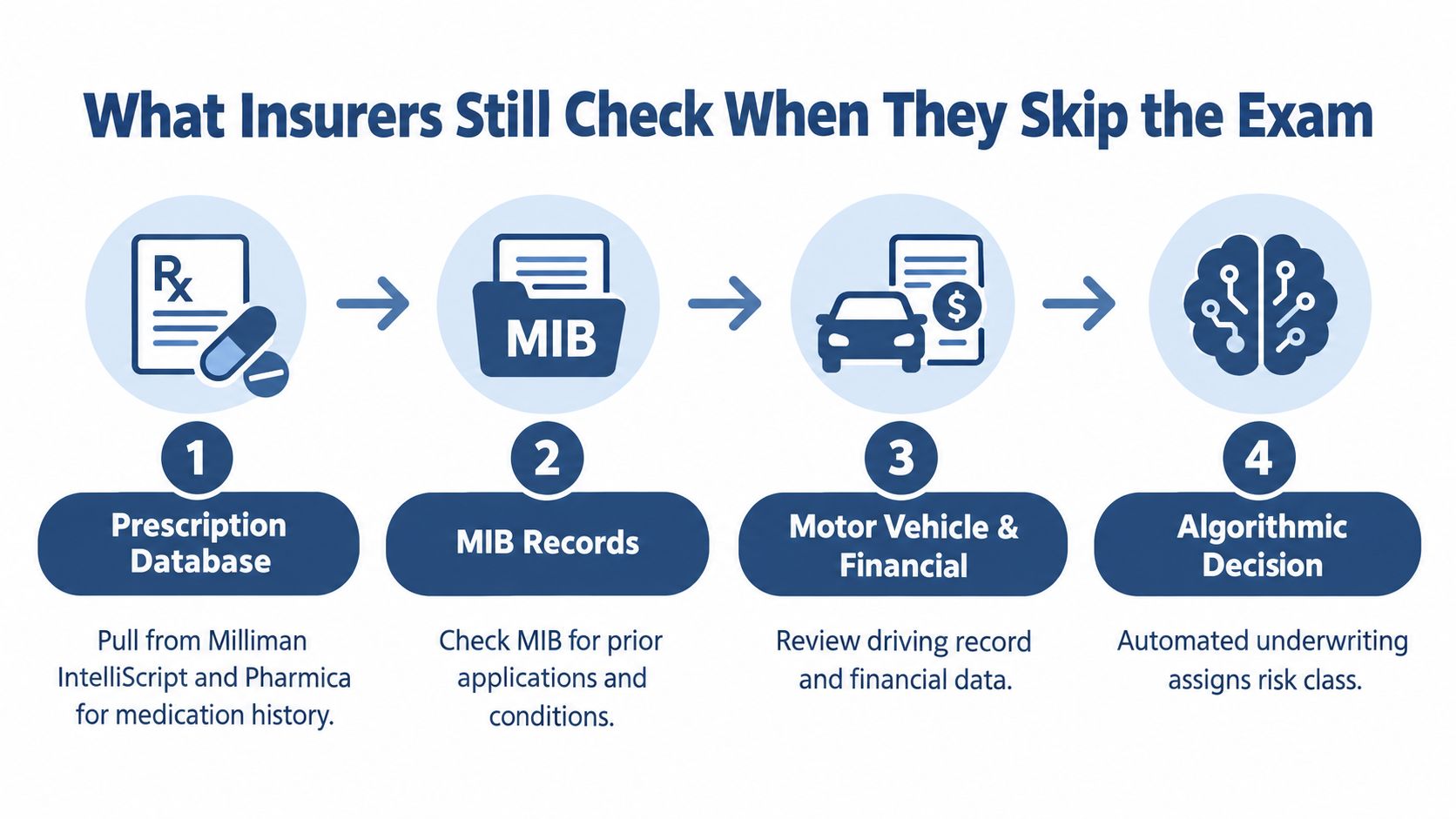
The insurer still needs evidence of expected mortality. Instead of collecting it through a nurse visit, the carrier assembles it from records, questions, and automated verification.
Prescription and industry records
Prescription history can reveal conditions that an applicant forgets to mention or describes differently. The carrier may compare medication patterns with the application and investigate inconsistencies. MIB records can also show information connected to previous life insurance applications, although they aren't a complete medical record.
Motor vehicle reports provide another risk signal. Serious driving violations can affect underwriting because insurers evaluate broader mortality risk, not just diagnosed illness. Depending on the carrier and product, other public, financial, claims, or electronic health information may also be reviewed.
Application answers still matter
The health questionnaire commonly asks about diagnoses, surgeries, medications, tobacco use, height, weight, and family history. Algorithms compare these answers and external records with the carrier's internal risk rules. A mismatch can lead to a follow-up call, additional records, a medical exam, a different offer, or a decline.
Recent cancer treatment, uncontrolled diabetes, significant cardiac history, or a build outside the carrier's acceptable range can create problems. The exact outcome depends on the insurer, timing, treatment, and product tier. No-exam underwriting isn't a loophole around medical risk.
Application discipline: List every medication and diagnosis accurately. A fast approval is worthless if a material misrepresentation creates a claim dispute later.
Watch this short overview before submitting an application:
Privacy matters here. Applicants who dislike automated review of prescription, driving, or other personal records may prefer to discuss the carrier's data practices before applying. The exam is only one part of the information exchange.
Who Each No-Exam Tier Fits Best
The best tier depends less on the marketing label and more on the applicant's health profile, coverage goal, and tolerance for underwriting data collection.
Accelerated underwriting fits the healthy applicant who values speed but still wants meaningful protection. A younger parent with a clean medical and prescription history may prefer a digital process and a larger policy, provided the carrier's questions and data review produce a favorable result. This is the no-exam tier I'd investigate first when the buyer is healthy and wants something beyond final-expense coverage.
Simplified issue fits the applicant in the middle. Think of someone with treated hypertension, a stable medication routine, or a past condition that is no longer active. This applicant may not want a paramedical visit and may not qualify for the most favorable accelerated decision, but a health questionnaire can still open access to permanent coverage.
Guaranteed issue fits the applicant who has run out of better choices. Someone with a serious recent diagnosis, complex cardiac history, or a prior decline may value acceptance more than price. The sensible goal is usually a small final-expense benefit, not income replacement. Read the graded-benefit provision carefully before buying.
| Tier | Best-Fit Profile | Typical Coverage | Premium Tier |
|---|---|---|---|
| Accelerated underwriting | Healthy applicants seeking speed and stronger limits | Higher amounts for qualified applicants | Lower among no-exam options |
| Simplified issue | Applicants with mild or stable conditions | Moderate permanent coverage, subject to carrier limits | Middle to high |
| Guaranteed issue | Applicants with serious health histories or prior declines | Small final-expense coverage | Highest per dollar |
One caution: don't choose guaranteed issue merely because the application looks easy. A buyer with manageable health issues may qualify for simplified issue or traditional underwriting at a better cost. Compare the alternatives before accepting guaranteed acceptance as the default.
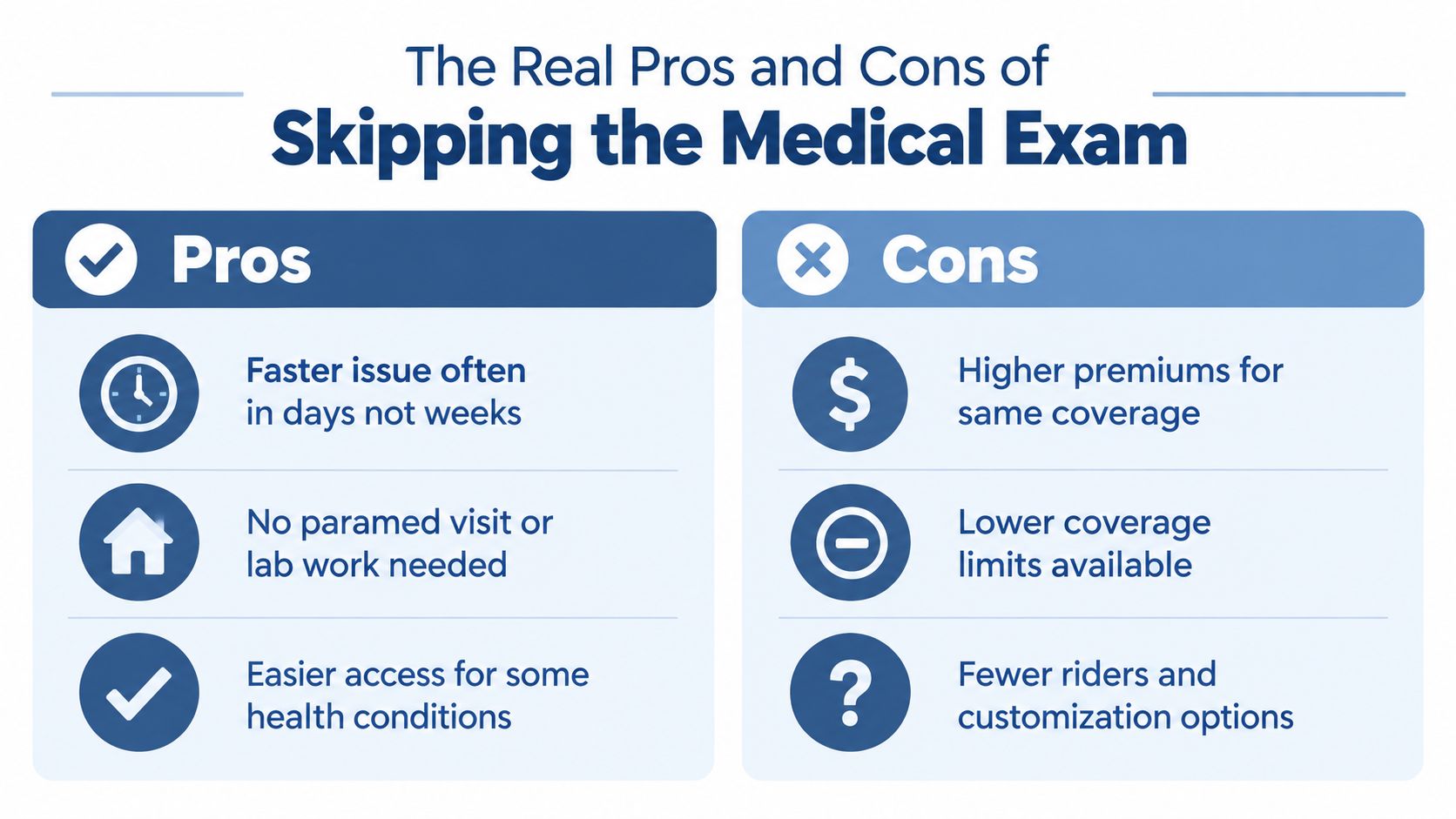
The Real Pros and Cons of Skipping the Medical Exam
No-exam whole life earns its place when the buyer needs permanent protection and the inconvenience or risk of a medical exam outweighs the pricing disadvantage. It doesn't earn its place because an advertisement promises a quick application.
Where the convenience helps
- Faster issue: A digital application can reduce the waiting associated with scheduling a paramedical appointment and processing lab work.
- Less physical friction: Some applicants have needle anxiety, mobility limitations, difficult work schedules, or travel obligations that make a nurse visit impractical.
- A chance to act during a health window: Applying before a new diagnosis or treatment changes eligibility can matter, provided the application is complete and truthful.
- Access after traditional obstacles: Simplified issue and guaranteed issue can provide a path for applicants who can't obtain broader coverage elsewhere.
Where buyers pay for it
- Higher cost: The carrier may charge more per dollar because it accepts greater mortality uncertainty and expects adverse selection.
- Smaller benefits: Permanent no-exam policies are often designed for final expenses rather than replacing years of income.
- Graded claims risk: Guaranteed issue commonly delays the full death benefit for a defined period, and some simplified-issue contracts can also limit early claims.
- Less flexibility: Riders, dividend potential, and cash value features may be narrower than in a fully underwritten contract.
The tradeoff can make sense for a person who needs a modest final-expense benefit, has serious health issues, or cannot complete an exam. It usually doesn't make sense for a healthy applicant who could qualify for fully underwritten whole life at a substantially better value.
Don't compare only the monthly premium. Compare the guaranteed death benefit, early-claim provisions, cash value schedule, surrender charges, riders, and the total premium required to keep the policy in force.
How to Choose the Right Path for Your Situation
Use four filters.
- Health profile: Excellent health points toward traditional underwriting or accelerated underwriting. Fair, stable health often supports accelerated or simplified issue. Serious or recent diagnoses may leave guaranteed issue as the practical fallback.
- Coverage need: Final expenses call for a small permanent policy. Lifelong income replacement or a substantial estate objective usually calls for broader underwriting and a larger face amount.
- Budget tolerance: If every premium dollar matters, request a fully underwritten comparison. Convenience products can cost more for the same benefit.
- Privacy comfort: Ask what prescription, MIB, driving, financial, public, or health data the carrier reviews. If you aren't comfortable with those checks, discuss the process before authorizing an application.
Request illustrations from two carriers within each tier that fits your situation. Compare guaranteed values, not just projected values, and confirm whether the death benefit is level from the first day or graded during an early period. Premiums can vary, but the underwriting tier determines the basic tradeoff between acceptance, price, and coverage.
My Policy Quote offers a way to compare life insurance options, including no-exam approaches, based on how you prefer to buy and the type of coverage you need. Visit My Policy Quote to review available options before committing to a policy that trades too much coverage for convenience.