

Some families are one missed paycheck away from stress. Others are doing okay month to month, but they know the whole plan depends on one person keeping income coming in. Maybe that's your house right now. One parent drives for work or works construction. The other has a part-time job, watches the kids, or helps an older parent. Maybe you're self-employed, so there isn't a benefits department handling this stuff for you.
That's where life insurance stops being an abstract financial product and starts looking more like a backup plan for the people you love.
A life insurance policy for family is really about keeping the household standing if one person dies too soon. It can help keep the rent or mortgage paid, cover debt, replace lost income, and give your children or dependents some breathing room while the family adjusts. If you've been meaning to look into it but keep putting it off, you're not alone. If you want a parent-focused starting point, why life insurance matters when you have kids is a helpful companion read.
Why Families Need Life Insurance Right Now
A lot of households assume they'll get to this later. After the next raise. After the baby is older. After the business settles down. But family risk doesn't wait for a cleaner calendar.
Think about a home where one spouse brings in most of the paycheck and the other keeps the whole machine running. School pickups, meals, doctor visits, homework, helping a grandparent, managing the budget. If either person dies, the surviving family doesn't just lose love and support. They can also lose income, time, and stability all at once.
The pressure families feel isn't just emotional
The bills keep moving whether a family is ready or not. Housing costs still show up. Loans still need payment. Kids still need rides, clothes, food, and care. A life insurance policy creates a pool of money that can help the people left behind keep going without making every decision in panic mode.
Families don't buy life insurance because they expect tragedy. They buy it because they know other people depend on them.
That matters even more because protection hasn't kept up across many households. The American Council of Life Insurers reports that by 2022 only 56% of U.S. households had at least some life insurance coverage, with 45.6% owning a term policy and 16.9% holding a cash-value policy, while the median face value of in-force policies had risen to $150,000. Fewer households are covered, even though the typical policy amount has grown.
What life insurance protects in real life
For most working families, the practical jobs of coverage look like this:
- Income replacement: It gives your spouse, kids, or other dependents time to adjust if your paycheck stops.
- Debt protection: It can help cover a mortgage, car loan, or personal debt so one death doesn't trigger a financial spiral.
- Family stability: It can pay for childcare, household help, or time off work for the surviving parent.
- Multi-generational support: It can protect a parent, grandparent, or adult child if the household shares money across generations.
Many people think life insurance is only for stay-at-home spouses with children or high earners. It isn't. If someone in the home contributes money, caregiving, transportation, or daily support that would cost real money to replace, their role has financial value.
How a Life Insurance Policy for Family Actually Works
Life insurance is a contract. You pay the insurance company to keep the contract active. If the insured person dies while the policy is in force, the company pays money to the people named on the policy.
That's the simple version. The confusion usually starts when people hear terms like owner, insured, beneficiary, term, and cash value all at once.
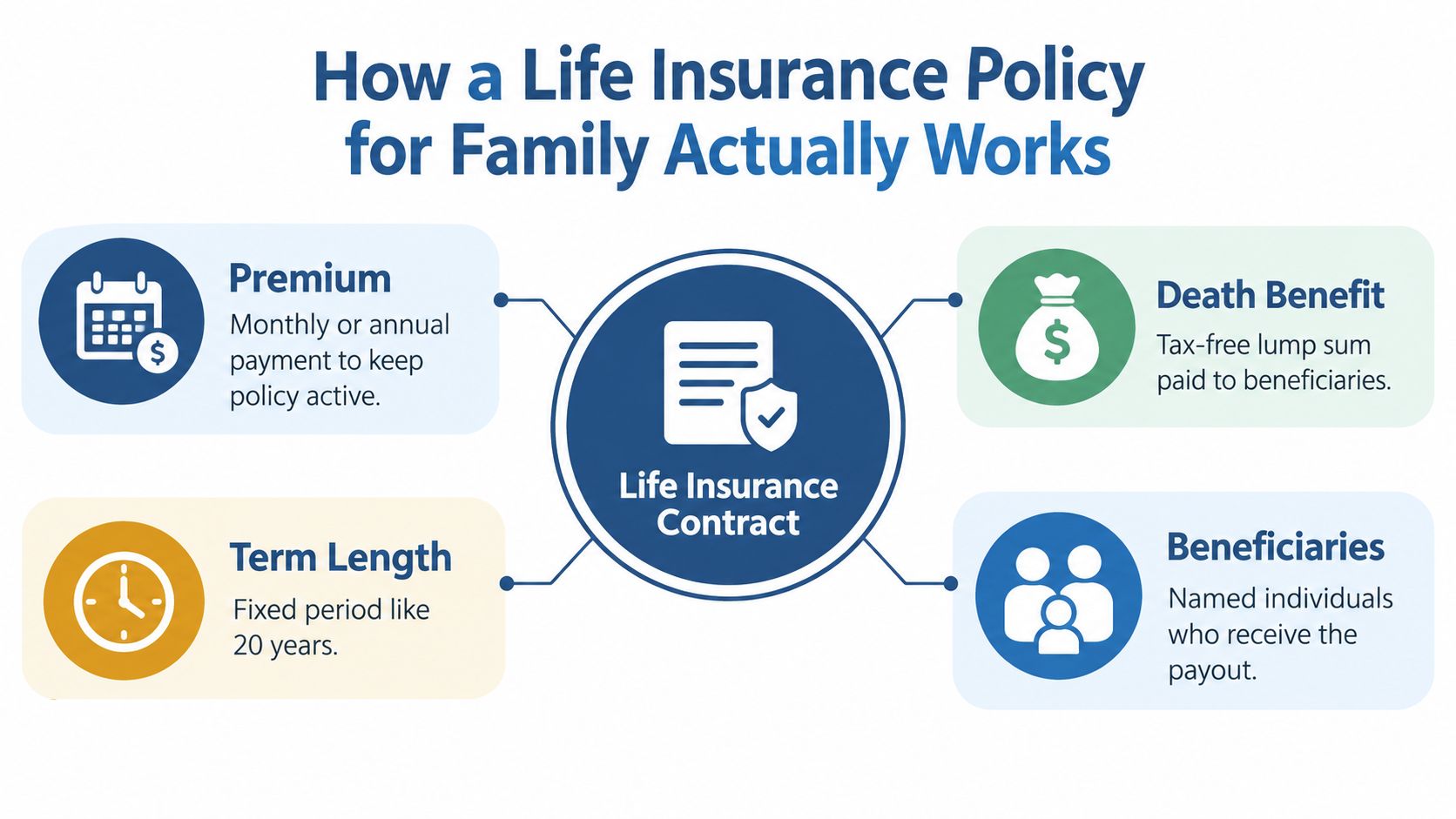
The four moving parts
Think of a life insurance policy like renting financial protection for your household, or in some cases owning a permanent version of that protection.
- Premium: This is the payment you make to keep coverage active.
- Death benefit: This is the payout your beneficiaries receive if the insured dies.
- Term length: If it's term life, coverage lasts for a set period.
- Beneficiaries: These are the people or entities you name to receive the money.
Practical rule: If you can explain who is insured, who owns the policy, who pays for it, and who receives the money, you understand the basics.
Who's who on the policy
These roles matter more than people realize:
- The insured person is the person whose life is covered.
- The policy owner controls the policy. This person can usually make changes, depending on the contract.
- The beneficiary is the person, people, or legal entity that receives the payout.
Sometimes one person fills all three roles. Sometimes they don't. A parent might own a policy on their own life and name a spouse as beneficiary. A parent might also own a policy on an adult child in situations where insurable interest and carrier rules allow it.
How payouts help a family
The death benefit is often used like a financial shock absorber. The family might use it to keep up with housing, cover bills, replace work income, or pay for support the household used to receive from the person who died.
That's why a life insurance policy for family should be tied to real responsibilities, not vague guesses. If your role in the home includes earning income, carrying health coverage, caring for children, supporting aging parents, or holding debt in your name, the policy should reflect that.
The basic policy types in plain language
Here's the short version:
- Term life covers a set period. It's often used when families want protection during working years, while raising kids, or while paying off major debts.
- Whole life is a type of permanent coverage that can stay in force for life if premiums are paid, and it can build cash value.
- Joint coverage can insure two people under one policy structure, depending on the product design.
People often get stuck trying to pick a product before they've decided what problem they need the policy to solve. That usually leads to overbuying, underbuying, or freezing and doing nothing.
Comparing Term Whole and Joint Family Options
Most families don't need every life insurance feature. They need the right structure for their budget, timeline, and responsibilities. That's why it helps to compare the main options side by side instead of treating life insurance like a one-size-fits-all purchase. If you want a deeper product-by-product breakdown, term vs. whole life insurance goes further.
Why timing matters so much
Price is not random. Life insurance pricing is driven by mortality cost, expense loading, and assumed investment interest, and age is the strongest pricing factor. Term insurance is typically priced on average mortality across the full term, and yearly renewable term becomes prohibitively expensive at advanced ages. In plain English, waiting usually gives you fewer options and higher costs.
For working parents, that often makes level term the first policy to consider. It lets you lock in coverage for a set period while kids are young, debts are large, or income replacement matters most.
Term vs Whole vs Joint Family Coverage Compared
| Feature | Term Life | Whole Life | Joint First-to-Die |
|---|---|---|---|
| Main purpose | Income protection for a set period | Lifetime coverage with cash value component | Covers two people under one policy that pays at the first death |
| Duration | Temporary | Permanent if premiums are paid | Depends on policy design |
| Cost feel | Usually easier on the budget at the start | Higher ongoing commitment | Can be useful when two lives are part of one planning goal |
| Best fit for | Parents raising kids, mortgage years, income replacement | Families seeking lifelong coverage and stable long-term planning | Couples who want one policy tied to shared obligations |
| Cash value | No | Yes | Varies by product |
| Trade-off | Coverage ends unless renewed or converted if available | Costs more, so buying enough can be harder | Simpler in some cases, less flexible in others |
Where families often get tripped up
Term life is often easier to understand because it solves a simple problem. “If I die during these working and parenting years, my family gets money.” Whole life asks for a different kind of commitment. It can make sense when permanence matters, but the higher premium can squeeze a household that already has an uneven income.
Joint first-to-die coverage tends to fit narrower situations. It may appeal to couples who share expenses closely and want one policy for the household, but they should look carefully at flexibility, ownership, and what happens after the first death.
The best policy isn't the one with the most features. It's the one your family can keep in force while it still needs protection.
Some families also add riders for a spouse or children rather than buying separate full-size policies for everyone. That can be efficient, but it's still worth checking whether one main breadwinner needs a larger standalone policy than everyone else.
How Much Coverage Your Family Really Needs
This is the question many jump to first, and it's the right question. But many families answer it too quickly. They pick a round number, use a rough rule they heard years ago, or buy whatever fits a monthly budget without checking what that amount would need to do.
The better approach is to ask a simple question: If this person died, what bills and responsibilities would the family need money to handle? If you want help organizing the math, a life insurance needs calculator can help you turn those responsibilities into a starting target.
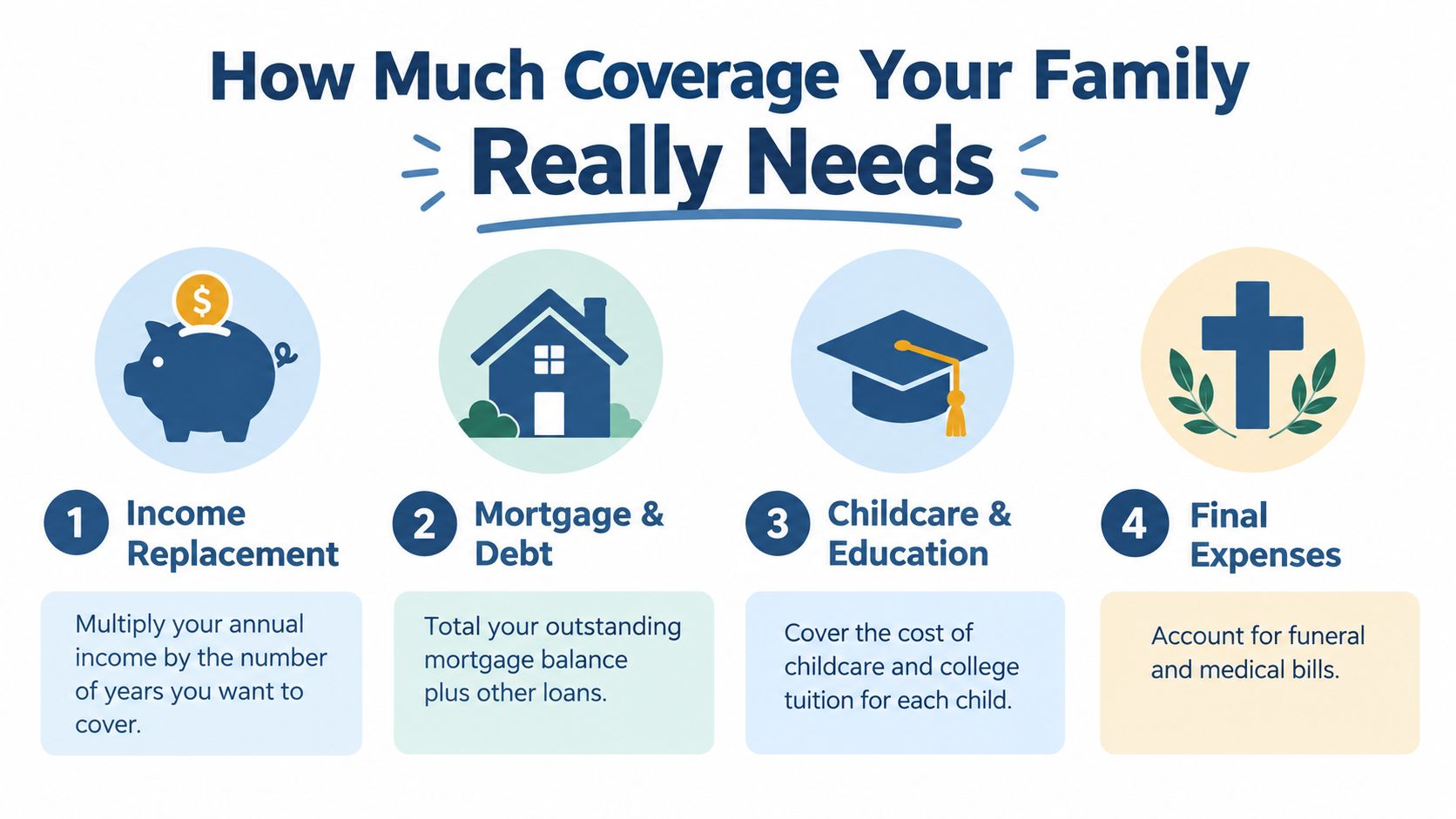
Start with the jobs the money would need to do
Most family coverage decisions come down to a few buckets:
Replace income for a period of time
If one paycheck disappears, how long would the family need support while the surviving adults regroup, work more, move, or change childcare?Handle housing and debt
Think mortgage, rent cushion, car loans, and other debts that don't disappear when a person dies.Cover child-related costs
Childcare, after-school care, transportation, and education planning all count.Pay for final and transition expenses
Funeral costs, unpaid medical bills, travel, legal tasks, and time off work can all hit at once.
Then subtract what already exists
A family may already have some resources:
- Savings or emergency funds that could carry part of the load
- Workplace life insurance through an employer
- A second income that could cover some, but not all, of the bills
- Family support from relatives who could help with caregiving or housing
Households often get surprised. A policy can exist and still not be enough.
When the budget is tight
Need and affordability are not the same question. A family may need a large amount of protection but only be able to buy part of it today. That doesn't mean the process failed. It means the household should prioritize.
A practical order often looks like this:
- Protect the highest-earning or hardest-to-replace adult first
- Match term length to the years of biggest family risk
- Add coverage for the second adult if their work at home or outside it would be expensive to replace
- Review later when income improves
In uneven-income households, “right-sized” coverage usually beats waiting for the “perfect” policy. Some protection in force is more useful than a plan that stays on a to-do list.
Choosing Beneficiaries and Organizing Family Coverage
A policy can be well priced and still fail the family if nobody knows it exists, the wrong beneficiary is listed, or the paperwork is buried in a drawer no one can find.
That problem is more common than many people think. Lincoln Financial reports that 78% of families have not had an in-depth discussion about life insurance, while 60% of adult children believe their parents have coverage but only 44% of parents say they actually do. That's not just a buying gap. It's a communication gap.

Beneficiaries need more thought than most people give them
A beneficiary is not just a name you type in and forget. It's part of the protection plan.
You'll usually name:
- A primary beneficiary who receives the money first
- A contingent beneficiary who receives it if the primary beneficiary can't
If your intended recipient is a minor child, don't assume the process will be simple. Many families use a trust or a custodial arrangement so the money can be managed responsibly until the child is legally able to control it. This is also why learning why beneficiary forms matter can prevent avoidable mistakes.
For a more focused overview, life insurance policy beneficiary choices can help you think through common family setups.
Build one family coverage map
Many households treat each policy like its own little island. That's how people lose track.
Create one simple record that lists:
- Who is insured
- Which company holds the policy
- Who owns it
- Who the beneficiaries are
- Where the policy documents are stored
- How premiums are being paid
One honest family conversation can close more protection gaps than hours of online searching.
This matters even more in multi-generational homes. A married couple may assume each other is covered through work. Adult children may assume a parent bought a policy years ago. A grandparent helping with bills may be financially central to the home, even if no one describes them that way.
Questions every family should ask at the table
Try these:
- Who would face the biggest financial disruption if one person died?
- Which family members are definitely insured right now, and which are only assumed to be insured?
- Does anyone rely on job-based coverage that could disappear if work changes?
- Would a payout go directly where you intend, with the beneficiary choices currently on file?
Those questions are plain, but they uncover a lot.
Real World Examples for Working Families and Parents
Rules are easier to understand when you can see how they play out in ordinary homes. The details differ, but the trade-offs tend to repeat. Budget, timing, health, and family responsibility usually drive the decision more than fancy policy features.

A big reason these decisions matter is the scale of underinsurance. In the U.S., the 2024 Insurance Barometer Study found 102 million adults needed more life insurance or none at all, and in 2025 about 100 million still reported a shortfall. It also found that 47% said loved ones would struggle to pay living expenses for six months if a primary wage earner died unexpectedly.
A dual-income family with young kids
One parent works in a warehouse. The other works in a school office. Neither income is huge, but both matter. They have children at home, a car payment, and rent that would be hard to carry on one paycheck.
For this family, the first move is often straightforward. Buy enough coverage on each parent to protect the household during the years when the kids are still dependent and the monthly bills are tight. Even if one parent earns less, replacing that person's childcare, transportation, and daily management would still cost money.
A self-employed contractor with no employer benefits
This person brings in solid income some months and lean income in others. There's no employer group policy in the background. If the contractor dies, the family doesn't just lose one paycheck. The entire business income may stop immediately.
That household usually needs a policy built around irregular cash flow. A level premium structure can help with budgeting because the payment doesn't jump around the way some people fear. It's also smart to apply while health is stable, because underwriting can get tougher if issues like smoking, higher BMI, uncontrolled blood pressure, or family medical history enter the picture.
Here's a short explainer that helps some families hear the topic in a different format:
Parents buying for an adult child
This situation comes up more often than people expect. Sometimes an adult child has health concerns. Sometimes parents want to help lock in coverage earlier. Sometimes the adult child supports younger siblings, an aging grandparent, or a co-signer arrangement the parents would be drawn into after a death.
The right question here isn't “Can we buy something?” It's “What financial risk are we trying to cover, who should own the policy, and who should receive the benefit?” If those answers are fuzzy, the family should slow down and clarify the purpose before applying.
One lesson runs through all three
The best family policy is usually the one tied to real responsibilities, bought before health or age narrows the options, and organized so everyone knows what exists.
If you want side-by-side quote help from licensed agents, My Policy Quote is one option families can use to compare carriers and look for a policy that fits the household's needs and budget.
Next Steps to Secure Your Family With Confidence
Most families don't need a complicated insurance strategy. They need a clear one. The strongest approach is usually simple. Figure out what financial hole a death would leave, match the policy type to that problem, choose a coverage amount that fits real responsibilities, and make sure the right people are named to receive the money.
If your income changes from month to month, don't wait for a perfect season. Use today's facts. What bills must be covered. Who depends on you. How long your family would need support. A workable policy in force is usually better than an ideal plan that never gets started.
A plain-language checklist
Before you buy or review a life insurance policy for family, check these items:
- List the people who depend on each adult: Include children, spouses, parents, and anyone financially tied to the household.
- Identify the biggest risk: Is it lost income, housing payments, debt, caregiving costs, or all of the above?
- Choose the structure that fits the job: Temporary family risk often points people toward term. Permanent goals may point elsewhere.
- Confirm who owns the policy and who gets the payout: This step prevents confusion later.
- Store documents where others can find them: Tell at least one trusted person where the policy information lives.
- Review after life changes: Marriage, divorce, a new child, new debt, a job change, or health changes can all affect what makes sense.
The quiet part families skip
The final step isn't shopping. It's talking.
Sit down with your spouse, your parents, or your adult kids and confirm what coverage exists. Don't assume. Ask who has a policy, where it is, who the beneficiaries are, and whether the amount still matches today's responsibilities.
A life insurance decision is really a family communication decision first, and a product decision second.
That one shift in mindset can prevent a lot of painful surprises later.
If you're ready to turn these ideas into actual quotes, comparisons, and next-step decisions, My Policy Quote helps families review life insurance options with licensed agents. It's a practical place to compare carriers, think through coverage amounts, and find a policy that fits the realities of your household.