

One Georgia enrollee's comparable premium reportedly rose from $226 to $2,716 per month after enhanced federal ACA tax credits expired at the end of 2025, according to 11Alive reporting on Georgia Marketplace enrollment after the enhanced credits expired. That single jump explains why self-employed health insurance in Georgia isn't mainly a shopping problem anymore. It's an income forecasting problem. If you're a freelancer, contractor, or 1099 worker, the premium you see at enrollment depends on the annual net income you project, the household size you report, and whether you update both when your year changes. Get the estimate wrong and you don't just pay the wrong premium. You can lose help you were entitled to during the year, or owe money back when you file your taxes.
Choose Your Coverage Path in Georgia
Georgia's individual market recorded 1,305,114 Marketplace plan selections during the 2024 open-enrollment period, according to figures cited in the Georgia Department of Community Health coverage presentation. That was roughly 48% more than the 879,084 selections in 2023. Georgia began using its state-based exchange, Georgia Access, with the 2025 open-enrollment period, which started on November 1, 2024.
A plan selection does not guarantee active coverage. You generally must pay the first monthly premium before coverage begins. For self-employed buyers, the practical choice is between Marketplace coverage, which may qualify for subsidies, and other options with different limits and financial risks. Compare the provider network and deductible as carefully as the premium.
Georgia Coverage Options for Self-Employed Buyers
| Coverage path | Who it suits | Subsidies available | Pre-existing conditions covered |
|---|---|---|---|
| Marketplace plan on Georgia Access | Self-employed buyers with projected net income and no employer coverage | Yes, advance premium tax credits based on income | Yes |
| Off-marketplace individual plan | Buyers above subsidy limits who want broker-led comparisons | No | Yes, under ACA rules |
| Short-term limited-duration plan | Short gaps between coverage | No | Usually not |
| Health care sharing ministry | Buyers who accept a shared-cost, faith-based model | No | Not guaranteed, not insurance |
| Pathways to Coverage | Low-income adults who meet work or qualifying activity rules | Low or no premium if eligible | Yes, if enrolled |
Start with the subsidy question. Georgia Access is the only path listed here that offers advance premium tax credits. If your projected net income qualifies, compare plans by the premium after credits, then check the deductible and network. For a broader cost baseline, review typical health insurance costs before comparing Georgia quotes.
An off-marketplace plan may suit buyers above subsidy limits, but you pay the full premium. Compare it with Marketplace plans that have similar deductibles, out-of-pocket maximums, and provider networks. Short-term plans can serve as a bridge during a coverage gap, but they may exclude or underwrite pre-existing conditions. Health care sharing ministries are not insurance, and payment of medical bills is not guaranteed.
Practical rule: If you cannot cover the deductible from savings, a low premium may leave you exposed to costs you cannot afford.
Pathways to Coverage is relevant when income is low and you meet the program's work or qualifying activity rules. A temporary drop in income alone does not establish eligibility. Check the rules against your household and documented activity before relying on this route.
How Marketplace Subsidies Follow Irregular 1099 Income
A subsidy is based on what you expect to keep after allowable business expenses, not on what clients pay you. Marketplace savings depend on projected annual net self-employment income and household size, according to HealthCare.gov guidance for self-employed applicants. Net income generally means business income minus allowable business expenses. That makes regular bookkeeping and updated annual estimates central to setting advance premium tax credits.
A freelance photographer invoices $70,000 and deducts $25,000 for equipment, software, studio costs, and mileage. The application should reflect $45,000 in net self-employment income, plus any other household income that counts. That difference can change the monthly credit sent to the insurer and the premium the photographer pays.
Build the estimate from a quarterly profit and loss statement, not bank deposits. Deposits can mix gross receipts, reimbursed expenses, transfers, and personal money. A profit and loss statement separates revenue from expenses and supports a clearer annual projection. Categorize expenses as you go in accounting software, or reconcile them monthly in a spreadsheet.
Why a Flat Monthly Average Misleads Contractors
Irregular work rarely arrives in equal monthly installments. A home-renovation contractor might net $15,000 in the first quarter, $4,000 in the second, then $28,000 in the third after two large jobs close. Using only the slow quarter understates the year; using only the strong quarter overstates it.
Recalculate projected annual income after each quarter closes. Add year-to-date net income to a realistic estimate for the remaining months, based on signed contracts, recurring clients, and supportable seasonal patterns. If that projection differs materially from the figure on your application, update it. Use a health insurance subsidy calculator to model a revised income estimate and compare the result with your current monthly credit.
In Georgia, an inaccurate estimate can affect both monthly assistance and tax-time reconciliation, and may leave you near the coverage gap. The state has not adopted full Medicaid expansion, leaving an estimated 184,000 adults in the coverage gap, while 67% of Georgia Medicaid adults are working, according to the KFF fact sheet on Medicaid in Georgia. Volatile 1099 income makes it harder to estimate where your annual household income will fall.
How Income Changes Affect Your Marketplace Subsidy
| Income event | What to do | Effect on subsidy | Tax-time effect |
|---|---|---|---|
| Income rises well above estimate mid-year | Update the application promptly | Lower monthly APTC | Smaller repayment risk |
| Income falls below estimate | Update the application | Higher monthly APTC | Lower repayment risk |
| Strong quarter after a weak one | Recalculate projected annual net income | Subsidy follows the annual total, not single invoices | Reconciled on Form 8962 |
| Business expenses rise | Count allowable expenses in net income | Lower net income can raise the subsidy | Reconciled on Form 8962 |
| Estimate was close to final income | No change needed | Monthly APTC stays steady | Small or no balance due |
Use the table as a prompt to review your projection, not as a reason to change the application after every invoice.
- Income rises well above the estimate: Update the application promptly. Your monthly credit will usually fall, reducing the risk of repaying excess credit later.
- Income falls below the estimate: Update the application rather than waiting for tax season. A higher monthly credit can ease cash flow during a slow period.
- A strong quarter follows a weak one: Recalculate the annual total before changing the application. One large payment may only bring a slow year back to your original projection.
- Business expenses rise: Include allowable expenses in the revised net income figure. Higher legitimate expenses can lower net income and raise the subsidy, provided your records support them.
- The estimate stays close to final income: Leave the application alone. Frequent small changes add paperwork without improving the estimate.
Reconciliation Is Where the Estimate Becomes Real
Advance credits are provisional. If your income changes materially and you leave the application unchanged, you may have to reconcile excess advance premium tax credits on federal tax return Form 8962. Underestimating income can increase monthly subsidies and create repayment exposure. Overestimating income can reduce assistance during the year and strain cash flow.
Use the most realistic annual net-income figure your books support, then revise it when the numbers change.
Include household changes in the same review. A spouse starting or losing work, a dependent joining or leaving the tax household, or a move can affect the application alongside business income. Report the household's combined picture, not just a change in business earnings.
Seasonal workers should account for the full work cycle, including expected slow months. Annualizing a busy quarter can overstate income; annualizing an off-season quarter can understate it. A trailing full-year view, adjusted for contracts gained or lost, gives a more grounded starting point.
Coverage Gap and Income Below Subsidy Limits
Falling below the income range for Marketplace help doesn't automatically move you into Medicaid in Georgia. That's the coverage gap. You can earn too much for traditional Medicaid categories, too little for Marketplace premium tax credits, and still not qualify for Pathways to Coverage if you don't meet its work or qualifying activity requirements or can't document them in the way the program requires.
This catches self-employed workers because their annual income is often clear only in hindsight. A consultant who loses a major client in March may project a low year, then replace the income by September. A seasonal contractor may do the reverse. When your estimate sits near a threshold, small changes in net income, household size, retirement withdrawals, or capital gains can move the result. Treat borderline estimates as a planning case, not as a guess you submit and forget.
Four Steps Near the Threshold
- Estimate the full household figure: Start with annual net business income, then include other household income that counts on the application, including retirement withdrawals or capital gains where they apply. Use household size from your expected tax situation, not just who lives with you today.
- Check public program eligibility against that figure: Review Medicaid and Pathways rules before you assume either program will take you. The income requirements for Medicaid are a useful starting point, but you still need to confirm category and activity rules for your situation.
- Price full-cost coverage if help isn't available: Compare off-marketplace and Marketplace plans without credits on the same deductible, network, and out-of-pocket maximum. A cheaper premium that excludes your hospital or specialists isn't a savings.
- Fund the deductible separately: Set aside a monthly reserve until you've covered the deductible you chose. If you can't fund it, consider whether a higher premium with lower cost sharing produces a safer annual cost.
Buyers aged 60 to 64 should model this risk before they retire early or cut back work. Premiums at those ages can be unforgiving when credits shrink, and drawing more from taxable retirement accounts to pay living expenses can raise household income at the same time. Selling a business or realizing capital gains can have a similar effect. Eligibility to enroll isn't the same as affordability, so run the household income scenario before you set a retirement date, convert retirement funds, or decide how a younger spouse will stay covered.
If you're near the threshold, don't wait until open enrollment to do the math. Prepare a low, expected, and high income scenario from your books. You'll make a faster, cleaner enrollment decision, and you'll know in advance which income change should trigger an application update.
How to Enroll Through Georgia Access
Enrollment goes faster when your income estimate is ready before you open the application. Georgia Access will ask for household and income information that determines whether you qualify for advance credits, so a vague guess at that stage creates problems you'll have to unwind later. Prepare the figures first, then enroll.
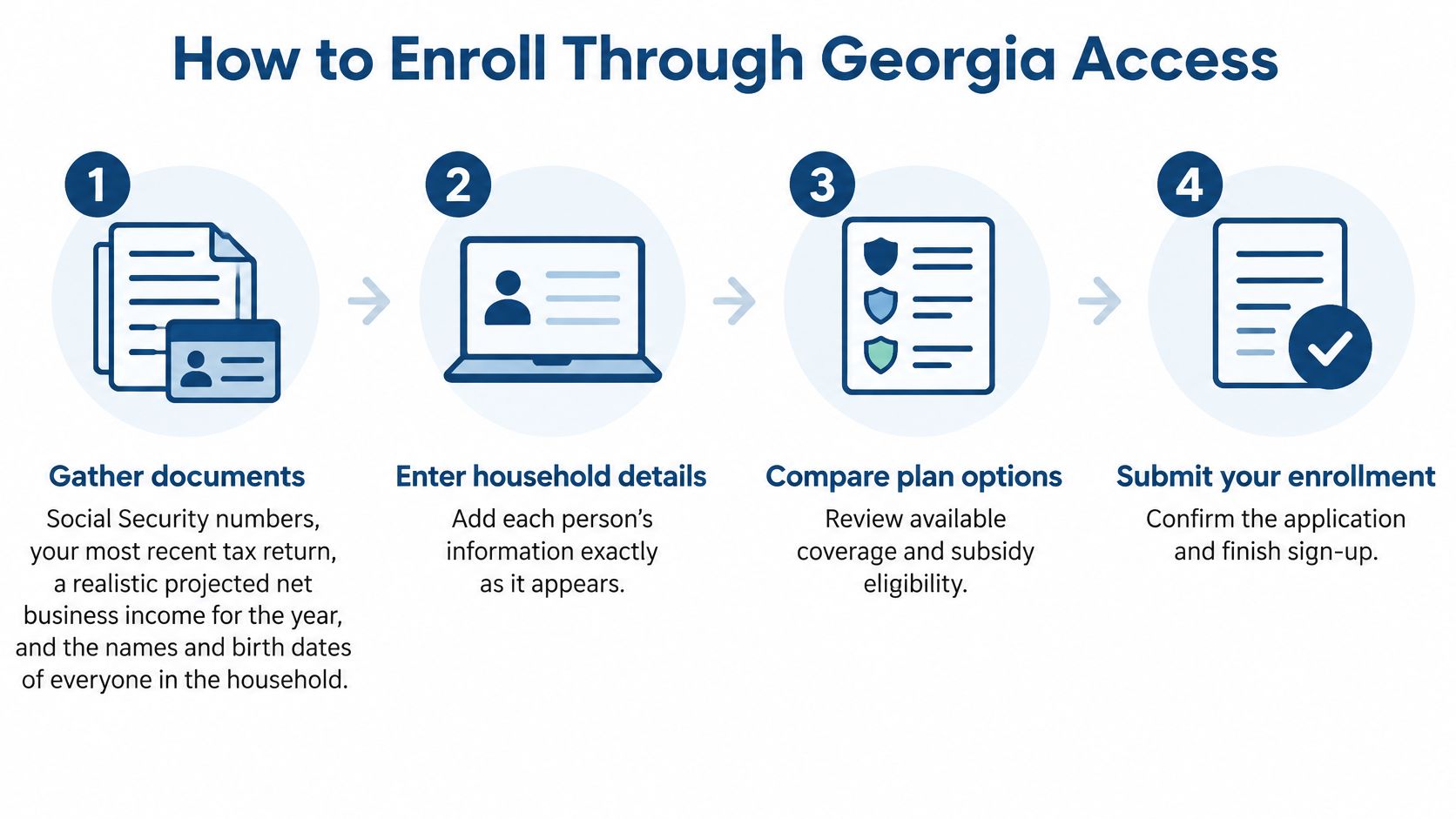
Enrollment Steps in Order
- Gather documents: Collect Social Security numbers, your most recent tax return, a realistic projected net business income for the year, and the names and birth dates of everyone in the household. Add current coverage information if anyone is insured now. This prevents mismatched names and missing household members from stalling the application.
- Create your Georgia Access account: Enter household size and your income estimate carefully. The subsidy depends on both, so don't use gross receipts out of habit. Enter each person's information exactly as it appears on official documents.
- Compare expected annual cost: Don't sort by monthly premium alone. Add twelve months of premium to the deductible you're likely to meet, then check the out-of-pocket maximum, copays for visits you use often, prescription tiers, and whether your doctors and hospitals are in network. A plan that costs more each month can cost less over a year with regular care.
- Select the plan before the window closes: Open enrollment typically runs from November 1 to mid-January, but you should confirm the exact dates for your plan year. Don't leave submission for the final day, when a document request or password problem can cost you the deadline.
- Pay the first premium: Coverage usually doesn't begin until the first premium is paid. Calendar the due date, confirm the payment posted, and keep the receipt. Selecting a plan and having active coverage aren't the same thing.
- Save the paper trail: Keep the enrollment confirmation, premium receipts, subsidy notices, and year-end tax forms in one folder. You'll need them if income changes, if a premium dispute arises, and when you reconcile credits at tax time.
If you lose other coverage mid-year, you generally have 60 days to enroll through a special enrollment period. Don't assume every life change qualifies, and don't wait to test it. Losing employer coverage after leaving a job is different from voluntarily dropping a plan you dislike. Check the qualifying event, gather proof, and submit within the window.
Enrollment check: Before you submit, read the income figure back against your profit and loss statement. If you can't explain how you got the number, it isn't ready.
For local help, Georgia Access navigators and licensed Georgia agents can walk through the application, plan comparison, and document requests. Use that help if your household includes a spouse with employer coverage, a dependent with separate coverage, or income from several sources. Those cases are where a small application error can change the credit.
Deducting Premiums on Your Federal Tax Return
The rule that prevents most tax errors is simple. You can't deduct the same premium dollars twice. The federal self-employed health insurance deduction and the Marketplace premium tax credit are complementary but cannot be applied to the same premium dollars, and premiums paid through advance or final premium tax credits cannot also be deducted, according to IRS Publication 502 on medical and dental expenses. The deductible amount must be determined after reconciling the credit, using IRS Form 7206 and, when Marketplace coverage is involved, Publication 974.
An eligible self-employed taxpayer with net profit may generally deduct qualifying medical, dental, and vision premiums paid for the taxpayer, spouse, dependents, and qualifying children under age 27 as an adjustment to income, subject to the applicable tax rules and business-income limitation. In plain terms, you need self-employment profit to support the deduction, and you deduct only the portion of premiums you paid after credits. The deduction is calculated on Form 7206 and flows into the return as an adjustment to income rather than requiring you to treat it as a business operating expense.
Which Form Does Which Job
- Form 1095-A: Reports Marketplace enrollment and advance credit information you'll need for reconciliation. Keep the final version, including any corrected form.
- Form 8962: Reconciles advance premium tax credits against the premium tax credit your final household income supports. Here, excess advance credit can become a repayment.
- Publication 974: Explains how the premium tax credit interacts with other tax provisions, including the self-employed health insurance deduction.
- Form 7206: Computes the self-employed health insurance deduction on the premium portion you paid yourself.
For a deeper walkthrough of eligibility and limits, review the self-employed health insurance deduction rules before you file alongside your actual Marketplace forms. Don't calculate the deduction from monthly premium invoices alone. Invoices may show the billed premium before credits, the amount due after advance credits, or adjustments that don't match the final reconciled credit.
Your record-keeping routine should be boring and consistent. Save insurer premium statements, Marketplace subsidy records, the final Form 1095-A, and year-end tax documents in one folder by tax year. Then calculate the deduction only on the out-of-pocket share. If subsidies, business income, and household size all changed in the same year, have a tax professional check the figures. The interaction can require iteration because the deduction can affect income measures used elsewhere on the return.
Final Check and Costly Mistakes
The most expensive mistake is treating the income estimate as a one-time enrollment field. Overestimate to avoid repayment and you can give up help month after month. Underestimate to lower the premium and you can face a large Form 8962 balance at tax time. The safer approach is a realistic annual net estimate, reviewed quarterly, with the application updated when the annual picture materially changes.

Mistakes That Cost Georgia Freelancers Money
- Choosing the lowest premium first: A low premium paired with a high deductible and high out-of-pocket maximum can leave you paying heavily before coverage pays much. Fix it by comparing expected annual cost using visits, prescriptions, and procedures you realistically expect.
- Assuming a short-term plan equals ACA coverage: Short-term coverage can exclude pre-existing conditions and doesn't come with Marketplace subsidies. Fix it by reading exclusions, benefit caps, and renewal terms before you rely on it for anything beyond a short gap.
- Assuming coverage starts at plan selection: If the first premium isn't paid, you can have a gap in the first month. Fix it by calendaring the payment date and confirming the insurer shows the policy as active.
- Deducting credit-paid premiums: Deducting premiums already paid with a credit double counts the same dollars. Fix it by deducting only the out-of-pocket share on Form 7206 after reconciliation.
- Missing the enrollment deadline: Missing open enrollment can leave you waiting for a special enrollment period that may not apply. Fix it by calendaring the window early and confirming exact dates for the plan year.
- Skipping the network check: A plan isn't useful if your primary doctor, specialists, or preferred hospital are out of network. Fix it by checking each provider and facility in the plan directory, then confirming directly with the office if the listing matters.
Final Check Before Enrollment Closes
Confirm four things before you submit. First, your preferred doctors, hospitals, and prescriptions work under the plan. Second, your income estimate is a realistic annual net figure for the correct household size. Third, your first premium date is set and funded. Fourth, your confirmation and premium records are saved where you can retrieve them at tax time.
Use Georgia Access for enrollment and the Georgia Department of Community Health for state program information. Use Form 7206 and Publication 974 for the tax side, and bring a tax professional into the conversation when credits, business income, and household changes collide. A licensed Georgia agent or broker can compare quotes across carriers, and My Policy Quote is one place to compare premium, deductible, and network side by side. Review the plan each year, and sooner if income or household size changes.
I would rather see a contractor choose a mid-priced plan with a deductible they can fund and an income estimate they can defend than chase the lowest monthly premium with a guess. Self-employed coverage works when the application, the books, and the tax return tell the same story. Keep those three aligned and you'll avoid most of the expensive surprises.
If you're comparing self-employed health insurance in Georgia, My Policy Quote can help you compare premiums, deductibles, out-of-pocket maximums, and networks side by side before you enroll. Bring your projected annual net income and household size, review the options against the subsidy you may qualify for, and choose a plan you can afford in both a healthy month and a month with a claim.