

You're comparing term life quotes between client calls, invoices, and family expenses, and the phrase “living benefits” keeps appearing in the policy descriptions. It sounds like extra protection, but the important question is what the insurer pays, what qualifies, and what your family gives up if you use it.
A living-benefit rider can provide access to part of a death benefit during a serious illness. It can also reduce the amount beneficiaries receive later, and the rules depend on the contract. Understanding that exchange matters especially if you're self-employed or don't have strong benefits through work.
What Living Benefits Mean on a Term Life Policy
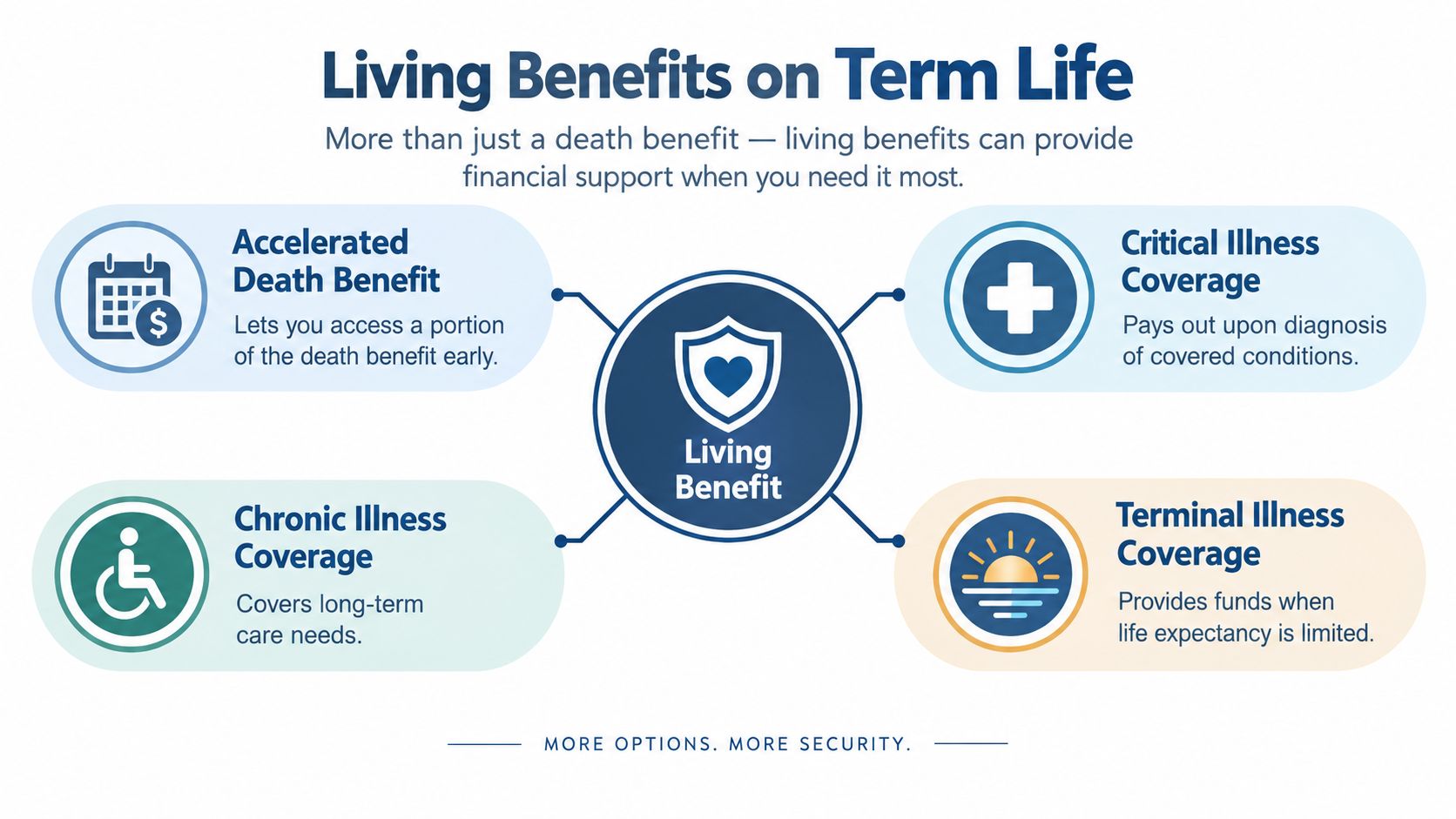
If you're shopping for term life and keep seeing “living benefits,” start with the mechanism, not the marketing. On many policies, the term refers to an accelerated death benefit (ADB), a rider that may let the policyowner receive some of the death benefit while the insured is alive and meets the rider's conditions. It's an advance from the policy's future payout, not a separate pot of money.
Think of the death benefit as a future payment reserved for your beneficiaries. An ADB lets you bring some of that payment forward to meet a current need, such as treatment costs, household bills, caregiving, or lost income. The trade-off is that money paid early generally leaves less for beneficiaries later, and the insurer may reduce the remaining benefit by more than the cash you receive.
The phrase can cover different medical triggers. Terminal illness provisions generally focus on a serious diagnosis with a limited life expectancy. Chronic illness provisions usually assess whether the person can manage essential daily activities or needs supervision because of cognitive impairment. Critical illness provisions, when offered, typically depend on a diagnosis named in the contract. The definitions and available riders vary by policy and state.
Why the feature can matter
A severe illness can create costs before any death benefit is payable. In 2023, 23% of U.S. adults reported a major, unexpected medical expense in the previous 12 months, with the median expense between $1,000 and $1,999; 27% went without some form of medical care because they couldn't afford it, according to the Federal Reserve's report on household expenses. Those figures help explain why some buyers value access to funds during life, particularly when income or employer benefits are limited.
Still, don't treat an ADB as a replacement for health insurance, disability income protection, or a dedicated emergency reserve. Before comparing offers, it can help to understand what a rider on life insurance is, then check whether the rider is included, optional, or subject to an added charge.
The simplest mental model is this: an ADB advances part of your future life insurance payout. That can give you flexibility during a qualifying health event, but it isn't bonus coverage or free money.
Terminal, Chronic, and Critical Illness Triggers Explained
The three labels aren't interchangeable. Each rider looks for a different medical fact, so a condition that qualifies under one provision may not meet another's definition.
A terminal-illness rider generally requires a physician to certify that the insured's condition can reasonably be expected to result in death within a specified period. For federal tax purposes, Internal Revenue Code §101(g) uses a 24-month life-expectancy standard for terminal illness, as set out in the U.S. Code. A particular contract can have its own eligibility language and documentation requirements, so verify the rider rather than assuming the federal tax definition controls every policy decision.
Chronic illness uses a functional test, not a prognosis alone. IRS guidance defines a chronically ill individual as someone certified at least annually by a licensed health-care practitioner as unable, without substantial assistance, to perform at least two activities of daily living for at least 90 days, or as requiring substantial supervision because of severe cognitive impairment. The activities include bathing, dressing, eating, toileting, transferring, and continence, as described in the IRS instructions for Form 1099-LTC.
Critical-illness riders take a different approach. They may pay when the insured receives a diagnosis named in the contract, such as cancer, a heart attack, or a stroke. The actual covered conditions, severity requirements, and exclusions depend on the rider. If you're weighing this type of protection, review what critical illness insurance covers and compare that policy's definitions with the term rider.
Compare the medical tests
| Trigger | Medical test | Typical documentation | Common use |
|---|---|---|---|
| Terminal illness | A physician's prognosis must meet the policy's life-expectancy threshold. | Physician certification and medical records supporting the prognosis. | Accessing part of the death benefit after a qualifying terminal diagnosis. |
| Chronic illness | Functional incapacity or severe cognitive impairment must meet the rider's definition. | Practitioner certification, assessment of daily activities, and any required follow-up certification. | Addressing expenses tied to ongoing assistance or supervision. |
| Critical illness | The insured must have a covered diagnosis that meets the contract's terms. | Diagnostic records, test results, and physician documentation. | Accessing a benefit after a listed serious illness. |
Practical rule: Ask for the exact trigger, waiting period, certification rules, and deadline for filing a claim. A label on a sales page doesn't tell you whether your particular diagnosis will qualify.
None of these provisions automatically supplies long-term-care coverage. An ADB may help with a financial shock, but its medical test and payout rules are set by the rider.
How the Payout Actually Works and What It Costs
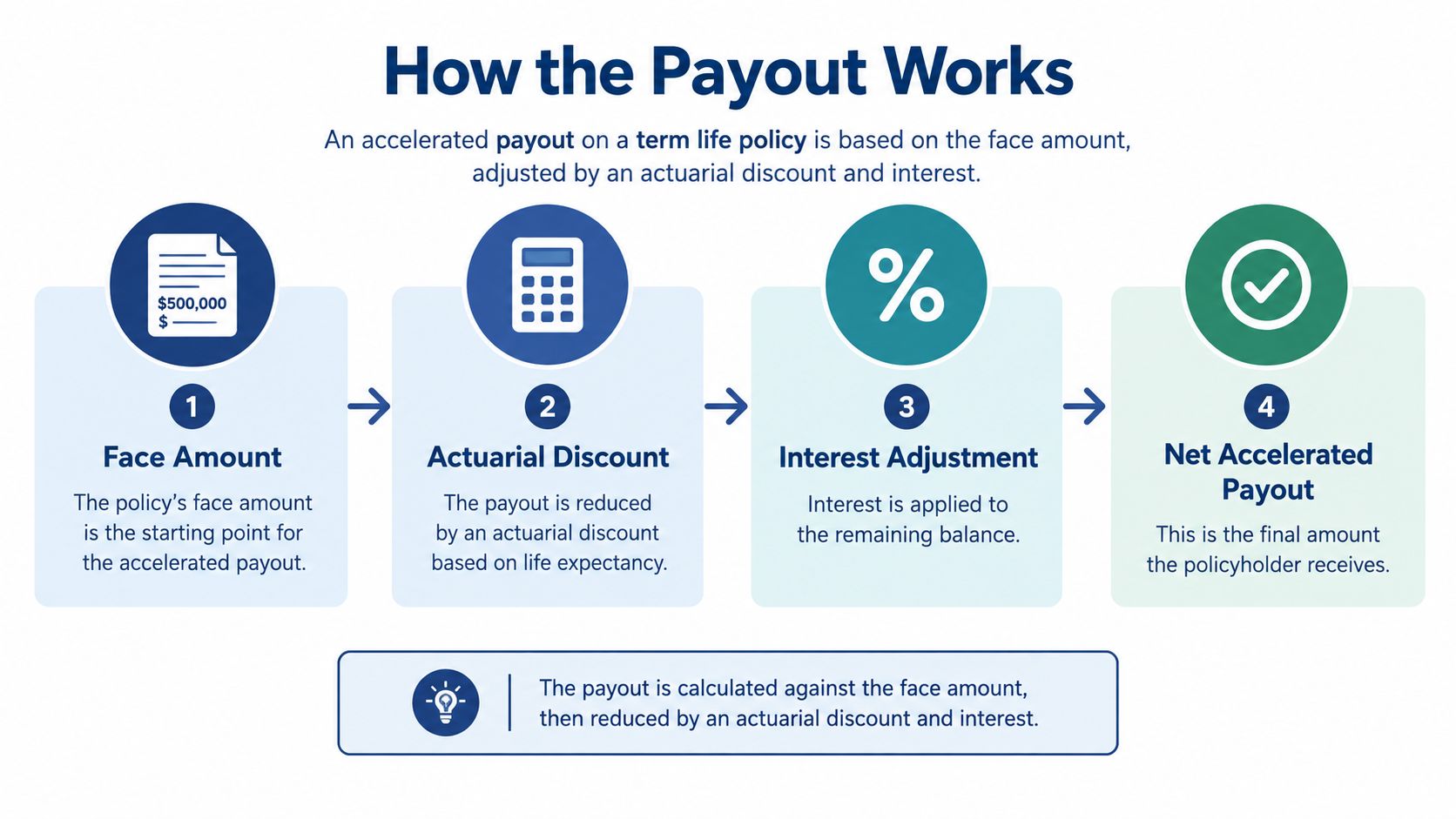
An accelerated benefit starts with the policy's face amount, but the face amount isn't necessarily the cash you'll receive. The insurer applies the contract's calculation method, which may include an actuarial discount, interest adjustment, or administrative fee. That can make the beneficiary reduction larger than the payment the policyowner receives.
An actuarial discount is a way of adjusting the future death benefit to account for paying some of it early. The insurer calculates a present value under the rider's terms, which means an advance against a stated portion of the death benefit may result in a smaller net payment. Don't assume you'll receive the selected amount dollar for dollar.
For illustration, a sample rider described in a filed policy allows a terminal-illness acceleration of up to the lesser of 90% of the face amount or $1 million, subject to its contract terms. That cap tells you the maximum eligible portion, not what a particular claimant will receive after discounts, interest, or fees. The sample rider filing also illustrates why it's important to distinguish a rider's limit from the net benefit paid.
Tax treatment needs its own check
Under Internal Revenue Code §101(g), a payment under a life insurance contract for a terminally ill insured is generally treated like a death benefit for federal income-tax purposes when a physician certifies that the illness or condition can reasonably be expected to result in death within 24 months. That rule doesn't guarantee that every accelerated payment is tax-free in every situation. Contract language, the amount accelerated, ownership structure, and applicable state law can matter.
Ask the insurer for a written illustration showing the amount paid to you and the death benefit left for beneficiaries under the same claim scenario. Also ask what happens to premiums and policy status after a payment; the rider and base contract determine whether premiums continue and how the policy remains in force.
The video below offers a visual explanation of the payout process.
Real-World Scenarios for Self-Employed and Family Buyers
The same rider can solve different problems for different households. These examples show how to think through the trigger and the beneficiary trade-off. They aren't benefit quotes: the actual eligible amount depends on the policy, insurer's calculation, and claim decision.
A contractor facing a treatment-related income gap
A 1099 contractor receives a cancer diagnosis and needs to keep household bills paid while treatment disrupts work. A critical-illness rider might apply if the diagnosis meets the policy's covered-condition definition. A terminal-illness rider would require a qualifying prognosis instead, so a cancer diagnosis alone doesn't establish eligibility under that provision.
If the claim is approved, the contractor could receive an accelerated payment subject to the contract's limits and deductions. The family should compare that net cash with the amount of death benefit left after the acceleration. A self-employed buyer should also review disability insurance for self-employed workers, because income replacement and an ADB address different risks.
A pre-Medicare couple planning for care
One spouse in a couple nearing Medicare eligibility develops a condition that makes daily activities difficult. A chronic-illness rider may be relevant if the insured meets its functional test and any certification requirements. It isn't enough that care would be helpful; the contract defines what level of inability or supervision qualifies.
If the insurer approves an acceleration, the couple could use the funds toward caregiving or household expenses, but the advance would reduce the death benefit available to survivors. Before relying on the rider for long-term needs, compare its limits and claim rules with dedicated long-term-care coverage and other resources.
A parent buying coverage for an adult child
A parent buys a term policy for an adult child because of a family history of heart disease. If the child later has a qualifying heart attack, a critical-illness rider might respond if that condition is covered and satisfies the policy's definition. The child's family history by itself doesn't trigger a payout.
One sample filed rider allows access to as much as 50% of the eligible death benefit, subject to a $1 million maximum and prior accelerations. That's a contract-specific cap, not a promise that every policy pays the same share. The parent and adult child should identify who owns the policy, who can request an acceleration, and who would receive any remaining death benefit.
Cost, Underwriting, and Approval Trade-Offs
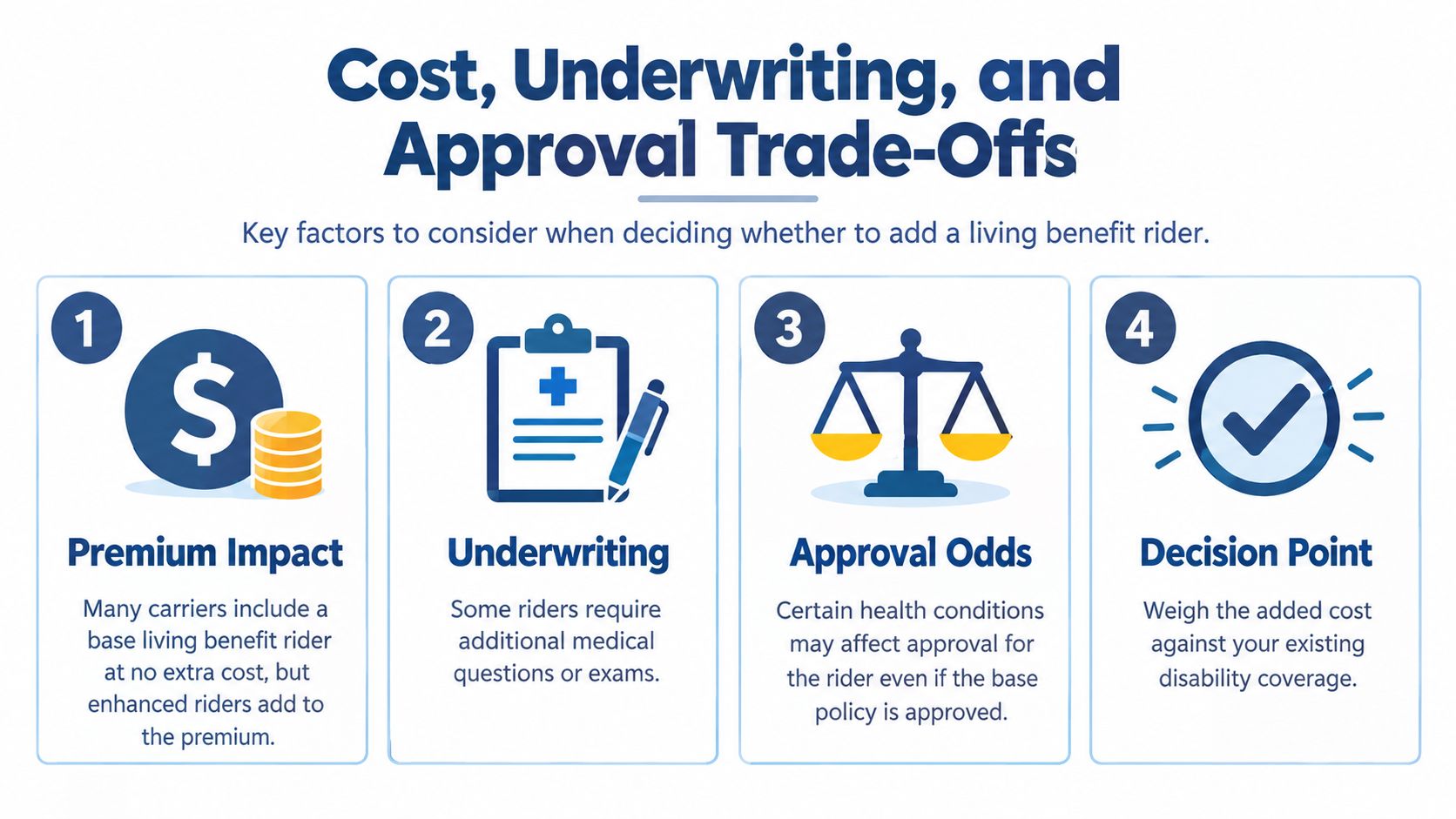
The cost of a living-benefit feature depends on the insurer and the rider design. Some policies include a basic terminal-illness ADB in the base contract, while enhanced chronic- or critical-illness provisions may have a separate price. Don't assume a feature is included or free because a quote page uses the phrase “living benefits.” Ask for the premium with and without the rider, and confirm whether the price can change.
Underwriting can also differ. An insurer may ask additional medical questions or require more documentation for an optional rider, while another may evaluate eligibility alongside the base policy. Approval for life insurance doesn't automatically mean approval for every rider, and the rate class for the policy may not answer whether a specific benefit applies.
If you're still learning how insurers assess applications, review the life insurance underwriting process and ask the carrier how its rules apply to the rider you're considering.
Questions to put to the insurer
- Available amount: What share of the eligible death benefit can be accelerated, and is there a maximum dollar cap?
- Claim conditions: Which diagnoses or functional limitations qualify, and is there a waiting period?
- Payout calculation: What discounts, interest adjustments, or fees apply, and how will the remaining death benefit be calculated?
- Premium and policy status: Does the rider change the premium, and what happens to the policy and future premiums after acceleration?
- Approval: Does the rider require additional health questions or an assessment separate from the base policy?
The household budget matters, too. In the Federal Reserve's 2022 survey, 63% of U.S. adults said they could cover a hypothetical $400 emergency using cash, savings, or a credit card they could pay off at the next statement, as reported in its household financial well-being findings. That figure helps explain why access to money during illness can appeal to buyers, but it doesn't tell you whether accelerating your own death benefit is the best way to meet a particular need.
When a Living Benefit Is Not the Right Answer
A rider isn't automatically useful just because it's available. If you have strong employer-provided disability coverage, a separate long-term-care policy, or enough savings to handle a temporary financial setback, you may have other ways to manage an illness without reducing the life insurance protection intended for your family.
The survivor benefit may be the priority. If your household depends on the full death benefit to replace your income or support dependents, taking an advance can work against the reason you bought the policy. Compare the net cash you'd receive with the amount left for beneficiaries, then consider whether savings, disability insurance, or another coverage source would address the need with less impact on your family's future protection.
A living-benefit payment can also interact with public benefits. The IRS guidance for Form 1099-LTC points to consumer disclosures concerning possible tax consequences and the potential effect of accelerated benefits on Medicaid or other government-benefit eligibility. If you or a family member receives means-tested assistance, speak with a qualified benefits adviser before requesting an acceleration.

Keep the purpose of each protection clear
Health insurance helps pay covered medical costs. Disability income coverage is designed to replace some income under its own eligibility rules. Long-term-care insurance is intended to address qualifying care expenses. A term-life ADB advances the policy's death benefit if the rider's conditions are met. Those tools can complement one another, but they don't perform the same job.
The Federal Reserve reported that the median major, unexpected medical expense in 2023 fell between $1,000 and $1,999. For a bill at that scale, a household may prefer to use savings if doing so preserves a much larger death benefit. The right choice depends on your cash reserves, coverage, family obligations, and the terms of the policy, not on the rider's marketing name.
Choosing the Right Term Policy With Living Benefits
Use a simple decision process before you sign. First, read the actual rider definitions. Confirm whether the policy offers terminal, chronic, or critical-illness access, what medical test applies, who must certify the condition, and whether timing or waiting-period rules could affect a claim.
Next, ask for a side-by-side illustration of three outcomes: no claim, a partial acceleration, and the maximum acceleration allowed under the contract. For each, have the insurer show the cash you might receive, any reduction or discount, the death benefit that would remain, and what happens to premiums and policy status. A cap alone won't tell you the economic value retained by your household.
Finally, check the tax and public-benefit implications before treating the rider as part of your emergency plan. A licensed insurance professional can explain the policy mechanics, while a tax adviser or benefits specialist can assess your circumstances. That extra review can be especially useful for self-employed buyers, pre-Medicare households, working families with limited employer coverage, and parents buying for adult children.
Before choosing a policy, compare the contract language, not just the rider label. Ask an insurer or independent agent to show the exact trigger, payout calculation, fees, maximum acceleration, and remaining death benefit in writing.
Compare term quotes, then request the rider wording for each policy you're considering. My Policy Quote offers life insurance quote comparisons and information to help you evaluate options, so you can ask informed questions about living benefits before you apply.