

You may be sitting at the kitchen table with a funeral arrangement sheet, an unpaid bill, and a life insurance policy you've never read. Someone you love has died, and you're trying to find out whether the money they intended for your family will arrive in time to help. You don't need a sales pitch. You need clear answers about who can claim it, what paperwork matters, and what to ask before choosing a payment option.
The Moment a Family Picks Up the Phone
A family member finds an insurance folder and calls the number on the policy. They expect to explain what happened and ask when the money will arrive. Instead, they're asked for a policy number, beneficiary information, and proof of death.
That conversation can feel jarring. The family is dealing with a personal loss, while the insurer needs to establish the details of a contractual claim. You can prepare for that conversation without having every answer ready.
Start with a manageable task
Before calling, put the policy and a notebook beside you. Write down the insured person's name, your contact information, and the questions you need answered. If you don't know whether you're the beneficiary, say so rather than guessing.
Your first goal isn't to complete the entire process. It's to leave the call knowing what the insurer needs next and where to send it.
- Ask for the claim packet. Request the forms and a written explanation of required documents.
- Identify your contact. Record the representative's name and ask how to reach the claims department again.
- Separate urgent bills from longer-term decisions. Make a list of immediate obligations before discussing how you'd like to receive the proceeds.
The question, “How does life insurance payout work?” is really several questions at once. Who has the right to the money? What amount is available? Can the recipient access it all, or will the insurer distribute it over time?
You don't have to make every financial decision during the first phone call. Ask for the information you need to make the next decision.
A useful approach is to keep a single claim folder, whether it's on paper or stored securely online. If another relative helps, that folder gives them a clear starting point instead of a collection of half-remembered conversations.
What a Life Insurance Payout Actually Is
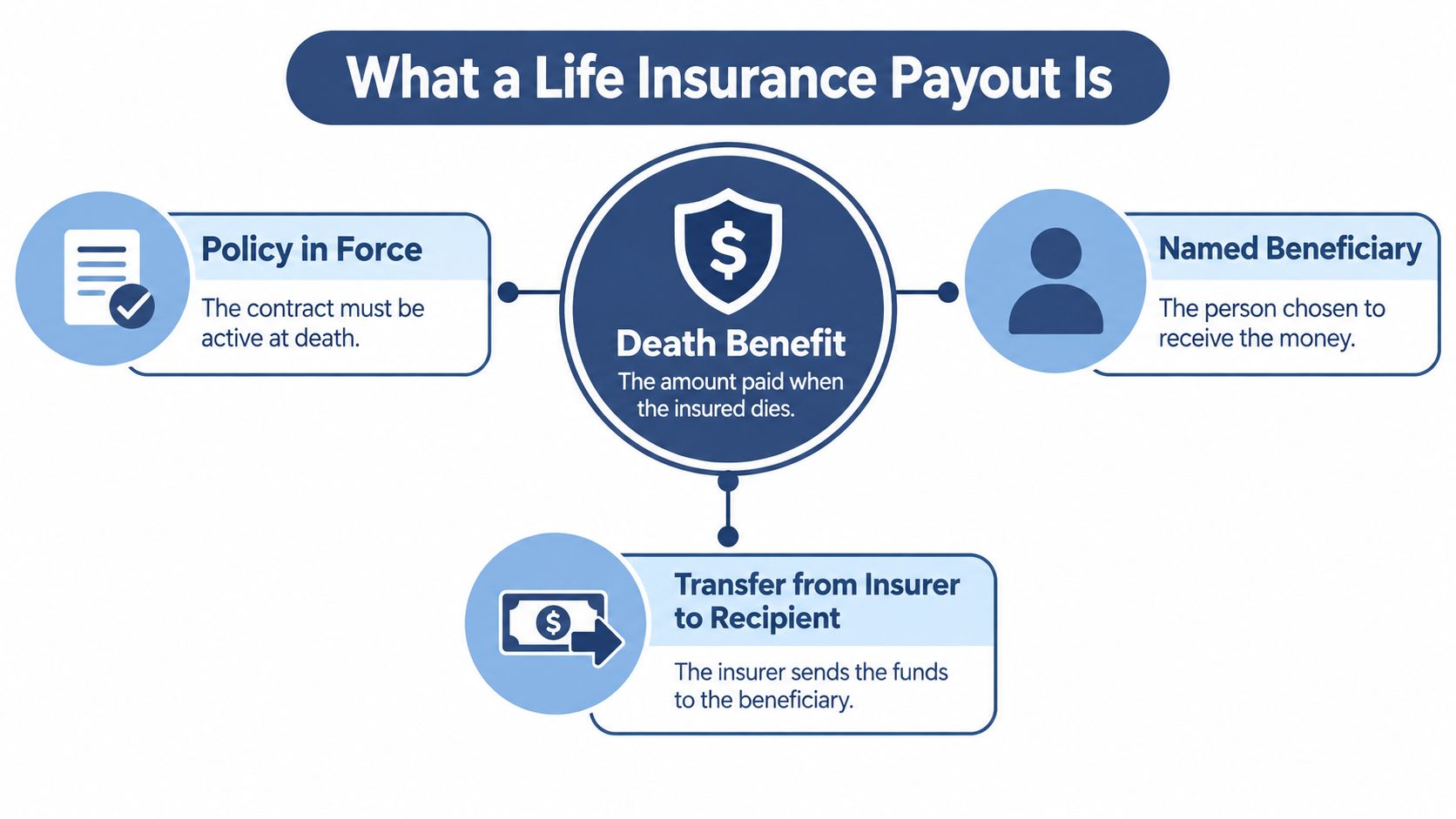
A life insurance payout is the payment an insurer makes under the policy after the insured person dies. The central amount is the death benefit, which is the benefit stated in the contract, subject to applicable adjustments.
The basic rule is straightforward: the insured must generally die while the policy is in force, meaning active, and the insurer pays the named beneficiary or beneficiaries rather than automatically paying the policy owner's estate. The NAIC's consumer guide to life insurance explains these mechanics, including how policy loans and cash value can affect the amount received.
The diagram separates the contract, the recipient, and the payment.
Distinguish the people from the money
The insured person is the person whose death triggers the claim. The policy owner controls the policy, while the beneficiary is designated to receive the death benefit. Those roles can belong to different people, so paying premiums doesn't by itself establish who receives the payout.
It also helps to separate the policy's different financial values:
- Death benefit. The contractual starting point for a death claim.
- Cash value. A feature of certain policies that generally doesn't get added to the death benefit unless the contract says otherwise.
- Net claim proceeds. The amount ultimately payable after applicable adjustments.
Why the printed amount may not be the final amount
An outstanding policy loan, together with accrued interest, can reduce the payout. That means a policy can be active at death while still delivering less than its stated face amount, as the NAIC guide explains.
Don't add a cash-value statement to the death benefit and assume that total belongs to the family. Instead, ask the insurer for a written benefit calculation showing the contractual benefit, any deductions, and the net proceeds.
That calculation gives you a more useful planning figure than the amount printed on an old policy summary. It also helps separate a reduced benefit from a claim delay: those are different problems requiring different questions.
Who Gets the Money and How the Decision Is Made
The beneficiary designation deserves as much attention as the coverage amount. A family may agree about what the deceased intended, but the insurer needs to determine entitlement under the policy's records and applicable rules.
A primary beneficiary is the first designated recipient. A contingent beneficiary is a backup if the primary beneficiary can't receive the proceeds under the contract's terms. The NAIC's guidance on life insurance beneficiary choices explains why individuals, estates, trusts, and minor children can lead to different outcomes.
The form below represents the document families should locate rather than relying on memory.

Follow the designation, not the family assumption
A will generally doesn't control policy proceeds unless the policy names the estate. Naming the estate can bring the proceeds into probate and create potential estate-tax complications, as the NAIC guidance explains.
Multiple beneficiaries also require clear allocations. Using the allocation mechanics described in the earlier NAIC consumer guide, a policyholder can assign each recipient a percentage rather than leaving the division to relatives.
For a plain-language explanation of the document itself, review what a beneficiary designation means. Then compare your understanding with the insurer's current record, not merely an unsigned copy in a drawer.
Handle difficult recipient situations deliberately
- A beneficiary died first. Ask how the contingent designation and policy language apply. Don't assume the deceased beneficiary's children automatically take their place.
- A recipient can't be located. Give the insurer available identifying information and ask what remains necessary to establish entitlement.
- A child is named directly. Insurers generally won't pay minors without an appropriate legal arrangement, such as a court-appointed custodian or properly structured trust.
- Relatives dispute the designation. Request the insurer's explanation of the record it's using and seek legal advice before accepting another relative's interpretation.
For someone receiving means-tested benefits, get individualized advice before naming them directly. In a blended family, consider whether the intended recipients and backup recipients are unmistakably identified.
A trust may be worth discussing when a minor needs protection or the family wants a legally structured arrangement. The Law Office of Bryan Fagan's resource on trust planning for Texas families provides context for that conversation; it shouldn't replace advice about your own ownership and beneficiary choices.
Lump Sum Versus Annuity and Other Payment Choices
Receiving an approved claim doesn't always mean receiving all the money immediately. The policy's settlement provisions may offer several ways to distribute the proceeds, and the available choices depend on the contract and insurer.
A lump sum usually gives the beneficiary the greatest liquidity and control. Installment arrangements create a stream of payments while leaving the unpaid balance subject to insurer-credit risk and contractual terms. FINRA's insurance investment guidance provides context for distinguishing insurance values and evaluating payment arrangements.
Use this comparison as a starting point, then request the actual terms in writing.
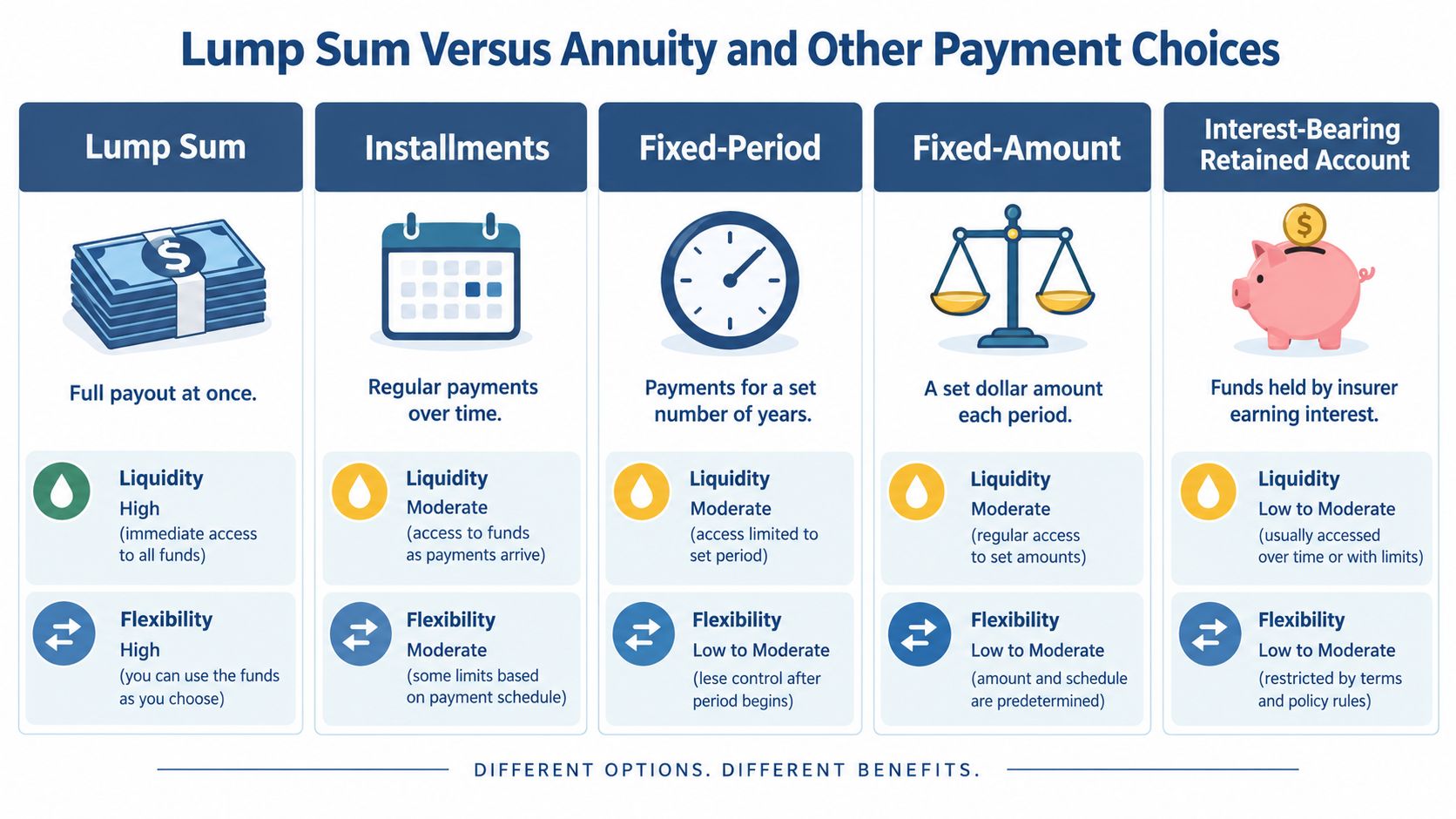
Compare access, not just payment size
| Settlement option | How it works | Main question to ask |
|---|---|---|
| Lump sum | The beneficiary receives the payable proceeds at once. | How and when will the funds be delivered? |
| Installments | The insurer distributes proceeds through scheduled payments. | What access remains to the unpaid balance? |
| Fixed period | Payments are arranged over a selected period. | What happens if your needs change before it ends? |
| Fixed amount | Payments use a selected amount per payment period. | What determines how long payments continue? |
| Interest-bearing retained account | The insurer holds proceeds under an account arrangement and credits interest. | Who holds the principal, and what are the withdrawal rights? |
Don't treat every scheduled-payment offer as the same annuity. Ask the insurer to identify exactly what product or settlement provision you're electing and explain its guarantees.
For a family facing funeral costs, a mortgage, and uncertain future income, access may matter more than a reassuring payment schedule. Another beneficiary might prefer scheduled payments, but that choice should follow a budget and a review of the contract.
Read the conditions before electing
Compare interest rates, guarantees, fees, withdrawal rights, and reversibility. Ask whether you can later take the remaining balance, whether a withdrawal changes future payments, and what happens to unpaid proceeds if the beneficiary dies.
Before signing: Ask for every available settlement option and a written explanation of which elections can't be changed later.
Payment form also affects the tax questions you'll need answered. Request a breakdown showing the original insurance proceeds separately from any interest, rather than accepting a payment illustration that blends them together.
Finally, a life settlement is different from settling a death claim. FINRA describes it as selling an existing policy to a third party for more than its surrender value but less than its net death benefit. It's not another way for a beneficiary to collect an already-approved death benefit.
Filing the Claim Step by Step
Start by contacting the insurer identified on the policy and asking for its current claim instructions. A life insurance claim generally requires a claim form and certified proof of death, followed by verification of policy status and beneficiary entitlement.
The checklist below can help a relative keep track of the administrative work.
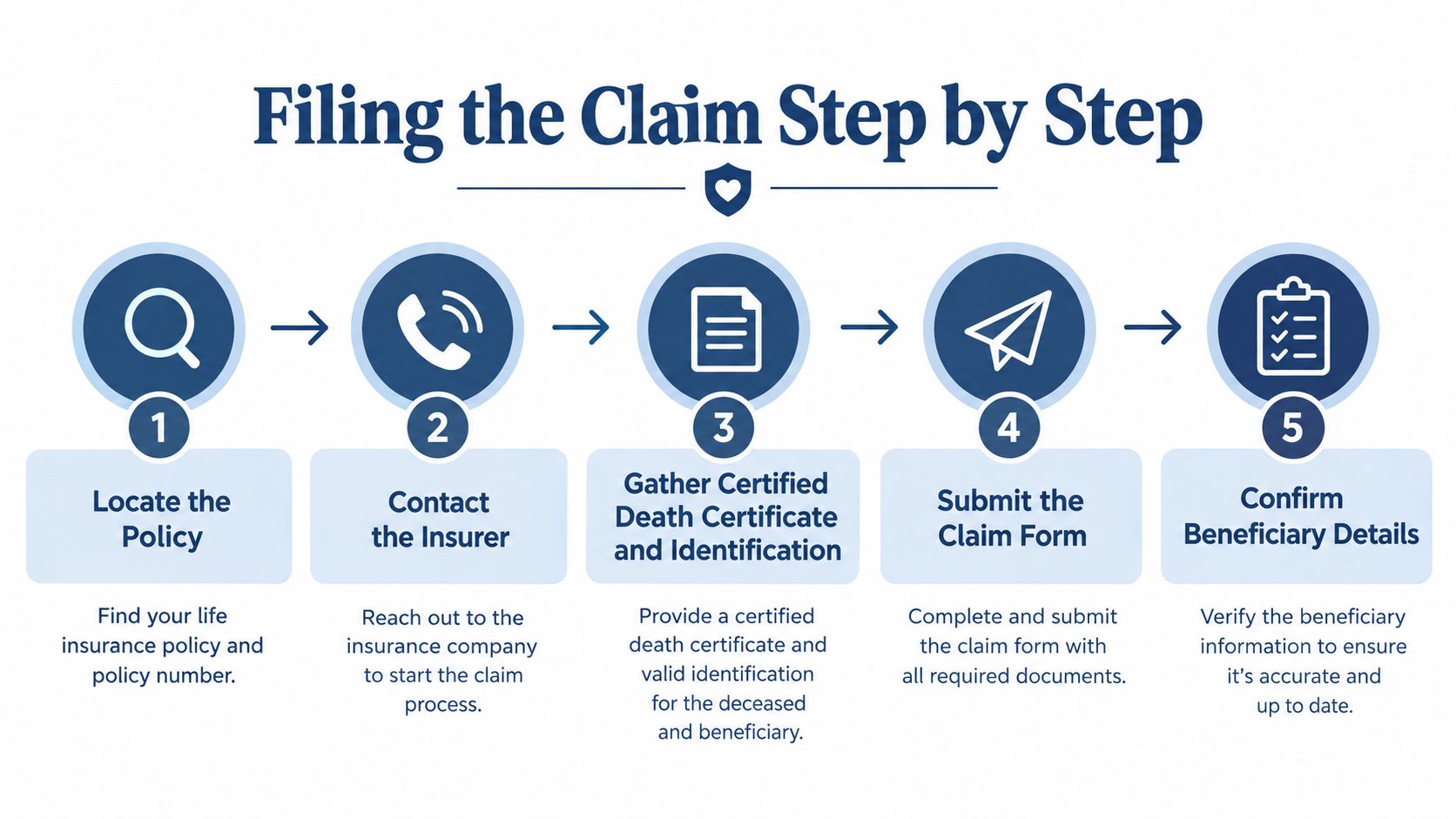
Assemble and submit the claim
- Locate the policy. Gather the contract, policy number, beneficiary records, and available premium-payment records.
- Contact the claims department. Ask which forms apply and how documents should be submitted securely.
- Gather certified proof of death and identification. Confirm exactly what the insurer accepts before sending documents.
- Complete the claim form. Check names, contact information, signatures, and requested identifying details against the records.
- Confirm receipt and beneficiary details. Ask whether the submission is complete and what verification remains outstanding.
Behind the scenes, the insurer checks whether coverage was active, whether the claimant is entitled to payment, and whether the death falls within a contractual exclusion. It may also review the application when contestability applies.
Establish a follow-up record
Ask for written confirmation of what the insurer received and what's missing. Record the submission date, claim reference, contact person, and agreed follow-up date so you're not restarting the conversation each time.
Texas policyholder-rights guidance states that insurers must pay within two months after receiving proof of death and verifying the beneficiary; interest may also accrue from proof of loss through acceptance and payment of an individual-policy claim. That's Texas guidance, not a universal promise measured from the date of death.
For another format to review alongside the written checklist, you can use the following video.
If the death also involves a separate bodily injury matter, keep those documents distinct from the life insurance submission. Lein Law Offices' article, What Happens When Someone Files a Bodily, is an adjacent resource about that different kind of claim, not a guide to life insurance deadlines.
How Taxes Actually Treat the Money
The death benefit and the interest are different tax components. A beneficiary shouldn't assume everything arriving from an insurer has the same treatment, but also shouldn't assume the entire payment is taxable.
For U.S. beneficiaries, a $250,000 lump-sum death benefit normally isn't reported as taxable income; interest paid while the insurer holds the proceeds generally is taxable, according to the IRS explanation of life insurance proceeds and interest. The distinction concerns what the money represents, not which company sent it.
Tax Treatment of Common Payout Components
| Payout Component | General Federal Tax Treatment | Notes |
|---|---|---|
| Principal death benefit | Generally excluded from gross income | Exceptions can apply. |
| Interest on retained proceeds | Generally taxable income | Keep it separate from the underlying benefit. |
| Interest within installment payments | Generally taxable income | Ask for the principal-and-interest breakdown. |
| Proceeds from a policy transferred for value | The exclusion may be limited | The amount paid, later premiums, and specified additional amounts matter. |
| Proceeds connected to the taxable estate | May raise estate-tax questions | Estate tax is separate from ordinary income tax. |
The transfer-for-value rule deserves particular care. The IRS explains that when a policy has been transferred for cash or other valuable consideration, the exclusion may be limited rather than applying to the full proceeds. Don't treat a purchased or transferred policy as an ordinary family-owned policy without review.
Ask which tax issue applies
Estate-tax exposure can depend on ownership arrangements and whether proceeds are included in the taxable estate. State taxation can also require separate advice, particularly when the family's situation involves substantial assets or ownership by someone other than the insured.
The practical step is to request an insurer statement that identifies benefit principal and credited interest separately. Give that statement, any tax reporting documents, and the relevant ownership history to your tax professional.
For additional plain-language background, consult this life insurance tax explanation. Use it to prepare questions, not to decide a complicated estate or policy-transfer issue on your own.
Keep the distinction clear: A payment can contain a generally excluded death benefit and taxable interest without making the whole payment taxable.
That distinction also makes settlement comparisons more honest. Evaluate the usable money and contractual restrictions, not just the total payments shown in an illustration.
Why Payouts Get Delayed and How to Push Back
A claim isn't necessarily denied because it hasn't been paid. Missing paperwork, unresolved beneficiary details, ownership conflicts, or an investigation can leave the family waiting while the insurer determines what it needs to approve payment.
Claims administration matters too. LIMRA's reporting on claims operations discusses attention to turnaround times, payment methods, claim volumes, and staffing. That doesn't establish a deadline for your claim or prove a backlog at your insurer, but it reinforces why families should track the administrative process rather than rely on a general expectation of quick payment.
Understand what contestability permits
Under the rights guidance referenced earlier, a policy's two-year contestability period can allow the insurer to review the original application after a death during that period. A proven material misrepresentation may support denial or rescission. An investigation alone doesn't justify withholding payment indefinitely.
After contestability ends, policies are generally incontestable except for limited circumstances, including unpaid premiums, fraud, or a death outside the contract's coverage. For a fuller explanation, review the life insurance contestability period and compare it with the actual policy language.
Don't confuse contestability with the benefit calculation discussed earlier. If the insurer raises a policy loan, ask whether it's calculating a deduction or saying that another issue prevents payment.
Turn a vague delay into specific questions
- Identify the missing item. Ask exactly which document, verification, or decision remains outstanding.
- Request the contractual basis. If coverage is questioned, ask for the relevant provision and the facts the insurer relies on.
- Preserve the evidence. Keep premium records, application materials, medical documentation, and claim correspondence.
- Set the next checkpoint. Request a written status update and a date for follow-up.
- Escalate unresolved concerns. Ask for supervisory review and consider contacting the appropriate state insurance regulator or an attorney.
A denial letter should become the starting point for review, not something you put aside because it feels overwhelming. Ask for the specific reason, applicable review instructions, and any deadline you need to preserve.
You don't need to argue every point on the phone. A short written request tied to the policy and documents is more useful than repeatedly asking why the money hasn't arrived.
Putting It All Together for Your Family
The most useful preparation is a claim-ready file and a clear understanding of who should receive the proceeds. Self-employed workers can focus on premium records; parents can review recipient choices; blended families can seek advice about legal arrangements; advisors can help clients compare settlement terms without rushing an election.
Keep the work manageable:
- Review the designation. Confirm recipients, backups, and identifying details with the insurer.
- Organize the records. Store the policy, payment history, and relevant correspondence where a trusted person can find them.
- Prepare settlement questions. Ask about access, guarantees, fees, reversibility, and the payment breakdown.
- Document the next action. During a claim, write down what's missing, who is responsible, and when you'll follow up.
If you're also handling a parent's household and administrative affairs, this checklist for what to do when a parent dies can help you organize the wider workload.
Choose one concrete task this week: verify a designation, locate the contract, or request a written claim status. You don't have to solve every financial question at once, but you can make the next step clearer for yourself and the people helping you.
My Policy Quote offers plain-language insurance explanations, including guidance on life insurance payouts and beneficiary decisions. Visit to prepare your questions about coverage and claim proceeds, then ask your insurer for the policy-specific answers your family needs.