

A 1099 worker buying a Marketplace plan in 2026 can often expect to see a roughly $400 to $900 monthly premium for a single adult before tax credits, but that sticker price is rarely the amount that comes out of pocket. For many enrollees, subsidies, the self-employed health insurance deduction, and plan design change the true cost much more than the headline premium does.
A freelance designer looking at two plan quotes can feel like the prices are speaking different languages. One quote looks cheaper until the deductible, copays, and coinsurance show up, while the other looks expensive but may cost less over a full year once subsidies and taxes are factored in.
What 1099 Health Insurance Cost Looks Like in 2026
A 1099 health insurance bill starts with the monthly premium, then adds the deductible, copays, coinsurance, and, in a bad health year, the out-of-pocket maximum. Two plans can share a similar premium and still lead to very different yearly spending.
The first reference point is what an employer usually helps cover for salaried workers. KFF reports that average total annual premium for employer-sponsored family coverage was $26,993, and employees paid about $6,850 of that themselves. That does not predict a Marketplace bill for a contractor, but it shows the size of the gap a self-employed worker has to fill with subsidies, deductions, and cash flow. If you are also sorting out your tax status, misclassified worker tax form help can help you check whether your coverage decision sits alongside a worker-classification issue.
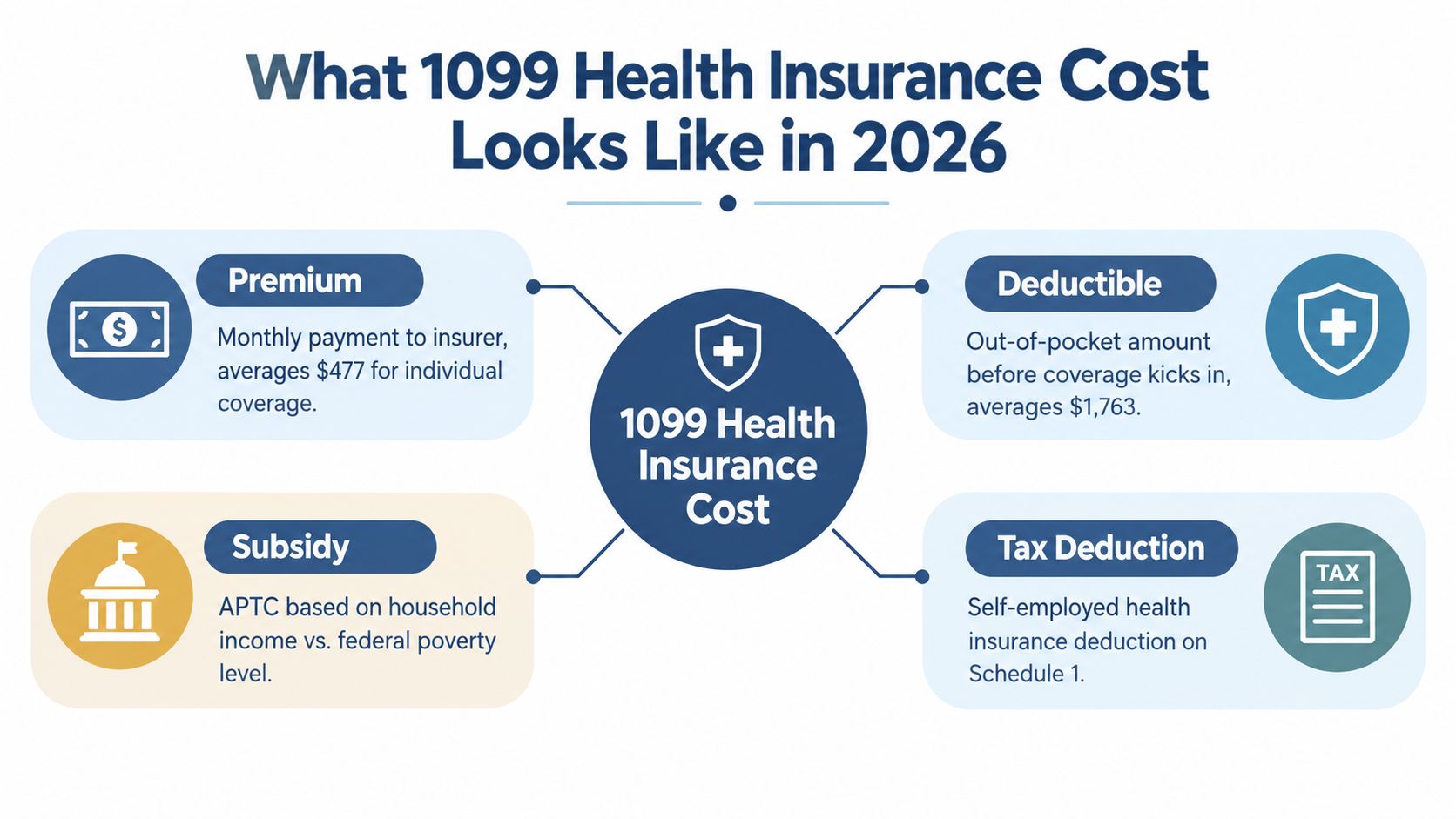
A Marketplace quote can look cheap until you read the whole policy. The better number is the net annual cost, after assistance and tax effects are included. A contractor with uneven income may see that number change during the year, because higher or lower earnings can change subsidy eligibility and the size of the final bill.
The four parts of any plan quote
| Cost Component | What It Means | Why It Matters for 1099 Workers |
|---|---|---|
| Premium | The monthly payment to keep the plan active | This is the bill you see first, but it is only one piece |
| Deductible | What you pay before the plan starts covering many services | A low premium can hide a high deductible |
| Copays and coinsurance | What you pay when you use care | Doctor visits, prescriptions, or imaging can push a plan higher than expected |
| Out-of-pocket maximum | The ceiling on covered spending for the year | This matters most if you have a rough health year |
CMS says that, for eligible HealthCare.gov enrollees in plan year 2026, the average premium for the lowest-cost plan will be $50 per month after tax credits, with tax credits covering about 91% of that premium on average (CMS). That is a reminder that the sticker price is often not the final price.
For a contractor, the smartest comparison is the full year, not the monthly quote. The plan that looks smaller on paper can cost more once you add the deductible, typical visits, and the tax credit you qualify for.
Bronze, Silver, and Gold Plans Compared
The metal tier changes where the money shows up. Bronze plans usually keep the monthly premium lower, but you pay more when care starts through the deductible and coinsurance. Gold plans usually do the reverse, with a higher monthly bill and less cost at the doctor's office. Silver sits between them, which is why it often becomes the middle ground for people who expect some care but do not want the highest premium.
CMS's 2025 open enrollment fact sheet showed that marketplace coverage was often more affordable than the sticker price suggests, because many HealthCare.gov customers qualified for substantial financial help (CMS). For a 1099 worker, that matters because the monthly quote is only one piece of the bill. A Bronze plan that looks cheap can still cost more over the year if you use care often, while a Gold plan can make sense if you know you will be filling prescriptions or seeing specialists.
Bronze versus Silver versus Gold at a glance
| Plan Tier | Premium Level | Typical Deductible | Best Fit For |
|---|---|---|---|
| Bronze | Lowest | Highest | Healthy contractors who want the smallest monthly bill and can handle a rougher year |
| Silver | Middle | Moderate | People who expect some care and want a balance between premium and use |
| Gold | Highest | Lowest | Contractors with prescriptions, therapy, ongoing treatment, or a planned procedure |
The deductible is where many people get tripped up. A low monthly premium can feel like a win, but if you need several visits, tests, or prescriptions, you may pay far more before the plan starts helping in a meaningful way. That is why a Bronze plan is not automatically the cheapest plan in real life.
Silver plans deserve a close look because they can fit the middle of the road for both cost and use. If you want more detail on the tradeoff, see the guide on Bronze or Silver health plan.
A simple way to compare tiers is to ask what the plan costs in a quiet month, a normal month, and a month when you need care. That question matters even more for a 1099 worker, because income can change during the year while the plan choice stays fixed. The best tier is the one that leaves your annual cost manageable after the subsidy, the deductible, and the care you expect to use.
How Marketplace Subsidies Change a 1099 Worker's Bill
A 1099 worker can buy Marketplace coverage that looks affordable at first and still end up with a very different monthly bill after subsidies are applied. The key number is projected household income, because the subsidy is based on what you expect to earn for the year, not what you earned last year. When freelance income jumps or slows, the credit can shrink, grow, or disappear.
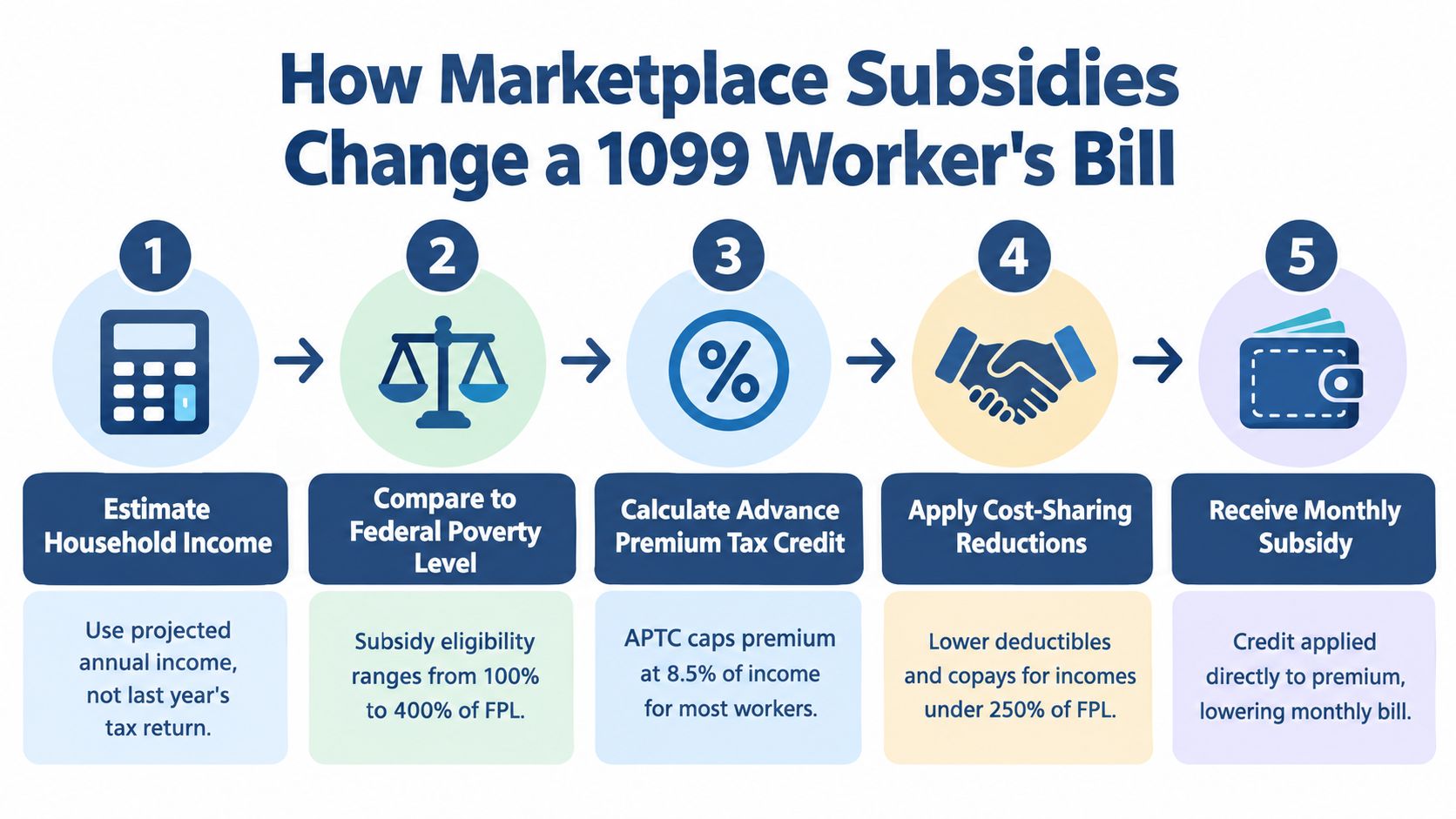
CMS notes that Marketplace savings can be large enough to bring premiums down to very low monthly amounts for many shoppers, and KFF explains that people with income above 400% of the federal poverty level can lose eligibility for premium tax credits entirely (KFF). For a contractor, that means the sticker premium is only part of the story. The actual expense is the premium after assistance, plus any tax-time adjustment if the estimate was off.
Income swings create the hardest part. A strong quarter can raise your projected annual income and reduce the credit. A slow stretch can leave you overestimating and paying more each month than you needed to. That is why the Marketplace application has to reflect current work, not a clean snapshot from last year's return.
A simple forecasting routine
- Estimate household income conservatively. Use projected annual net profit, not your best-case month.
- Update the application after major changes. A new contract or a weak quarter changes the subsidy math.
- Keep a cash cushion. Reconciliation at tax time can leave you owing money back.
- Review subsidy eligibility before renewal. Last year's credit may not fit this year's income.
The subsidy is a formula tied to income and household details, so when those details move, the credit moves too.
For a plain-language walkthrough of the process, this calculate health insurance subsidy guide is a useful companion.
The Self-Employed Health Insurance Deduction in Practice
A 1099 worker can cut the after-tax cost of coverage with the self-employed health insurance deduction, but the savings only show up when the tax rules fit the business. Under Internal Revenue Code Section 162(l), an eligible self-employed taxpayer may deduct qualified premiums for medical coverage for the taxpayer, spouse, dependents, and qualifying children as an above-the-line adjustment rather than an itemized deduction (IRS). The result depends on taxable income, business profit, filing status, and whether employer-subsidized coverage was available.
A sole proprietor with steady profit has the cleanest setup. If the business produces enough net profit, the premium deduction can reduce part of the annual bill, within IRS limits. Clean monthly records matter here. Premiums paid in one month and eligibility lost in another do not produce the same tax result.
An S-corp owner faces a more layered calculation. Salary, distributions, and how the business pays for coverage can all affect the outcome. The premium is only one piece of the tax picture, because the entity structure changes what the deduction can do.
Three real-world situations
Practical rule: if a spouse has employer coverage available, check the month-by-month rules before assuming your premiums are deductible.
A married contractor often meets the trickiest rule. If the spouse's employer offered subsidized coverage during the relevant months, those months generally do not qualify for the self-employed health insurance deduction. The household may still pay less for coverage through the spouse's job, but the tax deduction may shrink or disappear for those same months.
The IRS example gives a clear anchor. It shows a Schedule C taxpayer with $5,500 of business profit, $389 of deductible self-employment tax, and $3,000 of premiums, where the full $3,000 is deductible because it does not exceed the applicable net profit (IRS). The exact figures matter less than the constraint: the deduction cannot exceed the business economics underneath it.
For a fuller walkthrough of the tax mechanics, see this guide on self-employed health insurance deduction.
Pairing an HSA With a High-Deductible Plan
An HSA can lower the cost of coverage, but only if the plan is HSA-eligible and you can keep funding it. The account works best when you treat it as a tax tool first and a spending account second. If you never put money into it, you lose most of the advantage.
A Bronze high-deductible health plan can fit a healthy contractor who rarely uses care. The premium is usually lower, and the HSA can help reduce taxable income while building money for future medical bills. For someone who expects regular visits, prescriptions, or follow-up care, the math can shift fast. A lower premium may be outweighed by a larger deductible and more out-of-pocket exposure.
The contribution side matters too. IRS rules set annual HSA limits, and the limit depends on whether the coverage is self-only or family, so the account is not an open-ended savings bucket. That makes the decision practical, not abstract. You need a plan that fits both your monthly cash flow and the amount you can set aside for care.
HSA versus paying out of pocket
- HSA route: You keep the premium lower, save into the account, and pay qualified care with tax-advantaged dollars.
- No HSA route: Medical bills come straight from ordinary cash flow, so the same spending can cost more after tax.
- Richer plan route: You pay more each month, but you may feel less strain when you use care.
That tradeoff matters for a 1099 worker whose income can swing during the year. A slow month can make HSA contributions hard to keep up. A stronger month can make them easier, but the plan still has to survive the weaker months too. If the budget cannot handle both the premium and regular deposits, the HSA loses much of its benefit.
For a plain explanation of what counts as HSA-eligible coverage, the what is an HDHP guide is a useful place to check the rules before enrolling.
Calculating Your True Annual Cost as a 1099 Worker
The figure is not the monthly premium. It's the annual cost after subsidy, tax deduction, and the care you use. That means two contractors can pick the same plan and end up with very different financial outcomes.
Start with a simple worksheet. Add the monthly premium after any tax credit, estimate what you'll spend on expected care, then subtract the value of the self-employed health insurance deduction if you qualify. If you use an HSA, fold in the contribution you make, not the contribution you wish you could make.
A contractor with steady income and light medical use can get away with a lower-premium plan more often. A contractor with a volatile year, more prescriptions, or planned care should pay close attention to the total annual exposure. The cheapest premium can still be the most expensive choice once a deductible gets hit.
A better way to compare two plans
Simple rule: compare your plans on net annual cost, not on the quote page.
Use four numbers:
- Premium after subsidy
- Expected out-of-pocket spending
- Tax value of the deduction
- Any HSA contribution you'll fund
That framework works because it puts income instability where it belongs, inside the budget. A month with slow revenue can change your subsidy outlook, and a busy month can change your tax picture. The plan that looked fine in January may not be the plan that still fits in September.
For contractors who want to compare a side hustle or a driving income stream against insurance cost, driving income ideas for 2026 can help frame extra cash flow as part of the coverage budget. The point isn't to chase more work for its own sake, it's to see how additional income affects subsidy eligibility and whether it gives you room for a stronger plan.
Practical Ways to Lower Your 1099 Health Insurance Cost
Start with an honest income estimate. If your revenue is uneven, be conservative, because a subsidy based on a rosy forecast can create trouble later. Then update the Marketplace application whenever your work pattern changes in a meaningful way.
After that, compare Bronze, Silver, and Gold on expected yearly cost, not just premium. If you're healthy and can fund an HSA, a high-deductible plan may fit. If you expect frequent care, a richer plan can be cheaper once the year is over.
Keep records all year. Save premium statements, note which months you had employer coverage available through a spouse, and track the tax deduction separately from the Marketplace credit. If your situation is complicated, a tax advisor helps with S-corp structures, a licensed agent helps with household coverage choices, and a planner can put insurance into the bigger family budget.
If you're trying to avoid a cash crunch, you may also want a short-term backup for emergencies. A cash advance can be part of that safety plan, but it shouldn't replace careful subsidy forecasting or a proper health plan choice.
My Policy Quote helps self-employed people compare health insurance options and see how location, age, and coverage needs affect the numbers. If you want to sort out your 1099 health insurance cost with a quote that fits your situation, visit My Policy Quote and start with the coverage basics that matter for your household.