

Mortgage protection life insurance is a policy designed to pay off or reduce your remaining mortgage balance if you die, helping your family keep their home. It's a specific use of life insurance for mortgage debt, not the same as general life insurance or private mortgage insurance.
You may be thinking about this after opening a mortgage statement at the kitchen table. The payment is manageable today, but your household depends on your income, and a serious question appears: What happens to the home if you're no longer here to make the payments?
Understanding Mortgage Protection Life Insurance
Mortgage protection life insurance is designed to address the financial risk created by an unpaid home loan when the insured borrower dies. The policy can provide funds to reduce or repay the remaining mortgage balance, helping surviving family members preserve housing or avoid selling under financial pressure. The Federal Reserve reported that mortgage debt made up roughly three-fourths of total U.S. household debt in its 2025 financial-stability review, which helps explain why this concern is so common. The Federal Reserve's household borrowing review also noted that mortgage delinquency remained near the lower end of its historical range during the second half of 2024. That doesn't remove the income-loss risk created by a borrower's death.

The coverage isn't automatic mortgage forgiveness, and it isn't a government benefit. It's an optional life insurance arrangement with premiums, underwriting, exclusions, and policy conditions. Depending on the policy, the death benefit may go directly to a lender or to a named beneficiary who decides whether to pay the mortgage, continue making payments, or use the funds for another household need.
The basic purpose
The practical purpose is straightforward: turn a life insurance benefit into housing protection. A lender-directed policy may settle the mortgage balance, while a family-beneficiary policy may give survivors broader control. That distinction matters because a paid-off home doesn't replace lost income, cover taxes, pay for childcare, or replenish emergency savings.
Before applying, it can help to understand both the insurance contract and the broader financial picture. Resources explaining how life insurance policies work can help you identify the beneficiary, benefit structure, exclusions, and cancellation terms. You can also review what mortgage lenders look for when assessing a borrower's financial profile.
Practical rule: Protecting the mortgage is one objective. Protecting the household's ability to live, pay bills, and recover from lost income is a wider objective.
How Mortgage Protection Differs from Traditional Life Insurance
The most important difference isn't the name on the application. It's who controls the money and whether coverage follows the loan or the borrower.
In many lender-sold arrangements, the lender receives the death benefit directly. The proceeds reduce or eliminate the remaining mortgage, but beneficiaries generally don't receive flexible cash. Traditional life insurance usually pays a named beneficiary, allowing that person to decide how to allocate the funds among housing, income replacement, taxes, education, debts, or other needs.
Mortgage protection may also use a declining benefit. As the mortgage balance falls, the policy's potential payout can fall with it. Traditional term life insurance generally provides a level death benefit during the chosen term. That can create a larger cushion for a family whose financial needs extend beyond the house.
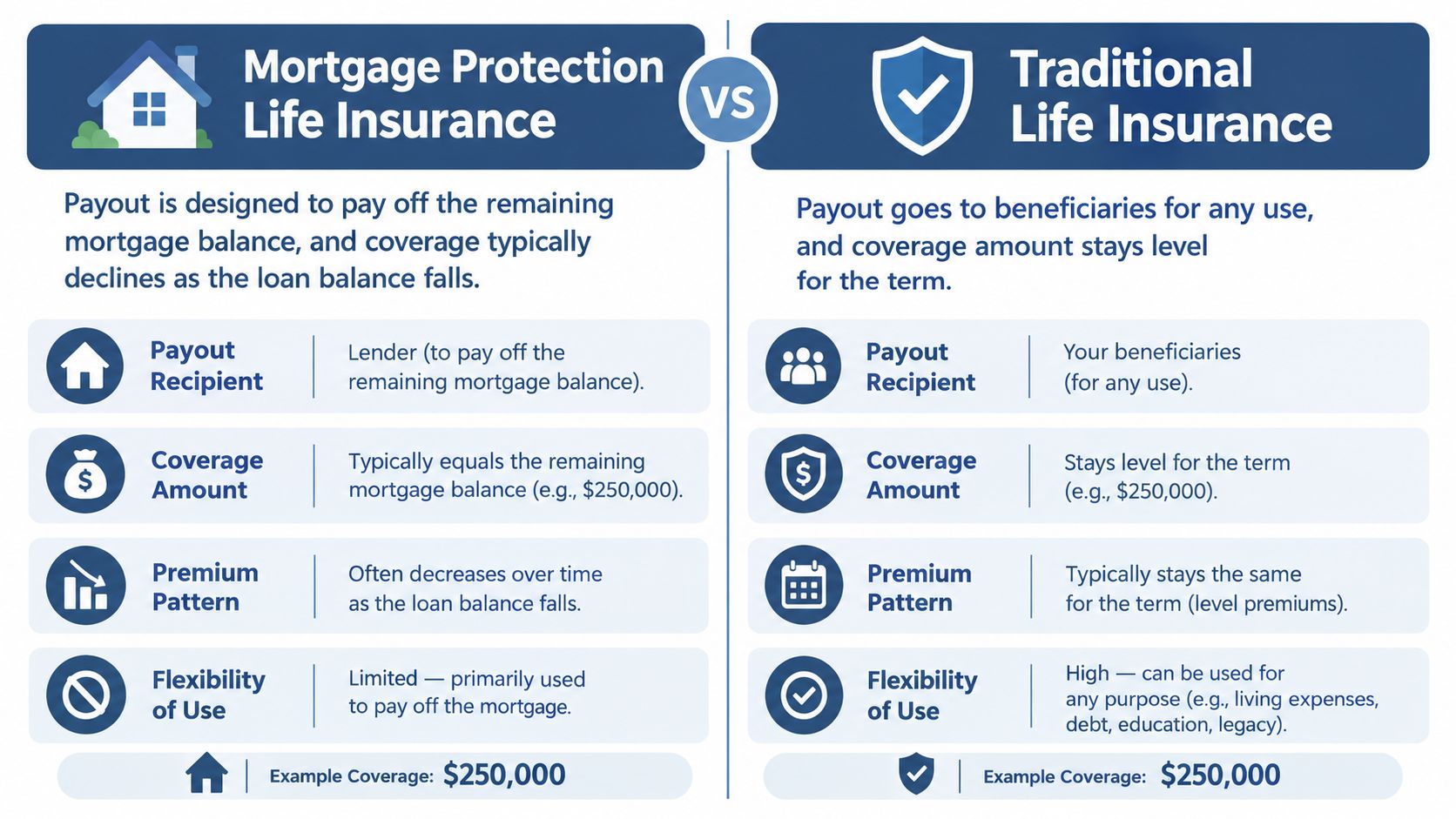
| Feature | Mortgage Protection | Traditional Life Insurance |
|---|---|---|
| Payout recipient | Often the lender, depending on policy structure | A beneficiary selected by the policy owner |
| Coverage amount | May decline as the mortgage balance falls | Typically remains level during the term |
| Primary purpose | Reduce or repay mortgage debt | Support broader household and financial needs |
| Flexibility | Often limited by lender-directed payment | Beneficiaries decide how to use proceeds |
| Refinancing impact | Loan-tied coverage may need review or replacement | Coverage generally follows the insured person |
Refinancing changes the calculation
A refinance can create a problem that borrowers often overlook. If coverage is tied to the original loan, refinancing may require a replacement policy. That replacement could be issued when you're older or your health has changed, which may affect eligibility, underwriting, or affordability.
A policy's relationship to the loan also deserves careful review alongside property and lending documents. For background on how alienation clauses affect sales, consider the legal and contractual language that can affect ownership or transfer arrangements. For a broader comparison of policy structures, review the difference between term and permanent life insurance.
How Premiums and Payment Structures Work
Premiums aren't based on the mortgage balance alone. Insurers may consider the insured mortgage amount, the borrower's age, health, policy design, underwriting approach, and relationship between the death benefit and the loan balance. The policy's exclusions and term also affect whether the price reflects useful protection for the household.
Lender-sold coverage may add the premium to the regular mortgage payment. That can make administration feel simple, but convenience can hide important questions about cancellation, renewal, benefit changes, and who owns the policy. Read the certificate or contract rather than relying only on a lender's summary.
Questions to ask before enrolling
- Ask who receives the benefit: Confirm whether the lender or your family is the beneficiary.
- Check whether the benefit declines: Find out whether the death benefit follows the mortgage balance while the premium stays unchanged.
- Review underwriting: Ask what health information is required and whether the policy is fully underwritten, simplified, or subject to exclusions.
- Test affordability: Consider whether you can maintain the premium during a slow business period, illness, or temporary income interruption.
- Confirm refinancing treatment: Ask whether the coverage remains in force if the loan is refinanced, transferred, or paid down early.
- Read cancellation terms: Determine how to end the policy and whether ending it affects the mortgage payment.
For self-employed professionals and 1099 contractors, irregular income makes payment durability especially important. A policy that fits during a strong month may become difficult to maintain during a slow season. Guidance on how to calculate insurance premiums can help you understand the inputs behind a quote, but the policy documents control the final terms.
Key Decision Factors for Choosing Coverage
A useful decision starts with the question, Who needs control of the death benefit? If the priority is a direct mortgage payoff and the lender-directed structure meets your needs, mortgage protection may provide a simple solution. If your family may need to balance the mortgage against income replacement, taxes, childcare, or business obligations, a family-beneficiary policy may be more adaptable.
| Decision factor | Lender-directed coverage | Family-beneficiary coverage |
|---|---|---|
| Recipient | Lender receives or controls the mortgage payment | Family or another named beneficiary receives proceeds |
| Main advantage | Direct focus on the home loan | Flexibility across several household needs |
| Main limitation | Little or no cash flexibility for survivors | Beneficiaries must decide how to manage the mortgage |
| Best question | Is a dedicated payoff the priority? | Does the household need broader financial control? |
Match the benefit to the risk
A declining benefit may track the loan efficiently, but it can leave less available for other needs over time. A level benefit may offer a steadier safety net, particularly when the insured person supports children, a spouse, or a business. Neither structure is automatically right. The answer depends on what the household would need after the mortgage is addressed.
Refinancing deserves its own checkpoint. Ask whether the policy follows you as the insured borrower or remains connected to the original loan. Self-employed borrowers, contractors, and families with unstable employer benefits should also ask whether separate income-replacement coverage is necessary. A mortgage payoff can preserve the house, but it may not replace the earnings that cover food, utilities, healthcare, and other costs.
Ask before signing: “If I refinance, become disabled, lose workplace coverage, or experience a long income gap, what exactly happens to this policy?”
Review exclusions and underwriting requirements with the same care you give the premium. A lower payment isn't useful if the benefit doesn't apply to the risks your family faces.
Real-World Scenarios and Use Cases
A self-employed contractor may value mortgage protection because it creates a dedicated housing safeguard without depending on an employer benefit. However, variable income makes premium stability critical. This borrower should compare a lender-directed policy with individually owned coverage and ask whether the benefit would also support business obligations or household income.

A young family with a new mortgage may care less about a single debt payoff and more about preserving choices. If one parent dies, the surviving parent may need time to adjust work, arrange childcare, pay taxes, and maintain the home. A family-beneficiary policy can offer more control over those decisions than a benefit assigned directly to the lender.
A pre-Medicare adult may face more challenging underwriting or higher premiums than a younger applicant. That person might still need protection for a spouse or dependent, but should compare mortgage-only coverage with term life insurance and examine exclusions carefully. The right answer may involve a smaller policy that remains affordable rather than a larger promise that later lapses.
The same issue affects people without employer-sponsored benefits. Mortgage protection offered through a lender may appear accessible, but accessibility doesn't make it complete. The applicant still needs to verify the beneficiary, benefit amount, payment structure, and whether the coverage remains useful after refinancing.
For a practical starting point, compare the questions raised by a life insurance quote for a mortgage with the wider needs of your household.
The following video can provide another way to think through mortgage-focused life insurance decisions:
No scenario produces a universal answer. Income stability, health, existing coverage, refinancing plans, and the family's need for flexible cash all change the decision.
Common Misconceptions About Mortgage Protection
The most common mistake is confusing mortgage protection life insurance with private mortgage insurance, or PMI. PMI protects the lender against borrower default. Mortgage protection life insurance addresses the mortality risk that arises when an insured borrower dies. PMI doesn't pay the mortgage after death, and mortgage protection isn't a substitute for PMI requirements.
Another misconception is that mortgage protection is always the best choice for a homeowner. It may suit someone who wants a dedicated payoff or has difficulty qualifying for broader coverage. A healthier borrower may find that traditional term life insurance offers a level benefit and more control over the proceeds.
What the policy may not solve
A lender-sold policy can be convenient, but it may not address:
- Lost income: Paying off the home doesn't replace the deceased borrower's earnings.
- Other obligations: Taxes, childcare, healthcare, debts, and business expenses may continue.
- Changing loan terms: Refinancing can affect loan-tied coverage.
- Policy exclusions: Certain causes or circumstances may limit payment.
- Insufficient benefit: The death benefit may not match the full balance or the household's wider needs.
A family should also avoid assuming that existing coverage remains adequate forever. Refinancing, a new child, a change in income, or the loss of workplace benefits can alter the protection required. If the estate or debt consequences are unclear, information from Morgan Morgan Attorneys at Law P C can help frame questions for an attorney, insurer, or financial professional.
The strongest response to a sales pitch is a document review. Ask who owns the policy, who receives the benefit, how the benefit changes, what exclusions apply, and what happens if the mortgage changes.
Making the Right Choice for Your Family
Mortgage protection life insurance can be useful when a household wants a clear housing-focused benefit, especially if the borrower is self-employed, works as a contractor, or lacks reliable workplace coverage. It isn't automatically the most suitable form of life insurance. The right choice depends on whether your family needs only a mortgage payoff or a broader pool of money to manage life after a death.
Use this checklist before applying:
- Identify the beneficiary. Know whether the lender or your family controls the proceeds.
- Compare benefit structures. Review declining mortgage protection against level term coverage.
- Stress-test the premium. Ask whether payments remain affordable during irregular income.
- Check refinancing rules. Confirm whether the policy follows you or the original loan.
- Review exclusions. Read the contract, not just the marketing summary.
- Measure the full need. Include housing, income, taxes, childcare, debts, and final expenses.

Compare quotes from more than one source and discuss the policy with an insurance professional who understands variable income, health underwriting, and mortgage planning. Review coverage after refinancing or other major household changes. The goal isn't just to erase a loan. It's to give your family a realistic path to keep stable housing and meet financial obligations.
My Policy Quote provides a broker-guided workflow for comparing life insurance options that can address housing expenses, including a mortgage. Visit My Policy Quote to explore coverage questions and compare options that fit your household's needs.