

A low premium can still hide a serious problem. The policy might provide too little money to replace your income, end before your family reaches financial independence, rely on underwriting conditions you didn't expect, or require payments you can't maintain when work slows down. The cheapest quote isn't automatically the safest choice.
The better approach is to treat questions to ask before buying life insurance as a conversation guide. Take your answers to an insurer, broker, or financial professional, then ask them to explain what changes under different health, income, policy duration, and beneficiary scenarios. You can also use a resource such as questions to ask about tax planning to prepare for the wider financial decisions that may affect your insurance needs.
My Policy Quote can be a practical starting point for comparing life insurance options. The important step is to compare like with like, including coverage amount, policy duration, premium structure, exclusions, riders, conversion rights, and underwriting requirements. Use the questions below in order. They move from the purpose of the policy to the details that determine whether it will remain useful.
1. How Much Life Insurance Coverage Do I Actually Need?
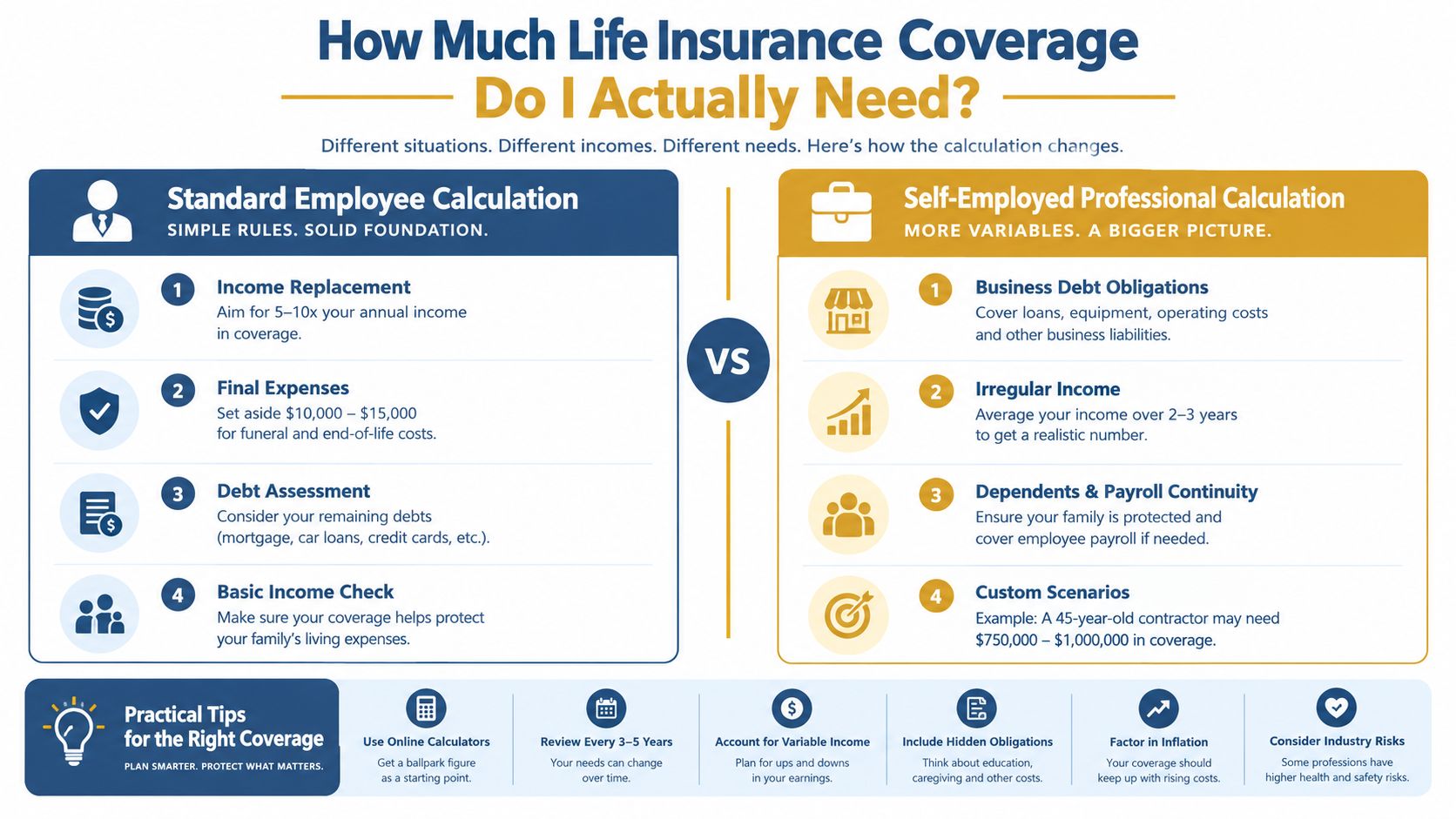
Start with the financial loss your household would face if you died, not with the premium you hope to pay. Life insurance may need to replace income, support children or other dependents, pay a mortgage, settle debts, fund education, cover final expenses, or protect a business.
A useful first calculation lists the obligations your family would inherit and the resources already available. Include savings, existing life insurance, employer benefits, retirement assets, debts, regular household spending, and any income your family could realistically continue receiving. For a self-employed person, add business loans, equipment financing, tax obligations, and the cost of transferring or closing the business.
A contractor with a mortgage and children may need enough coverage to replace income while the family adjusts, pay housing costs, and support the children through key years. A consultant who works through a home-based business should also consider whether clients, contracts, or business debt depend on that person's involvement.
Adjust the calculation for your household
An online calculator can help you organize the first estimate, but it can't understand every family obligation. Use the guide to calculating your life insurance need as a starting point, then ask a professional to challenge your assumptions.
Pay special attention to less visible responsibilities:
- Family support: Include money you regularly provide to parents, adult children, or other relatives.
- Shared debts: Review co-signed loans, personal guarantees, credit obligations, and business liabilities.
- Variable earnings: Self-employed workers should examine several years of income rather than relying on one unusually strong or weak year.
- Future transitions: Early retirees between ages 60 and 64 may need coverage that bridges a period before Medicare eligibility or another planned source of protection.
Recent U.S. research found that 38% of adults had a life insurance need-gap in 2026, representing about 92 million adults, while 48% didn't own life insurance at all. The same LIMRA research found that some existing policyholders still wanted more coverage, while some non-owners said they needed insurance. The question isn't just whether you have a policy. It's whether the amount would protect the people who depend on you.
2. What Type of Life Insurance Best Fits My Situation?
Term insurance and permanent insurance solve different problems. Term insurance covers a defined period, which can make it suitable for temporary obligations such as a mortgage, child-rearing years, or the period before retirement. Permanent insurance is designed to remain in force for life, subject to its terms and required payments, and may include cash value.
A young family with a new mortgage may value a large amount of term coverage at a manageable premium. The need could decline once the mortgage is paid and children become financially independent. A business owner, by contrast, may need coverage connected to succession, a buy-sell arrangement, or an obligation that doesn't have a predictable end date.
Permanent policies also require careful questions about guarantees, cash value, fees, premium flexibility, and what happens if the policy is underfunded. Universal and variable policies can have more moving parts than straightforward term coverage. Don't choose one because an illustration shows an attractive future outcome. Ask which values are guaranteed and which depend on assumptions.
Match structure to the obligation
Use the comparison of term and permanent life insurance to clarify the basic trade-off, then ask:
- What problem does this policy solve? Income replacement may call for a different structure than estate planning.
- What happens if I stop paying? Understand the grace period, lapse consequences, surrender value, and reinstatement rules.
- Can I convert term coverage? A conversion option may matter if your health changes and you later want permanent insurance without new medical underwriting.
- Can the premium change? Ask whether payments are level, guaranteed, adjustable, or linked to policy performance.
A blended approach can also make sense. Some households use term insurance for their largest temporary obligation and a smaller permanent policy for a lasting need. The right choice depends on the purpose, not on whether one product is generally described as better. If your income is unstable, don't commit to permanent premiums until you understand how the policy behaves during weak business years.
If insurance is part of a broader estate or retirement plan, also review where to hold life insurance for tax with an appropriately qualified professional. Ownership and beneficiary choices can affect how a policy fits into the rest of your finances.
3. What Health Issues or Conditions Will Affect My Rates and Eligibility?
Your health profile is one part of the underwriting picture. Insurers may review your medical history, current medications, tobacco use, family history, occupation, lifestyle, and requested coverage amount. The same diagnosis can lead to different decisions depending on how well it is controlled, whether complications exist, how recent treatment was, and which insurer assesses the application.
Ask what information the insurer will request before you apply. You may need to provide diagnosis details, treatment dates, prescription records, physician notes, or permission to access medical files. Give complete and accurate answers. Leaving out a condition or medication can create problems later if the insurer finds information that was not disclosed.
For help preparing a health history, review this guide to life insurance for pre-existing conditions. It can help you organize the questions to raise with an insurer or broker.
A person with controlled diabetes may receive a different assessment from someone with recent complications. A construction worker with an old back injury may still qualify, although the insurer could review current limitations and job duties. A cancer survivor may need treatment and follow-up records. These examples do not predict approval. They show why a broad online quote cannot replace a proper underwriting conversation.
Families should ask whether a parent's health history could affect income-replacement coverage or a policy intended to support children. Self-employed workers need to explain both medical history and physically demanding work, since an insurer may assess occupation alongside health. Blue-collar workers should describe actual duties rather than rely on a job title. Early retirees may need to clarify recent treatment, medications, and the purpose of coverage. Parents helping adult children can confirm who will answer medical questions and who will pay the premiums.
Ask about the process before submitting
Medical requirements vary by applicant and policy. Consumer life insurance guidance can provide background, but ask the insurer to explain its own process.
- Is an exam required? Ask whether your application may use accelerated, simplified, or traditional underwriting.
- Which records matter? Confirm whether physician notes, lab results, prescription history, or specialist reports may be requested.
- How are tobacco and lifestyle factors treated? Ask about definitions and look-back periods.
- Can a broker pre-screen the application? A preliminary review may identify insurers familiar with your circumstances.
A broker who regularly handles complex health histories can help you prepare documents and direct questions to suitable carriers. That support cannot guarantee approval or a particular rate. It can make the application clearer and reduce avoidable surprises.

4. How Long Do I Need the Coverage to Last?
A policy duration should follow the obligation it protects. If the purpose is to replace income while children are dependent, the term may need to last until they can support themselves. If the purpose is mortgage protection, compare the term with the expected repayment schedule. If the purpose is business succession or a lasting estate need, a permanent policy may be more appropriate.
A young parent may choose a term that extends beyond the expected end of the mortgage and the children's dependent years. A self-employed professional may need coverage until a planned business sale or retirement, but should also consider whether that timeline could change. An early retiree between ages 60 and 64 may need to bridge a specific period before Medicare eligibility or another source of financial protection.
Don't choose a long term just because it sounds safer. A longer commitment can cost more, while a short term may leave you exposed when renewal becomes expensive or your health makes replacement difficult.
Build in room for uncertainty
Write down the date when each major obligation should end, then ask what could delay it. Children may need support for longer than expected. A business sale may take more time. A mortgage may be refinanced rather than paid off on the original schedule.
Practical rule: Choose the policy around the obligation, then add a reasonable buffer for events you can't predict. Ask what renewal would cost if you still needed protection after the term ends.
Conversion rights deserve attention even if you don't expect to use them. A convertible term policy may let you move to permanent coverage without repeating the full health assessment, though the conversion rules, deadlines, available products, and premiums vary by carrier.
Ask the insurer to show what happens at the end of the term. Will coverage end, renew automatically, or become more expensive? Can you reduce the amount? Can you convert only part of the policy? Parents buying coverage for an adult child should also ask whether the duration matches the child's path toward financial independence rather than just mirroring the parent's policy.
5. What Is My Budget for Premiums, and Can I Afford to Keep Paying?
What premium could you pay during a difficult year, not only during a strong one? A policy protects your family only while it remains in force, so set a premium ceiling using income you can count on.
Start with the expenses that cannot wait. Blue-collar and working-class families should test the payment against housing, utilities, debt, childcare, food, and emergency savings. Self-employed workers and contractors should run the same calculation using a low-income month, not an optimistic business forecast. If the premium becomes unmanageable when work slows, the policy is not a sustainable fit.
A smaller amount of coverage may serve you better than a larger policy that later lapses. Term insurance can provide a straightforward way to cover temporary obligations while you build savings or stabilize income. The goal is a policy your household can keep, not a target that looks good only on paper.
Ask how the premium behaves
The first payment does not tell the whole story. Ask whether premiums stay level for the full term, rise at set intervals, depend on policy performance, or may change under stated conditions. Find out what happens after a missed payment, how long the grace period lasts, and whether automatic payments are available.
Run at least two affordability tests:
- Normal year: Can you pay the premium after regular household expenses and savings?
- Difficult year: Could you keep paying after reduced hours, lower business income, or unexpected costs?
An early retiree should compare the premium with retirement income, healthcare costs, and the possibility of reduced earnings. An employee who relies on workplace coverage should ask whether that protection ends after a job change and whether an individual policy is needed as a backup. Parents helping an adult child buy coverage should confirm who will pay the premiums and whether that arrangement can continue if either person's income changes.
Ask for two or three proposal versions. Compare a lower coverage amount, a different term, and another policy type. Then ask whether coverage can be increased later, what evidence would be required, and whether future health or pricing could affect the change.
A budget can also reveal a useful compromise. You might choose enough coverage for immediate household obligations now, then review the amount when debts decline, savings grow, or income becomes more predictable. Recheck the policy whenever a major financial responsibility changes.
6. Will I Need Riders or Additional Coverage Options?
A rider changes or expands the base policy, but it isn't automatically useful. Each add-on should answer a specific risk that the core policy doesn't address.
A self-employed professional may want to ask about a waiver of premium rider. If a qualifying disability prevents work, the rider may help keep the policy in force under its stated conditions. A family with children might ask about a child rider rather than purchasing separate policies, while a worker whose job involves extensive driving may ask how an accidental death benefit operates.
Other riders may address critical illness, long-term care, or conversion rights. Their availability, exclusions, waiting periods, definitions, and costs vary. A rider that sounds helpful in a sales conversation may provide limited value if its triggers are narrow or if the household already has another source of protection.
Evaluate the risk, not the label
Ask the insurer:
- What event activates the rider? Request the exact definition of disability, critical illness, accidental death, or qualifying care.
- What is excluded? Pay attention to pre-existing conditions, occupation restrictions, waiting periods, and claim documentation.
- Does the rider change the base policy? Find out whether a benefit reduces the death benefit, cash value, or future flexibility.
- Can I remove it later? Your needs may change as children grow, debts decline, or employment becomes more stable.
A rider is worth considering when it protects a risk you can't comfortably absorb. It isn't worth adding simply because it appears beside the policy on a quote.
For a blue-collar worker, occupation and disability questions may deserve more attention than a collection of optional features. For an early retiree, a long-term care feature may need to be compared with existing assets and other coverage. For a parent helping an adult child, ask who owns the rider, who pays for it, and who controls future changes.
Protect the core death benefit first. If the premium is already difficult to sustain, optional riders shouldn't force you to reduce essential coverage.

7. How Do I Compare Quotes and Choose the Right Insurance Company?
A quote comparison works only when the policies match in the ways that affect value. Place the coverage amount, duration, premium type, underwriting class, riders, conversion rights, exclusions, and guarantees side by side. A lower starting premium may reflect a shorter term, fewer options, non-guaranteed assumptions, or a preliminary underwriting result.
Review the insurer as carefully as the policy. Ask about financial strength ratings, licensing in your state, complaint information, claims procedures, customer support, and how policyholders handle service requests or changes. A household that prefers phone guidance may struggle with a provider offering only self-service. An applicant comfortable online may prefer a digital application, while still needing a clear way to reach a person about medical records or beneficiaries.
Match the company to your circumstances
Families may value responsive service and clear beneficiary support. Self-employed applicants should ask whether the carrier can evaluate business income, tax returns, contracts, and irregular earnings. An early retiree with health concerns may need a provider and broker familiar with the underwriting options available to that situation. Parents buying for adult children should confirm who owns the policy, who receives communications, and who can request changes.
Blue-collar workers should also check whether the insurer understands their occupation and how job duties affect underwriting or service. The right company is one whose process fits the applicant, not just one offering the lowest figure on a comparison page.
Consumer demand for advice remains strong. Bain and LIMRA reported that 90% of consumers wanted to understand life insurance better before buying, while 72% of prospects who said they needed coverage strongly wanted to speak with a financial professional, but only 15% did so. The Bain analysis supports a practical rule: ask for a clear explanation whenever a quote or recommendation is difficult to understand.
Use a broker or comparison service that explains which carriers it represents and how it receives compensation. Ask whether it compares multiple providers or only one company's products. Request the policy documents, including guarantees and exclusions, rather than relying on a summary page.
Compare the contract and the service experience, not just the monthly premium.
My Policy Quote can be one starting point for broker-guided quote requests and comparisons. Before accepting coverage, verify the final carrier, policy form, underwriting result, and contractual guarantees.
Review tools for smarter buying as part of the process, while keeping a conversation about suitability at the center.
8. What Is the Application and Underwriting Process, and How Long Will It Take?
What happens after you submit a life insurance application? The insurer may ask health and identity questions, review finances and prescriptions, request medical records, arrange an exam or lab work, and complete a final assessment. Some applicants qualify for accelerated underwriting, while others need a fuller review.
Your preparation depends on your situation. A family applying for income protection should have household income, debts, and dependent information ready. A self-employed worker or contractor may need tax returns, business financial statements, ownership details, and an explanation of variable income. A blue-collar worker should describe physical duties, equipment use, travel, and workplace hazards accurately. Early retirees may need retirement-income and health records. Parents helping an adult child should confirm who owns the policy, who pays, and whose financial information the insurer needs.
A complicated medical history can add record requests and follow-up questions. Clear, consistent answers help prevent avoidable delays.
Prepare before you apply
Ask the insurer or broker:
- What documents should I gather? Collect medication details, physician contact information, treatment history, and financial records that support the requested coverage.
- Will I need an exam? Ask what it includes, where it can take place, and how quickly it must be scheduled.
- What could delay a decision? Missing records, unclear answers, and incomplete income documentation can lead to more questions.
- When does coverage begin? Confirm whether protection starts at application, approval, policy delivery, or another stated point.
Automated underwriting is changing the application experience. In 2025, about 59% of individual life applications qualified for accelerated underwriting, compared with 42% in 2021, and 65% of companies said they had made material underwriting changes in the prior 12 months, according to Gen Re's summary of the next-generation underwriting survey. These figures do not guarantee an accelerated decision for your application. Ask which data sources the insurer may use, whether digital health information affects the review, and what happens if automation refers your case for full underwriting.
Human guidance can clarify each decision point. Capgemini's 2026 survey covered 6,175 individuals across 18 countries and found that 67% of consumers wanted an advisor's guidance when evaluating pricing and making purchase decisions, while 85% wanted advisor interaction at some point in the journey. The World Life Insurance Report provides those findings. If instructions are unclear, ask the broker to explain what happens next before you sign.
Read this guide on how life insurance underwriting works to organize your information and prepare questions early.
Life Insurance: 8 Essential Questions Comparison
| Item | 🔄 Complexity | 📦 Resource requirements | 📊 Expected outcomes | 🎯 Ideal use cases | 💡 Key advantages (⭐⚡) |
|---|---|---|---|---|---|
| How Much Life Insurance Coverage Do I Actually Need? | Moderate–High; requires detailed calculations and periodic review | Income records, debt statements, calculators, financial advisor time | Accurate coverage amount; avoids over/under-insuring dependents and business | Self‑employed, contractors, working families, early retirees | ⭐ Targets protection to obligations; ⚡ calculators speed initial estimate; review every 3–5 yrs |
| What Type of Life Insurance (Term vs. Permanent) Best Fits My Situation? | Medium; tradeoffs between cost, guarantees and complexity | Multiple carrier quotes, policy illustrations, planner consultation | Policy aligned to duration and goals (term for temporary; permanent for lifetime/cash value) | Young families (term); business owners/estate planners; pre‑Medicare retirees | ⭐ Term = affordability; permanent = lifetime guarantees/cash value; ⚡ term for lower upfront cost |
| What Health Issues or Conditions Will Affect My Rates and Eligibility? | Medium; medical underwriting varies by condition and carrier | Medical records, prescriptions, possible lab/exam, broker help for high‑risk cases | Risk classification; premium adjustments, possible specialized carrier placement | Applicants with chronic conditions, smokers, hazardous occupations, older applicants | ⭐ Enables tailored carrier selection; ⚡ manageable factors (quit smoking) can materially improve rates |
| How Long Do I Need the Coverage to Last (Policy Duration)? | Low–Medium; match term length to obligations or choose permanent | Mortgage/retirement timelines, family dependency schedule, conversion options | Coverage aligned to obligations; minimized renewal shock or gap risk | Homeowners with mortgages, parents, early retirees bridging to Medicare | ⭐ Matching duration reduces cost; 💡 keep conversion option to preserve insurability |
| What Is My Budget for Premiums, and Can I Afford to Keep Paying? | Low–Medium; requires cash‑flow planning and forecasting | Income history, payment frequency analysis, employer group benefit info | Sustainable premium plan; reduced lapse risk and consistent protection | Working‑class families, self‑employed with variable income, budget‑conscious buyers | ⭐ Affordability guidance (1–3% income); ⚡ annual payments often cheaper; set auto‑pay |
| Will I Need Riders or Additional Coverage Options? | Medium; riders add features and policy complexity | Carrier rider price quotes, policy wording review, cost‑benefit analysis | Customized coverage for disability, accidents, critical illness, LTC, children | Self‑employed (WOP), parents (child rider), pre‑Medicare (LTC), those needing specific protections | ⭐ Tailored protections; ⚡ child riders cost‑effective; 💡 avoid ROP unless ROI clear |
| How Do I Compare Quotes and Choose the Right Insurance Company? | Medium; requires market research and vetting of carriers | Multiple quotes/platforms/brokers, A.M. Best/J.D. Power ratings, reviews | Best balance of price, stability, underwriting fit and claims service | All buyers; especially self‑employed and pre‑Medicare shoppers | ⭐ Potential 20–40% savings by shopping; ⚡ digital platforms speed comparisons; verify ratings |
| What Is the Application and Underwriting Process, and How Long Will It Take? | Medium–High; timeline depends on underwriting level and documentation | Application forms, medical exam or records, tax returns for self‑employed, scheduling time | Policy issued in same‑day (GI) to 6–8 weeks (full underwriting); approval clarity | Those needing quick coverage, self‑employed (document prep), older/pre‑Medicare applicants | ⭐ Accelerated underwriting shortens wait; ⚡ guaranteed/simplified issue fastest; 💡 prepare docs early to avoid delays |
Turn These Questions Into a Safer Purchase
Buying life insurance becomes easier when you make the decisions in the right order. First, calculate the financial need. Identify who depends on your income, which debts would remain, how long your family would need support, and whether a business or shared obligation would create an additional burden. Include existing savings and coverage, but don't assume employer insurance will always follow you or remain sufficient.
Next, match the policy structure and duration to the obligation. Term insurance may fit a temporary need such as income replacement during a mortgage or child-rearing years. Permanent coverage may fit a lasting estate, business, or family need, but it requires a careful review of guarantees, cash value, fees, and premium commitments. Ask what happens if your health, income, or plans change.
Set a premium ceiling you can maintain in a difficult year. Self-employed professionals and contractors should test payments against irregular income. Working-class families should check the premium against essential spending and emergency savings. Early retirees should consider how premiums interact with retirement income and healthcare costs. Parents helping adult children should clarify who owns the policy, who pays, and who controls beneficiaries.
Then disclose health information accurately and ask how underwriting will work. Find out whether an exam is required, which records may be requested, whether accelerated underwriting is available, and how the carrier handles medical or occupational risks. Don't wait for a serious health event to begin asking these questions. You can't assume a future application will produce the same result.
Evaluate riders only after the core coverage makes sense. A waiver of premium, child rider, accidental death benefit, critical illness rider, or long-term care feature may be useful in a specific situation, but each should have a clear purpose and understandable terms. Remove features that add cost without addressing a risk your household faces.
Finally, compare several carriers using the same assumptions. Review the insurer's financial strength, service model, claims process, conversion rules, exclusions, and underwriting approach. Ask for the policy documents and read the beneficiary provisions before finalizing. A broker or licensed financial professional can explain the differences, but you should still understand what you're buying.
Write down the answers. Keep the application, illustration, policy, beneficiary designations, and payment information together. Review coverage after marriage, divorce, a new child, a home purchase, a business change, retirement, an inheritance, or a major shift in income. My Policy Quote is an insurance resource you may use while comparing term, whole, and universal life options at mypolicyquote.com.
Use My Policy Quote to request and compare life insurance options with your coverage need, policy duration, budget, and underwriting questions in mind. Start your comparison before applying, then take the results to a licensed professional who can help you evaluate the policy details and next steps.