

Most estate-planning advice starts with a bigger life insurance policy. That's often backwards. Before you commit to new premiums, find out whether the coverage you already own is transferable, correctly owned, properly coordinated, and large enough to solve a real liquidity problem.
Life insurance can provide cash for estate taxes, debts, administration costs, or unequal inheritances. The death benefit is generally income tax-free, but that doesn't automatically make it estate-tax-free. A policy can work exactly as designed for your beneficiaries and still create a tax problem because you retained ownership or control.
The right question isn't just, “How much more insurance should I buy?” It's, “What does my current policy do, who controls it, and does it still match my family and estate plan?”
Auditing Your Existing Coverage Before Buying More
Buying more insurance before reviewing what you already own is an expensive way to avoid a paperwork problem. A policy may have adequate death-benefit capacity, yet outdated beneficiaries, incorrect ownership, or missing trust documentation can prevent it from supporting the inheritance plan you intended.
A 2026 survey summary reported that only 21% of people had updated beneficiary designations, while 30% listed life insurance as an estate-planning document and 53% of existing estate documents would not be usable today. Those figures come from a survey summary on beneficiary and estate-document readiness. The practical lesson is simple: your policy file deserves the same attention as your will.
Start with the policy file
Collect every current policy statement, illustration, ownership record, beneficiary form, premium notice, and policy loan statement. Then compare the documents with your present circumstances.
Check:
- Owner: Is the policy owned by you, your spouse, a business, or a trust?
- Primary beneficiary: Is that person or entity still the intended recipient?
- Contingent beneficiary: Who receives the proceeds if the primary beneficiary dies first?
- Policy status: Is the coverage active, paid up, underfunded, or at risk of lapse?
- Policy obligations: Are there loans, assignments, surrender charges, or premium increases?
- Family changes: Have marriage, divorce, remarriage, births, deaths, or estrangement changed the plan?
- Business changes: Does the policy still fit a buy-sell agreement, business loan, or succession arrangement?
A beneficiary designation usually controls the policy proceeds, not a later instruction in your will. Naming “my children” may also create confusion in a blended family, especially if you intended specific treatment for stepchildren, adult children, or descendants.
Practical rule: A policy review should end with a written explanation of who receives the proceeds, under what ownership structure, and how the payout fits the rest of the estate.
Separate a coverage problem from a coordination problem
Use a needs analysis to determine whether your coverage is sufficient, but don't confuse insufficient coverage with misaligned paperwork. A useful starting point is this guide to calculating life insurance needs, followed by a review of debts, income replacement, business obligations, final expenses, and intended inheritances.
Self-employed professionals should pay particular attention to business ownership and personal guarantees. Parents who purchased policies for adult children should confirm who owns the policy and whether the adult child's current family situation has changed. Pre-Medicare adults and retirees should question whether a policy bought for income replacement is now being asked to serve an estate-liquidity purpose.
Don't add premiums until you can answer three questions:
- What specific obligation will the death benefit fund?
- Who should control and receive the proceeds?
- Will the current ownership create estate-tax exposure?
If those answers aren't documented, the next step isn't a larger policy. It's a coordinated policy audit with your insurance professional and estate-planning attorney.
Structuring Ownership to Avoid Estate Tax Traps
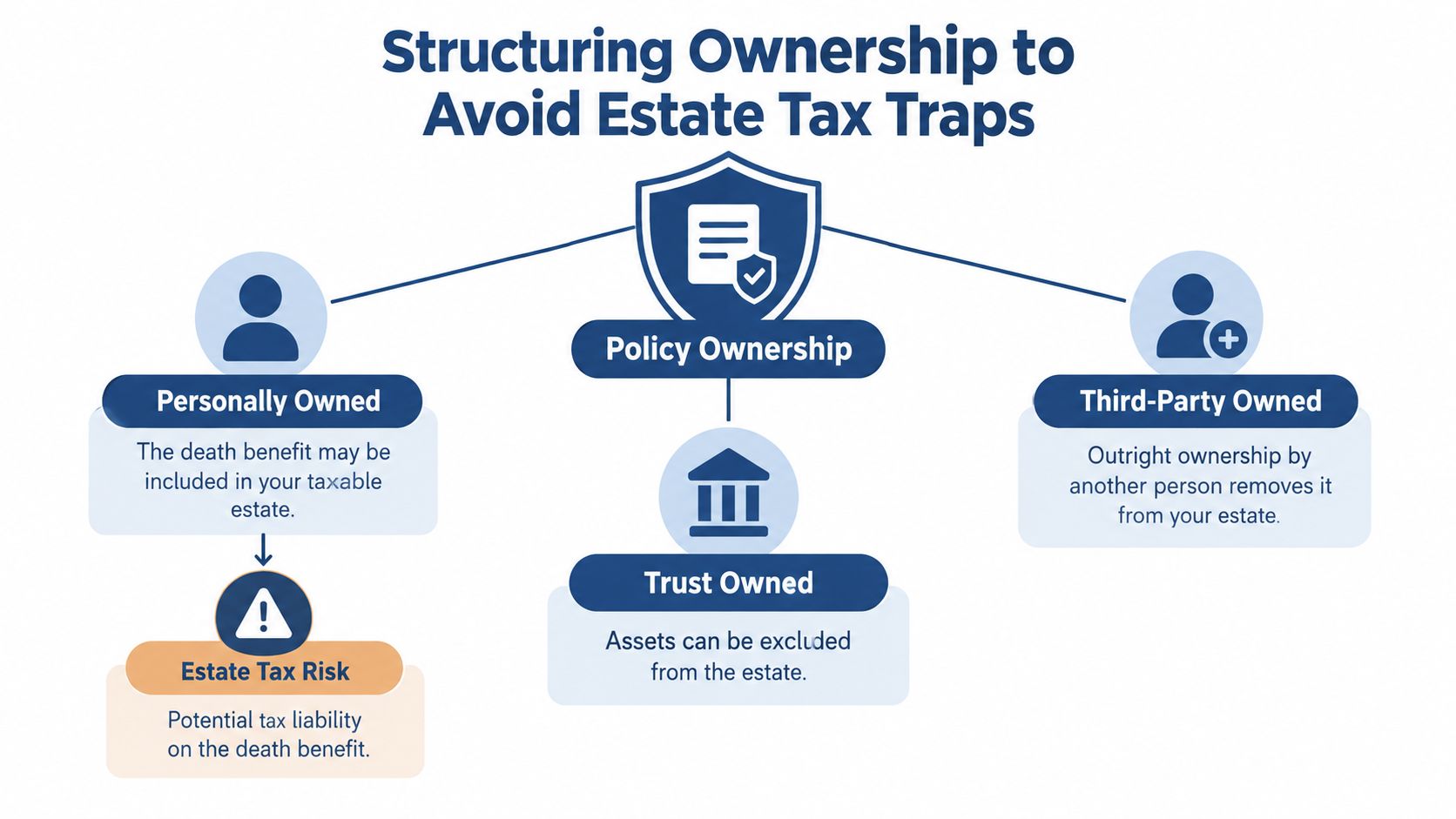
The beneficiary isn't the only person who matters. Ownership determines control, and control can determine estate-tax treatment.
Life insurance proceeds are generally income tax-free to the beneficiary, but if the insured owned the policy at death, the proceeds can still be included in the insured's taxable estate for federal estate-tax purposes. The issue isn't limited to who receives the money. It also includes who had the right to change beneficiaries, surrender the policy, borrow against cash value, assign the policy, or make other ownership decisions.
Those rights are commonly described as incidents of ownership. Keeping them personally can pull the death benefit into the estate even when a spouse, child, or other family member is the named beneficiary.
Federal and state exposure are different questions
In 2026, federal estate tax starts only above about $15 million per person, but several states impose much lower exemptions. Coverage of state and federal estate-planning thresholds identifies Oregon at $1 million, Massachusetts at $2 million, Washington at $3 million, and the District of Columbia at about $4.873 million.
That difference catches families who don't consider themselves wealthy. A residence, retirement assets, business interests, investment accounts, and life insurance can combine into an estate that faces state tax exposure even when federal tax isn't the immediate concern.
Compare the ownership structures
| Structure | Main feature | Estate-planning concern |
|---|---|---|
| Personally owned | You control the policy and usually name the beneficiary | The proceeds may be included in your taxable estate |
| Trust owned | An irrevocable trust owns and controls the policy | You give up personal control and must follow trust administration rules |
| Third-party owned | Another person or entity owns the policy | The arrangement must be reviewed for family, tax, and control consequences |
Naming a spouse or child as beneficiary doesn't by itself remove your ownership rights. A trust can help, but only if the trust owns and controls the policy and the insured hasn't retained prohibited control.
Your state also matters. Review the tax treatment of life insurance alongside your residence, property location, business interests, and domicile before deciding that federal exemption levels make planning unnecessary.
The decision isn't “trust or no trust” in the abstract. It's whether the policy should remain under your control, whether the death benefit needs to stay outside the taxable estate, and whether your family can operate the selected structure without creating administrative failures.
Implementing Irrevocable Life Insurance Trusts
An irrevocable life insurance trust, or ILIT, is useful when the policy needs to provide liquidity but shouldn't enlarge the insured's taxable estate. The trust, not the insured, owns and controls the policy. The trustee manages the policy, receives the death benefit, and distributes or lends funds according to the trust terms.
An ILIT isn't a form you sign and forget. It's an operating arrangement with strict ownership, trustee, gifting, notice, and premium-payment requirements.
Follow the ownership sequence
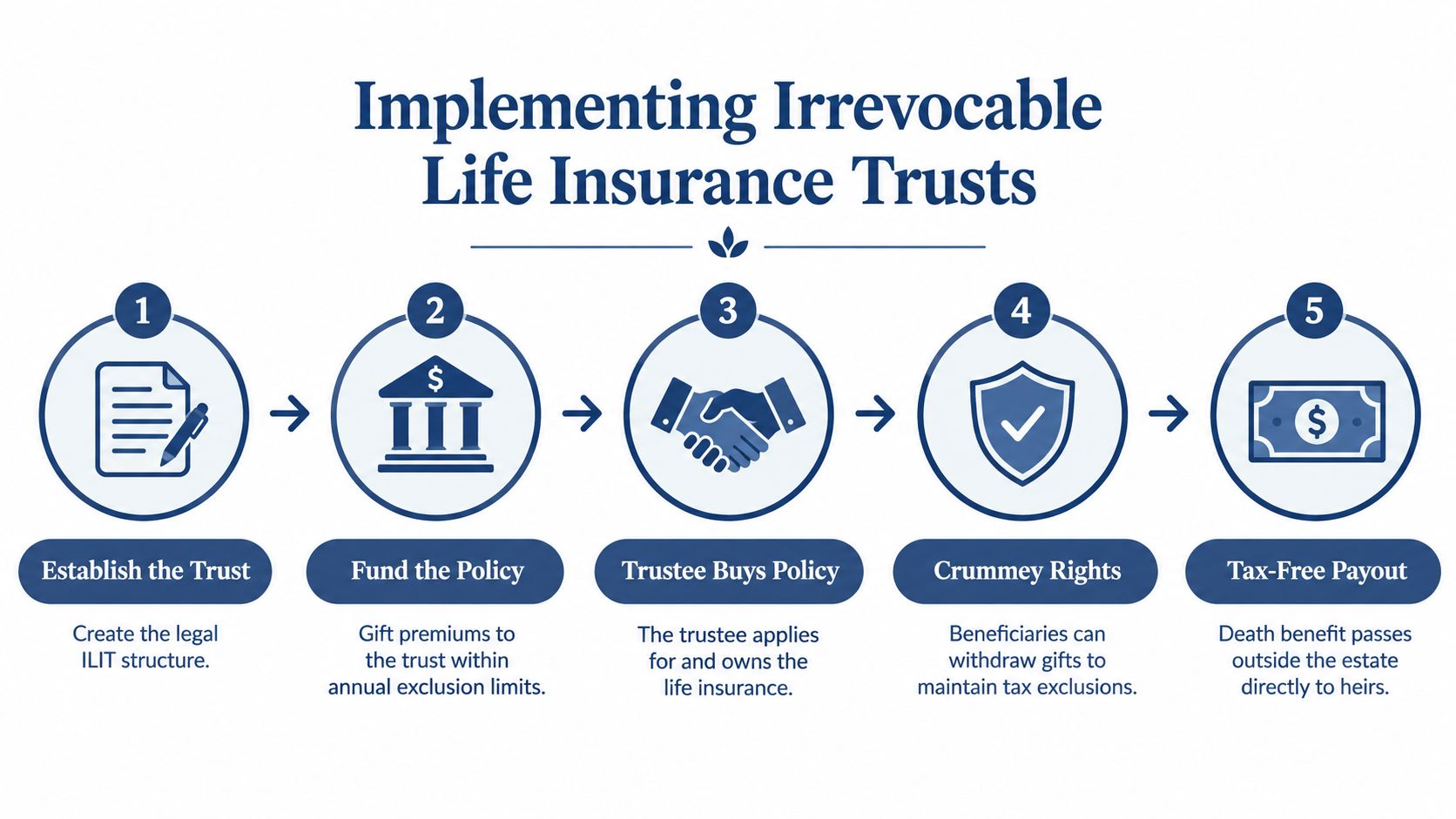
A sound implementation generally follows this order:
- Draft the irrevocable trust. The document should define beneficiaries, distribution standards, trustee powers, and how the death benefit can support estate expenses or family needs.
- Appoint an independent trustee. The insured can't serve as trustee or beneficiary of the ILIT. Choose someone capable of following the document rather than doing what the insured requests.
- Have the trust purchase the policy. This is usually cleaner than transferring an existing policy because the trust begins as owner and beneficiary.
- Gift cash to the trust for premiums. The trustee receives the cash and pays the insurer. Premium gifts must be handled according to the trust terms.
- Maintain the records. Keep contribution records, beneficiary notices, premium payments, policy statements, and trustee decisions together.
Avoid the three-year transfer problem
Transferring an existing policy can create a serious timing issue. If the insured dies within three years after moving an existing policy into the trust, the proceeds are generally pulled back into the taxable estate, as explained by the Financial Planning Association's discussion of ILIT implementation.
That's why advisors often prefer having the ILIT apply for and purchase a new policy outright. This approach avoids treating the trust as a late transfer and establishes the ownership structure from the beginning.
An existing policy may still be worth reviewing for transfer, but don't move it casually. The attorney should assess the policy's value, transfer consequences, health outlook, financing, and the effect of any outstanding loans before recommending a change.
Treat administration as part of the strategy
The trustee must receive premium gifts, provide beneficiaries with any withdrawal rights required by the trust, wait through the applicable notice process, and pay the insurer correctly. The insured should not direct the trustee's decisions or retain policy powers in an informal side agreement.
For a practical review of the broader tradeoffs, consult this resource on irrevocable trust benefits and risks from the Law Office of Bryan Fagan, Kingwood TX Lawyers. The legal details vary by jurisdiction, but the central point applies everywhere: irrevocability trades control for planning benefits.
Use a written administration checklist:
- Confirm the trustee, owner, and beneficiary records.
- Deposit gifts into the trust account.
- Send required notices to beneficiaries.
- Document the withdrawal period and any responses.
- Pay premiums directly from the trust account.
- Review the policy annually for performance and funding needs.
A trust that owns the policy but fails to follow its own procedures can create avoidable problems. Use this beneficiary designation guide to support the paperwork review, then have your attorney and trustee confirm that the designation matches the trust document.
Solving Liquidity Crunches and Equalizing Inheritances
Tax planning is only one reason to use life insurance. Families often need cash because their most valuable assets can't be divided neatly.
Consider a business owner with two children. One child works in the company and has the experience to continue operating it. The other child has no role in the business and reasonably expects a meaningful inheritance. Selling the company or splitting ownership may damage the business, while leaving the nonparticipating child with little may create lasting resentment.
Life insurance can provide a separate pool of cash for the child who isn't receiving the business interest. The business can remain intact, and the inheritance can reflect the family's actual assets rather than forcing a literal division of every holding.

The same issue appears with real estate. A family may own a farm, rental portfolio, or family home that one heir wants to retain while others prefer cash. A death benefit can help compensate the heirs who aren't receiving the property, provided the ownership and beneficiary structure support that result.
Match the policy to the obligation
The amount of insurance should reflect a defined need, not a round number selected during a sales conversation. Build the analysis around:
- Estate settlement costs: Cash may help the executor handle debts and other expenses without selling assets quickly.
- Tax exposure: If an estate faces federal or state estate tax, insurance can create liquidity for that liability.
- Business continuity: A policy can support a buy-sell arrangement or provide resources while ownership changes.
- Inheritance equalization: The proceeds can offset a business, property, or other indivisible asset.
- Family support: A trust can control distributions for minors, vulnerable beneficiaries, or other dependents.
The top federal estate-tax rate can reach 40%, so life insurance may create cash for estate taxes, debts, or equalization without forcing a sale of a family business or real estate, as described in this explanation of taxable life insurance proceeds.
The beneficiary should also understand whether the proceeds go directly to an heir, into a trust, to a business, or to an estate. Those choices affect control, timing, creditor exposure, and the way family members experience the transfer.
Use the following video as a discussion prompt with your advisor and family, not as a substitute for individualized legal or tax advice.
A good plan doesn't merely produce equal dollar amounts. It preserves the assets that create value, gives each heir a workable inheritance, and tells the trustee or executor exactly how to carry out the arrangement.
Coordinating Policies with Wills and Trust Documents
A policy can undermine an otherwise careful estate plan when its beneficiary form, ownership, or payment instructions tell a different story. Review it alongside your will, revocable trust, business agreements, marital agreement, powers of attorney, and family instructions.
Contradictions are common. A will may direct assets to a trust while the policy names an individual. A divorce decree may require coverage for a child while the beneficiary form still lists a former spouse. A revocable trust may contain detailed distribution terms, yet the policy may never name the trust.
Build one control map
Create an inventory showing each policy's owner, insured, beneficiaries, trustee, premium source, and intended purpose. Keep it with your estate documents. Then check whether every document supports the same family objective.
For an estate-tax exclusion strategy, the trust, not the insured, must control ownership and distribution. New York Life's overview of ILIT control points highlights beneficiary design, trustee independence, and premium-payment administration as safeguards that require careful coordination.
Use a review table like this:
| Document or record | Question to answer |
|---|---|
| Policy contract | Who owns the policy, and who can exercise its rights? |
| Beneficiary form | Does the designation produce the intended family outcome? |
| Will | Does it refer only to assets that pass through the estate? |
| Revocable trust | Should the policy pay the trust, or remain separate? |
| Business agreement | Does insurance funding match the ownership-transfer process? |
| Power of attorney | Can an authorized person manage policy matters if you lose capacity? |
Design for real family behavior
A sound document set still fails if relatives cannot find the records or understand who must act. Give the trustee and executor access to policy details, premium instructions, insurer contact information, and attorney records. Store them where the people responsible can reach them. Do not depend on one person's memory or a file hidden in a home office.
Families with older parents can use an estate planning guide for families 50+ as a starting checklist, then adapt it with their attorney and insurance professional. Discuss ownership, incapacity, beneficiaries, and document access before a crisis makes those decisions urgent.
Review the arrangement after marriage, divorce, a death, a new business agreement, a major property purchase, retirement, or a state move. Beneficiary forms do not update themselves when family circumstances change. You must revise them.
For more on the consequences of leaving insurance outside a broader plan, see life insurance without a will. Align the policy with your estate documents now, and the rest of the plan falls into place.
Evaluating Whether Your Current Coverage Is Still Needed
Buying another policy may be the wrong first move. Audit the coverage already in force, its ownership, beneficiaries, trust coordination, and the liquidity it is meant to provide.
Identify the original purpose. Was the policy designed to replace employment income, cover a mortgage, protect a business, fund a buy-sell agreement, pay final expenses, support a dependent, or create an inheritance? If that purpose has disappeared, reassess the contract before continuing premiums.
Recent coverage indicates that older policies may no longer be needed, while life settlement activity is rising as demographic patterns change. The 2026 succession and estate-planning survey coverage reinforces the case for reviewing whether existing coverage should be reduced, repurposed, or sold.
Compare the available decisions
| Choice | When it may fit | What to examine |
|---|---|---|
| Keep the policy | A clear liquidity or inheritance need remains | Premium affordability, policy strength, beneficiaries, and ownership |
| Reduce coverage | The obligation has declined but hasn't disappeared | Reduced benefit, new premiums, and future guarantees |
| Repurpose the policy | Cash value or permanent coverage may support another goal | Tax effects, loans, surrender value, and loss of protection |
| Sell the policy | The policy no longer fits and a qualified buyer may offer value | Eligibility, tax treatment, privacy, and impact on beneficiaries |
| Replace the policy | The existing contract is unsuitable or unstable | New underwriting, costs, guarantees, and the risk of a coverage gap |
Do not surrender a policy because the premium feels inconvenient. Request an in-force illustration, confirm cash value and loan balances, compare guaranteed with non-guaranteed values, and ask what happens if premiums stop. A lapse with an outstanding loan can create tax consequences, so have the insurer and tax advisor review the figures before any surrender or exchange.
Retirees and adults approaching Medicare eligibility should compare the policy's continuing estate purpose with other uses for the premiums. Working families may find a smaller policy with a defined final-expense or debt purpose more practical. Business owners must confirm that changing coverage will not violate a buy-sell agreement or leave a partner exposed.
The right policy is the one that solves a current problem at an acceptable cost.
Life insurance must earn its place in the estate plan. Audit the contract, ownership, beneficiaries, trust coordination, and liquidity need before adding coverage or canceling it.
My Policy Quote provides life insurance information and quote resources for reviewing existing coverage and considering options for estate liquidity, final expenses, and family protection. Visit My Policy Quote to compare current needs with available life insurance solutions before making a change.