
You're 55, self-employed, and your income doesn't arrive on a neat schedule. One month is strong, the next is quiet. You want life insurance that can stay in place for the long term, but the idea of being locked into the same premium every month makes you hesitate.
That's the situation universal life insurance is designed to address. It offers permanent coverage with adjustable premiums and a cash value account, but the flexibility can create a risk many sales explanations gloss over. If the policy isn't funded and monitored properly, it can lose its ability to support the coverage.
A Plain-English Look at Universal Life Insurance
Universal life insurance is permanent life insurance, meaning it's designed to remain in force for the insured's life, or according to the policy's maturity terms, as long as the policy requirements are met. Unlike term life insurance, it isn't limited to a selected coverage period. Unlike whole life insurance, it generally gives you more control over how much you pay and, within contract limits, how much coverage you carry.
For someone with uneven income, that control can be useful. You might pay more during a profitable year, reduce your payment during a difficult year, or potentially pause a payment if the policy's cash value and contractual requirements allow it. The policy also contains a cash value account that can accumulate on a tax-deferred basis.
A plain-language guide to different types of life insurance explained can help place universal life alongside term and whole life. The important distinction is that universal life isn't a savings account with insurance attached. Every premium is divided among policy charges, the cost of insurance, and the cash value.
The part buyers often miss
The cash value account has work to do. It may help cover future policy charges, support premium flexibility, or provide access to money through a loan or withdrawal if the contract permits it. But the account can also shrink when charges exceed new premiums and credited interest.
That's why two people with the same death benefit can have very different outcomes. One may fund the policy aggressively and review it regularly. Another may pay only the minimum shown in an early illustration, assume the policy will run forever, and discover much later that the cash value can no longer cover the charges.
The practical question isn't only whether universal life is flexible. It's whether the policy will still be adequately funded when the cost of insurance is higher and your working years are behind you.
The rest of the decision comes down to that distinction. Universal life can provide lasting protection and cash value potential, but it doesn't remove the need to understand how money moves through the policy.
How a Universal Life Policy Actually Works
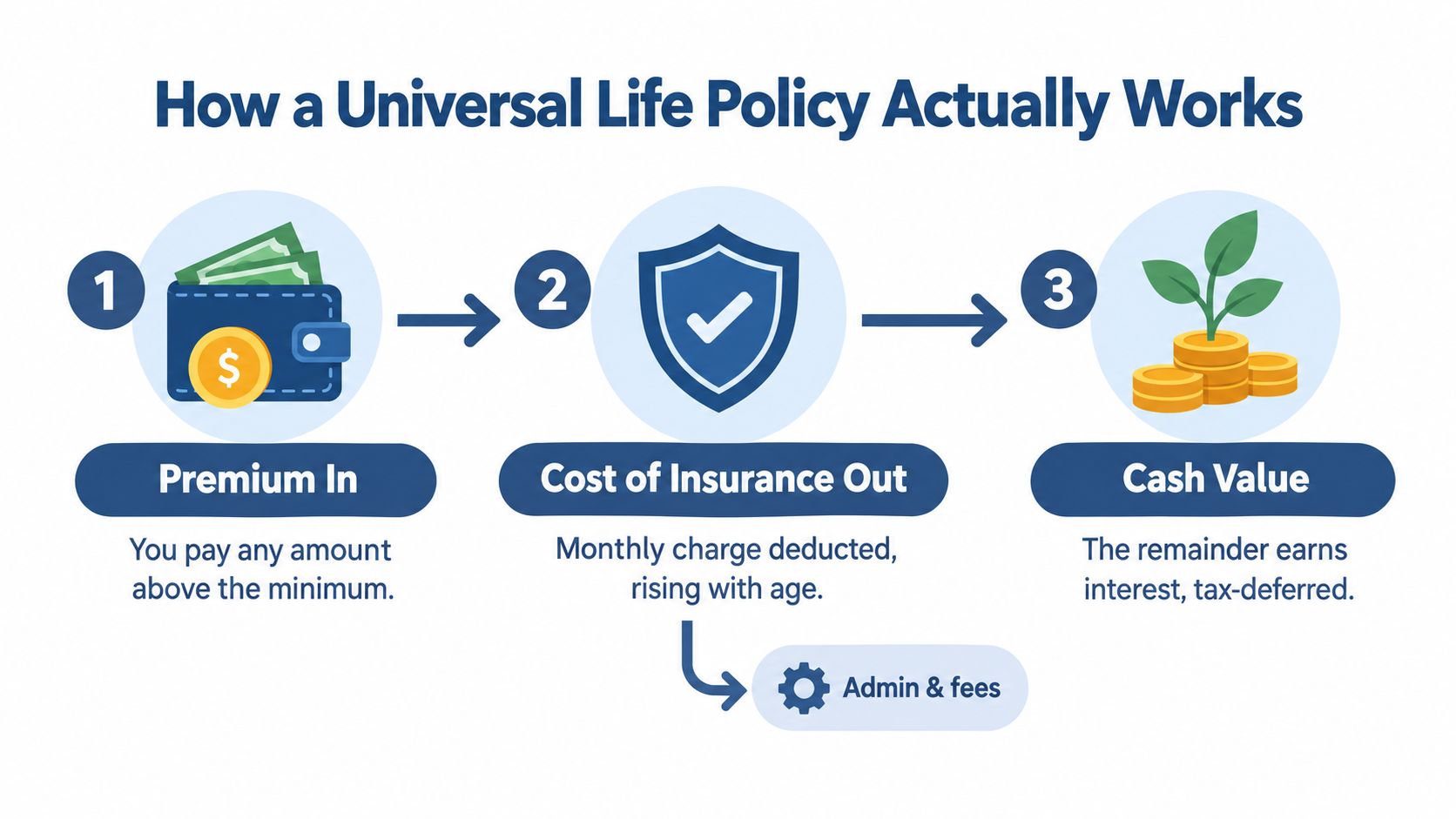
A useful way to understand universal life is to follow the money in three stages.
- Premiums come in. You pay an amount permitted by the policy. The amount may be adjustable, but there can still be minimum funding requirements, tax limits, and contract conditions.
- Policy charges come out. The insurer deducts the cost of insurance, administrative fees, and any applicable rider charges.
- The remainder supports cash value. After charges, the remaining amount is credited to the policy's cash value and may earn interest according to the policy design.
Follow one premium through the policy
Suppose you send the insurer one dollar. The entire dollar doesn't automatically become savings. The insurer first applies the policy's monthly deductions. Those deductions can include a cost of insurance charge, often calculated using a rate applied to the amount of insurance at risk, along with administrative expenses.
The remaining cents go to cash value. The insurer then credits interest based on the policy's fixed, indexed, or variable structure. If the policy has a level death benefit, the stated death benefit generally stays level unless you request and qualify for a change. A policy with an increasing death benefit follows different mechanics because the cash value can affect the amount paid to beneficiaries.
The cash value is therefore a moving account, not a guaranteed pile of premiums. Interest can add value, while insurance charges, fees, withdrawals, and loans can reduce it. Cornell Law's summary of universal life insurance structure notes that the investment account typically doesn't guarantee a fixed return or even a fixed death benefit, while coverage can continue as long as the policy requirements are satisfied.
For variable designs, the cash value may rise or fall with selected investment subaccounts. For indexed designs, interest credits may be connected to an index formula rather than direct ownership of the index. In both cases, the policy's charges continue regardless of whether the cash value has a strong year.
A video explanation can help visual learners see how premiums, charges, and cash value interact.
The policyholder gains funding control, but that control comes with responsibility. Paying less today can leave fewer dollars available for future charges. Paying more may strengthen the policy, subject to the contract and applicable tax rules. The policy's ability to stay alive in year 30 depends on those choices, not on the fact that it was issued as permanent insurance.
Universal Life vs Term and Whole Life
The three main policy types solve different problems. Term life is generally suited to a temporary need, such as replacing a parent's income while children depend on it. Whole life is built around fixed premiums, permanent coverage, and a more structured cash value design. Universal life sits between those approaches, offering permanent coverage with more adjustable funding and greater monitoring requirements.
| Feature | Term Life | Whole Life | Universal Life |
|---|---|---|---|
| Coverage period | Selected term, not necessarily lifelong | Permanent, subject to policy terms | Designed for permanent coverage, subject to funding and policy terms |
| Premium predictability | Usually fixed during the selected term | Generally fixed under the contract | Adjustable, but reducing payments can affect policy durability |
| Cash value | Typically no cash value | Cash value accumulates under the policy design | Cash value accumulates after charges and may support flexibility |
| Access to value | Not generally available as a policy feature | Loans or withdrawals may be available | Loans or withdrawals may be available, with possible effects on coverage |
| Management need | Lower after purchase if needs remain unchanged | More structured | Higher, because funding and assumptions need review |
| Typical decision | Temporary income replacement | Structured lifelong protection | Flexible permanent coverage for a buyer willing to monitor it |
A family with young children may prefer term because the primary need lasts through a defined responsibility period. A business owner arranging buy-sell or key-person protection may need coverage that lasts longer, but the appropriate design depends on the business agreement and funding plan.
A pre-retiree planning for estate liquidity may value permanent coverage. That doesn't automatically make universal life the right choice. The buyer still needs to decide whether adjustable premiums are more valuable than the predictability of whole life, and whether they're prepared to review the policy over time.
The comparison of whole life insurance and term life insurance offers useful context for the two alternatives. Universal life adds another choice, but also another layer of responsibility.
Choose term when the need is temporary, whole life when contractual predictability matters most, and universal life when flexibility solves a real cash-flow or planning problem.
The Main Variants of Universal Life
Universal life isn't one uniform product. The crediting method changes the policy's risk, potential growth, and monitoring demands. A $200 monthly premium can produce very different long-term results depending on the policy's charges, death benefit, funding schedule, and crediting engine. Without a carrier illustration and contract terms, it isn't possible to state what that premium will become at year 20 or year 30.
Guaranteed universal life
Guaranteed universal life, often called GUL, focuses on the death benefit rather than cash value accumulation. The contract may provide a scheduled premium and a death benefit guarantee if required premiums are paid according to the policy terms.
This design can suit a buyer who wants permanent or long-duration protection and has limited interest in market-linked cash value. The trade-off is less emphasis on accumulation and less flexibility if premiums are missed or changed.
Fixed universal life
Fixed universal life credits interest at a rate declared by the insurer, subject to the contract's provisions and any applicable minimum guarantee. It can appeal to a risk-averse buyer who wants cash value growth without direct exposure to investment subaccounts.
The declared rate can change. That means a current illustration isn't the same as a contractual promise. Policy charges can also reduce the account even when interest is credited.
Indexed universal life
Indexed universal life, or IUL, uses a formula tied to an external index for interest-crediting purposes. The policy doesn't usually buy the index directly. Instead, the insurer applies terms such as a participation rate, cap, floor, and spread.
For a simplified point-to-point example, an IUL might use an S&P 500 calculation with a 10% cap and a 0% floor. If the index calculation produces a result above the cap, the credited amount may be limited by the cap. If the result is negative, the floor may prevent a negative index credit, although policy charges can still reduce cash value.
The cap and floor don't eliminate policy risk. They only describe one part of the crediting formula. The cost of insurance, administrative deductions, withdrawals, loans, and premium choices still influence whether the policy remains in force.
Variable universal life
Variable universal life, or VUL, places cash value in separate investment subaccounts selected by the policyholder. These subaccounts can provide greater upside potential, but the account can also lose value when investments perform poorly. The policyholder carries more investment responsibility and must account for the possibility that poor returns coincide with rising policy charges.
The overview of variable life insurance provides additional background on how variable designs differ from other permanent policies.
| Variant | How Cash Value Grows | Upside Potential | Downside Floor | Best Fit |
|---|---|---|---|---|
| Guaranteed UL | Primarily through the contract's guarantee structure | Limited accumulation emphasis | Contractual guarantee if conditions are met | Buyer prioritizing scheduled protection |
| Fixed UL | Insurer-declared interest | Moderate, depending on declared rates | Contract terms may include a minimum rate | Buyer seeking a steadier cash value approach |
| Indexed UL | Formula linked to an external index | Higher than a purely fixed approach in favorable crediting periods | Index floor may limit negative index credit, but charges remain | Buyer comfortable with formula-based complexity |
| Variable UL | Selected investment subaccounts | Highest market-linked potential among these designs | Cash value can fall with investment performance | Buyer able to accept investment risk and monitor results |
The same premium amount doesn't make these policies interchangeable. The variant determines how the account behaves, but the policy design determines whether the account can support the death benefit over time.
Lapse Risk and What Underfunding Really Means
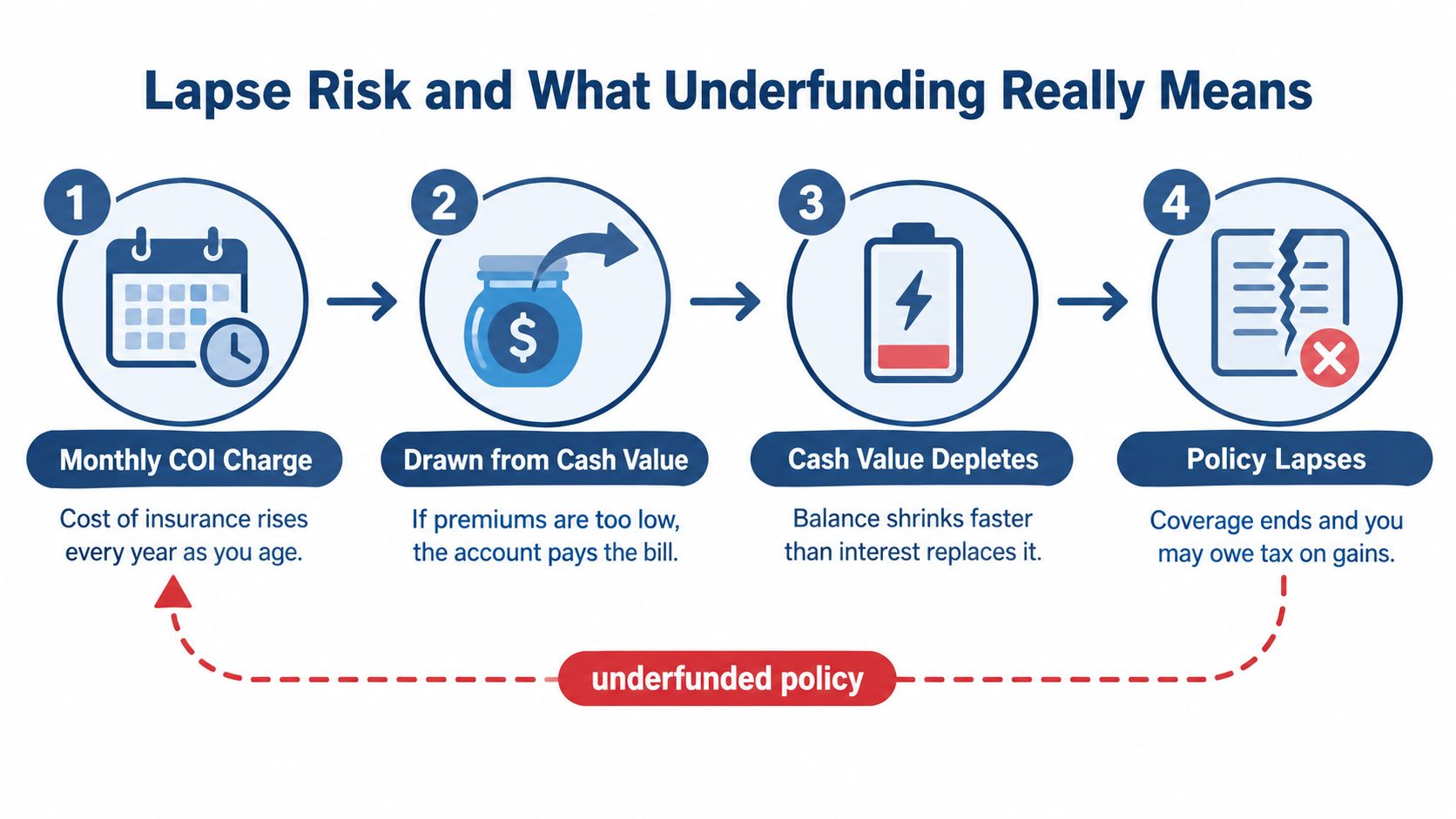
The most important risk in universal life is simple: the policy can lapse if its available value or required premium no longer covers its charges. The cost of insurance generally rises as the insured gets older, and the insurer deducts that cost from premiums or cash value according to the contract.
A policy can look healthy in its early years while still being underfunded for later years. If interest credits come in below the illustrated assumption, or if the owner pays only the minimum, the account may grow more slowly than expected. Later, higher insurance charges can draw it down faster.
An illustration is not a funding guarantee
Consider a hypothetical $500,000 guaranteed universal life policy illustrated at 4%, while the policy credits 3% instead. The lower crediting rate can leave less cash value available than the illustration projected. Whether the policy remains in force depends on the actual contract, guarantee provisions, premium schedule, charges, and any changes made by the policyholder.
Now compare that with a policy funded at the maximum permitted premium from the beginning. Higher funding may create a larger cushion, but it still doesn't turn the policy into an unconditional guarantee. Loans, withdrawals, fees, changing charges, and contract limits can alter the outcome.
The distinction matters because a policy can be illustrated to last for a long period without being funded to withstand less favorable experience. A projection shows an assumed path. It doesn't promise that the carrier will credit the assumed rate or that the owner will continue the assumed premium.
Why later policy years deserve attention
Early cash value growth can create false confidence. The account may appear to be building while the cost of insurance remains manageable. In later years, rising charges and weaker-than-illustrated credits can put more pressure on the balance.
Published persistency research reports individual life voluntary termination of 6.6% in 2024 and UL lapse experience around 4.3%, while the Society of Actuaries and LIMRA continue collecting universal life lapse and surrender data for 2022 through 2025. These figures and the ongoing research show why policy persistence remains an active industry concern, not a minor technical detail. See the SOA and LIMRA universal life lapse and surrender study.
Reviewing what happens if you stop paying life insurance can clarify the consequences before a missed payment becomes a coverage problem.
Flexibility is valuable only when you know the minimum funding needed to preserve coverage and revisit that calculation as the policy changes.
Honest Pros and Cons to Weigh
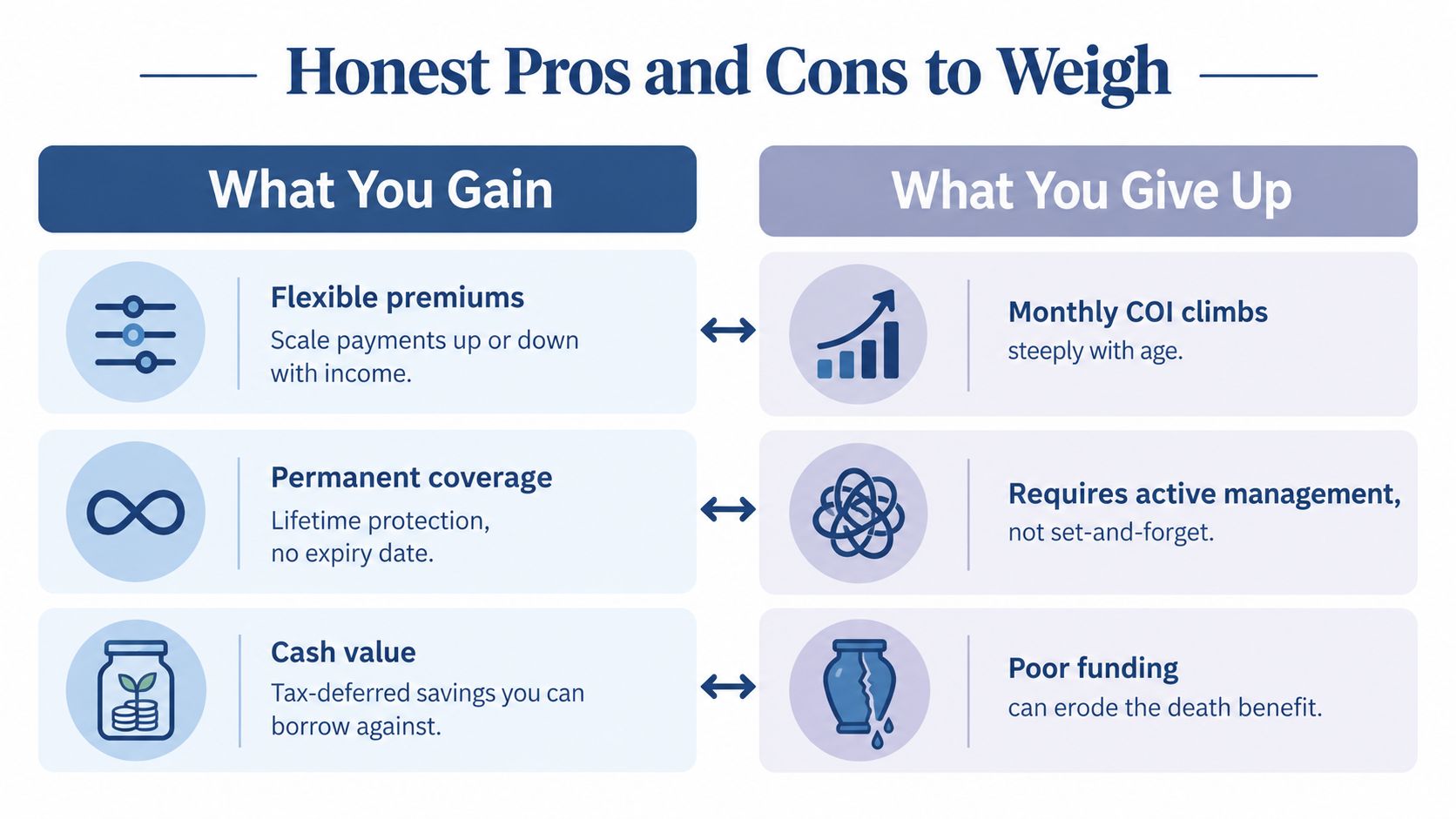
Universal life can solve a genuine planning problem, but every advantage has a corresponding cost. The adjustable premium that helps a self-employed buyer manage irregular income can also reduce the cash value available for future charges.
Flexibility versus stability
A self-employed professional may value the ability to increase contributions after a strong contract year and reduce them when revenue falls. That flexibility can keep coverage aligned with real cash flow. The price is that lower funding can weaken the account and shorten the projected duration of coverage.
Permanent coverage can support estate liquidity, charitable planning, or a surviving spouse's long-term needs. The matching concern is cost. Permanent insurance generally costs more than term insurance for the same face amount in the early years because it combines longer-duration protection with a cash value feature.
Cash value may be available for policy loans or withdrawals, depending on the contract. That can help with a business need or a large personal expense, but access can reduce the death benefit, increase lapse risk, or create tax consequences if the policy later terminates.
Growth potential versus predictability
Indexed and variable designs can offer more market-linked potential than a basic fixed structure. They also introduce formulas, investment choices, caps, floors, fees, and assumptions that a hands-off owner may not understand or monitor.
The policy may include surrender charges, especially during the early contract period. Those charges can make it costly to exit, replace, or reduce coverage before the policy has had time to develop value.
| What you gain | What you give up |
|---|---|
| Payment flexibility for uneven income | A lower payment can weaken long-term funding |
| Permanent protection potential | Higher cost than temporary term coverage |
| Cash value access | Loans and withdrawals can affect coverage |
| Market-linked crediting options | More assumptions and investment exposure |
| Adjustable planning structure | Ongoing reviews and contract expertise |
The right question isn't whether the pros outweigh the cons in the abstract. Ask whether the feature you want is worth the obligation it creates. A flexible policy may be appropriate for an owner who reviews it. It may be unsuitable for someone who wants to buy once and never revisit the contract.
Who Universal Life Really Makes Sense For
Universal life works best when it answers a specific long-term need. It shouldn't be chosen merely because an illustration shows cash value or because the word “permanent” sounds reassuring.
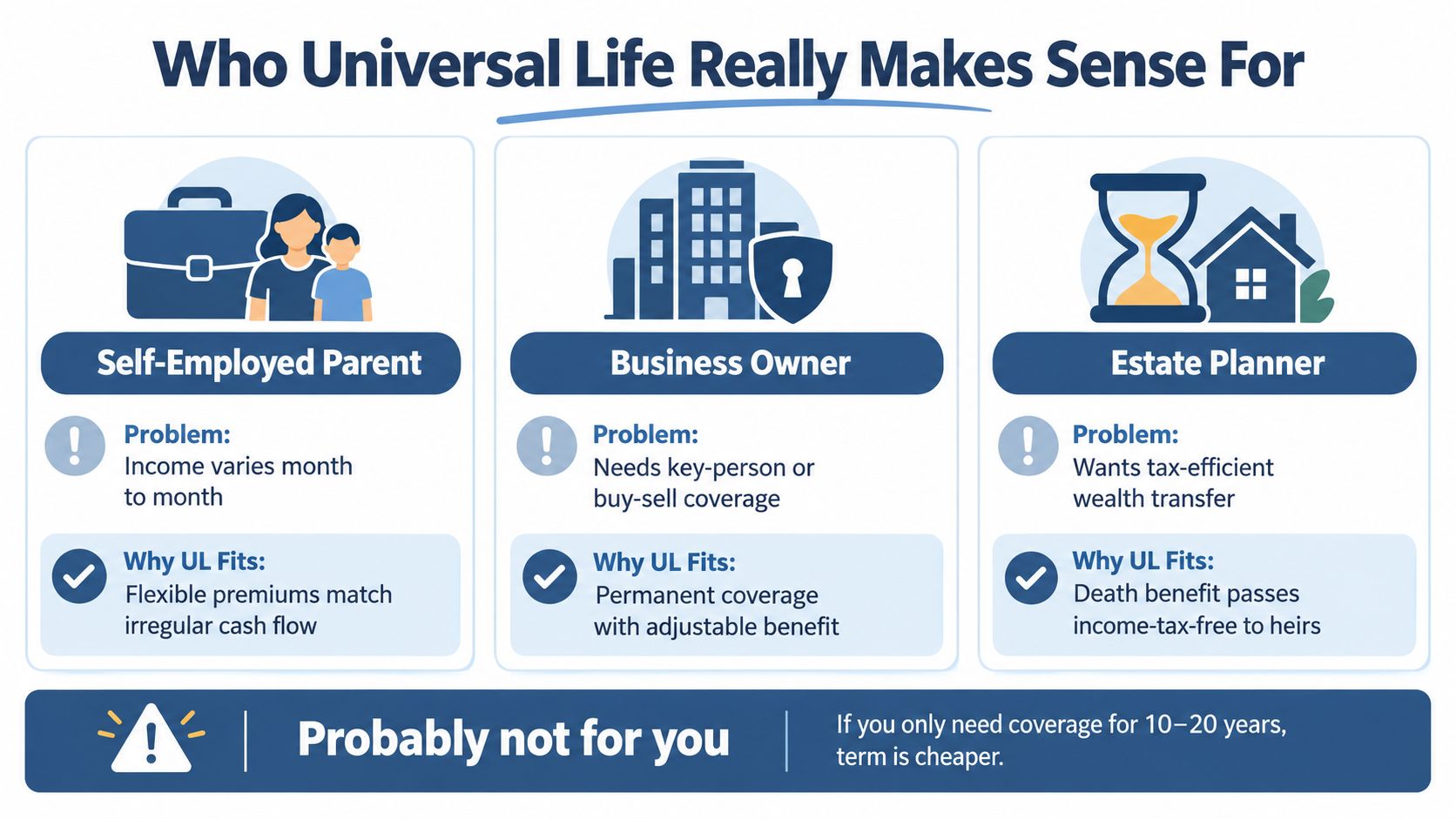
The self-employed parent
A 1099 consultant with uneven revenue may need coverage beyond the years when children are financially dependent. A flexible-premium policy can accommodate irregular cash flow, provided the owner understands the minimum funding needed to keep the policy active.
A guaranteed universal life design may fit when lifetime protection matters more than cash value growth. An indexed design may be considered only if the buyer understands its crediting formula and is prepared to review the policy.
The business owner
A small-business owner may need key-person coverage, buy-sell funding, or a benefit for a particular executive. The policy has to match the legal agreement, ownership arrangement, beneficiary structure, and funding responsibility. Universal life can offer an adjustable death benefit or premium structure, but the business shouldn't rely on an illustration without testing the funding plan.
For insurance professionals helping clients evaluate these choices, an insurance agents solution from Recepta.ai may provide additional operational context. The product choice still requires licensed advice and a review of the actual policy contract.
The pre-retiree or estate planner
A couple nearing retirement may want coverage for a surviving spouse or estate expenses. Guaranteed UL may appeal to buyers prioritizing certainty. Indexed or variable UL may suit a narrower group that accepts more complexity and market-related risk in pursuit of accumulation potential.
Universal life is usually a poor fit when the need is short-term, the budget is already strained, or the buyer won't review in-force illustrations. A family seeking income replacement while children are young may find term insurance more direct. A person who wants predictable premiums and doesn't want to manage assumptions may prefer whole life.
Questions to Ask Before You Sign
Bring a written list to the advisor meeting. A clear answer should connect the policy's premium, charges, cash value, guarantees, and projected duration. If the explanation depends only on a colorful illustration, ask for the underlying contract terms.
Policy mechanics
Ask:
- Interest crediting: How does this policy credit interest, and which rate is current rather than guaranteed?
- Cost of insurance: What is the current COI rate, how is it calculated, and can it change?
- Charges: Which administrative, rider, surrender, and transaction charges reduce value?
- Death benefit: Is the benefit level or increasing, and what changes if I lower the premium?
Request the complete policy illustration and an explanation of the current charge schedule.
Funding reality
Ask the advisor to show the premium needed to keep the policy in force to age 95 or 100 under the current illustrated rate. Then ask what happens if you pay only the planned minimum, reduce payments during a weak business year, or take a policy loan.
Request an in-force illustration, not only a sales illustration. If you already own the policy, the in-force document should use current policy values and assumptions rather than starting from a clean application.
Guarantees and downside testing
Separate contractual values from projected values. Ask which death benefit, cash value, premium, and lapse outcome are guaranteed, and under exactly what conditions.
Request:
- A lower-rate illustration: Show the policy with a lower credited rate than the current assumption.
- A minimum-rate illustration: Show the outcome if the carrier credits the minimum guaranteed rate for the next twenty years.
- A policy loan disclosure: Explain loan interest, direct or non-direct recognition, and the effect on lapse risk.
- A carrier financial-strength review: Request the carrier's current A.M. Best rating and the date of the rating.
Exit strategy
Ask what happens if you stop paying, lower the death benefit, surrender the policy, or replace it. Request the surrender-charge schedule year by year and ask whether a replacement would restart contestability, underwriting, or early-period charges.
The single most important question is this:
“Please show me what happens if the carrier credits only the minimum guaranteed rate for the next twenty years, and I follow the proposed premium schedule.”
If the policy still meets your goal under that test, you understand its resilience. If it doesn't, you need to decide whether the additional funding, a different variant, or a simpler policy makes more sense.
My Policy Quote offers life insurance quote services and broker-guided comparisons that can help you review term and permanent options, including universal life, against your coverage needs and underwriting assumptions. Before choosing a policy, visit My Policy Quote to compare options and prepare the questions you'll take to a licensed advisor.