

A healthy buyer in this age range will usually pay about the mid-$30s to the low-$60s per month for $10,000 of coverage if female, and roughly the low-$40s to the mid-$70s if male. That settles the first question. Burial insurance for seniors over 60 is usually affordable enough to buy, but only if you buy the right amount for the funeral plan you want.
Who start looking at this coverage are in one of two situations. Either they've watched a parent die without a plan and saw the family scramble for cash, or they've reached the point where they don't want their kids guessing what to do and how to pay for it. That's the issue. Not “Which company has the cheapest premium?” but “What bill am I trying to solve?”
That distinction matters because a direct cremation and a traditional burial are not even close to the same financial problem. A lot of seniors buy too much coverage because they assume they need a generic round number. Plenty of others buy too little because they want a burial, but forget to include cemetery and service costs. I think that's backward. Pick the disposition method first. Then insure the gap.
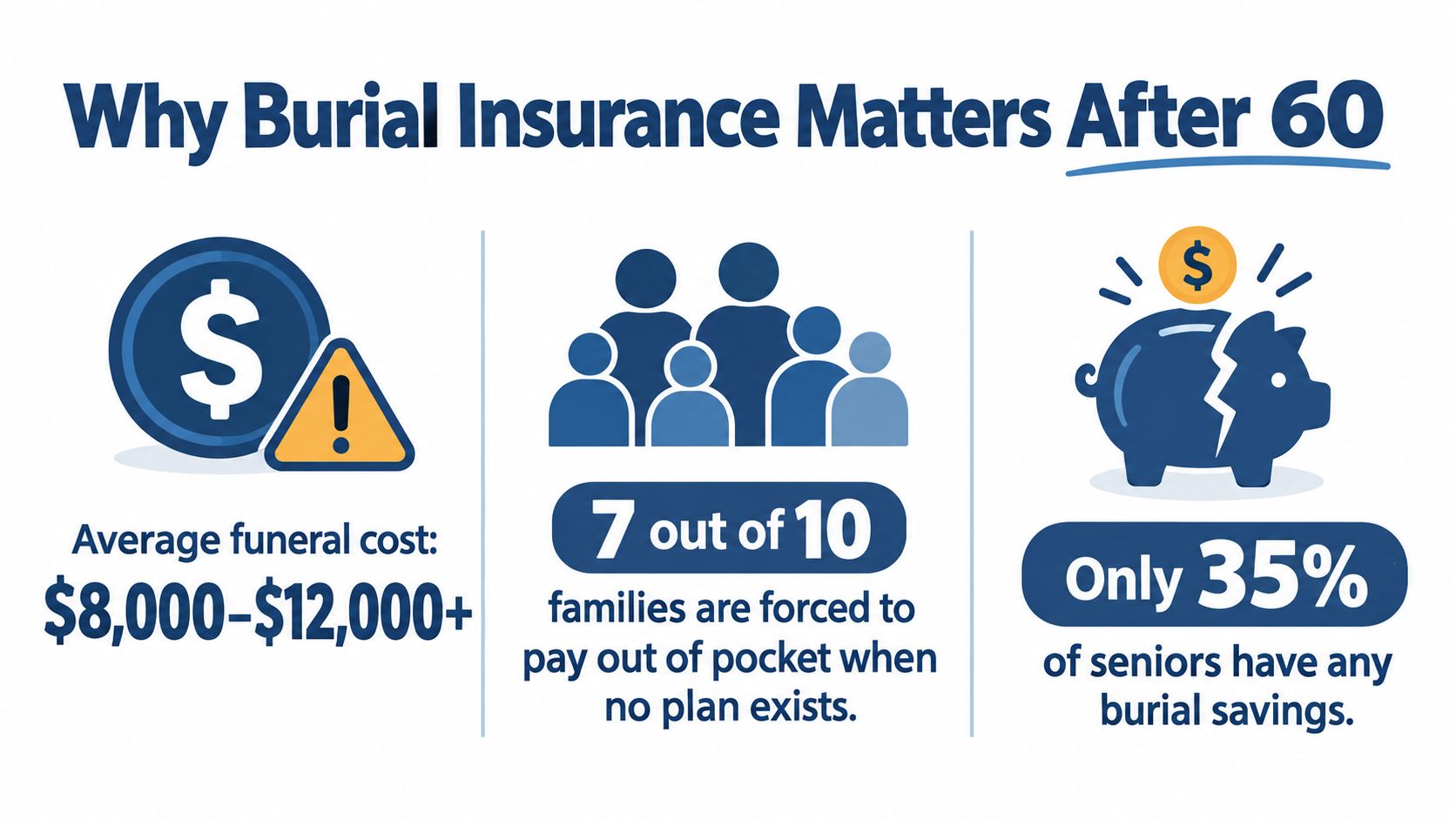
Why Burial Insurance Matters After 60
The reason people buy burial insurance after 60 is simple. They don't want family members pulling money from checking accounts, credit cards, or emergency savings to handle a funeral.
Funeral costs are real, and they're not small. International comparisons found the average cost of dying can equal about 10% of annual salary globally, with examples ranging from about £5,858 in the U.S. to £6,246 in Germany and about £22,320 in Japan. In one comparison, Japan's funeral cost equaled 68.3% of average salary, while the U.S. and Germany were 45.4% and 16.4% respectively. In the U.S., one comparison cited traditional funeral costs at about $6,642 nationally and $6,135 in California (SunLife funeral cost comparison).
The cost question isn't the hard part
For many healthy applicants, the premium is manageable. For $10,000 of final-expense coverage, benchmark rates for ages 60 to 64 are commonly around the mid-$30s to low-$60s monthly for healthy nonsmoking women and the low-$40s to mid-$70s for healthy nonsmoking men (benchmark final expense rates).
That's why I tell people to stop obsessing over a difference of a few dollars a month before they've answered the bigger planning questions.
Three questions to answer before you shop
Burial or cremation
If you haven't decided this yet, you don't know how much coverage you need.Full bill or just the gap
Some families already have savings set aside. Others have nothing earmarked. Your policy should cover the shortfall, not an arbitrary number.What does your health look like
Don't assume you need guaranteed issue just because you take medication. Plenty of applicants in their 60s still qualify for better-value coverage.
Practical rule: Buy burial insurance to solve a known expense, not to win a premium-shopping contest.
There's also a demand reason behind all this. Life-insurance application activity has risen sharply among older buyers, with one U.S. industry report showing activity up 34.4% among ages 60 to 69 and 53.9% among ages 70+ in one month, while year-to-date activity remained up 30% and 48% respectively (older-age application activity report). That lines up with what advisors already know. The older people get, the less theoretical final expenses become.
What Burial Insurance Actually Is
Burial insurance and final expense insurance are basically the same thing in the senior market. It's usually a small permanent life insurance policy meant to cover funeral costs, cremation, burial, and other end-of-life bills.
Many over 60 who buy this product are not buying large estate-planning coverage. They're buying a policy built to be approved quickly, stay in force for life, and create a cash benefit a loved one can use when the time comes.
The default product most seniors see
For buyers over 60, the standard version is usually simplified-issue whole life. That means there's typically no medical exam. Instead, the carrier looks at age, tobacco status, gender, a short health questionnaire, and commonly prescription history plus MIB records. Medically stable applicants in their 60s can often qualify for immediate full-benefit coverage instead of a graded death benefit (simplified-issue burial insurance overview).
A lot of people confuse “no exam” with “guaranteed approval.” That's wrong. No exam just means no paramedical visit. You still have to clear the health questions unless you're applying for guaranteed issue.
Burial insurance pays the beneficiary you name. It does not automatically pay the funeral home.
That matters. The money can be used for the service, transport, obituary, clergy, flowers, last medical bills, or just to give the family breathing room.
How it compares to other life insurance
| Feature | Burial / Final Expense | Term Life | Traditional Whole Life |
|---|---|---|---|
| Main purpose | Final bills and small permanent needs | Temporary protection | Larger permanent protection |
| Length of coverage | Lifetime if premiums are paid | Ends after the term | Lifetime if premiums are paid |
| Underwriting | Usually simplified issue or guaranteed issue | Often health-based | Full underwriting is common |
| Medical exam | Usually not required | May be required | Often required |
| Typical fit after 60 | Strong fit for funeral funding | Limited fit for many seniors | Better for larger needs and stronger health |
| Benefit payout | To named beneficiary | To named beneficiary | To named beneficiary |
If you want a deeper definition of the product itself, this explanation of what final expense insurance is covers the basics well.
Why term usually loses here
Term life still has uses after 60, especially if someone has a temporary debt or wants a larger death benefit for a short window. But for pure burial funding, term is often the wrong tool. It expires. Burial costs don't.
Traditional fully underwritten whole life can price better per thousand of coverage, but many seniors shopping for burial insurance aren't trying to go through full underwriting for a modest face amount. They want something simpler and faster.
Policy Types You Will Encounter
Once you start applying, you'll usually land in one of three buckets. This isn't complicated, but a lot of articles make it sound that way.
Simplified issue
This is the one that usually wins if your health is decent. No medical exam. A handful of knockout questions. If you qualify, the full death benefit is typically available from day one after issue.
This is the best value for many people between 60 and 75 because you get immediate coverage without paying guaranteed-issue pricing. Controlled blood pressure, cholesterol, and many routine medications do not automatically push you out of this category.
Guaranteed issue
Guaranteed issue accepts everyone within the age band offered by the carrier. No health questions. No exam. That sounds great until you look at the trade-offs.
Recent guidance for seniors over 60 notes that guaranteed issue usually costs 30% to 50% more and typically carries a 2 to 3 year waiting period, while simplified issue commonly asks about hospitalization history, oxygen use, heart attack or stroke history, recent cancer, and dialysis (senior burial insurance underwriting guide).
If you die from natural causes during that waiting period, the full face amount usually doesn't pay. That's the price of guaranteed acceptance.
Graded benefit
Graded benefit sits in the middle. These policies are often used for applicants with some health flags who don't qualify for clean day-one simplified issue, but still have options better than straight guaranteed issue.
The structure varies by carrier, which is why you have to read the illustration and policy summary carefully. Some graded products phase into the full death benefit over time. That can still be a useful compromise if your health isn't perfect but you're not in the guaranteed-issue-only bucket.
| Dimension | Simplified Issue | Guaranteed Issue | Graded Benefit |
|---|---|---|---|
| Medical exam | No | No | No |
| Health questions | Yes | No | Usually yes |
| Day-one full benefit | Often yes | Usually no for natural causes | Often limited early |
| Monthly cost | Lower | Higher | Middle |
| Best fit | Manageable health, wants value | Serious health issues or likely decline | Borderline health cases |
| Main downside | You can be declined | Waiting period and higher cost | Early benefit limits can be confusing |
The blunt recommendation
If you can pass simplified issue, take it.
If your health history includes recent major issues and a decline is likely, stop chasing the “cheap” policy you probably won't get approved for and look at guaranteed issue or a graded product. A clean recommendation beats a fantasy quote every time.
Realistic Premium Ranges by Age and Health
This is the section people want, but I'm going to be candid. Exact pricing always depends on the carrier, state, age, tobacco use, and health answers. The most reliable hard benchmark available here is the $10,000 face amount for ages 60 to 64 already covered earlier. Beyond that, the right way to think about premium is by direction, not false precision.
What changes the premium most
Four factors drive most of the price:
- Age: The older you are when you apply, the higher the starting premium.
- Gender: Women generally price lower than men for the same face amount.
- Tobacco use: Tobacco usually pushes you into a more expensive class fast.
- Underwriting tier: Simplified issue usually beats guaranteed issue on cost if you can qualify.
Sample monthly premium positioning
| Age Band | Preferred Health | Standard Health | Guaranteed Issue |
|---|---|---|---|
| 60 to 69 | Lowest pricing in this market segment | Moderate increase from preferred | Highest cost for this age band |
| 70 to 79 | Higher than 60 to 69 | Higher again depending on answers | Often heavily considered if health worsens |
| 80+ | Fewer strong-value options | Limited carrier appetite | Often the fallback product |
That table is qualitative on purpose. Anything more specific without real carrier quotes turns into guesswork, and guesswork is how people buy the wrong policy.
Two buyer profiles that matter
A healthy non-smoker in the mid-60s usually has the broadest menu. That buyer often fits squarely into simplified issue and can still get sensible pricing for a modest face amount.
A buyer in the late 70s taking routine medication is a different story. That doesn't automatically mean guaranteed issue, especially if the condition is stable, but carrier fit becomes more important and approval windows get narrower.
The monthly premium matters. The approval category matters more.
If you're trying to estimate where you fit, don't compare yourself to a single advertisement. Compare yourself to the underwriting lane you're likely to fall into. A basic primer on how much life insurance costs can help frame the broader pricing logic.
One mistake I see constantly
People assume rates “go up every year” after they buy. That's not how these policies usually work. With whole life final-expense coverage, the point is level premium. The price is based on your age when you apply, then it generally stays level as long as the policy stays in force.
That's why waiting hurts. You're not just aging into a higher starting rate. You may also age into a weaker underwriting lane.
How Much Coverage You Actually Need
Most burial insurance articles fail. They jump straight to face amount suggestions without forcing the buyer to choose the funeral method first.
That's backwards.
Recent funeral data puts a traditional funeral with burial and viewing around $7,736 to $8,300, while direct cremation runs roughly $1,500 to $2,500, or about $1,834 nationally. The same analysis notes that cremation is projected to rise to 63.4% in 2026. It also warns that cemetery costs can push total burial needs to $11,000 to $15,000+ in some estimates (national funeral cost analysis).
Start with disposition, not the policy
If you want direct cremation, a small policy may be plenty.
If you want burial, service, cemetery, and related items, that same small policy may leave your family short.
That's why “How much burial insurance should I buy?” is the wrong first question. Ask this instead: “What exact arrangement do I want, and how much of that bill is already covered by savings?”
A practical sizing framework
Choose the method
Burial, direct cremation, or a cremation with memorial service.List what isn't optional
Cemetery expenses matter only for burial. Service-related costs matter if the family wants a viewing or ceremony.Subtract what's already available
Existing savings, prepaid arrangements, or family funds reduce the insurance gap.Insure the remainder
That's the face amount target.
| Expense Category | Low Estimate | High Estimate | Typical Policy Coverage |
|---|---|---|---|
| Direct cremation | $1,500 | $2,500 | Often coverable with a smaller final-expense policy |
| Traditional funeral with burial and viewing | $7,736 | $8,300 | Often needs careful sizing |
| Burial need including cemetery-related costs | $11,000 | $15,000+ | Can exceed the amount many buyers casually choose |
Where buyers usually miss
They overinsure for cremation or underinsure for burial.
If you're planning cremation, buying more coverage than the actual shortfall just because someone told you “everyone needs $15,000” doesn't make sense. If you want a full burial and have not priced the cemetery component, buying a low face amount because the premium feels comfortable can create the exact family burden you were trying to prevent.
Use a calculator only after you've made the funeral decision. This guide on how to calculate life insurance need is useful if you want a structured way to think through the gap.
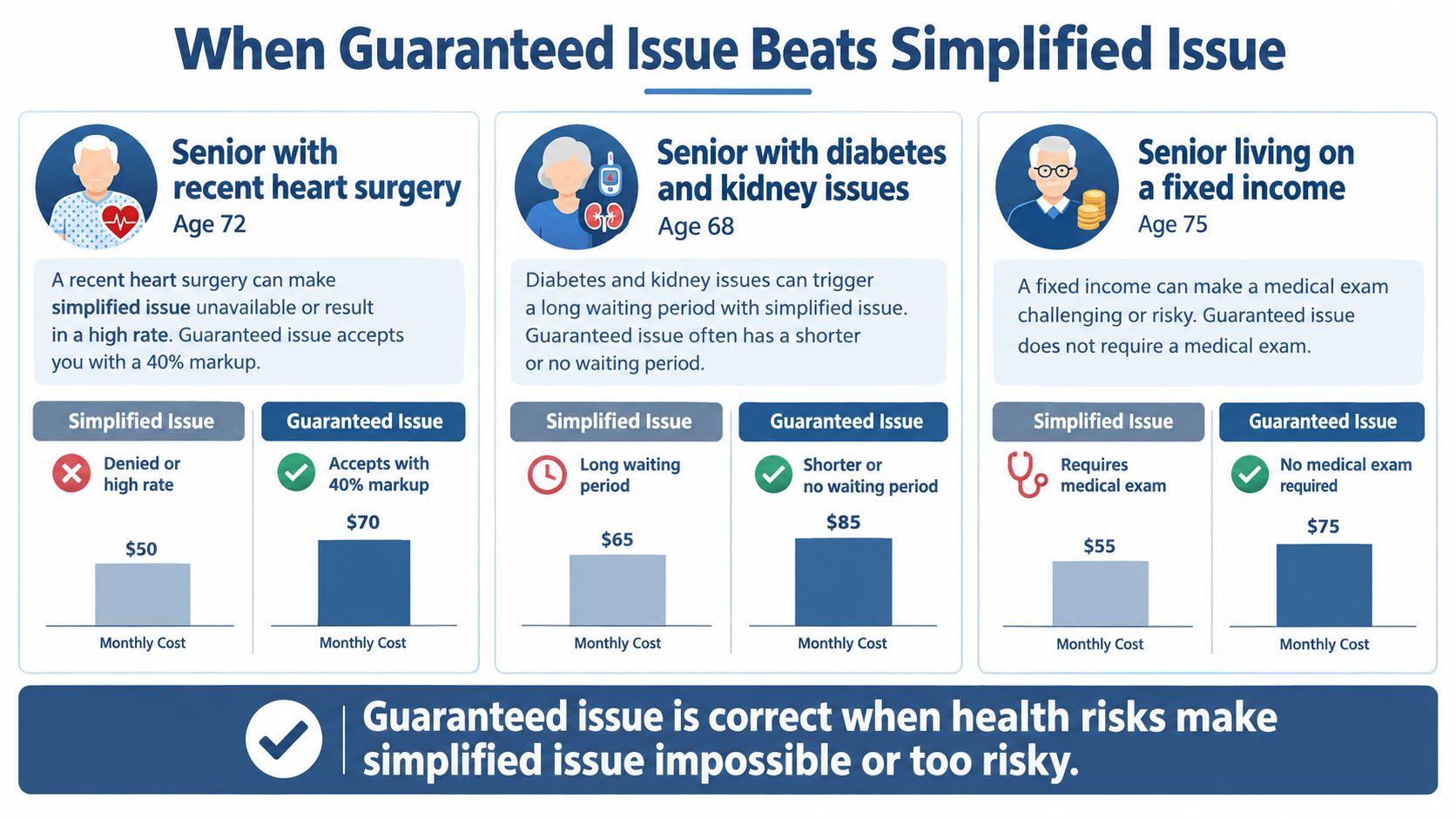
When Guaranteed Issue Beats Simplified Issue
A lot of agents say simplified issue is always better. That's lazy advice.
Most of the time, yes, simplified issue is the better value. But not when the client is likely to get declined, stalled, or placed into a weak graded option that still doesn't solve the immediate problem.
Three cases where guaranteed issue can be the honest answer
- Recent cancer treatment: If the treatment is recent enough to trigger an automatic decline on simplified issue, guaranteed issue may be the only clean path.
- Serious cardiac history: Recent heart attack, stroke, or major cardiac instability often puts simplified issue in doubt quickly.
- High-risk medication profile: Multiple medications tied to severe conditions can make “let's try simplified issue” a waste of time.
The premium will usually be higher. The waiting period is real. But a policy you can get is worth more than a lower-priced one that never issues.
The trade-off you have to face directly
Guaranteed issue commonly carries a 2 to 3 year waiting period and costs 30% to 50% more than simplified issue for many applicants, based on the senior-market guidance cited earlier in this article. That makes it a poor fit for someone who can reasonably qualify for simplified issue and expects to live well beyond the waiting period.
If simplified issue is realistic, guaranteed issue is usually overpriced. If simplified issue isn't realistic, guaranteed issue stops being overpriced and starts being necessary.
The right rule of thumb
If a simplified-issue approval looks plausible, pursue that lane first.
If not, don't treat guaranteed issue like a backup you should feel bad about. Treat it as the correct product for a hard health case. It exists for a reason. If you want a straightforward definition of the category, this article on guaranteed issue life insurance is a good reference.
Application Tips and Common Pitfalls
The application isn't where you want surprises. Most policy problems come from buyers not reading the benefit structure or giving sloppy health answers.
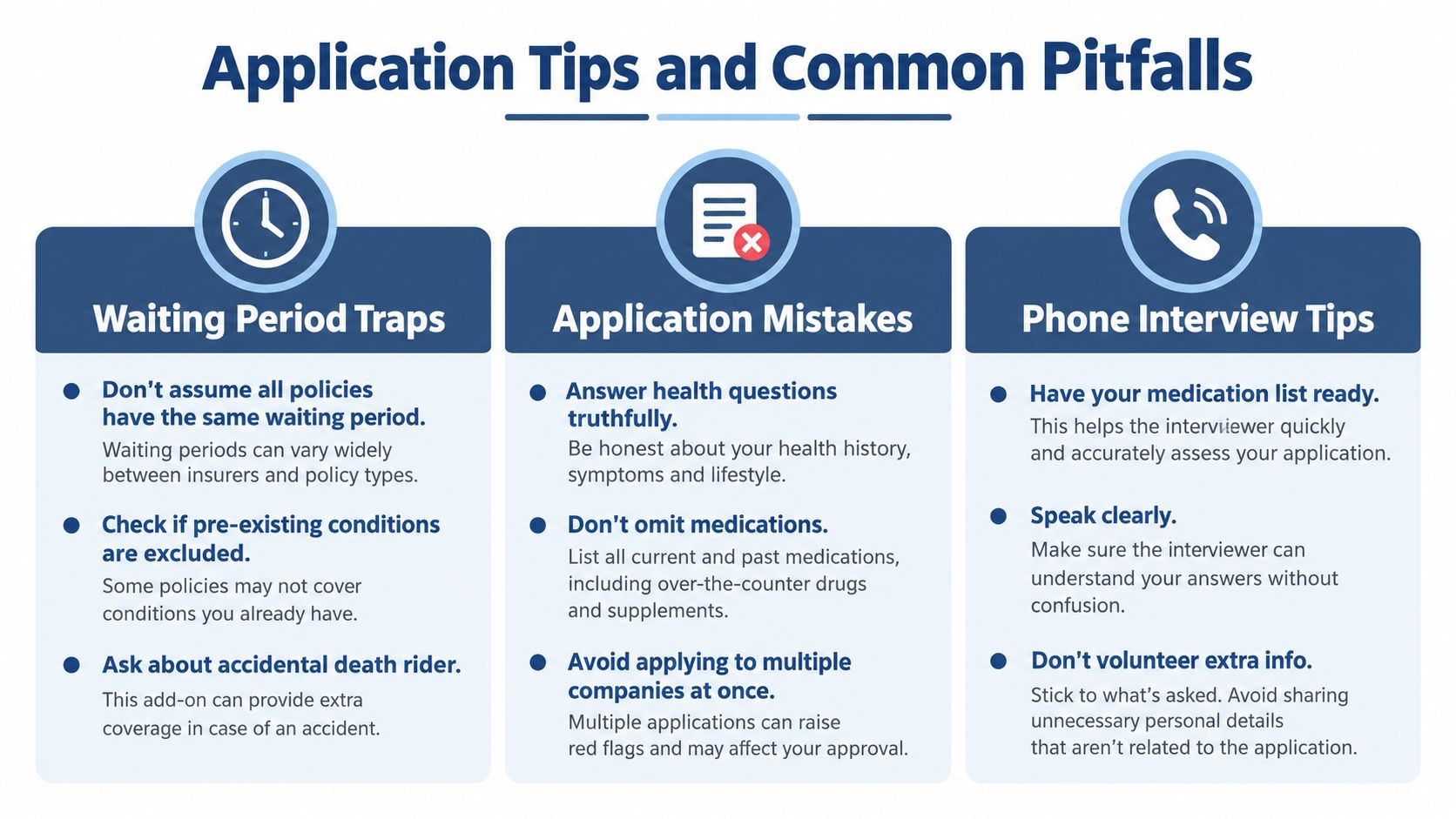
The traps that catch people
- Waiting-period confusion: Don't assume every no-exam policy pays the full benefit immediately.
- Overpriced extras: Some return-of-premium style features sound comforting but can inflate cost without fixing the need.
- Accidental-death bundling: If the policy is padded with accidental coverage you don't need, you may be paying for the wrong thing.
How to apply the right way
- Answer health questions truthfully: Carriers check records. “Close enough” answers are how claims become messy.
- Have your medication list ready: Prescription history often drives underwriting decisions.
- Name the right beneficiary: I usually prefer a trusted loved one over the funeral home so the family keeps flexibility.
- Compare policy structure, not just premium: A cheaper policy with a waiting period may be worse than a slightly higher one with day-one full coverage.
Here's a useful walkthrough before you apply.
What to read before signing
Check the graded death benefit language. Check the suicide clause. Check tobacco answers. Check whether the first years limit the payout for natural causes.
This isn't paperwork trivia. It determines whether your family gets the result you thought you bought.
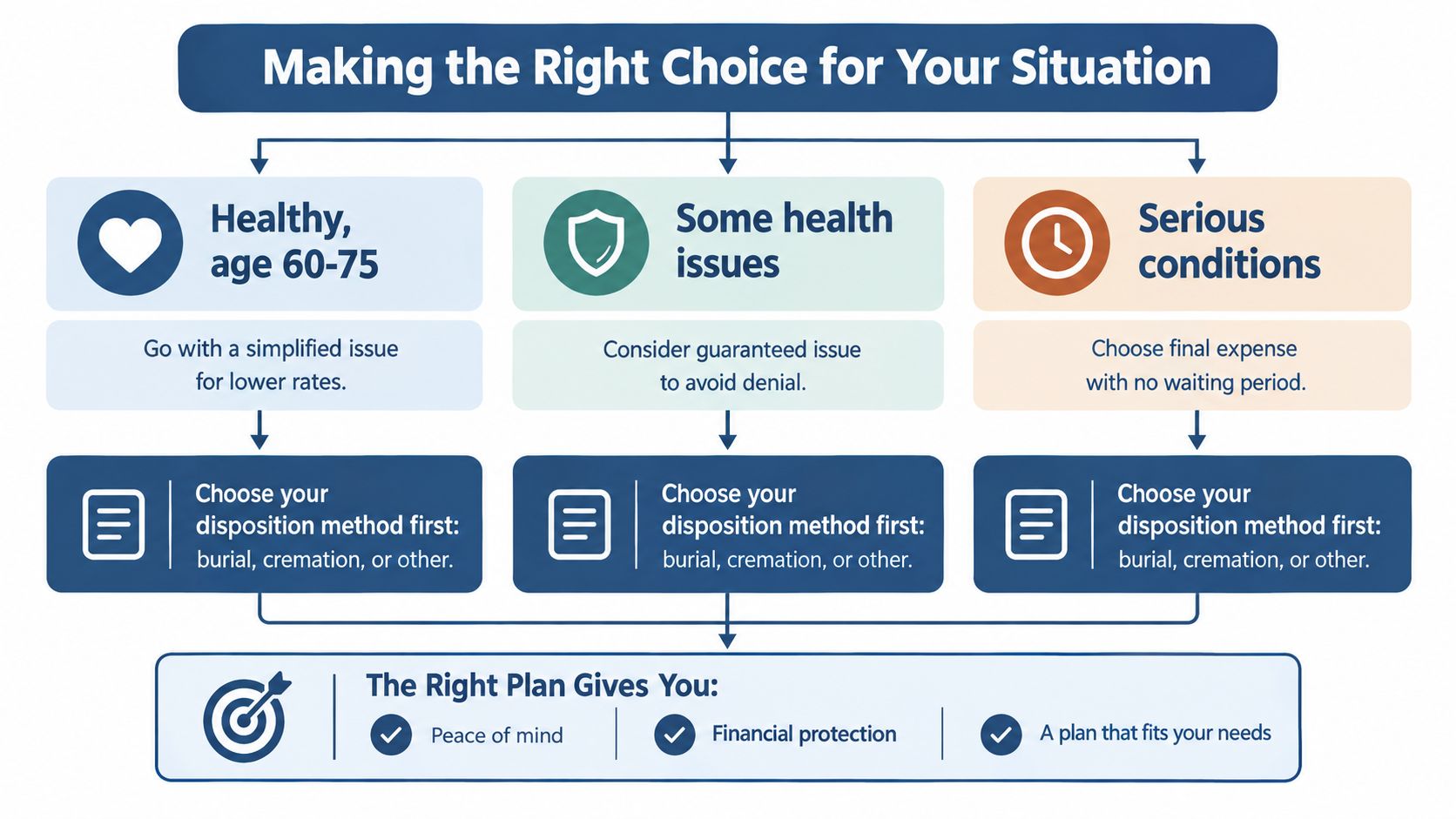
Making the Right Choice for Your Situation
The right burial insurance for seniors over 60 depends on three things. Your funeral preference, your health, and the size of the financial gap.
If you're healthy and in the younger end of this market, simplified issue usually wins. If you want cremation and already have some savings, you may need less coverage than you think. If you want a traditional burial, don't guess. Price the actual local arrangement and then fill the shortfall.
My blunt advice
- Healthy buyer, wants modest permanent coverage: Start with simplified issue.
- Manageable conditions, unsure about approval: Don't self-decline. Have the health profile reviewed before jumping to guaranteed issue.
- Serious recent medical problems: Look at guaranteed issue or a graded product and focus on what will issue.
- Burial plan instead of cremation: Size the policy around the total arrangement, not a random round number.
One option people use during comparison is My Policy Quote, which publishes information on final-expense coverage and helps shoppers review life insurance choices in this category. That's useful if you want to compare policy type and underwriting lane before settling on face amount.
Burial insurance is not an investment. It's a funding tool for a known expense. The right policy is the one that closes the gap between the funeral plan you want and the cash your family would otherwise have to come up with on short notice.
If you want help sorting out whether you need simplified issue, guaranteed issue, or just a smaller policy because you're planning cremation, My Policy Quote offers information and comparison guidance for final-expense and life insurance options. It's a practical place to start if you want to match coverage to your actual funeral plan instead of buying a generic policy amount.