

You're 62, recently retired, and healthy enough to wonder whether paying for coverage is worth it. Then the COBRA notice arrives, and the premium is higher than your mortgage. Your 59-year-old spouse is still working, but adding you to the employer plan may cost more than expected. You have savings, investment income, and perhaps consulting work, yet one hospital admission could turn a carefully planned retirement into a financial emergency.
That's the difficult bridge before Medicare. You're too young for Medicare, exposed to age-rated premiums, and potentially dependent on income-based assistance that can change when you sell an investment, complete a Roth conversion, or accept a short-term contract. A consultant whose individual plan just renewed at $1,400 a month, a business owner who closed her company and lost group coverage, and a couple with one spouse at 64 and the other at 60 all face different versions of the same problem.
The right answer isn't the plan with the lowest monthly premium. It's the plan that protects your doctors, prescriptions, assets, and Medicare transition without creating a tax surprise. If you're building an early-retirement budget, the simple math behind FIRE is only useful when healthcare is included.
A Familiar Bridge Moment Before Medicare
A single emergency-room visit billed at $14,000 can expose the weakness in a plan that looked affordable on paper. The bill may not equal your final responsibility, but the underlying risk is real: a narrow network, a high deductible, or an exclusion for a condition you already have can matter more than the advertised premium.
Advisor's rule: Treat the years before 65 as a financial-planning problem first and an insurance-shopping problem second.
The bridge years create competing pressures. You want to preserve retirement assets, but you also need major-medical protection. You may want to keep working for employer coverage, yet continuing employment can affect taxes, subsidies, and your retirement date. A spouse may prefer coverage, while the other wants a cheaper plan and accepts more out-of-pocket exposure.
That disagreement deserves numbers, not optimism. A $1,400 monthly renewal is a budget item. An uncovered specialist, excluded prescription, or out-of-network hospitalization can become a much larger planning issue. The same applies to COBRA. It may preserve your current doctors and benefits, but you'll generally bear the full premium rather than the employee share.
The recommendations in this guide are straightforward:
- Start with ACA-compliant major medical coverage: It's usually the first comparison for people without affordable employer insurance.
- Project income before choosing a plan: Your Modified Adjusted Gross Income, or MAGI, can affect the premium you pay.
- Audit prescriptions and networks: A low premium is useless if your oncologist, cardiologist, hospital, or medication isn't covered.
- Plan the Medicare handoff early: Coverage that works today may create a drug-coverage or enrollment problem later.
What Pre-Medicare Coverage Means
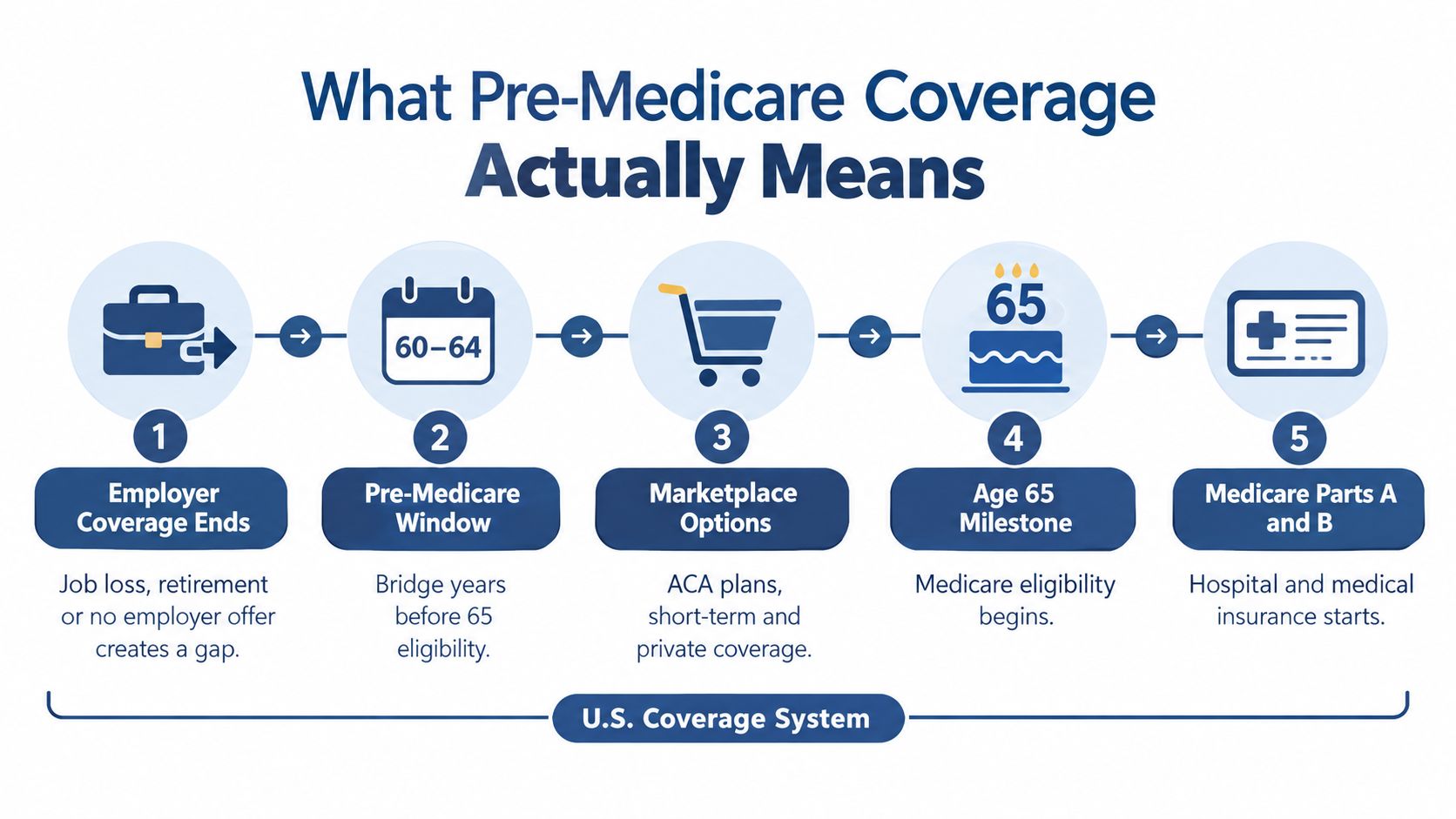
Pre-Medicare coverage is health insurance for the period after employer coverage ends or becomes unavailable and before Medicare eligibility begins. It is a planning category, not one product. The right choice depends on your work status, household income, prescriptions, providers, and the date Medicare will start.
Available paths include employer group insurance, plans purchased through Healthcare.gov or a state exchange, Medicaid, COBRA continuation, retiree health benefits, short-term limited-duration insurance, and private individual policies. Self-employed professionals and 1099 contractors often buy coverage directly. A small-business owner may lose group insurance when the business closes, while someone between jobs may need a temporary bridge.
The key milestone is age 65, when Medicare Parts A and B generally become available. Some people qualify earlier after extended SSDI eligibility, and people with ALS or certain qualifying conditions can have different Medicare timing. Confirm your specific eligibility with the Social Security Administration and Medicare, particularly while disability benefits are pending.
Who falls into this category
Pre-Medicare adults commonly include:
- Early retirees: They leave work before Medicare and need coverage for themselves, a spouse, or both.
- Self-employed workers: Consultants, freelancers, and contractors manage insurance without a traditional benefits department.
- Small-business owners: Their company may not offer group insurance, or the business may no longer exist.
- People between jobs: Losing employer coverage can create a special enrollment opportunity.
- Adults approaching 65 with younger spouses: Medicare may begin for one spouse while the other still needs individual or employer coverage.
- Parents and dependents: A younger family member may age off a parent's plan while the parents manage their own pre-Medicare coverage.
Compare these options as financial tools, not interchangeable monthly bills. An ACA Silver plan, COBRA continuation, Medicaid, and a short-term policy can differ sharply in covered services, provider access, drug benefits, and out-of-pocket exposure. A lower premium can be expensive if it leaves a preferred specialist or medication outside the plan.
Review what creditable coverage means before selecting drug coverage. A plan that fits today's budget can create a Medicare prescription-drug decision later, so record the plan's coverage status and keep its notices. Price the bridge through Medicare, including income timing and the risk of losing assistance, rather than choosing on premium alone.
Why the Years Before 65 Carry Higher Coverage Risk
The years before Medicare create a planning problem, not merely an insurance gap. A retirement date, a layoff, or a business closure can interrupt coverage while age-based pricing raises the replacement cost. A longitudinal study of adults ages 51 to 57 found uninsured rates declining from 14.3% in 1992 to 8.2% in 2000, yet 23.3% were uninsured at least once during the eight-year period, and only 60.1% remained continuously enrolled in private insurance across all five interviews. The Census Bureau publication on historical health coverage reports that at least one quarter of older adults would be uninsured at some point before Medicare eligibility.
Historical context explains why Medicare changed the risk calculation. Before Medicare began in 1965, only 25% of older Americans had meaningful private hospital insurance, according to research using 1963 National Health Survey data. After implementation, hospital insurance coverage for older Americans rose to almost 100%, a transformation documented in the Census historical health insurance series.
The risks that deserve attention
Age-rating increases the premium pressure as you approach 65. Under the ACA's 3:1 age-banding rule, a 64-year-old can face a premium up to three times the rate charged to a 21-year-old for the same plan, as described in the Covered California research packet. Your projected income can also affect subsidy eligibility, so coverage belongs in the retirement-income plan, not in a separate monthly-budget category.
| Risk Factor | Adults Under 50 | Adults 50–64 | Why It Matters |
|---|---|---|---|
| Coverage stability | Often linked to active employment | Retirement, layoffs, and business closures can disrupt coverage | A point-in-time quote can hide a recurring gap |
| Premium exposure | Generally lower age-rated pricing | Older applicants face stronger age-based pricing | Subsidy planning can affect the real monthly cost |
| Medical underwriting | ACA plans cannot deny eligible applicants for health history | Non-ACA products may limit or exclude conditions | Short-term coverage can leave a serious gap |
| Prescription continuity | Often managed through employer benefits | Drug coverage may change before Medicare | The wrong bridge can affect later Part D enrollment |
A short-term policy may advertise a lower premium while excluding pre-existing conditions, prescriptions, preventive care, or major benefits. A recent diagnosis or ongoing treatment can then leave you paying the bills you expected insurance to cover.
Choose the bridge by checking the network, drug coverage, out-of-pocket exposure, and income effect together. A slightly higher premium can cost less overall if it preserves treatment access and avoids a subsidy loss or later prescription-coverage problem.
Every Pre-Medicare Plan Option Side by Side
Leaving work before Medicare requires more than comparing premiums. The plan must protect your doctors and prescriptions, fit your income strategy, and carry you to Medicare without an avoidable coverage problem. Start with those requirements, then compare the monthly premium and cost sharing.
| Plan Type | Best Fit | Typical Monthly Premium at Age 60 | Key Trade-Off |
|---|---|---|---|
| ACA Marketplace | People without affordable employer coverage, including early retirees and self-employed workers | Varies by location, plan, age, household, and projected income | Premium assistance may change with MAGI, while deductibles and networks vary |
| Medicaid | Applicants who meet state eligibility rules | Low-cost or no-premium coverage for eligible applicants | Eligibility and provider access depend on state rules and income |
| COBRA | People who need to keep an existing employer plan and doctors | The full plan cost, plus any permitted administrative charge | Familiar coverage, but the employee subsidy generally ends |
| Short-term medical | People seeking temporary protection and accepting exclusions | Varies by insurer and underwriting | May exclude pre-existing conditions, prescriptions, preventive care, or major benefits |
| Retiree health benefits | Former employees whose employer offers a retiree plan | Set by the former employer and plan design | Availability is limited, and benefits can change |
| Private individual major medical | Shoppers outside an exchange who qualify for compliant individual coverage | Varies by location, age, and plan | May not provide the same subsidy access as Marketplace enrollment |
| Hospital-only or limited-benefit policy | People focused on narrow catastrophic benefits | Varies by benefit schedule and underwriting | A fixed benefit may be far below the actual medical bill |
| Employer continuation or part-time work | People who can retain group eligibility through work or a spouse | Depends on employee and dependent contributions | Work decisions affect income, schedule, and subsidy eligibility |
How I'd evaluate each route
ACA Marketplace plans are the first route I review for most early retirees. They provide standardized metal tiers and generally accept eligible applicants without medical underwriting. Bronze plans shift more costs to the patient, while Silver or Gold coverage can fit someone who expects regular treatment. Review these early-retiree health insurance options before assuming COBRA is safer.
Your projected income matters alongside the premium. Wages, business income, investment income, capital gains, retirement distributions, or a Roth conversion can change the subsidy calculation. Set the income estimate before choosing a plan, and account for how a withdrawal or conversion could change what you pay each month.
Medicaid fits households that meet their state's income and eligibility rules. Confirm the rules and provider network before enrolling. A contract payment, asset sale, or other income change may require reporting and can alter eligibility during the coverage year.
COBRA buys continuity. It may preserve the employer network, deductible progress, and formulary, which can matter during active treatment. You pay the full plan premium, plus any permitted administrative charge, so compare the total cost with an ACA plan covering the same doctors and prescriptions.
Short-term policies are temporary protection, not a substitute for major medical coverage. Check exclusions, benefit limits, renewability, and prescription provisions. I would avoid this route for a client with cancer history, diabetes, heart disease, or expensive ongoing medications unless the gaps are fully understood.
Retiree benefits and employer continuation deserve a direct comparison. A spouse's plan may fit better than an individual policy, but verify the dependent premium, doctors, prescriptions, and eligibility rules. Part-time work can preserve group coverage, yet it also changes income, schedule, and subsidy eligibility. Choose the bridge that controls total exposure, not just the plan with the lowest listed premium.
How Pricing and Subsidies Really Work for Older Adults
At 64, the same individual-market coverage can cost far more than it did at 21. The ACA's 3:1 age rule permits a 64-year-old to be charged up to three times a 21-year-old's rate for identical coverage, as documented in the Covered California age-rating material. Location, household composition, tobacco rating where applicable, and plan design also affect the listed premium.
Premium tax credits can change the decision entirely. They depend on household income and the cost of a benchmark plan, not on a universal discount for every applicant. Two neighbors of the same age can therefore have very different net premiums because their household MAGI, family size, state, and benchmark plan differ.
MAGI is a planning variable
For early retirees, MAGI may include wages, self-employment income, taxable investment income, capital gains, retirement distributions, and Roth-conversion income. A conversion may support long-term tax planning while raising the current-year ACA premium. A one-time gain can produce the same result. Set the income estimate before choosing coverage, then test how withdrawals or conversions affect the full year.
Medicaid eligibility follows state rules and household income, with expansion eligibility commonly associated with roughly 138% of the federal poverty level. Subsidy eligibility can also change sharply when income crosses the applicable threshold. Do not build a retirement budget around assistance until you have modeled the entire tax year.
Cost-sharing reductions add another decision point. Eligible households generally must choose a Silver plan to receive extra savings on deductibles, copayments, and other cost sharing. A Bronze plan with a lower premium can cost more overall for someone who expects regular physician visits or costly prescriptions.
For 2026, KFF estimates that a 60-year-old earning $65,000 could pay $10,389 more annually toward premiums if enhanced premium tax credits are unavailable. National average unsubsidized payments are projected at $11,625 per year for the lowest-cost Bronze plan, $15,914 for benchmark Silver, and $15,672 for lowest-cost Gold, according to KFF's analysis of reduced enhanced premium tax credits.
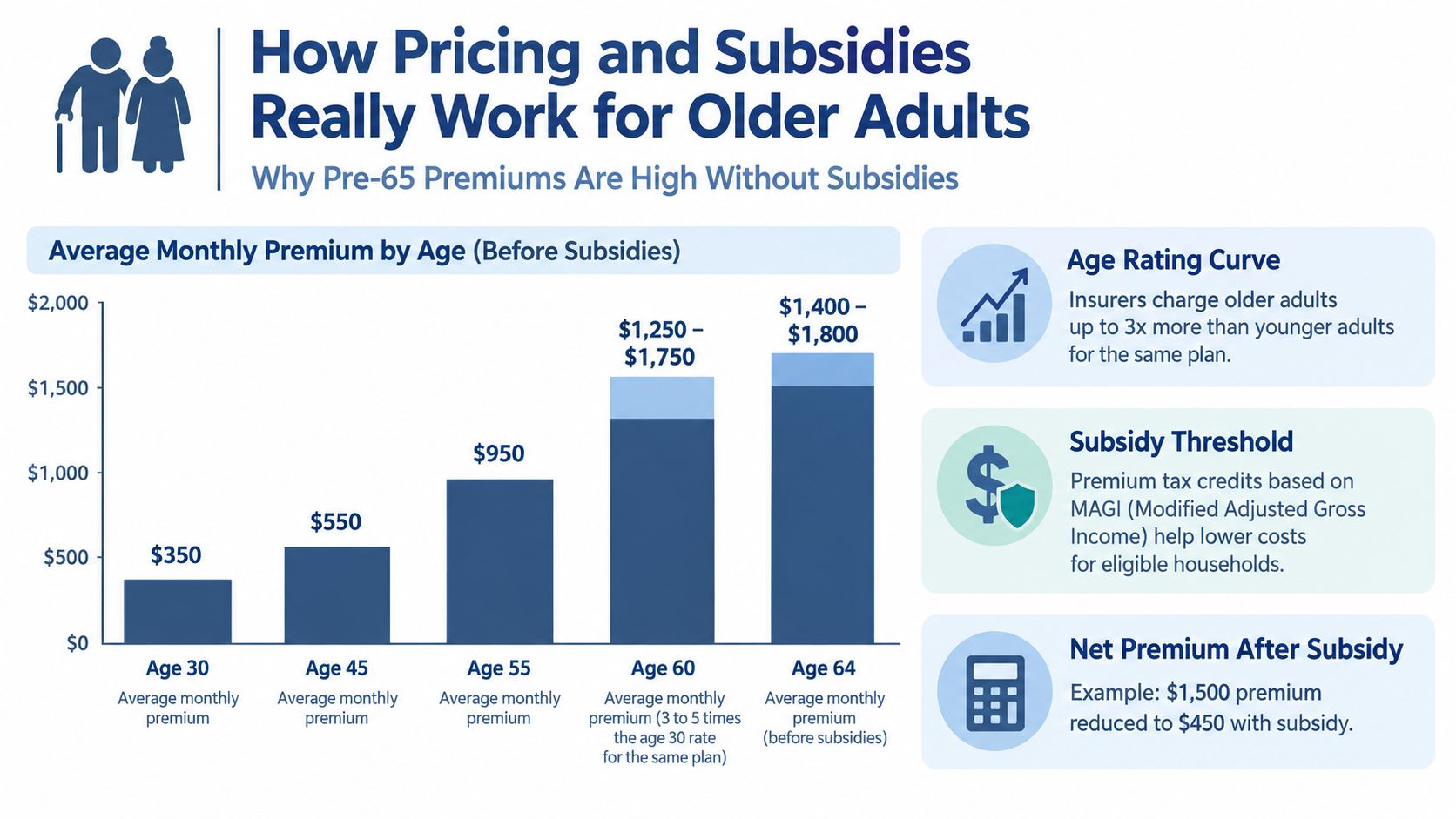
A separate 2026 projection shows how income can reverse the result. A single 64-year-old with income near $26,500 was projected to pay roughly $1,700 per year after a $13,600 tax credit, as noted earlier. Use the health insurance subsidy calculator to test income scenarios, then verify the estimate through the official Marketplace application.
Choosing the Right Plan for Your Situation
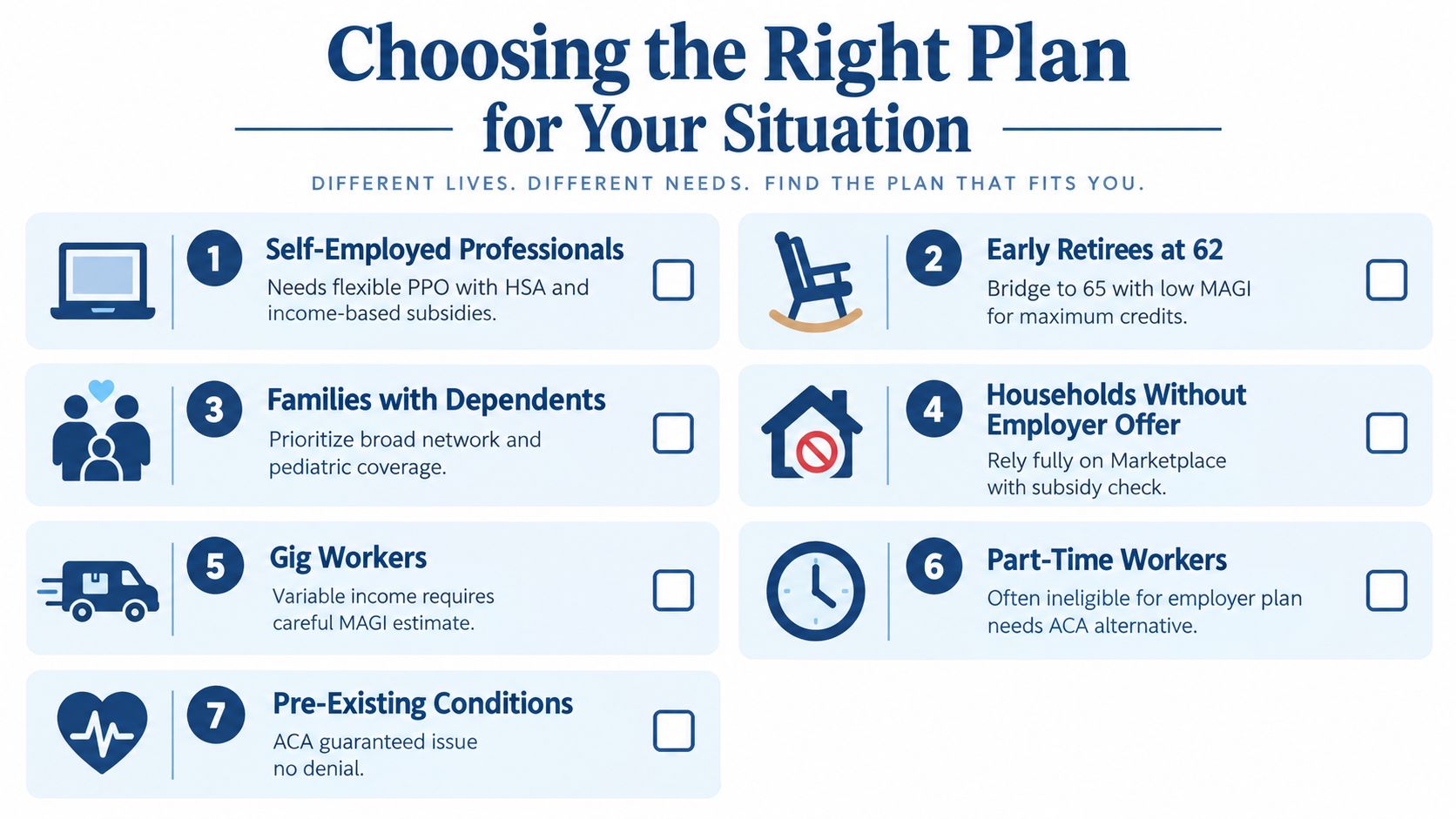
The right plan depends on how you earn money, how often you use care, and which risks you can afford to retain. A self-employed 60-year-old and a healthy early retiree may both qualify for Marketplace coverage, yet their best choices can differ because their income is more or less predictable.
Match the plan to the household
Self-employed professionals: Start with ACA plans and prepare a realistic MAGI estimate from business revenue, expenses, and investment income. Ask about HSA compatibility, specialist access, and whether your preferred hospital is in network. Gather tax returns, current profit-and-loss records, and a medication list.
Early retirees at 62: Compare Marketplace coverage with COBRA before assuming retirement means immediate enrollment. Model withdrawals and conversions across the entire year, not just the month you retire. Bring your retirement-income schedule, expected distributions, and current plan documents.
Families with dependents: Prioritize network breadth, pediatric providers, urgent care, and prescription coverage. A family plan with a slightly higher premium may be financially safer if it avoids fragmented coverage. Verify each family member's doctors and pharmacies.
Households without an employer offer: Treat the Marketplace as the primary source for individual coverage. Run the subsidy application using household income, not just the income of the person applying. A spouse's employer plan may still matter if dependent coverage is available.
Gig workers: Use a conservative income estimate and update it when contracts change. Underestimating income can create a tax repayment problem, while overestimating it can cause you to miss available assistance. Keep invoices, bookkeeping reports, and quarterly tax projections available.
Part-time workers: Ask whether the employer offers coverage and whether you meet eligibility rules. If no employer plan exists, compare ACA options before accepting a limited-benefit product.
People with pre-existing conditions: Put ACA-compliant coverage at the top of the list. Ask the advisor to verify prior authorization, specialty-drug rules, and continuity with existing specialists. Don't let a low-cost non-ACA policy hide exclusions that could affect ongoing care.
What I'd want on the table: your projected MAGI, household members, prescription list, preferred doctors, preferred hospitals, current deductible progress, and the date your existing coverage ends.
Enrollment Steps and Timing Windows to Know
Enrollment mistakes are often timing mistakes. Start before the old plan ends, because a quote is not coverage and an approved application is not always the final step.
Confirm your enrollment window. Check whether you have a qualifying life event or must use Marketplace open enrollment. Losing employer coverage generally creates a special enrollment opportunity, but confirm the dates and documentation requirements.
Estimate household MAGI. Include wages, self-employment income, retirement withdrawals, taxable investment income, and planned conversions. Use a full-year estimate rather than copying last year's income without review.
Run ACA and Medicaid checks together. Household income and state rules can direct different family members into different programs. Submit the application accurately and keep the supporting records.
Check doctors and prescriptions. Search the plan's provider directory, call the insurer about network status, and verify each medication's formulary tier, authorization rules, and refill process.
Confirm creditable drug coverage. Marketplace or employer coverage may not automatically answer every future Medicare Part D question. Medicare's official Medicare and You handbook explains the importance of creditable prescription coverage and late-enrollment penalties.
Apply and bind the plan. Submit the application during the applicable window, provide proof of the qualifying event or income when requested, and make the first premium payment. Coverage usually isn't active until the insurer receives the required payment and confirms the effective date.
A practical 90-day checklist looks like this:
- Days 90 to 61: Request current plan documents, list prescriptions, identify doctors, and estimate income.
- Days 60 to 31: Compare Marketplace, Medicaid, COBRA, and employer options. Confirm the special enrollment period and collect proof of lost coverage.
- Days 30 to 1: Submit the application, verify the effective date, pay the binder premium, and obtain member identification.
- After enrollment: Recheck income, address, household, prescriptions, and provider access whenever circumstances change.
Key Takeaways and Common Edge Cases
Three decisions usually move the most money:
- Choose the subsidy strategy before choosing the metal tier. Project MAGI, then compare the net premium and cost sharing.
- Decide whether COBRA preserves valuable continuity or carries an unaffordable full-cost premium.
- Protect prescription continuity before Medicare. Ask whether your coverage is creditable and retain the documentation.
A spouse who turns 65 first may move onto Medicare while the younger spouse remains on an employer plan, Marketplace plan, COBRA, or another qualifying option. Don't cancel the younger spouse's coverage until you've confirmed the new effective date and reviewed whether the household application must be updated.
Moving to another state generally requires a fresh Marketplace application and can create a special enrollment opportunity, but confirm the event and timing before terminating existing coverage. Marketplace assistance can continue through age 64 when the applicant remains eligible, although the amount depends on household circumstances and applicable rules.
A pending SSDI application doesn't automatically mean you should leave yourself uninsured. Maintain qualifying coverage while the disability claim is reviewed, then coordinate Medicare timing if approval changes your eligibility.
If a 1099 windfall pushes projected income higher during the year, update the Marketplace application promptly. The safest response is to recalculate the subsidy rather than wait for tax filing, because the final reconciliation is based on actual household income.
The most expensive mistake is assuming the cheapest premium is the cheapest year. Compare premiums, deductible exposure, out-of-pocket limits, excluded services, prescription access, provider continuity, subsidy risk, and the Medicare handoff before you commit.
My Policy Quote helps shoppers compare ACA-compliant health insurance options before Medicare, including situations involving early retirement, self-employment, and changing employer coverage. Visit My Policy Quote to review your pre-Medicare options and start a focused comparison based on your household, income, doctors, and prescriptions.