

A funeral bill rarely arrives at a convenient time. One day, you're helping a parent sort medications or discussing where family photos should go, and the next, you're sitting in a funeral home office trying to understand which services must be paid for immediately. The family may have savings, but not enough liquid money to cover every charge without borrowing, selling something, or asking relatives for help.
Final expense life insurance is designed for that narrow, practical problem. It's permanent life insurance with a smaller death benefit, intended to help pay for funeral arrangements, medical bills, and modest debts. The right policy isn't about buying the biggest face amount. It's about matching coverage to the household's actual plan, whether that means a traditional burial, direct cremation, or a smaller memorial service.
The Moment a Family Realizes They Are Not Ready
The call comes from the funeral home. A family is told that a traditional service could cost somewhere between $9,000 and $12,000, depending on the arrangements and local charges. At the kitchen table, adult children open a bank account and find enough for part of the bill, but not enough to cover everything without disrupting rent, groceries, or their own household obligations.
The invoice isn't one simple number. It can include the funeral home's basic services fee, transportation, an obituary notice, flowers, cemetery-related charges, and copies of the death certificate. Each item may look manageable by itself. Together, they can leave a family several thousand dollars short, especially when the money must be available quickly.
Practical rule: Plan around the actual disposition choice first, then choose the insurance amount. A policy should answer a real bill, not an arbitrary sales target.
That's the purpose of a small permanent policy. The benefit is paid after the insured dies, assuming the claim meets the contract terms, and the money can generally be used by the beneficiary for eligible final bills and other needs. It doesn't make grief easier, but it can prevent relatives from turning a funeral into an emergency financing decision.
Families also need emotional support during this period. Someone struggling with depression after a loss may benefit from speaking with a qualified counselor, and find depression counselling can be a useful starting resource for locating that kind of help. Practical planning and emotional care belong in the same family conversation.
Before applying, the person handling arrangements should also know what happens immediately after a death, including whom to call and where important documents are kept. A clear checklist for what to do when a parent dies can reduce confusion when relatives are making decisions under pressure.
This guide focuses on the details that are easiest to misunderstand: how final expense coverage differs from term insurance, what simplified and guaranteed issue policies pay during the early years, and how to size a benefit around burial or cremation costs.
What Final Expense Life Insurance Actually Is
Final expense life insurance is best understood as permanent, smaller-face-amount whole life insurance. Its historical roots are in burial insurance, which spread through industrial Britain before being introduced in the United States in 1875 with the founding of the Prudential Friendly Society, as documented in the LIMRA and LIC final expense report.
The original purpose was straightforward. Families wanted money set aside for burial and funeral costs so relatives wouldn't have to collect donations or borrow funds. The product later broadened into the modern final expense category, which may also help with medical bills, small debts, transportation, or other immediate obligations.
The permanent coverage model
A final expense policy generally remains in force as long as premiums are paid and the policy stays active. The premium is usually designed to remain level, although the exact contract language controls. The policy may also accumulate modest cash value, but the main reason people buy it is the death benefit, not investment growth.
The face amount should be connected to a household liability. A family choosing a traditional burial may need more coverage than one choosing direct cremation. A family planning a cremation followed by a memorial service may fall somewhere between those choices, depending on venue, transportation, urn selection, and other arrangements.
How it differs from term life insurance
Term life insurance is usually built for income replacement during a defined period. A parent may use it while children are dependent, a mortgage is outstanding, or a household relies heavily on one person's earnings. If the term ends while the insured is alive, coverage may expire or become more expensive under the contract terms.
Final expense insurance serves a different mental model. Term insurance pays for the decades of life still ahead, while final expense coverage pays for the goodbye and the bills that arrive around it. The smaller benefit reflects that narrower purpose.
That doesn't make final expense insurance automatically better. Someone who is younger, healthy, and still working may need broader income protection first. Someone with savings and an existing life policy may not need another small permanent policy at all. The useful question is whether a permanent benefit solves a specific cash-flow problem that other resources don't cover.
The Three Policy Types and What They Pay Out
The label on an insurance advertisement can be misleading. Two policies may both be called final expense whole life, yet one may pay the full benefit immediately while another may limit the beneficiary's payment during the early policy years.
The three designs most often discussed are simplified issue, graded benefit, and guaranteed issue.
Simplified issue whole life
Simplified-issue policies ask health questions but generally don't require a full medical exam. The carrier uses the answers, prescription information, and other underwriting details to decide eligibility and pricing. If approved, the policy may provide the full death benefit from the start, subject to exclusions and the actual contract.
Graded benefit coverage
A graded policy sits between simplified issue and guaranteed issue. It may pay only part of the face amount during the first policy year, a larger amount during the second year, and the full amount after the grading period. The exact schedule varies, so the policy document matters more than the marketing name.
Guaranteed issue whole life
Guaranteed-issue policies generally don't ask health questions or require an exam. That accessibility comes with a trade-off. Many contracts grade the benefit for two years, returning premiums plus interest, rather than paying the full face amount, if the insured dies from a covered natural cause during that period. Accidental-death provisions can differ, so beneficiaries should read the exclusions and definitions carefully.
Here is the difference using a $10,000 policy example. The amounts below are illustrations of how the designs work, not a promise of what every carrier pays. For a real policy, use the schedule printed in the contract.
| Policy Type | Health Questions | Death in Year 1 | Death in Year 2 | Death After Year 2 |
|---|---|---|---|---|
| Simplified issue | Yes | Usually full benefit, subject to contract terms | Full benefit | Full benefit |
| Graded benefit | Usually yes | Partial benefit under the schedule | Larger benefit under the schedule | Usually full benefit |
| Guaranteed issue | No | Often premiums plus interest for natural causes | May still be subject to the contract's two-year schedule | Full benefit after the graded period |
At month six, a simplified-issue policy might pay the full $10,000 if the contract has no applicable limitation. A graded policy may pay less, and a guaranteed-issue policy may return premiums plus interest for a natural-cause death. At month eighteen, the graded schedule may provide more than it did at month six, while guaranteed issue may still be within its early limitation period. At year five, each design will generally be beyond the initial grading period, assuming the policy remains active.
For questions involving beneficiary rights, ownership, or guardianship, readers may also need legal guidance. The Law Office of Bryan Fagan, PLLC on guardianship and life insurance policies provides context for situations where someone else manages financial decisions.
You can also review a plain-language explanation of guaranteed-issue life insurance before comparing quotes.
Typical Coverage Amounts and What They Cost
A face amount is useful only when it connects to a real arrangement. National funeral-cost figures vary by source and by what each index includes. One national source lists a traditional burial arrangement at about $14,720 when cemetery costs are included, while another reports a median funeral with viewing and burial of $8,300, viewing plus cremation of $6,280, and a burial vault that can bring the burial case to about $9,995. These figures come from independent funeral-cost data, and the differences show why local planning matters.
The LIMRA and LIC market data reports an average annual premium per final expense policy of $1,064 in 2025, but that market average isn't a quote for your household. Premiums depend on age, health, tobacco use, state, carrier, benefit design, and payment mode.
Match the benefit to the arrangement
For a traditional burial, start by asking the funeral home for a written estimate that separates required services from optional choices. For cremation, ask whether the family wants direct cremation, a viewing, a memorial service, transportation, or a permanent placement for the urn. A hybrid plan may include cremation plus a gathering, which can produce a very different bill from direct cremation.
A benefit that matches only the funeral home's base charge may leave no room for medical bills, transportation, or small debts. On the other hand, buying more insurance than the family can comfortably keep may create a lapse risk.
The face amount should be sustainable, not impressive. A smaller policy that stays active can be more useful than a larger policy that becomes unaffordable.
Why quotes can differ sharply
A healthy applicant may qualify for simplified issue and receive a lower premium than someone routed to guaranteed issue. Tobacco use, serious medical history, and recent treatment can move an applicant into a more expensive class or a graded design. The same face amount can therefore produce very different offers.
Rather than relying on an advertised monthly figure, ask each carrier for the premium, benefit schedule, exclusions, cash-value treatment, and lapse rules in writing. A focused guide to life insurance for funeral costs can help you prepare questions before requesting quotes.
Who Can Qualify and What Underwriters Ask
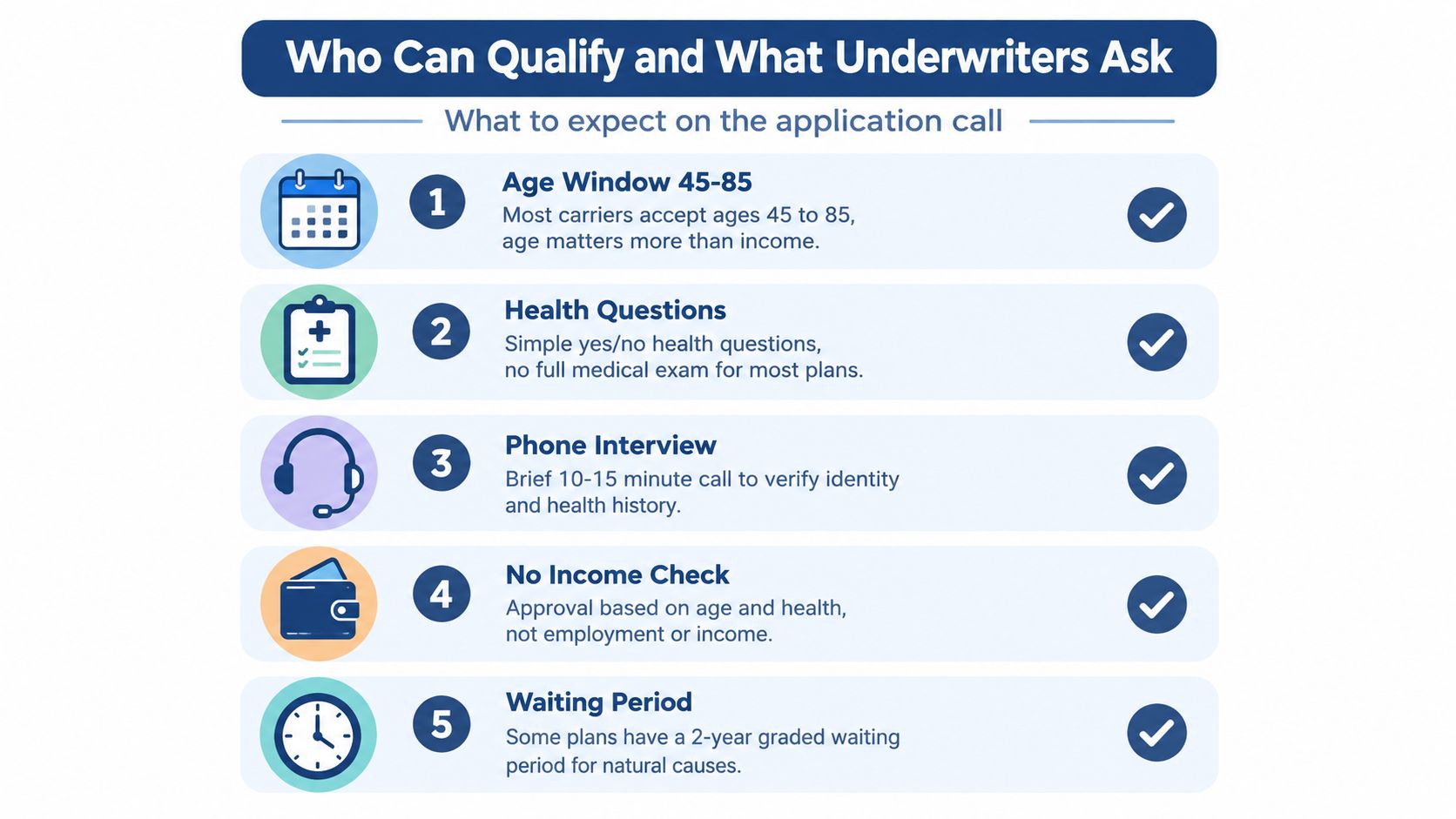
The application call is usually less mysterious than people expect. Carriers focus on age and health because those factors help them evaluate the chance of an early claim. Income may matter for some forms of life insurance, but final expense underwriting is generally centered on whether the applicant fits the carrier's age and health rules.
Many carriers market final expense products to adults roughly between 45 and 85, though the actual window varies by company and state. Someone outside that range may still find another type of coverage, but shouldn't assume every final expense plan uses the same age limits.
Questions that affect the decision
A simplified-issue application may ask about recent hospitalizations, cancer, heart disease, COPD, diabetes complications, mobility, and current medications. It may also ask whether the applicant uses tobacco. A short answer can change the rate class, so guessing or minimizing a condition creates problems later.
A carrier may offer simplified issue, graded benefit, or guaranteed issue depending on the answers. Guaranteed issue can be helpful for someone who can't qualify medically elsewhere, but the early death-benefit limitation is a serious trade-off.
The phrase “waiting period” needs careful reading. It may apply to natural causes, while accidental death may be treated differently. If the insured dies during the graded period, the beneficiary may receive premiums plus interest or a scheduled portion of the face amount, depending on the contract.
Before the call, gather:
- Identification: Have a current government-issued ID available.
- Beneficiary information: Write down full legal names, relationships, and contact details.
- Doctor details: Keep recent physicians, clinics, and relevant treatment information nearby.
- Medication list: Include prescription names and the conditions they treat.
- Existing coverage: Note current policies so you don't accidentally duplicate or replace useful protection.
A step-by-step overview of the life insurance underwriting process can make the conversation easier to follow.
This short video may also help applicants understand the basic process before they speak with an agent.
How Final Expense Stacks Up Against Prepaid Plans and Savings
Insurance isn't the only way to prepare. A prepaid funeral contract, a dedicated savings account, or a trust may fit better depending on how certain the family is about the funeral provider and the desired arrangements.
A prepaid funeral plan can lock in some services and direct funds toward a selected funeral home. A revocable contract may offer more flexibility, while an irrevocable arrangement may provide stronger protection from later changes in financial circumstances. The specific legal treatment depends on state law and the contract, so ask what happens if the funeral home closes, the family moves, or arrangements change.
The Federal Trade Commission's Funeral Rule requires funeral providers to disclose prices and give consumers certain rights, but a disclosure doesn't guarantee that a prepaid plan will suit every household. Read the cancellation, transfer, refund, and provider-failure provisions before paying.
| Feature | Final Expense Policy | Prepaid Funeral Plan | Burial Savings or Trust |
|---|---|---|---|
| Main purpose | Provides a death benefit for final bills | Funds selected funeral arrangements | Sets aside household money |
| Access before death | Usually limited to policy features or cash value | Tied to contract rules | May be accessible under account or trust terms |
| Early-death certainty | Depends on immediate or graded benefits | Depends on funding and contract terms | No guaranteed insurance payout |
| Provider flexibility | Beneficiary may generally use funds for final needs | Often connected to selected provider | Family controls use, subject to ownership rules |
| Key concern | Waiting periods and premium affordability | Transfer, cancellation, and provider rules | Savings may not grow fast enough or remain protected |
A payable-on-death bank account can direct money to named beneficiaries without the same probate process that may apply to an ordinary account. A burial trust can separate funds for a stated purpose, but its protections and limits vary by state. Savings offer control and liquidity, yet they won't create a guaranteed larger benefit if death occurs before the household has accumulated enough.
Many families use a hybrid approach. For example, a smaller permanent policy can provide immediate liquidity while a modest savings account handles flexible expenses. Another household may prearrange the service but keep insurance for transportation, medical bills, or changes that the funeral contract doesn't cover.
End-of-life planning often overlaps with broader retirement decisions. Families comparing ways to protect cash reserves can also review guidance on assisted living payment strategies before committing money to a funeral arrangement.
Who This Coverage Is Built For in Real Life
Demographics don't make the decision by themselves. The useful question is what a household owns, what it can afford each month, and what kind of farewell it wants.
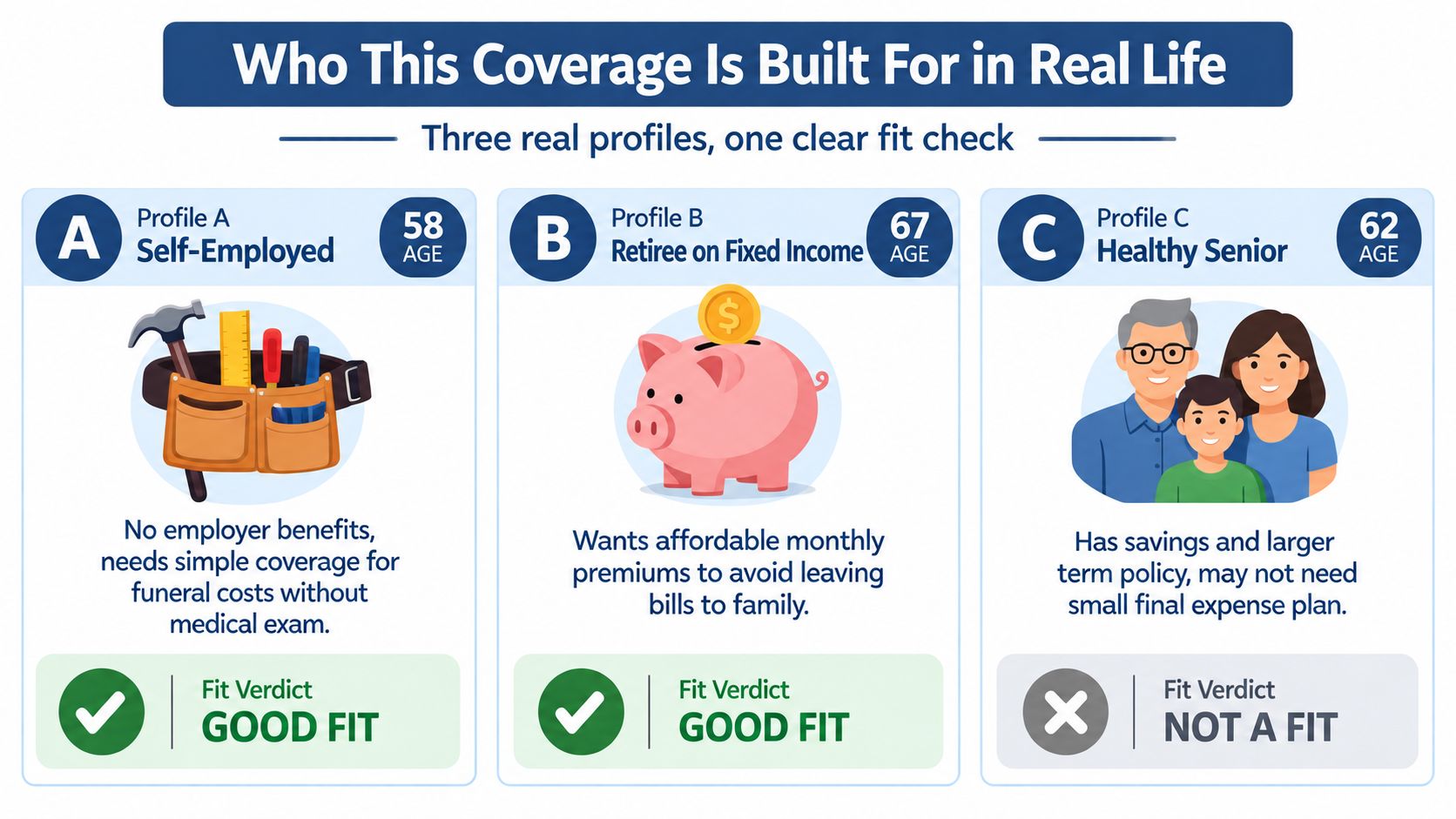
The self-employed contractor
A contractor in their late 50s may have no employer-paid life insurance and no dependable workplace benefit to replace after changing jobs. If the household prefers a full burial, a small whole life policy can create a dedicated death benefit that doesn't depend on an employer relationship.
The contractor should still ask whether a broader term policy is affordable and medically available. Final expense coverage may solve the funeral problem, but it won't replace business income or protect a surviving spouse from a large mortgage.
The early retiree on a fixed income
An early retiree in their early 60s may live mainly on Social Security and want to avoid leaving funeral bills to adult children. If the preferred plan is direct cremation, the needed benefit may be lower than a traditional burial plan, although the family should request a local written estimate before choosing the amount.
Affordability is the deciding factor. A policy that consumes too much of the monthly budget can become a liability, especially if premiums compete with food, housing, prescriptions, or utilities.
The homeowner with distant children
A homeowner in their late 60s may have adult children living more than an hour away. A hybrid plan, perhaps cremation with a small memorial, can give the family a clear arrangement without requiring them to coordinate a large cash collection from different households.
If the homeowner already has adequate savings and a larger life policy, another final expense policy may add little. The benefit is strongest when it fills a defined liquidity gap rather than adding another bill.
Across these profiles, the shared need is certainty without locking every decision into a prepaid funeral contract. The policy can provide a named beneficiary and a permanent benefit, while the family retains more flexibility about the provider and final arrangements.
Smart Next Steps Before You Sign Anything
A final expense policy can be sensible for someone who wants a permanent, modest benefit, has limited liquid savings, and needs coverage tied to a known funeral plan. It may be the wrong tool for someone who needs income replacement, already has enough accessible assets, or can qualify for broader insurance at a better value.
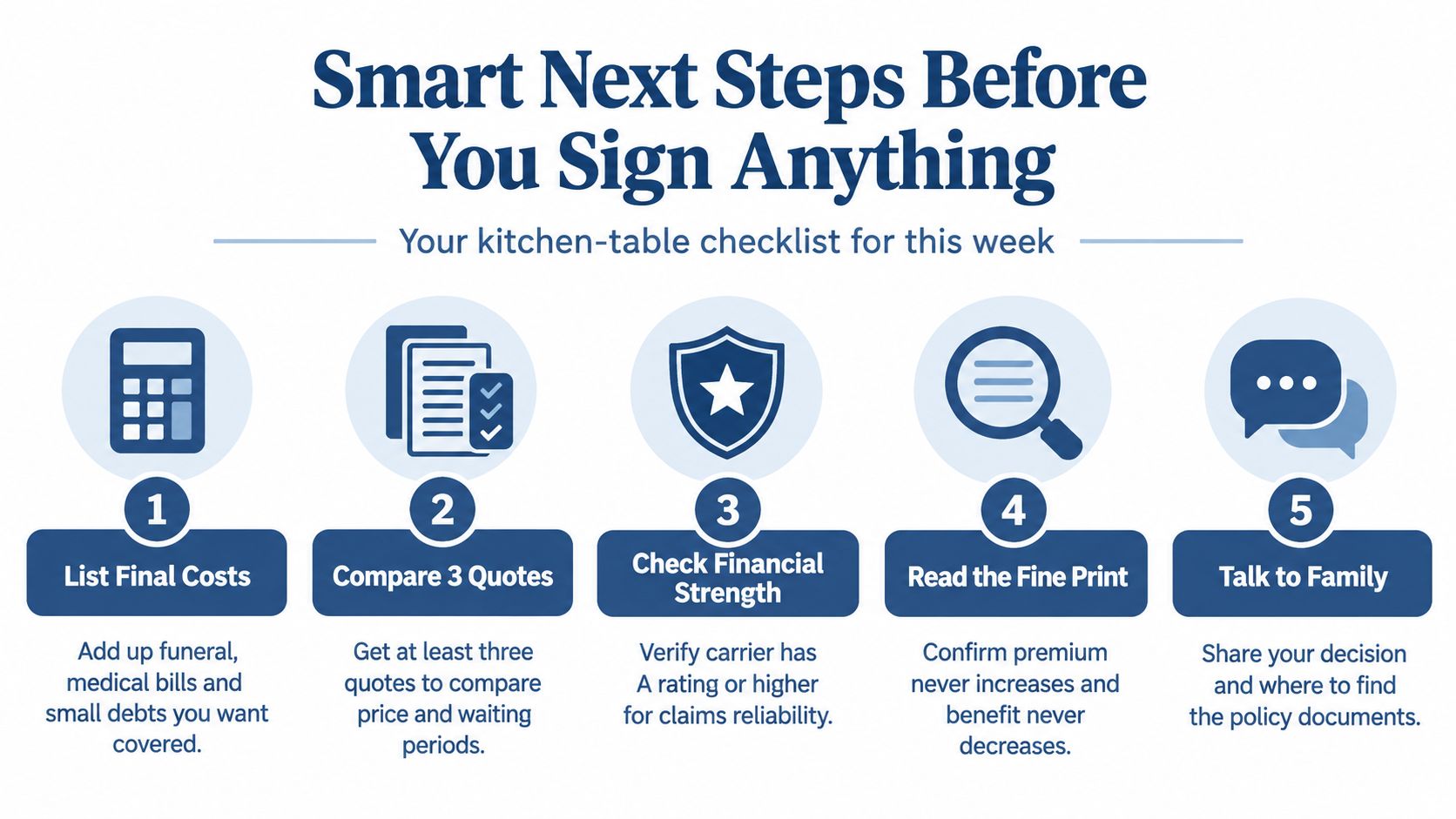
Use the kitchen table to complete these checks before signing.
Price the actual disposition choice. Ask a local funeral provider for written estimates for burial, direct cremation, or cremation with a memorial. Include transportation, certificates, obituary costs, and any small debts you want the benefit to address.
Request comparable quotes. Get quotes from at least three carriers using the same face amount. Ask each one to show the premium, underwriting class, immediate benefit, graded schedule, exclusions, and whether the premium and death benefit can change.
Review the carrier and contract. Check the insurer's financial-strength rating and read the policy illustrations and application carefully. Don't rely on a verbal explanation of the waiting period.
Test the premium against your budget. Look at a recent bank statement and ask whether the payment remains manageable during a difficult month. A policy only helps if it stays in force.
Tell the beneficiary. Confirm the beneficiary's legal name and contact information. Explain who should receive the policy documents and who will contact the insurer when a claim must be filed.
Final expense life insurance is usually most useful for households that need a permanent benefit for a specific burial or cremation plan and don't want relatives scrambling for cash. Someone with substantial savings may prefer a dedicated account, someone planning a fixed service may prefer prepaid arrangements, and someone with dependents may need term or broader whole life coverage first.
My Policy Quote offers life-insurance quote requests and comparison information that can help you compare final expense options using the same face amount and policy questions. Visit My Policy Quote to organize your next step, then review every waiting-period provision and premium detail before choosing coverage.