
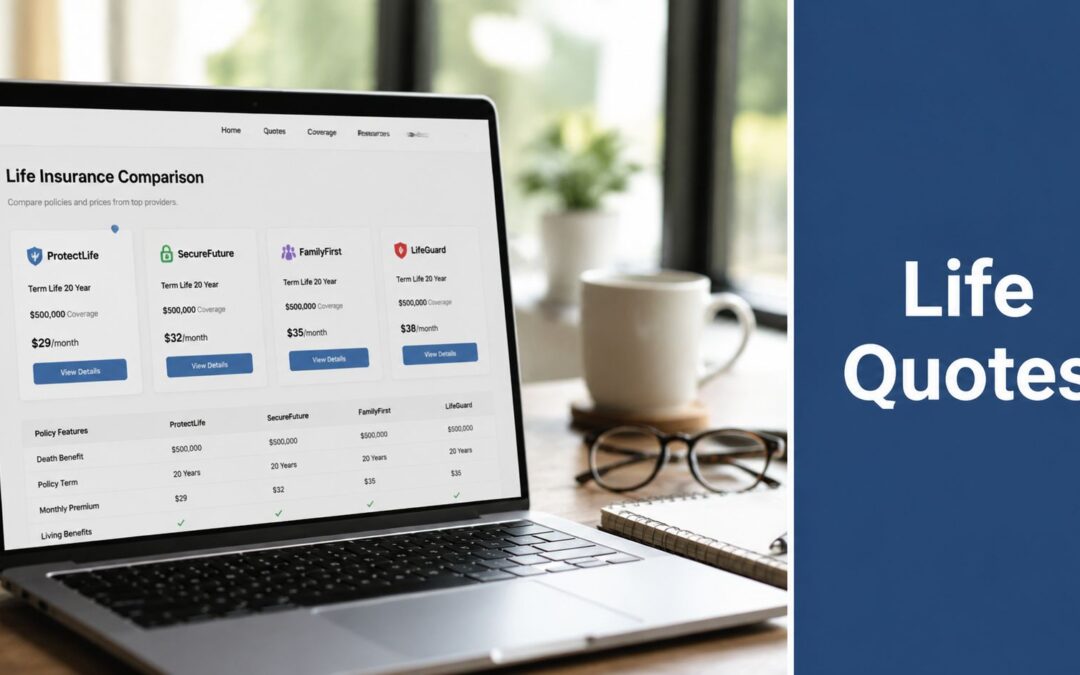
You're probably here because life insurance has moved from “I should deal with that someday” to “I need to handle this now.” Maybe you've got kids, a mortgage, a partner who depends on your income, or you're self-employed and know there isn't a benefits department covering the gaps for you.
So you open a browser, type in life insurance quotes online, and instantly run into a wall of forms, price ranges, product types, and fine print. Some sites promise fast answers. Others ask a dozen health questions before they'll show anything. A few make it sound like the number on the screen is your final price, which is where many shoppers get tripped up.
Online shopping is now a normal way to start. Consumer preference for online life insurance shopping has increased 29% since 2016, according to the Insurance Information Institute's life insurance facts and statistics. That shift makes sense. Digital quote tools let people compare options quickly instead of waiting for multiple phone calls.
But speed creates a new problem. The first quote often feels more certain than it really is.
That gap between the first estimate and the issued policy is what I call quote-to-policy drift. It matters most if your income is irregular, you're a contractor, you've had past health issues, or your work is harder to classify than a standard office job. If you understand that drift before you shop, you'll ask better questions, enter better information, and avoid the frustration of thinking you found one price only to get another later.
If you're also trying to think through how much coverage your family may need in practical terms, this UK guide to life insurance offers a useful framework for approaching the question from a household budgeting perspective.
Your Guide to Getting Life Insurance Quotes Online
The internet is excellent at one part of life insurance shopping. It gives you fast price discovery. That's valuable because life insurance used to be much harder to compare side by side. You often had to rely on whichever agent you spoke to first, and the process felt more opaque than it needed to be.
Today, you can get a rough sense of your options in minutes. That's the upside.
The downside is that many shoppers treat an online quote like a shelf price at a store. Life insurance doesn't work that way. It's closer to a personalized offer built from your age, health, habits, work, and the type of policy you choose. If any of those inputs are thin, vague, or incomplete, the quote may still be useful, but it's less reliable.
Why online quotes help
Online quote tools work well when you use them for what they are meant to do:
- Compare starting points: You can quickly see whether one carrier appears more competitive than another for the same basic profile.
- Pressure test your budget: A quote tells you whether your target coverage amount is realistic before you commit to a full application.
- Spot product fit: You may learn early that a simple term policy fits your needs better than a permanent policy with more moving parts.
Practical rule: Treat the first quote as a screening tool. Useful, fast, and worth doing. Just don't confuse it with a final offer.
Where shoppers get confused
People usually run into trouble in one of three places:
| Situation | What shoppers assume | What often happens |
|---|---|---|
| Quick quote form | “This is probably my real rate.” | It may only be a ballpark estimate |
| Minimal health questions | “The company has already priced my risk.” | The carrier may still need deeper underwriting |
| Unusual work or health history | “If I answer later, it won't matter much.” | Those details can change the offer materially |
That's why a careful online process matters. The goal isn't only to get a quote. It's to get a quote that's close enough to the final policy to be useful.
What an Online Life Insurance Quote Really Is
An online life insurance quote is usually a non-binding estimate, not a guaranteed premium. That's the cleanest way to think about it. According to PinnacleQuote's explanation of online life insurance quotes, quote accuracy improves when the form captures key underwriting details such as age, tobacco use, and health status. Without those details, the result is closer to a ballpark figure.
A simple analogy helps. Think of an online quote like the number you get when you estimate shipping costs before checkout. It tells you the likely range, but the final total depends on the actual package details. Life insurance works the same way. The more complete the details, the better the estimate.
Quote versus final offer
A real final offer usually comes later, after the insurer reviews your application and decides how it classifies your risk. That review may be quick for straightforward cases. It may be more involved if your file raises questions.
Here's the difference in plain English:
- Online quote: A preliminary estimate based on the information entered
- Application: The formal request for coverage
- Underwriting decision: The insurer's review of your risk profile
- Issued policy offer: The premium and terms the carrier is willing to approve
Why some quotes feel firmer than others
Not all quote forms are built the same. Some ask only for age and coverage amount. Others dig into tobacco use, medication history, occupation, and family medical history. The second type usually produces a more dependable estimate because it gives the pricing engine more to work with.
A quote that asks almost nothing about you can only know so much about your risk.
That doesn't make short forms useless. They're helpful for orientation. But if you want a quote you can plan around, you need a form that captures the details an underwriter will eventually care about anyway.
For most shoppers, that's the mindset shift that makes online shopping much less frustrating. You're not buying a number off a page. You're narrowing the field before the real review begins.
The Key Factors Driving Your Quote Price
Price doesn't come from one thing. It comes from a mix of personal factors and policy factors. If you understand both, quotes make a lot more sense and seem a lot less random.

Personal factors
Insurers start with you. Your age matters because pricing generally gets less favorable as you get older. Health history matters because past diagnoses, medications, and ongoing conditions can change how a carrier classifies your application. Tobacco use is a major pricing input. Occupation can also matter, especially if your work includes physical risk, travel, or inconsistent income documentation.
If you're self-employed or work on a contract basis, the occupation question can get more complicated than people expect. A title like “consultant” sounds simple, but underwriters often want to know what you do day to day. Someone who consults from home and someone who climbs structures for contract work may both call themselves independent contractors, but insurers won't price those risks the same way.
Policy factors
Then there's the policy itself. The biggest drivers are:
- Policy type: Term and whole life can price very differently even when the coverage amount looks the same.
- Coverage amount: More death benefit usually means a higher premium.
- Term length: The length of time you want coverage affects cost.
- Riders and features: Optional benefits can change the premium and policy value.
For a healthy 40-year-old, NerdWallet reports that a $500,000, 20-year term policy averages $26 per month, while a whole life policy with the same coverage averages $252 per month, based on its life insurance quotes guide. The same source notes that premiums typically rise 4.5% to 9.2% for every year you wait to buy. Those numbers make one point very clear. Small delays and product choices can have real cost consequences.
Why this matters when comparing quotes
A cheap quote only means something if you know what produced it. Sometimes a lower quote reflects a simple, good-fit policy. Other times it reflects thinner benefits, tighter underwriting assumptions, or a different product category than the one you thought you were comparing.
That's not so different from lead pricing in business. A low number can look efficient until you learn what was included. If you've ever compared acquisition costs, this overview of marketing spend per lead shows the same basic lesson. Unit price without context can mislead.
If you want a broader look at what shapes premiums before you start applying, this guide on how much life insurance costs can help frame the trade-offs.
How to Prepare for an Accurate Online Quote
Most quote problems start before the form is submitted. People guess, round, skip details, or try to “clean up” their health history because they don't want to see a worse number. That usually backfires. Better inputs produce better quotes.
The easiest way to think about it is a pre-flight check. A few minutes of preparation can save you a lot of confusion later.

What to gather before you start
Have these details ready before you use any quote engine:
- Basic identity details: Date of birth, sex, state of residence
- Physical information: Height and weight as accurately as possible
- Health history: Current conditions, past diagnoses, surgeries, and ongoing follow-up care
- Medication list: Prescriptions you take now, and what they're for
- Family medical history: Especially major conditions in close relatives
- Lifestyle details: Smoking, nicotine use, alcohol patterns, and risky hobbies
- Work details: Job title, actual duties, and whether your income is salaried, hourly, or variable
- Policy preferences: Desired coverage amount, term length, and intended beneficiary information
Where honesty matters most
Some fields cause more quote drift than others. If you're going to slow down anywhere, slow down here:
Smoking and nicotine use
Don't answer this based on what you're trying to quit. Answer based on your actual recent use.Medical follow-up
If a doctor is monitoring something, mention it. “It's probably nothing” is not an underwriting category.Job description
Use actual work, not the safest-sounding title. “Business owner” is less useful than explaining whether you manage paperwork, drive long distances, or perform physical labor.Income pattern
If your earnings swing from month to month, expect questions. That doesn't mean you can't get coverage. It means the insurer may need a clearer picture.
The closer your quote form matches the facts in your application, the less likely you are to be surprised later.
A practical way to fill out the form
If your profile is straightforward, a standard quote flow is often enough. If your profile is layered, use a quote request tool that gives you room to explain your situation instead of forcing everything into yes-or-no boxes. My Policy Quote offers an online life insurance quote request form that fits that use case, especially when a shopper wants to provide more context before moving deeper into the process.
A good quote starts with clean information. That sounds simple, but it's the most reliable way to reduce quote-to-policy drift.
Comparing and Validating Your Online Quotes
Once you have a few quotes, don't jump straight to the cheapest one. First check whether you're comparing the same thing. In life insurance, price only tells the truth when the underlying policy specs match.
Guardian's guidance is clear on this point. A sound comparison requires holding the coverage level and term constant across carriers and then evaluating price alongside insurer quality measures such as financial strength, complaint experience, and conversion flexibility, as outlined in Guardian's life insurance comparison guide.

Compare apples to apples
Use a simple checklist before you decide a quote is better:
| Comparison point | What should match |
|---|---|
| Coverage amount | Same death benefit |
| Policy type | Same category, such as term versus whole life |
| Term length | Same duration |
| Underwriting style | Similar process and disclosure requirements |
| Riders | Similar optional benefits if included |
If one quote is cheaper because it uses a shorter term, a different policy type, or fewer features, it isn't really a cheaper version of the same policy. It's a different policy.
Look beyond the premium
Once the basics line up, look at the carrier itself and the contract details.
- Financial strength: You want an insurer with a strong ability to pay long-term claims.
- Complaint patterns: A low premium loses its shine if service becomes difficult when your family needs help.
- Conversion options: For term coverage, some policies give you more flexibility to convert later.
- Exclusions and riders: These can affect the practical value of the policy, not just the price.
A good quote isn't just affordable. It's dependable, understandable, and suited to how your life may change.
If you want a framework for organizing multiple offers side by side, this page on life insurance quotes comparison is a useful companion when you're narrowing choices.
Red Flags and Why Your Final Price Might Change
Frequently, shoppers feel blindsided. They apply after seeing a reasonable quote, then the actual offer comes back at a different price or with different terms. That doesn't always mean anyone did something wrong. It usually means the insurer moved from quick screening to full review.
Many online guides skip this part. Western & Southern notes that the initial online estimate is often just a screening price, while final pricing depends on a deeper review of health, occupation, and lifestyle in its guide on getting affordable life insurance.

Why drift happens
The quote engine prices based on what it knows. Underwriting prices based on what it can verify.
That difference matters most in cases like these:
- Borderline health histories: The quote may assume a mild issue is well controlled, but records may show ongoing testing, complications, or additional diagnoses.
- Variable work profiles: Self-employed applicants may enter a broad title, while underwriting asks what the work really involves and how stable the income is.
- Incomplete lifestyle details: Risky hobbies, nicotine use, or alcohol patterns can move an application into a different class.
- Missing policy detail alignment: The first quote may not reflect the exact features, riders, or limits that end up in the actual application.
Red flags to watch for early
Some quote experiences should make you pause:
- Very low quotes with almost no questions: If a site asks for almost nothing, it can't price you with much precision.
- No mention of underwriting: Every insurer has to assess risk somehow. If the process sounds frictionless to the point of vagueness, look closer.
- No discussion of occupation or health nuance: This especially matters for contractors, tradespeople, and people with complex medical backgrounds.
- Pressure to apply before you understand the policy: A quote should clarify choices, not rush you past them.
If a quote looks unusually easy, ask yourself what the insurer still needs to learn before it can stand behind that number.
Who should expect more movement
Quote-to-policy drift tends to be more common for people whose profiles don't fit neatly into a standard underwriting box. That includes business owners, gig workers, pre-retirees with medication history, and applicants managing past health events that are stable but still documented.
If you want a plain-language explanation of what happens after the quote stage, this guide on what underwriting in insurance is and how it works can help you decode the process.
From Quote to Policy Your Next Steps
Once you've found the strongest quote, the process becomes more formal. This is the point where good preparation pays off.
What happens after you choose a quote
Most applications follow a sequence like this:
Submit the formal application
You'll provide detailed personal, health, work, and beneficiary information.Complete any required follow-up
Some policies move forward with only health questions. Others may require more review or additional records.Underwriting review
The insurer checks the information, classifies the risk, and decides what offer it can make.Review the issued offer carefully
During this step, you confirm the premium, policy type, term, features, and any conditions attached to the offer.Accept and place the policy in force
Coverage usually starts only after the insurer's conditions are satisfied and the policy is activated according to its terms.
When to stop doing it alone
Online shopping is excellent for straightforward cases. It's less reliable as a solo project when your profile has friction points.
Consider speaking with a licensed advisor if:
- Your income isn't easy to document
- You own a business or work multiple jobs
- You've had recent or ongoing medical follow-up
- You're comparing term against permanent coverage and the trade-off isn't clear
- You've received one quote that seems out of line with the others
That doesn't mean the online route failed. It means the online quote did its job by showing where expert clarification can save time.
A grounded way to move forward
Start with a quote, but don't stop at the number. Ask what assumptions sit underneath it. Check whether the policy specs are truly comparable. Be precise about your health and work history. If your situation is more complex, get help before you apply rather than after a surprising offer arrives.
That's how life insurance quotes online become useful instead of confusing. The goal isn't just to get a fast estimate. It's to get coverage you can trust your family to rely on.
If you're ready to turn rough estimates into a more informed next step, My Policy Quote offers a practical place to request life insurance pricing online and move toward a quote that better reflects your real situation.