

Medicare Plan N is one of those options that hits a sweet spot for a lot of people. It’s a Medigap plan designed for folks who want a good balance between solid coverage and a lower monthly premium. Think of it as a middle-ground choice—it protects you from the big, scary healthcare costs but asks you to chip in for small, predictable expenses like doctor’s visits.
Unpacking Your Medicare Plan N Coverage

Navigating Medicare can feel like learning a new language, but Medicare Plan N is actually pretty straightforward once you get the hang of it. At its core, Plan N is a type of Medicare Supplement Insurance, which you’ll often hear called “Medigap.” Its whole job is to step in and pay for the things that Original Medicare (Parts A and B) leaves behind—those financial “gaps” like deductibles and coinsurance. If you want a deeper dive into the basics, our guide on what is a Medicare Supplement plan is a great place to start.
Here’s a simple analogy: If Original Medicare is your home insurance that covers major disasters, a Medigap policy like Plan N is the extra coverage that helps pay your deductible when you have to make a claim. It’s all about protecting your savings from those unexpected, and often huge, medical bills.
What Makes Plan N A Popular Choice?
Plan N has really caught on with people who are in relatively good health and want to keep their monthly premiums down without giving up protection for major medical events. You get a lower monthly bill compared to more comprehensive plans like Plan G, and in return, you agree to handle a few small, predictable costs on your own.
This cost-sharing approach is really what defines Plan N. Here’s what you’ll be responsible for:
- Small Copayments: You might pay up to $20 for some office visits. If you head to the emergency room, there’s a $50 copay, but that gets waived if you’re admitted to the hospital.
- The Annual Part B Deductible: Just like with most Medigap plans sold today, you’ll need to pay the annual Medicare Part B deductible yourself before Plan N starts covering its share of your medical services.
- Potential Part B Excess Charges: This one is pretty rare, but some doctors who don’t accept Medicare assignment can charge up to 15% over the Medicare-approved amount. Plan N does not cover these "excess charges."
By taking on these small and predictable costs, you can often lock in a much lower monthly premium. It’s a trade-off that makes budgeting for healthcare a whole lot easier, and for many, it just makes financial sense.
Let’s take a quick look at how Plan N lays out what it covers and what you'll pay.
Medicare Plan N at a Glance
This table breaks down the key benefits of Medicare Plan N, showing you exactly what the plan pays for and what portion you're responsible for after you’ve met your Part B deductible.
| Coverage Benefit | What Plan N Pays | Your Responsibility |
|---|---|---|
| Part A Coinsurance & Hospital Costs | 100% (up to 365 extra days) | $0 |
| Part B Coinsurance/Copayment | 100% (except for small copays) | Up to $20 office visit copay, up to $50 ER copay |
| First 3 Pints of Blood | 100% | $0 |
| Part A Hospice Care Coinsurance | 100% | $0 |
| Skilled Nursing Facility Coinsurance | 100% | $0 |
| Part A Deductible | 100% | $0 |
| Part B Deductible | 0% | 100% of the deductible amount |
| Part B Excess Charges | 0% | 100% of any excess charges |
| Foreign Travel Emergency | 80% (up to plan limits) | 20% and any remaining costs |
This summary makes it clear: Plan N handles the big hospital bills and most medical costs but leaves a few minor, everyday expenses in your hands in exchange for that lower premium.
With Medicare Advantage plans now covering over half the market, people who stick with Original Medicare are finding that a good supplement is more important than ever. Plan N has become a popular solution to fill those gaps. The average monthly premium hovers around $128, but this can change quite a bit depending on where you live and other factors.
When you're looking at Plan N, it’s also useful to know what Original Medicare itself does and doesn't cover, especially for services like in-home care. Understanding the answer to Does Medicare cover home care? helps you see exactly where and why a Medigap plan is so valuable.
A Clear Breakdown of Your Costs with Plan N
Let’s be honest—when it comes to insurance, the bottom line is what matters most. Understanding how Plan N handles costs is the key to feeling confident that you've made the right call.
Unlike some plans that wrap everything into one big, expensive premium, Plan N takes a different approach. It uses a smart cost-sharing model, which means you handle a few small, predictable costs yourself. In return, you get a much lower monthly premium. Let's break down exactly what you’ll pay, so there are no surprises down the road.
The Four Parts of Your Plan N Costs
Think of your out-of-pocket costs with Plan N as a simple, four-item checklist. Once you get these, you’ve pretty much mastered how the plan works.
-
Your Monthly Premium: This is the straightforward, fixed amount you pay the insurance company each month for your Plan N policy. It’s what keeps your coverage active. While the price tag varies depending on where you live, your age, and the company you choose, it’s almost always noticeably lower than what you’d pay for a plan like G.
-
The Annual Part B Deductible: This is a once-a-year cost set by Medicare, not the insurance company. For 2024, the Part B deductible is $240. You’ll pay this amount out of your own pocket for things like doctor visits or outpatient care. After you’ve met that $240 for the year, you’re done with it until next year, and your Plan N coverage takes over.
-
Predictable Copayments: This is where that "cost-sharing" idea really kicks in. After you’ve paid your Part B deductible for the year, you’ll have a small copay for certain services. We’re talking up to $20 for a doctor's office visit and up to $50 if you have to go to the emergency room. Here's a great little detail: that $50 ER copay is completely waived if you end up being admitted to the hospital as an inpatient.
-
Part B Excess Charges: This one sounds scarier than it is. It's easily the most misunderstood—and rarest—cost associated with Plan N. An excess charge is an extra amount, up to 15% over what Medicare agrees to pay, that some doctors can legally bill you. Plan N does not cover this charge.
But here’s the good news: most people will never see an excess charge. Why? Because many states have banned them outright, and the overwhelming majority of doctors across the country "accept Medicare assignment." That's just a fancy way of saying they agree to take Medicare's approved amount as full payment.
How to Easily Avoid Excess Charges
The thought of a surprise 15% bill is enough to make anyone nervous, but avoiding it is incredibly simple. All you have to do is ask your doctor’s office one direct question: “Do you accept Medicare assignment?”
If they say yes, you’re in the clear. You will never get an excess charge from that doctor. It’s that easy.
For a deeper dive into how these charges work and to see which states protect you from them, our guide on what are Medicare Part B excess charges has all the details you need. Arming yourself with this knowledge lets you use your Plan N benefits with total confidence.
The official Medicare website is also a fantastic resource for double-checking deductibles and learning exactly which services fall under Part B.
A Real-World Cost Scenario
Let's walk through an example. Say you have Plan N and you go to your primary care doctor for a check-up at the beginning of the year.
- First, the bill for that visit will be applied to your $240 Part B deductible.
- Once that deductible is paid off for the year, any future office visits will only cost you a small copay of up to $20.
- And if something major happens, like a hospital stay? Plan N has your back, covering your big Part A deductible and coinsurance completely. That alone can save you thousands.
This structure makes Medicare Plan N a fantastic choice for people who are perfectly fine with small, predictable copays in exchange for a much friendlier monthly premium. It gives you ironclad protection from catastrophic medical bills while keeping your fixed costs low and manageable.
Comparing Plan N With Other Popular Medigap Plans
Choosing a Medigap plan can feel like staring at a menu where everything looks almost the same, yet the prices are all different. It’s confusing. Most of the time, the decision boils down to three top contenders: Plan N, Plan G, and the old favorite, Plan F.
Instead of just throwing charts at you, let’s break down the real-world trade-offs. We'll look at premiums, what you actually pay out-of-pocket, and why one person might gladly pay more for simplicity while another prefers saving money every month.
Plan N vs. Plan G: The Main Event
For anyone new to Medicare, this is the big decision. Think of Plan G as the “all-inclusive” resort of Medigap. Once you pay your annual Part B deductible, it covers pretty much everything else. No copays for doctor visits, and it even handles those rare Part B excess charges. Simple.
Plan N, on the other hand, is more of an “à la carte” option that comes with a lower monthly price tag. You get the exact same powerful coverage for big things like hospital stays, but you agree to pay for a few small, predictable costs yourself:
- A small copay of up to $20 for a doctor's office visit.
- A $50 copay if you go to the emergency room (but it's waived if you're admitted).
- You cover Part B excess charges (which are very uncommon).
The choice is pretty straightforward: Plan G gives you total predictability for a higher monthly premium, while Medicare Plan N offers a lower premium in exchange for minor, pay-as-you-go costs. It all depends on your preference—pay more upfront for peace of mind, or save on premiums and handle small bills as they come.
Understanding The Role of Plan F
You’ll still hear people talk about Plan F. It was once known as the "Cadillac" of Medigap because it covered every single gap, including the Part B deductible. But the rules have changed.
A federal law now prevents anyone who became eligible for Medicare on or after January 1, 2020, from buying Plan F. It’s only available to those who were eligible before that date.
For the folks who can still get it, Plan F offers true first-dollar coverage. You pay your premium, and that's it—zero out-of-pocket costs. While that sounds perfect, it comes with the highest monthly premium. Plus, since only older beneficiaries can enroll, the risk pool is aging, which often leads to steeper and more frequent rate increases over time.
Side-by-Side Plan Comparison
To make these differences pop, here’s a simple table laying it all out. This shows you exactly what’s covered after Original Medicare pays its share.
Plan N vs. Plan G vs. Plan F Feature Comparison
| Feature | Medicare Plan N | Medicare Plan G | Medicare Plan F* |
|---|---|---|---|
| Part B Deductible | You Pay | You Pay | Plan Pays |
| Office Visit Copays | Up to $20 | $0 | $0 |
| ER Visit Copay | Up to $50 | $0 | $0 |
| Part B Excess Charges | You Pay (if charged) | Plan Pays | Plan Pays |
| Monthly Premium | Lowest | Medium | Highest |
| Hospital Coverage (Part A) | Fully Covered | Fully Covered | Fully Covered |
| Availability | All New Beneficiaries | All New Beneficiaries | Only if eligible before 2020 |
*Plan F is only available to individuals eligible for Medicare before January 1, 2020.
The numbers don't lie. Between 2020 and 2023, Plans G and N made up a whopping 75.8% of all new Medigap policies sold. While Plan G has been the frontrunner, savvy insurance carriers are now pushing Medicare Plan N hard to attract new, healthier members as the claims costs for the richer Plan G start to climb.
Think of your Plan N costs like a pyramid. Your monthly premium is the solid base—it's predictable and consistent. The other costs are much smaller and less frequent.
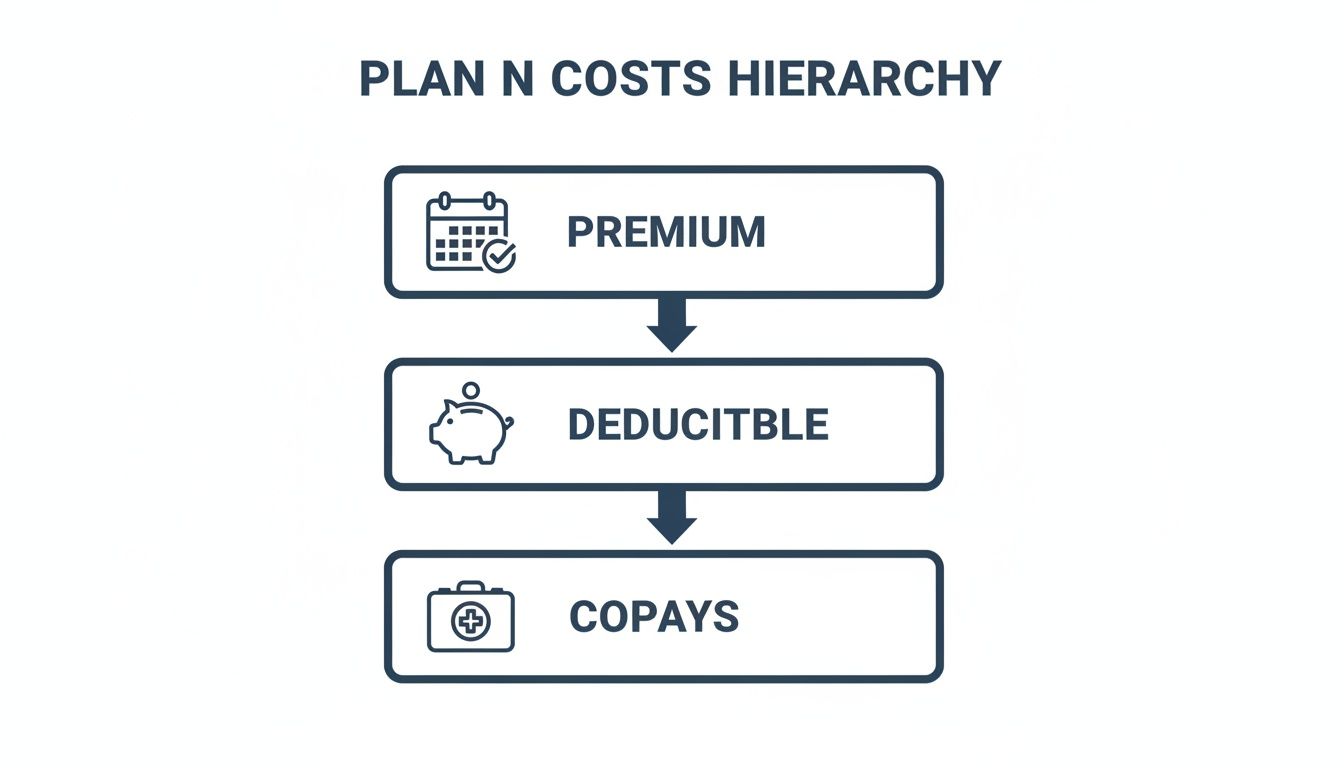
This visual makes it clear: your biggest cost is the one you budget for each month. The rest are either once-a-year (the deductible) or only happen when you see a doctor.
Ultimately, picking the right plan is a personal call. It's about balancing your budget with your desire for predictability. If you want to dig deeper, check out our guide on the best Medicare Supplement plan options available this year.
Is Medicare Plan N the Right Fit for You?

Choosing a Medigap plan isn’t about staring at a comparison chart. It’s about finding a plan that fits your actual life—your health, your budget, and how you feel about handling small, predictable costs as they come up.
Medicare Plan N strikes a smart balance for many, offering lower monthly premiums in exchange for some cost-sharing. But it’s definitely not a one-size-fits-all solution.
So, let's step away from the technical jargon for a minute and look at how Plan N plays out for real people. Seeing it in action is the best way to figure out if it aligns with what you need from your healthcare coverage.
Who Benefits Most from Plan N?
The person who thrives with Plan N usually fits a certain profile. They’re looking for a good financial trade-off: paying less every month for their premium, knowing they might have to cover small, pay-as-you-go costs for routine care.
If any of this sounds like you, Plan N could be a fantastic match.
Let’s meet Sarah, a 66-year-old retired teacher. She’s in great health, doesn't take daily medications, and typically only sees her doctor for an annual wellness visit.
- Her Priority: Keeping her fixed monthly bills as low as possible to make her retirement budget stretch further.
- Why Plan N Works for Her: The lower monthly premium is a huge win. The thought of a potential $20 copay for a doctor's visit once or twice a year is a tiny price to pay for the significant savings she sees compared to Plan G. She’s got solid protection if a serious illness ever pops up, but she isn’t overpaying for everyday coverage she hardly uses.
Now, think about David, who is 68. He's very budget-conscious and lives in a state like Pennsylvania or Ohio, where doctors aren't allowed to bill for Part B excess charges.
- His Priority: He wants comprehensive coverage without the risk of surprise bills, but he also wants the most bang for his buck.
- Why Plan N Works for Him: Living in a state that bans excess charges removes one of Plan N's only potential wild cards. This makes the plan an even safer bet, giving him peace of mind that feels a lot like Plan G but with a smaller premium hitting his bank account each month.
The bottom line? When you know your state's rules on excess charges and have a good handle on how often you see a doctor, the financial upside of Medicare Plan N becomes crystal clear. It’s all about finding that sweet spot where premium savings easily outweigh any potential out-of-pocket costs.
When to Think Twice About Plan N
While Plan N is a great deal for many, it’s not for everyone. Certain health situations or even just personal preferences might make a plan with more upfront coverage, like Plan G, a better fit. It really comes down to your comfort level with copayments and how you prefer to budget for your health.
Imagine someone with a chronic condition who sees different specialists several times a year. If you're visiting doctors ten or twelve times annually, those $20 copayments will start to add up quickly. For that person, the higher premium of a Plan G might actually save them money and simplify their life by eliminating those per-visit costs.
Here are a few signs that Plan N might not be the best choice for you:
- You Have a Chronic Condition: If you need regular visits to specialists or require ongoing therapies, the total cost of copays could make another plan more affordable in the long run.
- You Value Simplicity Above All Else: Some people just want to "set it and forget it." They'd rather pay a higher, predictable premium and not have to pull out their wallet at the doctor's office.
- Your Doctors Don't Accept Medicare Assignment: If you live in a state that allows excess charges and your trusted doctors don't accept Medicare's approved amount, you’ll likely want the complete protection that Plan G offers.
In the end, it’s your call. Weigh the monthly premium savings of Medicare Plan N against the possibility of small, out-of-pocket expenses. Finding that perfect balance is the key to securing your health and financial future.
How to Enroll in Your Medicare Plan N Policy
Choosing your Medigap plan is a big decision, but getting enrolled in Medicare Plan N is usually more straightforward than you might think. The trick is to understand the timeline and the rules that work in your favor.
With a clear roadmap, you can lock in your policy with confidence, knowing you got the best possible price without any health-related roadblocks.
The absolute best time to sign up is during your Medigap Open Enrollment Period. This is a one-time, six-month window that kicks off on the first day of the month you’re both 65 or older and signed up for Medicare Part B.
During this golden window, insurance companies can't use medical underwriting. What does that mean for you? They are legally required to sell you any Medigap policy they offer—including Plan N—no matter what your health history looks like. They can’t turn you down or charge you more because of pre-existing conditions. It’s your single best shot to get covered, guaranteed.
The Step-by-Step Enrollment Process
Once you’re in your Medigap Open Enrollment Period, the process is pretty simple. Because every Medicare Plan N policy offers the exact same standardized benefits, your main goal is to find the insurance company with the most competitive price in your zip code.
-
Get Your Info Ready: Have your Medicare card handy. You'll need your Medicare number and the start dates for your Part A and Part B coverage.
-
Shop Around for Quotes: The smartest move is to work with an independent agent or use an online tool to compare premiums from different carriers. You’d be surprised how much prices for the identical Plan N can vary, so comparing is key to finding a great deal.
-
Fill Out the Application: The application itself is typically short and sweet. It will ask for basic personal details and your Medicare information. Since you’re applying during Open Enrollment, there won’t be any health questions.
-
Pick Your Start Date: You can choose when you want your policy to begin. Most people align it with their Part B effective date to make sure there are no gaps in coverage.
Securing your plan during the Medigap Open Enrollment Period is the most strategic move you can make. It removes all barriers, guarantees your acceptance, and puts the power entirely in your hands. Missing this window can make enrolling more difficult and potentially more expensive later on.
What Happens If You Miss Open Enrollment
It's still possible to apply for a Medicare Plan N policy outside of that initial six-month window, but the game completely changes. In most cases, you’ll have to go through full medical underwriting.
This means the insurance company will dig into your health history with detailed questions, and they can legally deny your application based on your answers.
But there's hope. Certain life events can trigger a Special Enrollment Period, giving you another shot at guaranteed issue rights. These situations might include losing coverage from an employer or moving out of your current plan’s service area.
Some people also look to switch from a Medicare Advantage plan to Medigap. That process has its own set of rules and timing you need to follow. If that’s you, it’s a good idea to check out our guide on how to change from Medicare Advantage to Medigap to see what your options are. By getting the timing right, you can make the whole process a lot smoother.
Answering Your Top Questions About Plan N
Even after digging into the details, it’s completely normal to have a few questions left. Let’s be honest—the world of Medicare has its own language and rules, and it’s smart to get clear on the finer points before you make a commitment.
This is where we tackle the most common questions that pop up when people are seriously considering Medicare Plan N. We’ve gathered the top concerns and are here to give you clear, direct answers so you can feel confident in your choice.
Are Part B Excess Charges a Big Concern with Plan N?
It’s a valid question, but the reality is that Part B excess charges are far less common than you might think. An excess charge is an extra fee—up to 15%—that some doctors can add on top of the Medicare-approved amount for a service. Plan N doesn't cover this, which is a key difference between it and Plan G.
But for most people, this is rarely an issue. Here’s why.
First, many states have simply outlawed them. If you live in a state like Ohio, Pennsylvania, or New York, doctors aren't legally allowed to bill for excess charges. For residents there, it's a non-issue.
Second, even where they are allowed, the huge majority of doctors "accept Medicare assignment." That’s a critical phrase. It means they've agreed to accept Medicare's approved rate as full payment. If your doctor accepts assignment, they legally cannot bill you an excess charge.
The easiest way to protect yourself is to just ask your doctor's office one simple question: "Do you accept Medicare assignment?" If they say yes, you’ll never see this charge. For most people, the money saved on Plan N premiums is well worth the tiny risk of running into this.
Can My Medicare Plan N Premium Increase Over Time?
Yes, and it’s normal for Medigap premiums to go up over time. Plan N is no different. Insurance companies price their policies in a few different ways, and that affects how your rates might change as you get older.
- Attained-Age-Rated: This is the most common method. Your premium starts lower and gradually increases as you age.
- Issue-Age-Rated: The premium is based on your age when you first buy the policy. It won’t go up just because you get older, but it can still rise with inflation.
- Community-Rated: Everyone in a certain area pays the same premium, no matter their age.
No matter the method, all premiums can be adjusted for inflation and rising healthcare costs. The key takeaway? While you should expect increases, Medicare Plan N premiums almost always stay lower than what you’d pay for more comprehensive plans like Plan G.
Can I Switch from a Medicare Advantage Plan to Plan N?
Yes, you can make the switch, but the timing is everything. You can’t just jump from a Medicare Advantage plan to Original Medicare with a Plan N whenever you feel like it.
This kind of change usually has to happen during specific times of the year, most commonly the Annual Enrollment Period (AEP) from October 15 to December 7.
But here’s the most important part: if you leave a Medicare Advantage plan after your initial “trial right” period (usually the first year), you will almost always have to go through medical underwriting to get Plan N. This means the insurance company gets to dig into your entire health history.
Based on what they find, they can deny your application or charge you a much higher premium for pre-existing conditions. Your best shot at enrolling with no health questions asked is during your one-time Medigap Open Enrollment Period right when you first get Medicare.
Does Plan N Cover Prescription Drugs?
No, Medicare Plan N does not cover prescription drugs. In fact, no modern Medigap plan sold today does. These plans are designed only to fill the gaps in Original Medicare—Part A for hospital stays and Part B for doctor visits.
To get your medications covered, you have to sign up for a separate Medicare Part D Prescription Drug Plan. It's so important to enroll in a Part D plan as soon as you're eligible for Medicare. If you wait, you could face a permanent late enrollment penalty that gets tacked onto your monthly premium for life.
With Plan N, you’ll pay a separate monthly premium for your Part D plan. This is on top of what you pay for Medicare Part B and Plan N itself. This setup gives you the freedom to pick the drug plan that actually fits the medications you take.
Navigating your Medicare options is a major decision, but you don't have to figure it all out alone. The licensed agents at My Policy Quote are here to give you personalized help at no cost. We can help you compare plans, find the lowest rates in your area, and make sure you land on the perfect coverage for your life and your budget. https://mypolicyquote.com