
Income records to gather before a self-employed health insurance review
A strong sales month, a quiet winter and a contract that might renew can make one income question surprisingly difficult. Before comparing health plans, put your records and assumptions on one page. You need a reasonable estimate you can explain, rather than a guess based on the last deposit in your account.
This checklist is for preparing a coverage conversation, particularly when you are considering Marketplace coverage. It does not calculate your tax return, determine financial assistance or replace an application. Keep the completed notes for your own reference.
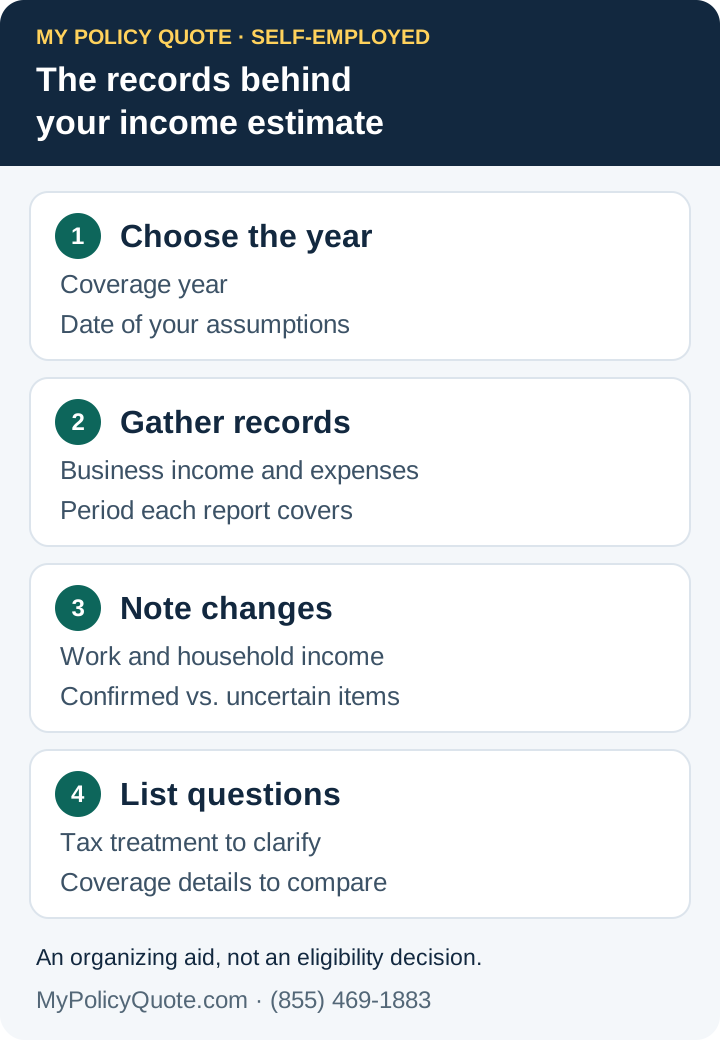
Write the coverage year at the top
For a plan starting in 2027, prepare an estimate for 2027. Last year's return can give you a starting point, but it cannot explain a new contract, a closed business or a spouse's changing work schedule.
HealthCare.gov's self-employment guidance bases Marketplace savings on expected net income for the year of coverage. A business's sales total and its profit are different figures. If you are unsure which expenses belong in your calculation, mark the question for your tax professional.
Gather records in three small groups
1. What your business records show
Bring together your income-and-expense ledger or accounting reports, recent invoices and relevant expense records. Label the period each report covers. A report through September should not accidentally be treated as a full year's result.
Put last year's tax return beside these records as a reference. Then write down what has changed. The IRS recordkeeping overview explains why a system that clearly shows income and expenses matters; it does not require every business to use the same software.
2. What you reasonably expect to change
Make a short list of signed work, likely renewals, seasonal slow periods and expenses you expect to change. Distinguish a confirmed contract from a possible project. Date the assumptions so you can see later why you made them.
A clearly labeled hypothetical: a consultant's largest client has signed only through March. The useful note is not “same as last year.” It is “contract confirmed through March; later work still uncertain.” That identifies the part of the estimate to review without pretending future income is guaranteed.
3. What belongs to the household
Your business records are only one part of the picture. Gather relevant wage statements and information about other household income and expected changes. Marketplace household guidance explains whose income to consider, including the rules for dependents required to file a return. Do not assume that a household member's income is irrelevant just because that person is not seeking coverage.
Copy this preparation worksheet
Use a notebook or your own document. Fill the blank column with a short answer and the record behind it. This is an organizing tool, not an official verification form or a calculation of Marketplace household income.
| Item to record | Your note and supporting record |
|---|---|
| Coverage year and review date | Year: ______ · Notes updated: ______ |
| Business records available | Report or ledger: ______ · Period covered: ______ |
| Expected business changes | What changes, when, and why: ______ |
| Confirmed versus uncertain work | Confirmed through: ______ · Still uncertain: ______ |
| Other household income to review | Source and expected change: ______ |
| Questions for a tax professional | Expense treatment, household rules or adjustments: ______ |
| Questions for the coverage review | What estimate is being used, and what needs updating? ______ |
Keep three different tasks separate
Preparing an estimate means using records and reasonable expectations. Verifying information means responding to a specific request from the Marketplace. Choosing a plan means comparing the coverage you would actually use.
If the Marketplace asks for proof, follow its notice and deadline. Its document instructions explain that acceptable evidence depends on what needs confirming. A home-made preparation sheet is not automatically sufficient, and an ordinary coverage inquiry does not submit documents to the Marketplace.
After organizing the income questions, compare doctors, prescriptions, deductibles and other costs. Our guide to reading a Summary of Benefits and Coverage gives you a way to examine a plan's terms. The broader self-employed health insurance guide discusses coverage choices; use current official guidance for the year and rules that apply to you.
End with the question you want answered
“Which coverage options should I compare using this expected income, and what would I need to revisit if my work changes?” is a useful starting question. You can discuss the assumptions before sending tax documents or detailed financial records.
To request a coverage review, call My Policy Quote at (855) 469-1883 or send a coverage inquiry. Have your coverage year, current plan questions and the main uncertainties ready. If your expected income changes after enrollment, use the Marketplace's change-reporting instructions promptly rather than waiting for the next annual review.
General education, not individual tax advice or an eligibility determination. Plan availability, benefits and financial assistance depend on the applicable rules and your circumstances. Daniel R. is an MPQ editorial pen name; no licensed review is claimed.