
How to read a Summary of Benefits and Coverage before switching plans
A lower premium gets your attention. The next question is what happens when you use the plan. Before switching health insurance, open its Summary of Benefits and Coverage, or SBC. Read the deductible, services covered before it, out-of-pocket limit, network rules and service limitations together. Then check the details the summary cannot settle, including your doctors and exact medications.
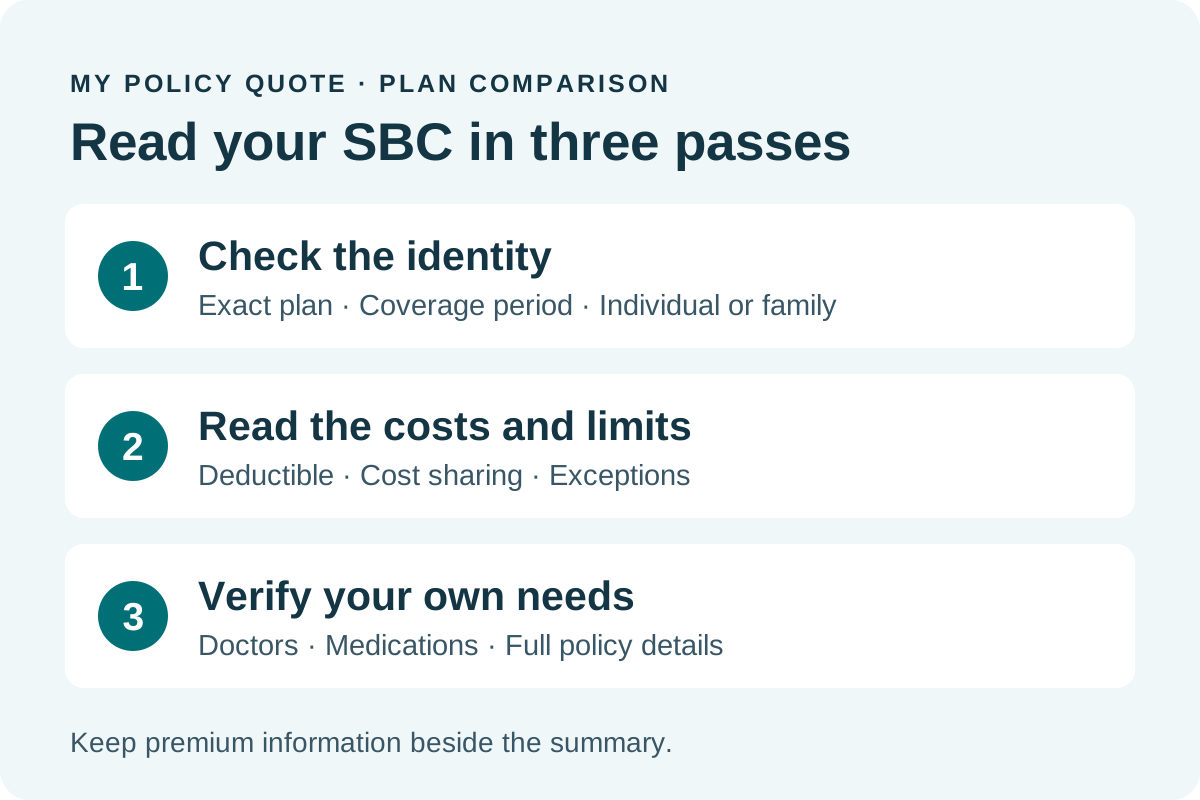
The SBC gives you a consistent way to compare individual and job-based health plans. It is a starting document, not the complete insurance contract or a personalized estimate of your medical bills. Here is a practical way to use it without getting lost in every row.
Get the right document first
Download the SBC for the exact plan and coverage period you are considering. Check the plan name, dates, plan type and whether the document describes individual or family coverage. A familiar insurance company name does not establish that you have the right version.
On the Marketplace, the SBC is linked from the detailed plan information. You can also request it from the insurer or job-based plan. HealthCare.gov explains where to find the SBC and its accompanying Uniform Glossary.
Put your current plan and proposed plan side by side. For a renewal comparison, use the upcoming coverage period for both options. Keep the premium information beside them: the standard SBC explains that premiums are supplied separately.
Read these five parts together
- The overall deductible. Note the individual and family amounts, then look for separate deductibles for services such as prescriptions. Ask how the family deductible works for one person’s care.
- Services available before the deductible. Find which services are covered before you meet it and what you still pay. “Before the deductible” does not automatically mean free.
- The out-of-pocket limit and its exceptions. Read what counts toward the limit and what does not. Keep in-network and out-of-network figures separate when both appear.
- Network and specialist rules. Look for network requirements and whether referrals are needed. A benefit listed in the summary does not confirm that your preferred clinician participates.
- The limitations beside each service. For the care you expect to use, read across the row rather than stopping at the copayment or percentage.
The CMS explanation of the SBC describes how its common format helps consumers compare benefits, cost sharing and limitations. Your own plan’s current document supplies the actual terms.
Watch the words beside the number
A deductible is what you pay for certain covered services before the plan begins sharing those costs. Many plans cover some services before it is met, and some have separate deductibles. Check the relevant service row rather than applying one rule to the whole plan. HealthCare.gov’s deductible explanation describes these distinctions.
Here is a hypothetical illustration, not an actual plan offer: two SBCs both show 20% coinsurance for a particular covered service. One applies a deductible first; the other says the deductible does not apply to that service. The matching percentages do not make the costs equivalent. You still need the applicable allowed amount, benefit terms and any remaining deductible to estimate your share.
Also, an out-of-pocket limit is not a ceiling on every health expense. Premiums, noncovered services and other excluded expenses can sit outside it. For Marketplace plans, the official out-of-pocket limit definition explains the in-network covered-care protection and what is excluded. Do not add premiums to the limit and call the result a guaranteed maximum for every situation.
Check doctors and medications separately
Use the exact plan’s provider directory, then confirm the specific doctor and location with the insurer and the doctor’s office. Ask about the proposed coverage year and network. A general statement that an office takes an insurance company is not the same as confirmation for your particular plan. See HealthCare.gov’s provider-checking steps.
For prescriptions, check the plan’s formulary and pharmacy network. Have the medication name, strength and dosage available. Ask about the applicable tier, deductible and any authorization or other restrictions. The SBC’s general prescription rows are useful, but they do not replace checking your exact medication. HealthCare.gov outlines the ways to verify prescription coverage.
Use the coverage examples as comparisons
The examples near the end illustrate how the plan shares costs in standardized medical situations. They are not promises about your treatment or bills. The CMS sample SBC explicitly warns that its examples are not a cost estimator. It is a teaching sample with a past coverage period, not a plan you can purchase.
Compare the same example across plans to notice differences, then return to your own needs. Do not use a sample’s dollar figures as current insurance rates or assume its benefits apply to an MPQ option.
Make a short comparison sheet
For each plan, write down these items. Mark unresolved questions instead of guessing.
- Exact plan name, network and coverage dates.
- Premium you would pay, recorded separately.
- Individual, family and any separate service deductibles.
- Costs for the visits, tests and prescriptions you expect.
- Applicable out-of-pocket limit and expenses outside it.
- Doctor and medication verification, including who confirmed it and when.
- Restrictions or exclusions you still need explained.
For the broader decision, our health insurance comparison guide helps connect those details to your budget. The SBC walkthrough answers a narrower question: where to find the terms behind the comparison.
Ask for a comparison you can explain
A useful question is: “Can you walk me through what changes for my doctors, medications and expected care if I switch?” Bring the two SBCs and your open questions.
Call My Policy Quote at (855) 469-1883 or request a plan review. Ask for the relevant plan documents and an explanation of meaningful differences before deciding. A lower premium can matter; so can the costs and restrictions you accept with it.
Marcus L. is a My Policy Quote editorial pen name. This educational guide concerns individual and job-based health insurance SBCs; it is not a Medicare Evidence of Coverage guide. Benefits, availability, networks and costs vary by plan, state and year. The applicable policy and plan documents govern. No savings, eligibility or licensed review is claimed.