

Figuring out affordable family health insurance is all about finding that sweet spot between what you pay each month and what you'd have to shell out if someone actually gets sick.
The "best" plan isn't always the cheapest one on the sticker. It’s the one that gives you real value for your family’s unique needs, protecting your health and your wallet at the same time. This means looking way past that monthly bill to see the whole picture.
What Makes a Family Health Plan Truly Affordable

Think of it like choosing a family car. You could buy a tiny, fuel-efficient two-seater for a low price, but it’s not going to work for a family of five with soccer practice and grocery runs. The minivan with more space and higher monthly payments is actually the more "affordable" choice because it fits your life.
Health insurance works the same way. A plan that looks great for a healthy, single person might be a disaster for a family with young kids who need regular check-ups or have an ongoing condition.
True affordability is about finding a plan that matches your family’s reality.
Key Factors Defining an 'Affordable' Health Plan
To get a handle on what a plan will really cost you, it helps to break down the main components. This table lays out the core terms that determine a plan's true affordability, moving beyond just that monthly premium.
| Factor | What It Means for Your Budget | Ideal For… |
|---|---|---|
| Premium | Your fixed monthly payment to keep the plan active. This is your predictable, ongoing cost. | Families who need a stable, predictable monthly budget. |
| Deductible | The amount you must pay out-of-pocket before the insurance company starts paying its share. | Healthy families who don't expect many medical needs and prefer lower monthly premiums. |
| Copay | A flat fee you pay for specific services, like $30 for a doctor’s visit, after your deductible is met. | Families who want clear, fixed costs for routine visits and prescriptions. |
| Coinsurance | The percentage of costs you share with your insurer after the deductible is met (e.g., you pay 20%, they pay 80%). | People comfortable with variable costs in exchange for potentially lower premiums. |
| Out-of-Pocket Max | The absolute most you'll have to pay for covered services in a year. It's your financial safety net. | Every family. This number protects you from catastrophic medical bills. |
Understanding these pieces is the first step toward making a confident choice. It’s about knowing where your money is going and what you’re getting in return.
Decoding the Language of Affordability
Let's quickly demystify those terms because they're the building blocks of any plan.
- Premium: This is your non-negotiable monthly ticket to have coverage. Think of it like a subscription fee.
- Deductible: This is your share of the costs before the insurance really kicks in. A high deductible usually means a lower monthly premium, and vice-versa.
- Copayment (Copay) & Coinsurance: These are what you pay after you’ve hit your deductible. A copay is a set dollar amount for a visit, while coinsurance is a percentage of the final bill.
Getting comfortable with this language is key. You can learn more about how all these benefits fit together in our guide on what are essential health benefits.
The Bigger Picture of Family Coverage
A plan is only truly affordable if it covers the specific care your family might need. For some, that might mean access to specialists or having affordable autism diagnosis options within the network.
If your plan doesn't cover what you need, it doesn't matter how low the premium is—it's not affordable.
A plan is only affordable if it works when you need it most. Low premiums are tempting, but if a massive deductible stops you from getting care, the plan has failed you.
This idea of creating smart, cost-effective coverage for the whole family is catching on globally. The market for "family floater" plans, which cover everyone under one policy, was valued at USD 59.51 billion and is expected to soar to USD 94.28 billion by 2029.
It just goes to show that families everywhere are looking for simpler, more practical ways to protect their health without breaking the bank.
Exploring Your Top Health Insurance Options

Shopping for health insurance can feel like standing at a crossroads. You see a handful of different paths, and each one seems to lead somewhere else. The trick is figuring out which road was paved for your family's unique journey.
Let's walk through the main routes to finding affordable health coverage. Some are built for long-term security, while others are more like a temporary bridge during a life transition. Getting a feel for how they work is the first step toward making a confident choice.
ACA Marketplace: The Main Highway for Coverage
The Affordable Care Act (ACA) Marketplace is the central hub for millions of families searching for health insurance. Think of it as a regulated, one-stop shop designed with one thing in mind: protecting you.
Every plan sold here has to cover essential health benefits, and you can't be turned away for pre-existing conditions. Even better, this is where you can get help paying for it. Government subsidies, like the Premium Tax Credit, can dramatically lower your monthly bill based on your income and family size.
This makes the Marketplace the go-to for self-employed professionals, gig workers, and anyone whose job doesn't offer affordable coverage. If you need a reliable, long-term solution, this is the best place to start looking.
Medicaid and CHIP: Your Financial Safety Net
For families with lower or unpredictable incomes, Medicaid and the Children's Health Insurance Program (CHIP) are a critical safety net. These aren't just "free insurance"—they are strong, government-funded health plans built to ensure a tight budget never stands in the way of seeing a doctor.
Whether you qualify is mostly based on your household income compared to the Federal Poverty Level (FPL). If you're eligible, your family could get comprehensive coverage for little to no cost.
- Medicaid generally covers low-income adults, kids, pregnant women, and people with disabilities.
- CHIP offers low-cost coverage for children in families who earn too much for Medicaid but can't afford a private plan.
These programs are lifelines, making sure every family has access to the care they need to stay healthy.
Short-Term Plans: The Temporary Bridge
So, what happens if you’re between jobs or waiting for new coverage to kick in? That’s where short-term health plans come in. They are designed to be a temporary bridge over these gaps—not a permanent fix.
These plans are cheaper because they don't have to follow ACA rules. That means they often skip coverage for things like pre-existing conditions, prescription drugs, or maternity care. They can offer a safety net for a true catastrophe, but that's about it.
While short-term plans have their place for very specific, brief situations, they just don't offer the solid protection most families need. It's vital to know what they don't cover before you sign up.
High-Deductible Health Plans with an HSA
If your family is generally healthy and you're good with money, a High-Deductible Health Plan (HDHP) paired with a Health Savings Account (HSA) can be a fantastic strategy. It’s like a two-in-one tool for your health and your finances.
First, the HDHP has a lower monthly premium because you agree to pay more out-of-pocket (the deductible) before the plan starts paying. This keeps your monthly budget in check.
Second, the HSA is a savings account with amazing tax benefits that you own forever. You put money in pre-tax, use it for medical expenses tax-free, and anything you don't spend rolls over and grows year after year. It's a smart way to pay for care now while saving for the future. For a deeper look, check out our insights on individual and family health plans that use this model.
Understanding the Real Cost of Health Insurance
To find a family health plan that’s truly affordable, you have to look beyond the sticker price. The number you see on the screen is just the beginning. The real cost is a mix of that fixed monthly payment and all the other costs that pop up when you actually need to see a doctor.
Think of your monthly premium like a gym membership fee—it gets you in the door. It’s predictable and based on a few key things: your age, where you live, and how many family members are on the plan. Pretty straightforward.
But the true test of affordability happens when your kid spikes a fever or you need a prescription filled. That’s when the less obvious costs—deductibles, copayments, and coinsurance—show up. Getting a handle on these is the secret to protecting your family’s budget.
The Big Picture on Premiums
Your premium is the most visible part of the bill, but what’s driving that number behind the scenes? Insurers are basically making an educated guess about how much medical care you and your family might need.
- Age: It’s simple—older individuals generally have higher premiums because, statistically, they’re more likely to need medical services.
- Location: Healthcare is local. Costs can vary dramatically from one zip code to the next, so where you live matters a lot.
- Family Size: Adding a spouse and children means more people to cover, which naturally increases the premium.
- Plan Category: On the ACA Marketplace, the "metal levels" (Bronze, Silver, Gold, Platinum) are all about balance. A Bronze plan has a low monthly premium but higher costs when you need care, while a Gold plan is the opposite.
Knowing this helps you understand why a plan that’s a perfect fit for your neighbor might be a terrible one for you.
Why Employer Plans Aren't Always the Answer
Most people assume that getting health insurance through a job is the cheapest way to go. While the company’s contribution definitely helps, the reality for families can be shockingly expensive.
The financial squeeze on working families is real. Recently, the average annual premium for employer-sponsored family coverage hit a staggering $26,993. That's a 6% jump in just one year, growing faster than wages or inflation.
Out of that, workers had to pay an average of $6,850 from their own pockets. For perspective, single coverage was much less, averaging $9,325 total.
When your share of the premium at work is more than you can comfortably afford—or if the plan’s deductible is so high you’d never meet it—it's time to see what else is out there. You might be surprised.
Demystifying Your Out-of-Pocket Costs
Let’s make this real. Imagine your child gets sick, and you head to an urgent care clinic. Here’s how the costs could play out:
- Copayment: First, you’ll likely pay a flat fee at the front desk. Let's say it's $50.
- Deductible: The total bill for the visit and a few tests comes to $500. If your family has a $3,000 deductible, you have to pay this $500 yourself. Your insurance doesn't start helping with the big stuff until you've "paid up" to that $3,000 mark for the year.
- Coinsurance: Now, let's say you've finally met your $3,000 deductible. Hooray! From this point on, you share the costs. For the next medical bill, your plan might have 20% coinsurance. That means you pay 20%, and your insurance company picks up the other 80%.
Getting this flow is key to budgeting for healthcare without getting blindsided. You can learn more by checking out our simple breakdown of deductibles and copays explained.
And when thinking about your family's financial health, it's smart to consider all possibilities, including understanding the cost of home care for aging parents. Once you master these terms, you’re in control. You can finally choose a plan that protects both your family’s health and your savings account.
Proven Strategies to Lower Your Health Insurance Costs
Knowing what drives the price of health insurance is one thing. Actually finding ways to lower your bill is another. The good news is, you have some powerful tools on your side, especially if you’re shopping on the ACA Marketplace.
This isn’t about finding secret loopholes. It’s about understanding and using the financial assistance programs that were literally designed to make health coverage affordable for families like yours.
Unlocking Government Subsidies on the ACA Marketplace
The single most effective way to find affordable family health insurance plans is by tapping into government subsidies. These aren't complicated handouts; they’re financial aids tied directly to your income and family size, meant to bring quality plans within your budget.
There are two main types of savings you can get:
- Premium Tax Credit (PTC): This is the big one. It’s a subsidy that directly slashes your monthly health insurance premium. You can have it sent straight to your insurer each month, which means you pay way less out of your own pocket from day one.
- Cost-Sharing Reductions (CSRs): Think of these as a bonus discount. They lower your out-of-pocket costs like deductibles, copayments, and coinsurance. The only catch? You have to enroll in a Silver plan to get them.
Your eligibility for these savings is based on your household's estimated income for the year compared to the Federal Poverty Level (FPL). The closer your income is to the FPL, the more help you’ll get. For a deeper dive, our guide explains more about how the Premium Tax Credit works.
Think of subsidies as a manufacturer's rebate on a new car. The sticker price is high, but after the rebate, the final cost you pay is much more manageable. The PTC works the same way for your health insurance premium.
For instance, a family of four with a household income of $75,000 could easily qualify for a PTC that cuts their monthly premium by hundreds. If that same family chooses a Silver plan, they’d also get CSRs, which could drop their deductible from $5,000 all the way down to $1,000.
To make it simple, we've broken down how income levels connect to potential savings.
Subsidy Eligibility at a Glance (Based on FPL)
This table gives you a quick snapshot of how your family’s income, measured against the Federal Poverty Level, can unlock some serious savings on the ACA Marketplace.
| Your Family's Income (% of FPL) | Potential Subsidy Type | What It Helps With |
|---|---|---|
| Below 138% | Medicaid or CHIP | Provides comprehensive, low-cost or free coverage. |
| 100% – 250% | Premium Tax Credit + Strongest CSR | Lowers monthly premiums and significantly reduces out-of-pocket costs. |
| 251% – 400% | Premium Tax Credit + Some CSR | Lowers monthly premiums and offers some reductions on out-of-pocket costs. |
| Above 400% | Premium Tax Credit | Lowers monthly premiums, ensuring you pay no more than 8.5% of your income. |
Remember, this is just a guide. Your exact savings will depend on your specific income, family size, and the plans available in your area.
Making Smart Choices to Reduce Your Expenses
Beyond subsidies, a few practical moves can help you manage costs without cutting corners on the coverage your family needs.
Embrace a Higher Deductible When It Makes Sense
If your family is generally healthy and you don't expect a lot of doctor visits, choosing a plan with a higher deductible can be a fantastic move. These plans, often called High-Deductible Health Plans (HDHPs), come with much lower monthly premiums.
This keeps your fixed costs down while still giving you a strong safety net for a major, unexpected medical event. The key is making sure you have enough in savings to cover that deductible if something happens.
Leverage a Health Savings Account (HSA)
Pairing an HDHP with a Health Savings Account (HSA) is one of the smartest financial moves you can make. An HSA is a special savings account you can use to pay for medical expenses with some serious tax advantages.
Here’s why it’s so powerful:
- Tax-Deductible Contributions: The money you put in is tax-deductible, which lowers your taxable income for the year.
- Tax-Free Growth: The funds in your account can be invested and grow completely tax-free.
- Tax-Free Withdrawals: You can pull money out for medical costs without paying a dime in taxes.
An HSA basically gives you a dedicated, tax-free fund to cover your deductible and other costs. It’s a win-win-win.
Always Stay In-Network
This one is huge. One of the most common and expensive mistakes people make is going to a doctor or hospital that is out-of-network. Your insurance plan has a list of providers it has negotiated special rates with.
Staying inside that network gets you those discounted prices. Going out-of-network means your plan will cover much less of the bill—or sometimes, nothing at all. That can leave you stuck with a surprise bill that could wipe out your savings. Before you book anything, always double-check that the provider is in your plan's network.
Your Step-By-Step Plan for Choosing the Right Coverage
Choosing a health plan can feel like solving a puzzle with a dozen moving pieces. It's easy to get overwhelmed. But with a clear, structured approach, you can make a final decision that’s not just affordable on paper but actually works for your family in the real world.
Think of it like buying a car—you wouldn't just look at the sticker price without knowing who will be riding in it or where you'll be driving. The same logic applies here. Let's break it down into a simple roadmap.
Create Your Family Healthcare Needs Checklist
Before you even glance at a single plan, grab a notepad. This simple step turns a vague search for "good coverage" into a targeted mission. It stops you from getting lured in by a low premium that hides critical gaps in what you actually need.
Start by asking these questions:
- Who are our must-have doctors? List every single one—the pediatrician the kids love, your trusted specialist, your primary care physician. You'll need to check if they are "in-network" for any plan you consider.
- What prescription drugs do we take? Write down every medication, its dosage, and how often it's refilled. A plan that doesn’t cover a crucial daily medicine can become incredibly expensive, fast.
- Are there any planned medical events coming up? Think about the year ahead. Is a surgery scheduled? Is someone expecting a baby? These major events come with significant costs that your plan must be ready to handle.
- What's our health history? Don't forget any chronic conditions like asthma or diabetes that require consistent, ongoing care.
This checklist becomes your personal filter. It helps you immediately weed out plans that won’t meet your family’s fundamental needs, saving you a ton of time and future headaches.
Assess Your Budget and Financial Risk
With your needs clearly defined, it’s time for an honest look at your finances. Finding an affordable family health insurance plan is all about striking the right balance between what you pay each month and what you could truly handle in a worst-case scenario.
First, figure out a realistic monthly premium you can comfortably afford. This is your fixed cost.
Next, think about your financial safety net. Ask yourself: what is the absolute maximum I could pay out-of-pocket in a single year if something serious happened? This number helps you decide on an acceptable deductible and out-of-pocket maximum. A recent poll found that just under half of U.S. adults find it difficult to afford healthcare costs, so being brutally honest here is crucial.
Your budget isn't just about what you want to pay. It’s about what you can pay without putting your family's financial stability at risk. A low premium means nothing if a high deductible would push you into debt.
How to Compare Plans Like a Pro
Now you’re ready to line up your options. It's time to look past the premium and analyze the three core parts of any plan: the network, the formulary (drug list), and the overall cost structure.
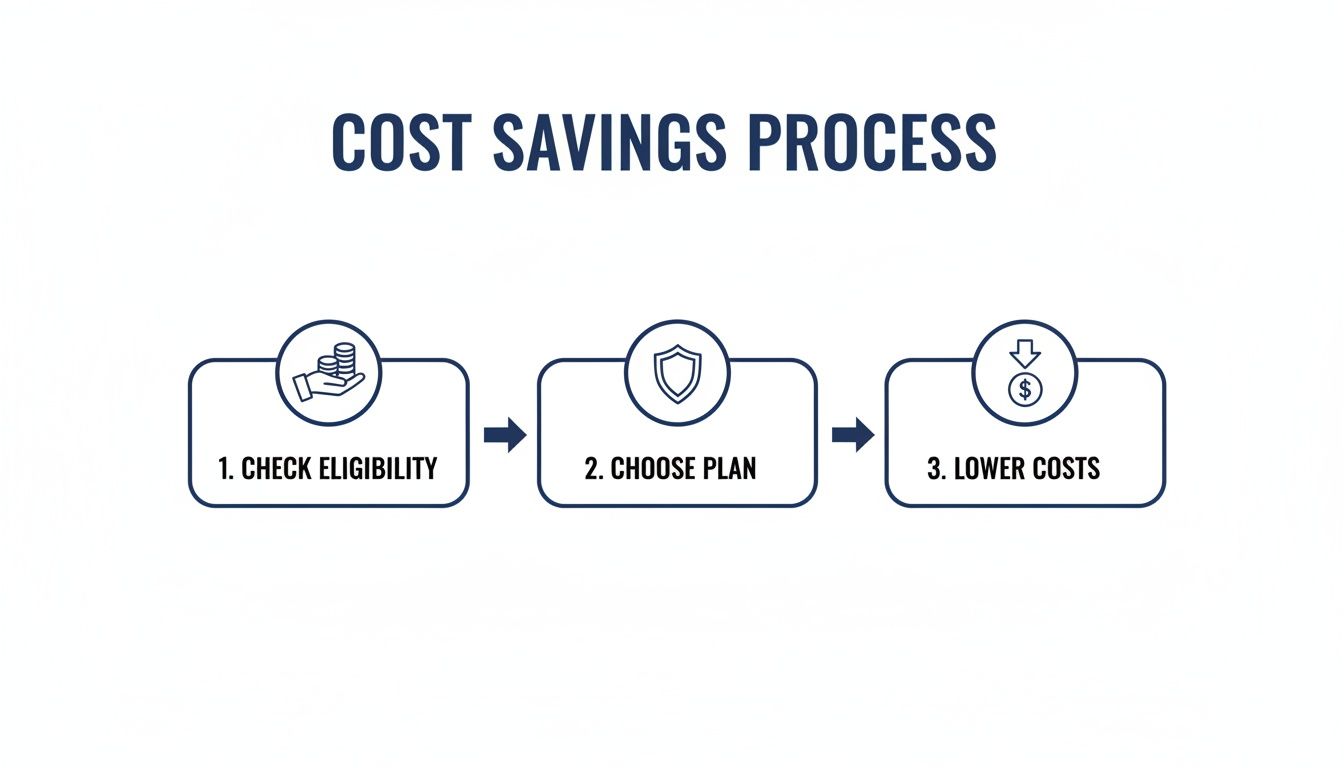
This methodical approach ensures you're not just finding a cheap plan, but the right plan—one that truly maximizes both your coverage and your savings.
- Check Provider Networks: Take your list of "must-have" doctors and check them against each plan’s provider directory online. If your trusted pediatrician isn't in-network, that plan might be a non-starter.
- Review the Drug Formulary: The formulary is just a fancy name for the list of prescription drugs a plan covers. Make sure your family’s essential medications are on it and see what "tier" they fall into—Tier 1 drugs are always the cheapest.
- Analyze the Total Cost: Compare the premium, deductible, copays, and out-of-pocket maximum side-by-side. A plan with a $100 lower monthly premium but a $5,000 higher deductible might be a much riskier bet for your family.
Following these steps methodically transforms a confusing process into a series of manageable decisions. It ensures the plan you choose truly protects both your family's health and your financial well-being.
Of course. Here is the rewritten section, crafted to sound completely human-written and natural, following the provided style and guidelines.
Common Questions About Family Health Insurance
Life doesn't always fit into a neat little box, and neither does your health insurance journey. When you're self-employed, between jobs, or your income swings up and down, questions are bound to pop up. Let's clear the air on some of the most common ones so you can move forward with confidence.
Lots of freelancers, entrepreneurs, and gig workers assume a family plan is out of reach. Is that true? Absolutely not. In fact, the ACA Marketplace was created with people like you in mind—individuals and families who don't have the option of an employer-sponsored plan. It's the go-to place to find solid, comprehensive coverage, often with financial help to make it affordable.
What Happens If My Income Changes
One of the biggest worries for families with fluctuating income is what to do when your earnings change mid-year. If you land a new client, get a surprise bonus, or switch jobs, it's so important to update your income in the Marketplace right away.
Why? Because your subsidy is tied directly to your income.
- If your income goes up: Your subsidy might shrink. Updating it now prevents you from owing money back during tax season. Nobody likes that kind of surprise.
- If your income goes down: You could qualify for a bigger subsidy, which means lower monthly premiums almost immediately. That’s extra money in your pocket when you need it most.
Think of your Marketplace application as a living, breathing document. Keeping it current ensures you're always getting the right amount of help for your real-life situation.
The key is to treat your Marketplace application as a living document. Keeping it updated ensures you are always receiving the right amount of financial assistance for your current situation.
Are Short-Term Health Plans a Good Alternative
Short-term health plans look tempting. The premiums are incredibly low, but here's the catch: they aren't a real substitute for a proper health insurance plan. Think of them as a bandage for a specific, short-term gap—like if you're between jobs for a month—not a long-term healthcare solution.
These plans come with some serious risks. They don't have to cover essential benefits (like maternity care or prescriptions), they can deny you for pre-existing conditions, and there's no limit on what you might have to pay out-of-pocket. They might cover a broken arm from a sudden accident, but they’ll leave you exposed to crippling medical debt for almost everything else.
With global medical costs expected to jump by 10.4% in 2025—the third year in a row of double-digit hikes—locking in real, comprehensive coverage is more critical than ever. You can read the full research about these global medical trends to see why a solid Marketplace or employer plan is the only safe bet for your family's financial security.
You don't have to figure this all out on your own. The experts at My Policy Quote are here to help you compare your options and find the perfect plan for your family’s needs and budget. https://mypolicyquote.com