

Imagine you're trying to get a Medicare Supplement plan, but you're worried about a pre-existing health condition. Will they turn you down? Will they charge you a sky-high price? This is where a special protection called "guaranteed issue rights" comes into play.
Think of it as a federally protected window where insurance companies have to sell you a policy. They can't ask you about your health, deny you coverage, or charge you more just because you have a health issue. These rights are a lifeline, triggered by specific life events, like when you lose other health coverage.
Understanding Your Guaranteed Issue Rights

This right is basically your "golden ticket" to getting a Medicare Supplement plan, also called Medigap. Normally, if you apply for a Medigap policy outside of your initial Medigap Open Enrollment Period, insurers put you through medical underwriting. They dig into your health history to decide if you're a "risk."
Based on that review, they can legally say no, charge you more, or make you wait before covering your pre-existing conditions. For anyone with a chronic illness, this can feel like a door slamming shut right when you need the most help.
Why This Protection Exists
Guaranteed issue rights were created for a reason. They're federally mandated safety nets to make sure you're not left without critical coverage because of something you couldn't control.
The whole point is to give you a fair shot at getting coverage when your old plan disappears. It ensures that life changes—like moving or your old employer plan ending—don't leave you stranded with huge medical bills.
For instance, if you move out of your Medicare Advantage plan's service area or your company's retiree plan shuts down, you get a guaranteed issue right. This lets you smoothly switch over to Original Medicare with a Medigap plan, filling in the gaps without being penalized for your health history. If you need a refresher, check out our guide on what is a Medicare Supplement plan.
This protection is a game-changer. Without it, someone who develops a health condition while covered by another plan could be locked out of Medigap forever. These rights make sure everyone gets a fair chance when they need it most.
Key Benefits of Guaranteed Issue
When you use your guaranteed issue rights, you get some powerful advantages that protect your health and your wallet. Let's break down why this is so important with a quick summary.
Guaranteed Issue Rights at a Glance
| Benefit | What It Means for You |
|---|---|
| No Medical Questions | You don't have to fill out a long health questionnaire or take a medical exam. Your health history is off-limits. |
| Guaranteed Acceptance | The insurance company must sell you one of the available Medigap policies. They cannot turn you down. |
| Standard Pricing | You pay the same premium as everyone else your age in your area for that specific plan. No higher rates for health issues. |
These rules are what make Medigap such a reliable choice for so many people. They create a clear path to predictable healthcare costs, which is exactly what you want in retirement.
Here’s a closer look at the key benefits:
- No Medical Underwriting: Insurers are flat-out prohibited from asking about your health or requiring an exam.
- Guaranteed Acceptance: As long as you apply during your specific window, the insurer must sell you one of the offered Medigap policies.
- Standard Premiums: You won't be penalized with a higher rate because of your health. You get the same price as anyone else in your demographic.
In the next section, we’ll dive into the exact situations that trigger these all-important rights.
Key Events That Trigger Your Medigap Protections
Think of your Medicare Supplement guaranteed-issue rights like a set of spare keys. You don’t get them all at once. Instead, life hands you a specific key when a specific event happens—usually one that leaves you without health coverage through no fault of your own.
Knowing what these triggering events are is everything. Recognizing one is the first step to unlocking a Medigap policy without having to answer a single medical question or worry about being denied. Let's walk through the most common situations that put these powerful rights in your hands.
When Your Medicare Advantage Plan Ends
This is one of the big ones. A lot of people find themselves needing a Medigap plan after their Medicare Advantage (MA) plan changes or disappears. These protections are designed to give you a clear path back to Original Medicare if your MA plan no longer works for you.
You get this right if:
- Your plan leaves the area: Sometimes, an insurance company simply stops offering your plan where you live.
- You move out of the plan’s service area: If you pack up and move to a new city or state, your MA plan probably won’t come with you, forcing a change.
- Your plan misled you or broke the rules: If you can prove the company wasn't upfront with you or didn't follow Medicare's guidelines, you have a right to leave and get a Medigap policy.
Losing Employer or Union Group Health Coverage
Another major trigger is losing group health coverage, which is a common scenario for people who keep working past 65 or have retiree benefits from an old job.
You get a guaranteed-issue right if the employer or union plan that was supplementing your Original Medicare ends. This isn't about you getting fired; it's about the plan itself being discontinued for everyone.
Here’s a real-world example: Sarah is 70 and has been relying on a retiree health plan from her former employer. She gets a letter announcing the company is ending the plan for all retirees in three months. That letter just triggered Sarah's guaranteed-issue right. She now has a 63-day window, starting the day her old coverage ends, to buy a Medigap plan without any health screening.
This is a critical safety net that ensures people aren't left high and dry when a corporate decision suddenly changes their healthcare landscape.
Your "Trial Right" Period Expires
Medicare gives you a special "trial right" to test-drive a Medicare Advantage plan. It’s a way to try one out for up to a year without giving up your chance to easily get a Medigap policy later.
It works in two main ways:
- Joined an MA Plan at 65: If you signed up for a Medicare Advantage plan as soon as you were eligible for Medicare, you have 12 months to change your mind. You can switch back to Original Medicare and buy any Medigap policy sold in your state, no questions asked.
- Switched from Medigap to MA: If you had a Medigap policy, dropped it to try a Medicare Advantage plan for the first time, you also have a 12-month window to go back. You have the right to get your old Medigap policy back if it’s still sold. If not, you can pick from several other standard plans.
These trial rights offer peace of mind, so you can explore your options without feeling like you're making an irreversible decision.
When Other Insurers Fail You
These triggers are less common, but they’re just as important. They protect you when an insurance company itself runs into trouble—something completely out of your control.
Your guaranteed-issue rights kick in if:
- Your Medigap insurer goes bankrupt: If your insurance company closes down and you lose your policy, you’re protected.
- You lose coverage for other reasons you can't control: This is a catch-all for unique situations where you involuntarily lose your supplemental coverage.
These are all considered qualifying events because they represent a loss of coverage you didn't choose. To get a better sense of the big picture, you can read our guide on what constitutes a qualifying event for health insurance. Each of these triggers opens a specific, time-sensitive window for you to act.
How to Navigate Critical Timelines and Deadlines
Knowing you have a medicare supplement guaranteed issue right is a fantastic first step, but it’s not the finish line. Think of it like a golden ticket with an expiration date. The magic only works if you use it in time, and in the world of Medigap, those deadlines are ironclad.
What truly matters is acting on your rights within the strict, federally mandated timelines. Miss it, and the opportunity vanishes.
The most important number you need to burn into your memory is 63. For almost every situation that triggers a guaranteed issue right, you have exactly 63 calendar days to apply for your new Medigap policy. That clock usually starts ticking the day your old health coverage ends.
It’s a window that can slam shut faster than you think, especially when you’re already juggling a move, a job change, or the stress of losing your old plan.
The All-Important 63-Day Window
To lock in your new plan, your application must be in the insurance company's hands within this 63-day period. It’s not about when you start the paperwork; it’s about when they officially receive it. Before midnight on day 63. That's it.
If you miss that deadline, even by a single day, your federal protection for that event disappears. Poof. Gone. Insurance companies can then force you to go through medical underwriting, which could mean higher premiums, waiting periods for pre-existing conditions, or an outright denial. Your guaranteed issue right was designed to protect you from exactly that.
Key Takeaway: The 63-day window is a hard stop. Missing it means you lose your guaranteed issue right, and you'll likely face medical questions to get a Medigap policy.
Gathering Your Proof of Eligibility
Insurance carriers won't just take your word for it. You need to prove you qualify for a guaranteed issue right, and this is where documentation becomes your best friend.
Having your paperwork lined up and ready to go makes the whole process smooth and stress-free. Here’s what you’ll almost always need:
- A termination letter: This is the big one. It’s a formal notice from your old insurance plan (like a Medicare Advantage or employer plan) that clearly states the exact date your coverage ended.
- Proof of a move: If moving out of your plan’s service area was your trigger, you'll need something like a new utility bill or driver's license to prove your new address.
- A letter of creditable coverage: This is a document that proves you had prior health insurance without a major gap in coverage.
Getting these documents organized early prevents that last-minute scramble and ensures you don’t blow past your deadline.
This timeline shows how different events all start that same 63-day clock for securing a Medigap plan.
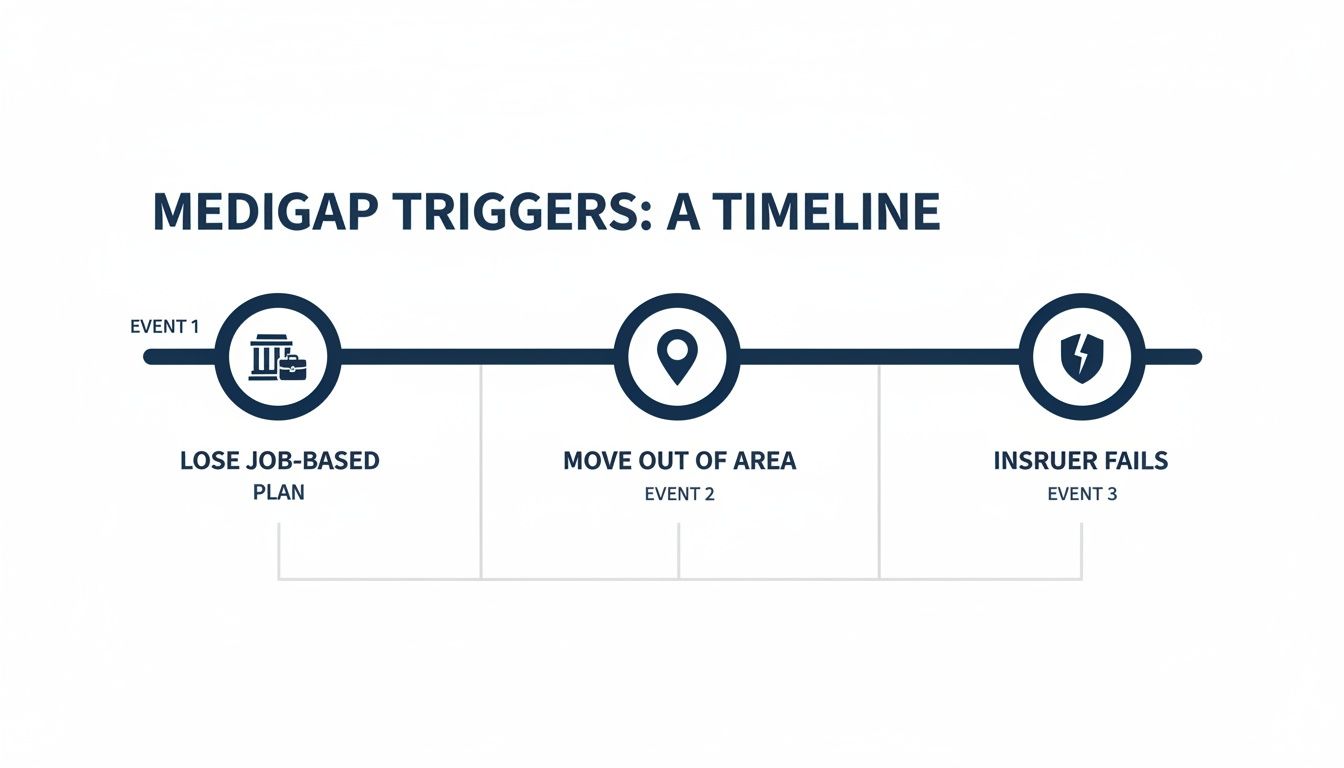
Whether it's losing a plan, moving away, or an insurer going out of business, the outcome is the same: a critical, time-sensitive window to get covered.
Actionable Steps for a Successful Application
This doesn't have to be complicated. With a clear game plan, you can move forward with confidence and get the coverage you need.
- Identify Your Triggering Event: Get crystal clear on why you qualify. Is it because you're leaving an employer plan? Are you using your Medicare Advantage "trial right"? Knowing the specific reason tells you exactly what paperwork you need to track down. For those leaving an MA plan, our guide on how to change from Medicare Advantage to Medigap breaks it down step-by-step.
- Mark Your Calendar: The moment you know your old coverage is ending, do the math. Calculate your 63-day deadline and circle it in red. Treat it like the final, non-negotiable date it is.
- Collect Your Paperwork Immediately: Don't put this off. Call and request your termination letter right away. Gather any other proof you need. Make digital copies and keep the originals somewhere safe.
Taking these steps puts you in the driver's seat. And you're not alone in this—with 12.5 million people enrolled in Medigap, which is 42% of all traditional Medicare beneficiaries as of 2022, this is a path many have walked before. You can explore the full breakdown of these Medigap enrollment facts on KFF.org.
Choosing the Right Medigap Plan for You

One of the biggest myths about Medicare supplement guaranteed issue rights is that they’re an all-access pass to every Medigap plan out there. The reality is a bit different, but still incredibly valuable.
Think of it less like a master key and more like a special invitation. This powerful protection guarantees you access to a specific, federally defined set of plans. While you can't pick just anything, you get solid, reliable options when you need coverage the most.
Knowing exactly which doors are open to you is the first step toward making a smart choice.
The Guaranteed Issue Plan Lineup
When a life event gives you guaranteed issue rights, federal law steps in. It requires insurance companies to offer you several standardized Medigap plans, no matter your health history.
The plans available under this protection are:
- Plan A
- Plan B
- Plan K
- Plan L
- Plan C (Only for those eligible for Medicare before January 1, 2020)
- Plan F (Also only for those eligible for Medicare before January 1, 2020)
What if you became eligible for Medicare after that January 1, 2020, date? No problem. You can’t get Plans C or F, but you have guaranteed issue rights to Plans D and G, which are their modern-day equivalents.
Key Insight: Guaranteed issue means an insurer must sell you one of these plans. It doesn’t mean they have to give you the lowest price. The premium will be their standard rate for your age and location, which can vary wildly between companies. Shopping around is still your best move.
How These Plans Differ in Coverage
Every Medigap plan is labeled with a letter, and that letter represents a standardized package of benefits. This is a huge plus for you—it means a Plan G from Company X provides the exact same medical coverage as a Plan G from Company Y.
The real choice comes down to matching a plan’s benefits to your budget and how you want to handle healthcare costs.
For instance, Plan G is famous for its comprehensive coverage. Once you meet your annual Medicare Part B deductible, it picks up nearly all of your remaining out-of-pocket costs. It’s a go-to for people who value predictability and want minimal bills after a doctor's visit.
Then you have plans like K and L. These work on a cost-sharing model. You pay a lower monthly premium, but in return, you cover a percentage of certain costs until you hit an annual out-of-pocket maximum. They're a great fit if you're comfortable with some shared costs to keep your monthly payments down.
Ready to go deeper? Our guide to finding the https://mypolicyquote.com/2025/06/26/best-medicare-supplement-plan/ can help you weigh all the factors.
Comparing Your Medigap Options
Sometimes, seeing everything side-by-side just makes it click. The table below breaks down what the most common guaranteed issue plans cover.
Comparing Medigap Plans Available with Guaranteed Issue Rights
This chart simplifies the core differences in coverage among the Medigap plans you're guaranteed access to.
| Benefit | Plan A | Plan B | Plan D | Plan G | Plan K | Plan L |
|---|---|---|---|---|---|---|
| Part A Coinsurance | 100% | 100% | 100% | 100% | 100% | 100% |
| Part B Coinsurance | 100% | 100% | 100% | 100% | 50% | 75% |
| Blood (First 3 Pints) | 100% | 100% | 100% | 100% | 50% | 75% |
| Hospice Coinsurance | 100% | 100% | 100% | 100% | 50% | 75% |
| Skilled Nursing Coinsurance | No | No | 100% | 100% | 50% | 75% |
| Part A Deductible | No | 100% | 100% | 100% | 50% | 75% |
| Foreign Travel Emergency | No | No | 80% | 80% | No | No |
| Out-of-Pocket Limit | None | None | None | None | $7,060 | $3,530 |
At its heart, the decision is a trade-off. Plans like D and G offer more comprehensive, first-dollar coverage for predictable costs. Plans K and L, on the other hand, act as a financial safety net against major health events with their out-of-pocket limits.
It’s also wise to remember that while Medigap is crucial, a truly secure retirement plan often involves understanding long-term care insurance for needs that go beyond what Medicare covers. Choosing the right plan is about finding that sweet spot between your monthly premium and the out-of-pocket costs you’re comfortable with down the road.
Exploring Special State-Level Protections
The federal government sets the basic rules for your Medicare supplement guaranteed issue rights, creating a safety net that protects everyone in the country. But that's just the starting point. Think of it as the minimum standard.
Many states have decided to go further, building on those federal rules to give their residents even better, more flexible opportunities to get a Medigap policy without having to answer a single health question.
Where you live can completely change the game. Depending on your state, you might have access to special enrollment windows that people in other parts of the country can only dream of. These local laws can be a lifesaver, especially if you’ve missed a federal deadline or your health has changed over the years.
States with Continuous or Annual Enrollment
A handful of states have really rolled out the welcome mat for their Medicare residents. In these places, the fear of being locked out of a Medigap plan because of a pre-existing condition is practically a non-issue.
Two of the strongest examples are:
- New York: If you live here, you can enroll in a Medigap plan anytime you want, all year long. This is called continuous open enrollment, and it means medical underwriting is never a barrier.
- Connecticut: Just like New York, Connecticut gives its residents continuous guaranteed issue for Medigap plans, ensuring you can always get a policy when you need one.
Other states, like Massachusetts and Maine, also have very strong protections that offer year-round or special annual chances to enroll. It's no surprise that in these states, people with significant health needs are more likely to switch from Medicare Advantage back to Original Medicare with a Medigap plan—they have the freedom to choose the coverage that truly fits them.
Understanding the Birthday Rule
Ever heard of the "birthday rule"? It’s a fantastic state-level perk that acts like your own personal, recurring open enrollment period. If you live in a state with this rule, you get a special window every year, usually around your birthday, to switch Medigap plans without going through medical underwriting.
This rule is a powerful tool for shopping around. It gives you a 30 to 60-day window to switch from your current Medigap plan to another one with the same or lesser benefits, often from a different company that’s offering a much better price.
States like California, Oregon, and Nevada have a version of the birthday rule, and more are starting to adopt it. It’s the perfect example of how state laws can provide a level of flexibility that federal rules simply don't offer.
Protections for Beneficiaries Under 65
One of the biggest gaps in federal law affects people who qualify for Medicare before age 65 due to a disability. On a national level, insurance companies aren't required to sell Medigap policies to this group, which can leave younger beneficiaries in a really tough spot.
Thankfully, most states have stepped in to fix this problem. A majority of states now require insurers to offer at least one type of Medigap plan to disabled beneficiaries under 65. The plan options might be more limited and the premiums a bit higher, but this state-level protection is an absolute lifeline for those who need it most.
How to Find Your State-Specific Rules
So, with all these differences, how can you find out exactly what rules apply to you?
Your best friend here is your local State Health Insurance Assistance Program (SHIP). SHIPs offer free, unbiased, one-on-one counseling on everything Medicare, and they are the absolute experts on the specific regulations in your state. A quick call to your local SHIP office is all it takes to get clear, personalized guidance on the unique Medigap rights you have where you live.
Common Mistakes to Avoid When Using Your Rights
Your Medicare Supplement guaranteed issue rights are an incredible safety net, but they're not foolproof. Think of them as a special key that only works for a limited time and under very specific conditions. One simple mistake can make that key useless, leaving you locked out and facing medical underwriting you thought you'd avoided.
Knowing the common pitfalls ahead of time is the best way to make sure your journey goes smoothly. Let's walk through what can go wrong, so you can make sure everything goes right.
Missing the Critical 63-Day Deadline
This is, without a doubt, the most common—and most costly—mistake people make. The moment your old health coverage ends, a 63-day clock starts ticking. This isn't a suggestion; it's a hard stop.
Imagine this: Sarah’s employer-sponsored retiree plan ends on March 31st. She knows she has a guaranteed issue right and plans to use it, but life gets busy. She finally gets around to submitting her Medigap application on June 5th. What she didn't realize is that her 63-day window slammed shut on June 2nd.
The result? The insurance company now treats her application like any other, meaning it's subject to full medical underwriting. Because of her high blood pressure, she’s denied. Missing that deadline by just a few days cost her the guaranteed coverage she was counting on.
Key Takeaway: Treat the 63-day deadline as non-negotiable. Circle it on your calendar, set a reminder on your phone—do whatever it takes. It’s always best to get your application in well before the final day to avoid any last-minute hiccups.
Providing Incomplete or Incorrect Proof
Insurance companies need to verify that you actually qualify for a guaranteed issue right. They won’t just take your word for it. You need to provide the right paperwork to prove you had a qualifying event.
Failing to send the correct documents can cause serious delays or even get your guaranteed issue status denied. The single most important piece of paper is usually the termination letter from your previous insurance plan.
To keep this from happening, make sure you have your documents in order:
- A Termination Letter: This is the official notice from your old plan. It needs to clearly show your name, your policy number, and the exact date your coverage ended.
- Proof of a Move: If you're using guaranteed issue because you moved, you'll need something like a new utility bill or an updated driver's license with your new address.
- Creditable Coverage Letter: This document proves your history of continuous health coverage and is often required.
Start gathering these papers the minute you know you’ll need them. Waiting until the last minute only adds stress and puts your enrollment window in jeopardy.
Misunderstanding Which Plans Are Available
A guaranteed issue right is powerful, but it doesn't give you a free pass to any Medigap plan on the market. Federal law lays out a specific list of plans that companies are required to offer you.
This list typically includes Plans A, B, D, G, K, and L, depending on when you first became eligible for Medicare.
If you apply for a plan that isn't on that guaranteed list—like a popular high-deductible plan—the insurance company will treat your application as a standard, underwritten one. If you have any health conditions, you'll likely be rejected. Stick to the plans you're guaranteed the right to buy.
Voluntarily Dropping a Medigap Plan
Once you have a Medigap policy, be extremely careful about dropping it unless you have a new guaranteed issue right. It’s tempting to cancel a plan to save a few dollars, especially if you're healthy, thinking you can just sign back up if you get sick later. This is a huge gamble.
Unless you live in one of the few states with special year-round protections or you have a new qualifying event, you won't be able to get that plan back without passing medical underwriting. If your health has changed for the worse, you could find yourself permanently locked out of Medigap, exposed to all of Medicare's gaps and out-of-pocket costs.
Common Questions About Guaranteed Issue Rights
When it comes to Medicare Supplement guaranteed issue rights, a few questions pop up again and again. Let's clear up the confusion so you can use these protections with total confidence.
Is My Medigap Open Enrollment Period the Same as a Guaranteed Issue Right?
That's a great question, and it's easy to see why they get mixed up. They feel similar, but they’re not quite the same.
Think of your six-month Medigap Open Enrollment Period as your one-time, golden ticket. It starts when you first get Medicare Part B and lets you buy any Medigap plan available in your state—no health questions asked.
Guaranteed issue rights, on the other hand, are like special safety nets. They’re triggered by specific life events, like losing your employer health plan. They show up after your initial Open Enrollment window has closed and usually give you access to a specific, more limited list of Medigap plans.
Can an Insurer Jack Up My Rates if I Use This Right?
Nope. And this is a big deal. When you use a guaranteed issue right, the insurance company is legally forbidden from charging you more because of your health history. You get the same standard rate as everyone else your age in your area.
What if I Miss My 63-Day Window?
This is where you have to be careful. If that 63-day deadline passes, that specific federal protection disappears. Poof.
After the window closes, you'll almost certainly have to go through medical underwriting to get a Medigap plan.
This means the insurance company can legally deny your application or charge you a much higher premium based on your health. It’s a make-or-break deadline, which is why acting fast is so critical.
Are These Rights the Same as a Medicare Advantage Special Enrollment Period (SEP)?
They're related but serve two different purposes. Losing your health coverage can often trigger both a Special Enrollment Period (SEP) for a new Medicare Advantage plan and a guaranteed issue right for a Medigap policy.
They're parallel paths for two completely different types of coverage:
- A SEP lets you enroll in a new Medicare Advantage plan.
- A guaranteed issue right lets you buy a Medigap policy (to go with Original Medicare) without underwriting.
Sorting through these rules can feel like a maze, but you don't have to figure it out alone. The experts at My Policy Quote are here to help you understand your rights and find the perfect plan. Get your free, no-obligation quote today!