
Let's cut through the jargon. You can think of a Pharmacy Benefit Manager (PBM) as a powerful, behind-the-scenes middleman for your prescription drug plan. They're the ones hired by your insurance company or employer to manage everything related to your pharmacy benefits.
In short, they’re the central link connecting drug manufacturers, your local pharmacy, and your health plan.
So, What Does a Pharmacy Benefit Manager Actually Do?
Have you ever wondered why your prescription costs what it does, or why one drug is covered while another isn't? The answer almost always traces back to a PBM—an entity you've likely never spoken to.
A PBM is essentially a third-party administrator hired to manage prescription drug benefits for millions of Americans. Their main job is to try and control drug costs for health plans while deciding which medications are available to you.
Imagine a PBM is the general manager of a professional baseball team. That manager negotiates player contracts (drug prices with manufacturers), decides who makes the team roster (which drugs land on the approved list, or "formulary"), and manages the team's budget (processing claims from pharmacies). Their behind-the-scenes decisions shape the team's entire season, just like a PBM’s choices impact your healthcare costs and access to medicine.
These terms can get confusing fast. It’s often helpful to review a detailed health insurance glossary to get a better handle on your plan's language.
PBMs are a massive—and growing—part of our healthcare system. The global PBM market was valued at around USD 447.61 billion in 2024 and is expected to soar to nearly USD 674.05 billion by 2032. You can see the full market projections and growth trends on intelmarketresearch.com.
Who Are the Key Players?
To really get what a PBM does, you have to see where they fit in the whole prescription drug supply chain. It takes a few different players to get medication from the factory into your hands.
Here’s a quick breakdown of who’s involved and how they all connect.
Key Players in the Prescription Drug Supply Chain
| Player | Primary Role | How They Interact with PBMs |
|---|---|---|
| Drug Manufacturer | Creates and produces prescription drugs. | Negotiates rebates and discounts with PBMs to get their drugs onto the approved "formulary" list. |
| Health Plan/Insurer | Provides health coverage to you and other members. | Hires the PBM to manage pharmacy benefits and keep drug spending under control for its members. |
| Pharmacy | Fills your prescriptions and gives you your medication. | Submits claims to the PBM for payment and gets reimbursed based on rates the PBM negotiated. |
| Patient (You) | The person who needs and takes the medication. | Your out-of-pocket costs and which drugs you can get are directly shaped by PBM policies. |
As you can see, the PBM sits squarely in the middle of it all, influencing every step from the price set by the manufacturer to the copay you hand over at the pharmacy counter.
How PBMs Shape Your Prescription Benefits
So, what does a pharmacy benefit manager actually do? It’s a fair question. While they work completely behind the scenes, their decisions directly control which medications you can get and how much you pay for them at the pharmacy counter.
Think of PBMs as the architects of your prescription plan. They design the entire structure through four main jobs.
This chart shows how PBMs sit right in the middle, between the drug companies making the medicine and the pharmacies filling your prescriptions.
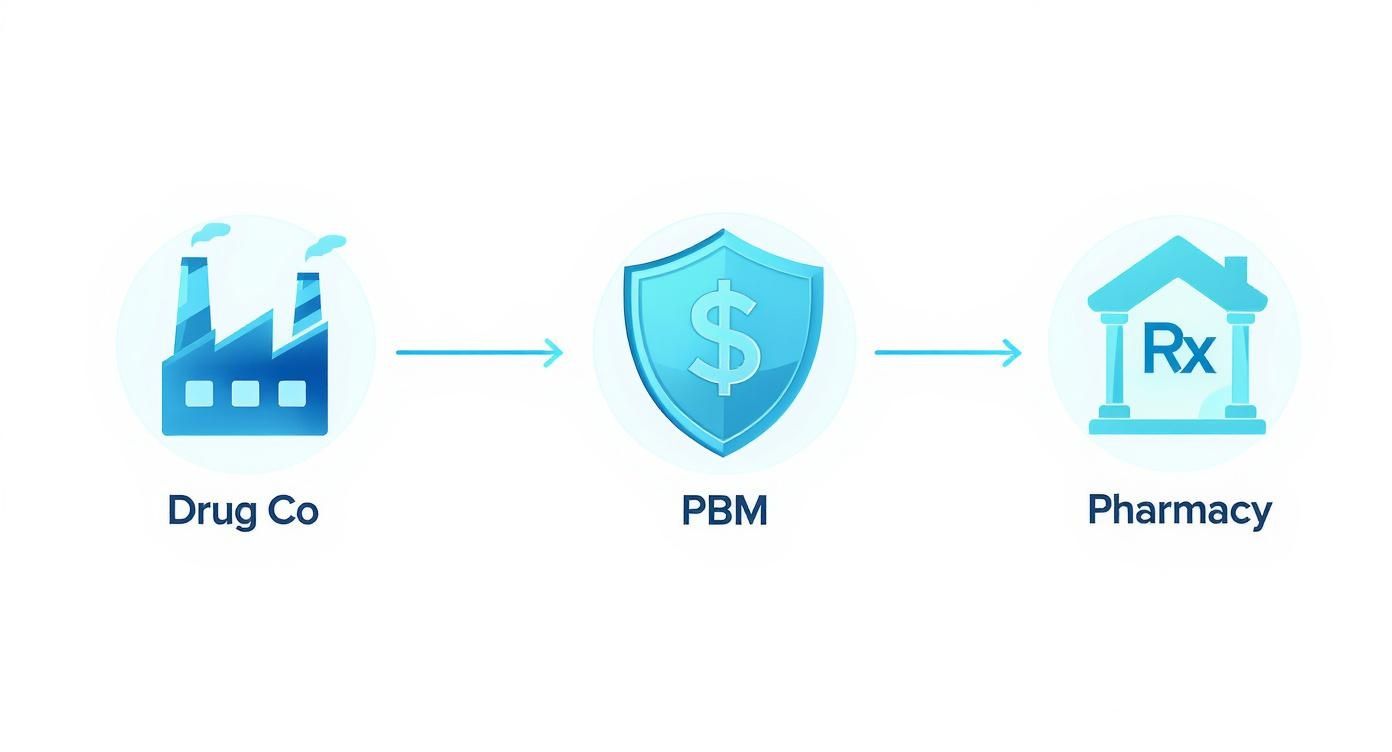
They use this central position to manage the money and logistics for everyone involved.
Formulary Management: The Official Drug List
First and foremost, PBMs handle formulary management. A formulary is just a fancy name for the list of prescription drugs your health plan agrees to cover. PBMs build and maintain this list, deciding which drugs get a thumbs-up and which ones get left off entirely.
Their goal is to create a list that balances a drug's effectiveness with its cost. This means they often give priority to cheaper generics or brand-name drugs where they’ve negotiated a good deal. If your doctor prescribes something that isn't on your plan's formulary, your insurance might not cover it at all—or you could be on the hook for a much higher price.
Rebate Negotiations: Using Group Buying Power
This brings us to their second key role: rebate negotiations. PBMs represent millions of people, which gives them massive bargaining power. They go to the big pharmaceutical companies and negotiate for discounts, called rebates, in exchange for putting a company’s drug on their formulary.
A big rebate can make an expensive brand-name drug look more attractive to the PBM than a cheaper alternative that doesn't offer one. It’s a complicated dynamic, but it’s one of the biggest reasons PBMs have become so powerful.
A PBM's ability to secure huge rebates is a double-edged sword. It can lower costs for the insurance company, but it can also lead to higher out-of-pocket costs for you if a pricier, rebated drug is prioritized over a cheaper one.
Claims Processing and Specialty Drug Management
Next up is claims processing. Every time you fill a prescription, the pharmacy zaps an electronic claim over to the PBM. The PBM instantly checks if you're covered, confirms the drug is on the formulary, figures out your copay, and tells the pharmacy how much they'll get paid. It's the financial command center for every single transaction.
Finally, PBMs play a huge role in specialty drug management. These are the incredibly expensive medications for complex conditions like cancer, multiple sclerosis, or rheumatoid arthritis. Because these drugs can cost thousands, PBMs often require extra approvals (prior authorization) and manage how they're distributed to keep costs in check. You can see this system in action within Medicare Part D plans.
The PBM market is enormous—globally, it's valued at around $747 billion and is expected to hit $1.73 trillion by 2033. In the U.S. alone, PBMs manage benefits for over 266 million Americans. Their control over specialty drugs is particularly critical for people who face massive out-of-pocket costs, a situation you can learn more about in our guide to the https://mypolicyquote.com/2025/11/11/insurance-donut-hole/.
The Real Impact of PBMs on Your Wallet
It all comes down to what happens at the pharmacy counter. The behind-the-scenes work of a PBM directly shapes what you pay out of pocket—from your monthly premiums all the way down to the copay on your 30-day prescription.
The heart of this system is the drug formulary, which is usually split into different levels, or tiers. Think of it like a pricing ladder. The higher a drug is on the ladder, the more you’re going to pay for it.
How Drug Tiers Set Your Costs
A formulary isn't just a simple list of covered medications; it's a carefully designed pricing structure. Every single drug is assigned to a tier, and that tier decides how much of the cost is your responsibility.
Here’s a typical breakdown you might find in your health plan's documents:
- Tier 1: Generic Drugs. These are your most affordable medications. They have the lowest copay because they offer the same benefits as brand-name drugs at a much lower cost.
- Tier 2: Preferred Brand Drugs. This tier is for brand-name drugs where the PBM has successfully negotiated a big rebate from the manufacturer. You’ll pay more than you would for a generic, but less than for other brands.
- Tier 3: Non-Preferred Brand Drugs. These are brand-name drugs that have a cheaper alternative on a lower tier. Your plan will still cover them, but you’ll face a much higher copay or coinsurance.
- Tier 4: Specialty Drugs. This is the most expensive tier, reserved for complex medications that treat serious conditions like cancer, multiple sclerosis, or rheumatoid arthritis.
This tier system is where insurance terms like copay, coinsurance, and deductible really come into play. A drug's tier determines whether you pay a flat fee (like $10) or a percentage of the cost (like 30%). If you want to get a better handle on these terms, our guide on coinsurance vs. copay breaks it all down.
The Rebate Game and Your Out-of-Pocket Spending
This is where things can get a little tricky—and controversial. A PBM is motivated to get the biggest rebate it can from a drug company. Because of this, it might place a more expensive brand-name drug on a preferred tier over a cheaper one, simply because the rebate is larger.
The catch is that the savings from these rebates usually go back to the insurance company, not to you. Your copay or coinsurance is often calculated based on the drug's high list price, not the lower price the PBM actually paid.
Let's walk through a quick example.
Imagine two similar drugs are available for high cholesterol.
- Drug A: Has a list price of $150 but doesn't offer a rebate.
- Drug B: Has a list price of $400 but comes with a huge $200 rebate for the PBM.
The PBM might make Drug B a "preferred" option because its net cost to the health plan is just $200 after the rebate—only slightly more than Drug A. But if your plan has a 25% coinsurance, you’d pay $100 for Drug B ($400 x 0.25) instead of the $37.50 you would have paid for Drug A ($150 x 0.25).
In this scenario, a decision driven by rebates forces you to pay more at the counter, even when a more affordable option is available. This is exactly why it's so important for everyone to understand what a pharmacy benefit manager is and how they influence our healthcare costs.
The Big Debate: Are PBMs Helping or Hurting?
Pharmacy Benefit Managers were supposed to keep drug costs down. That was the whole idea. But their actual business practices have kicked up a storm of debate and are fueling calls for major reform.
The heart of the controversy? A serious lack of transparency and a web of potential conflicts of interest that often leave patients, pharmacies, and even health plans paying more than they should.
The Problem with "Spread Pricing"
One of the most talked-about issues is something called spread pricing. It sounds complicated, but the concept is pretty simple.
It’s when a PBM charges your health plan one price for a medication but pays the pharmacy a lower price for that same drug. The PBM then pockets the difference—the "spread"—as pure profit.
Think of it this way: Your employer’s health plan gets a bill for $100 for your prescription. The PBM turns around and pays the pharmacy just $80 to fill it. That extra $20 vanishes into the PBM's pocket, adding a hidden cost to the system that does nothing for you.
Squeezing Your Local Pharmacy
Another huge concern is the financial chokehold PBMs have on independent, community pharmacies. PBMs hold all the power when it comes to setting reimbursement rates, and they often set them so low that your local pharmacy actually loses money every time they fill certain prescriptions.
This constant financial pressure makes it nearly impossible for small, independent pharmacies to survive. Over time, it creates "pharmacy deserts" in rural towns and underserved neighborhoods, making it harder for people to get the medicine and care they need.
Critics often say the P-B-M model has created a broken market with zero transparency. It’s almost impossible for anyone—a patient, an employer, anyone—to find out the true price of a drug. That completely undermines how a fair, competitive market is supposed to work.
Conflicts of Interest and Patient "Steering"
The conflicts of interest are also a massive red flag. The three biggest PBMs in the country aren't standalone companies; they are part of giant healthcare corporations that also own insurance companies and their own specialty or mail-order pharmacies.
This setup gives them a powerful incentive to "steer" you toward using their pharmacies, even if your local drugstore is more convenient or a better fit for you.
This tangled, powerful structure has built an unbelievably massive market. The U.S. pharmacy benefit management industry was valued at around USD 459.65 billion in 2025 and is on track to blow past USD 1 trillion by 2034.
You can dig into the numbers and see how dominant these players are with these findings from Precedence Research. All this controversy is exactly why understanding what a pharmacy benefit manager is and how they work is so critical if you want to take control of your healthcare costs.
How to Navigate Your PBM and Lower Drug Costs
It’s one thing to know how your pharmacy benefit manager works, but it’s another to use that knowledge to actually save money. The good news is, you can become your own best advocate. With a few proactive steps, you can get a handle on your prescription benefits and take back control of your out-of-pocket costs.
Think of this as your personal playbook for making smarter choices.
The first move? Get to know your plan’s formulary—the official list of drugs it covers. This document is your roadmap to lower costs, but honestly, most people never even look at it.
You can usually find the formulary on your insurer's website, often in a section called "Prescription Drug Coverage" or "Pharmacy Benefits." Once you have it, you can see which tier your medication falls into and exactly what your copay or coinsurance will be. No more surprises at the pharmacy counter.
Talk with Your Doctor About Alternatives
With your formulary in hand, you’re ready for a much more productive conversation with your doctor. If your prescribed medication is in a high tier or isn't covered at all, don’t just accept the sticker shock. Ask your doctor if there’s a lower-cost alternative that could work just as well.
You can ask simple, direct questions like:
- "Is there a generic version of this medication available?"
- "My plan puts this drug in Tier 3. Is there a similar drug in Tier 1 or 2 we could try first?"
- "Would a different dosage or form of this medication be cheaper?"
Often, a five-minute conversation can lead to a new prescription that saves you hundreds of dollars. For common issues, it also helps to know your options outside of prescriptions. Understanding the best over-the-counter medicine for acid reflux and similar conditions can give you more control when PBM decisions limit your coverage.
Navigate the Prior Authorization Process
Ever been told your prescription needs prior authorization (PA)? This is a hurdle PBMs put in place for expensive or specialty drugs. It means your doctor has to submit paperwork explaining why that specific drug is medically necessary for you.
Yes, the process can be frustrating, but don't give up. Work closely with your doctor's office to make sure they have all the information needed to submit the request. Follow up regularly with both your provider and your insurance plan to check on the status.
Key Takeaway: Prior authorization is a cost-control tool for PBMs. Your best strategy is to be persistent and ensure your doctor provides clear medical justification for the prescription.
Look Beyond Your Insurance for Savings
Finally, remember that your insurance plan isn't the only game in town. Manufacturer coupons, patient assistance programs, and prescription discount cards can offer significant savings—sometimes even beating your insurance copay.
Services like GoodRx tap into PBM-negotiated discounts to offer lower cash prices to everyone. It’s always worth a quick search before you head to the pharmacy.
And if you have a Health Savings Account (HSA), you can use those pre-tax funds for your prescriptions. Learning what you can use your HSA for is a powerful way to make every healthcare dollar go further.
Actionable Checklist for Evaluating Your Prescription Plan
Feeling overwhelmed? Use this simple checklist to break down what you should look for in any prescription drug plan. It’s a great tool whether you're choosing a new plan during open enrollment or just want to get more value out of your current one.
| Checklist Item | What to Look For | Why It Matters |
|---|---|---|
| Check the Formulary | Is your regular medication on the list? What tier is it in (Tier 1 is cheapest)? | A drug not being on the formulary—or being in a high tier—means you'll pay a lot more out of pocket. |
| Understand Cost-Sharing | What are the copays for each tier? Do you pay coinsurance (a percentage) for expensive drugs? | This tells you your predictable costs versus what could be a surprise bill for specialty medications. |
| Look for a Mail-Order Option | Does the plan offer a 90-day supply through a mail-order pharmacy, often at a discount? | This is an easy way to save money and time on long-term maintenance medications. |
| Review the Pharmacy Network | Are your preferred local pharmacies in-network? Is the network broad or restrictive? | Using an out-of-network pharmacy can mean you pay the full cash price with no insurance help. |
| Identify Prior Authorization Rules | Which drugs on the formulary require pre-approval from your doctor? | Knowing this in advance helps you and your doctor prepare the necessary paperwork to avoid delays in treatment. |
| Find Specialty Drug Coverage | If you take a specialty drug, how is it covered? Is there a separate, higher deductible for it? | Specialty drugs can cost thousands. Understanding your plan's rules is critical to managing these expenses. |
By taking a few minutes to run through these points, you can spot a plan that truly works for your needs instead of one that just looks good on paper. It's about empowering yourself to make the best financial and health decisions possible.
Still Have Questions? We’ve Got Answers.
Even after laying it all out, it's normal to have a few more questions about pharmacy benefit managers. After all, it's a complicated system. Let's tackle some of the most common ones people ask so you can feel more confident about your own prescription plan.
Why Isn’t My Medication on My Plan’s Drug List?
It almost always comes down to money. When your medication isn't on your plan's formulary (the official list of covered drugs), it’s usually because your PBM made a financial decision.
PBMs build these formularies by weighing a drug's effectiveness against its cost—a cost that’s massively influenced by the secret rebates they negotiate with drug makers.
When a PBM scores a huge rebate on a brand-name drug, they have a powerful reason to make it a "preferred" choice. This means another, equally good drug that doesn't come with a big rebate might get kicked off the list completely. If this happens to you, you’ve got a few moves:
- Talk to your doctor. They can often prescribe a covered alternative that’s already on the formulary.
- Request a formulary exception. Your doctor will need to provide a medical reason to the insurance company explaining why you must have that specific drug.
- Pay the cash price. It's not ideal, but sometimes using a discount card can bring the cost down to something more manageable.
Do I Really Have to Use a Specific Pharmacy?
In most cases, yes. PBMs build pharmacy networks—groups of pharmacies that agree to the PBM's terms and reimbursement rates. To get your medication covered by insurance, you need to stick to an in-network pharmacy.
But it can get even more restrictive as PBMs look for ways to steer you toward their most profitable partners:
- Preferred Pharmacies: Some plans will give you lower copays if you go to a "preferred" pharmacy, where the PBM has negotiated even better rates.
- Mail-Order Mandates: For medications you take long-term (think blood pressure or cholesterol meds), your plan might force you to use the PBM’s own mail-order pharmacy after your first couple of refills. It's a common tactic to drive business to themselves.
If you go to a non-preferred or out-of-network pharmacy, you could end up paying the full, undiscounted cash price for your prescription.
What’s the Difference Between a PBM and My Health Insurance Company?
This is where it gets confusing for a lot of people. Think of it like building a house. Your health insurance company is the general contractor managing the whole project—your doctor visits, hospital stays, and surgeries.
The PBM is the specialized subcontractor they hire to handle one specific, complicated job: the plumbing. Or in this case, your prescriptions.
Your health insurance company hires a Pharmacy Benefit Manager to handle only the prescription drug part of your benefits. The PBM is a partner, not a replacement for your insurer.
The lines have gotten blurry because the three biggest PBMs (CVS Caremark, Express Scripts, and OptumRx) are now owned by or merged with major insurance companies (Aetna, Cigna, and UnitedHealth Group, respectively). But their jobs are still separate: your insurer handles your medical plan, and their PBM handles your pharmacy plan.
Navigating the world of health insurance and prescription coverage can feel like a full-time job, especially when you're on your own. At My Policy Quote, we specialize in finding the right plans for self-employed professionals, early retirees, and families. Get a free, no-obligation quote today and let us help you find coverage that truly works for you.