
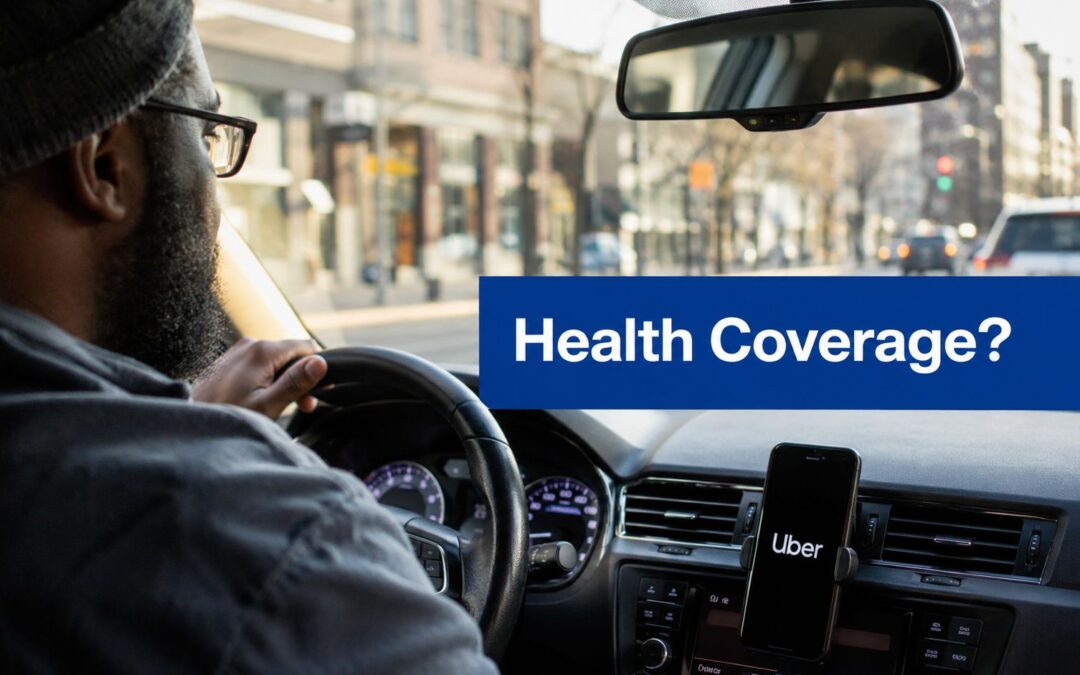
Uber doesn't offer traditional employer-sponsored health insurance to U.S. drivers because drivers are classified as independent contractors, not employees. What Uber does offer in some situations is accident-related coverage, and if you're in California there may be a healthcare stipend if you meet the rules, so the main question isn't whether Uber covers you fully. It's how you protect yourself without overpaying.
If you're driving full time, part time, or using Uber to close a gap between jobs, this matters more than many might realize. The stress usually isn't just medical. It's financial. One illness, one injury off the app, one prescription you didn't budget for, and suddenly your flexible income doesn't feel flexible at all.
The good news is that you do have options. The right plan can reduce a lot of background anxiety, smooth out cash flow surprises, and help you make decisions like a business owner instead of reacting like someone hoping nothing goes wrong.
So Does Uber Offer Health Insurance for Drivers?
The direct answer is no, not in the commonly understood way.
Uber doesn't provide traditional group health insurance to drivers the way a W2 employer often would. If you're asking whether Uber offers medical, dental, or vision benefits as part of a standard employment package, the answer is no. That's tied to your worker classification, not to an application error or a benefit you somehow missed.
For most drivers, that means you need to arrange your own coverage. If you've wondered whether that feels unfair, you're not alone. But from a practical standpoint, the most useful move is to stop waiting for Uber to act like an employer and start treating your insurance decision like part of running your business. The legal reason sits in the same bucket as questions about whether employers are required to offer health insurance. It depends on employee status.
The few exceptions people hear about
There are some exceptions, and they create a lot of confusion.
In California, Proposition 22 created a specific rule that requires Uber to provide a quarterly healthcare stipend to eligible drivers and couriers who average at least 15 eligible hours per week, but that stipend is based on the average statewide monthly premium for a covered California bronze health plan and is a subsidy, not full group coverage, according to Uber's U.K. insurance overview discussing jurisdictional differences and worker protections in different markets (Uber insurance details).
In the U.K., Uber also offers Partner Protection Insurance for self-employed drivers and couriers, but that still isn't health insurance. It focuses on liability and accident-related protection.
If you're trying to answer "Does Uber offer health insurance?" the practical answer is no for standard employer coverage, with a narrow California stipend exception for eligible drivers.
What matters more than the label
The label matters less than the result. If you don't have major medical coverage, you're exposed.
That exposure isn't always dramatic. Sometimes it's routine. A primary care visit, lab work, urgent care, imaging, a prescription refill, or follow-up treatment after something unrelated to driving can all become out-of-pocket problems. Getting your own plan doesn't just protect your health. It gives you breathing room.
Why You Are a Contractor Not an Employee
The cleanest way to understand this is to stop thinking of Uber as your boss and start thinking of Uber as a client.
You're a 1099 independent contractor. That means you operate your own small business, even if it doesn't feel like one. You choose when to log in, when to stop, and how much you want to work. In exchange for that flexibility, you take on responsibilities that employees usually hand off to an HR department.

Think like the owner
A lot of drivers resist this framing at first because it sounds bigger than what they're doing day to day. But it's accurate.
As a contractor, you're responsible for:
- Your health coverage: No employer is building a benefits package for you.
- Your taxes: You're generally handling self-employment tax issues yourself.
- Your risk management: Auto coverage, income protection, and healthcare become your problem to solve.
- Your long-term planning: Retirement and emergency savings don't happen automatically.
This is the same reason contractor-focused insurance rules matter across more than just health coverage. If you want a broader view of that responsibility, this guide to contractor insurance requirements is a useful place to start.
Why classification changes your benefits
A W2 employee usually gets taxes withheld and may get access to benefits. A 1099 worker gets pay, but not the same infrastructure.
That difference shows up everywhere. Health insurance is the most visible example, but it also affects payroll taxes, workers' compensation expectations, and what happens if someone believes they were classified incorrectly. If you've ever had mixed income or you're trying to sort out a tax issue tied to worker status, understanding Form 8919 can help you see how the IRS handles certain misclassification situations.
Practical rule: If your income comes through apps and 1099 work, assume you need to build your own benefits stack unless a specific law says otherwise.
A short visual explanation can help if this distinction still feels fuzzy.
The mental shift that helps most
Once drivers accept that they're running a business, their insurance choices usually get clearer.
You stop asking, "Why doesn't Uber give me this?" and start asking better questions:
- What risk can I afford to carry myself?
- What coverage keeps one bad month from turning into debt?
- What plan fits my actual income pattern?
That shift reduces frustration because it puts you back in control. Not of the system, but of your next move.
What Benefits Uber Does Provide to Drivers
Uber doesn't offer health insurance, but it does provide important accident-related coverage during active trips. That's useful. It just isn't the same thing as major medical insurance.
According to Talk to Mira's summary of health insurance options for Uber drivers, Uber drivers in the United States are classified as independent contractors rather than employees, and as of 2026 that remains the general model across most states. The same source states that the average annual earnings for an Uber driver are $42,257, and that figure excludes health benefits because there aren't any employer-sponsored medical benefits attached to the role.
What Uber's accident coverage can do
During active trips, Uber provides several protections that matter in the right situation:
- Third-party liability insurance: Up to $1,000,000 during active trips.
- Uninsured or underinsured motorist bodily injury coverage: Included as part of the accident-related protection.
- Contingent other damage and collision coverage: Up to the vehicle's actual cash value, with a $2,500 deductible.
- Occupational accident medical expense coverage: Up to $1,000,000 with no deductible or copay.
- Disability earnings replacement: Up to $1,324 per week.
Those numbers matter because they show Uber isn't offering nothing. It is offering a layer of protection for accidents connected to driving activity on the platform.
What it does not do
At this stage, drivers get tripped up.
Uber's accident policy is not primary health insurance. It doesn't replace an ACA plan, a private major medical plan, or other full health coverage. It won't function like a normal health plan for routine care or for medical needs unrelated to a covered driving accident.
That means it generally isn't your answer for things like:
- Primary care visits
- Ongoing prescriptions
- Specialist appointments
- Chronic condition management
- Care unrelated to an active-trip accident
A driver can have strong accident coverage through Uber and still be completely exposed to everyday medical bills.
Why that distinction matters financially
The biggest mistake I see people make is treating rideshare accident protection as if it solves the health insurance problem. It doesn't. It solves a narrower problem.
If you get hurt in a covered accident while actively driving, that protection can be meaningful. If you wake up with chest pain, need imaging, have a chronic condition flare up, need a biopsy, or deal with a non-driving injury, you need your own health plan. That's the line.
Once you understand that line, your decision gets cleaner. Keep Uber's accident protection in its proper place, and build your real health coverage around the rest of your life.
The Exception to the Rule State Laws and Stipends
California is the biggest exception drivers talk about, and for good reason. It's one of the rare situations where Uber has to contribute toward healthcare costs while still treating drivers as contractors.
Under Proposition 22, passed in 2020 and implemented in 2021, app-based companies like Uber must provide a quarterly healthcare stipend to eligible drivers and couriers in California. To qualify, a driver must average at least 15 active hours per week, opt in, and provide proof of enrollment in a qualified healthcare plan, according to this California Proposition 22 overview video.

What the stipend really is
This benefit helps, but it helps in a very specific way.
The stipend amount is calculated based on the average statewide monthly premium for a covered California bronze health insurance plan. That means California isn't forcing Uber to put you on a company group plan. It's requiring a contribution toward coverage you buy and maintain yourself.
That distinction matters because a stipend is not the same as benefits administration. You still have to:
- Choose a plan
- Enroll on time
- Keep proof of coverage
- Meet the active-hours requirement
- Opt in if required under the platform process
If you've heard people compare this to an employer reimbursement model, that can be a helpful mental shortcut. For a broader explanation of reimbursement-style health benefit design, this overview of what an ICHRA is gives useful context, even though Prop 22 is its own legal framework.
Who should pay attention to this
If you drive in California and consistently put in enough active time, this is worth tracking closely. Missing the paperwork or assuming Uber will sort it out for you can cost you money.
If you drive outside California, manage your expectations. The verified rule here is that outside California, drivers in other U.S. states and internationally do not receive a health insurance stipend or employer-sponsored coverage from Uber under this model.
The California stipend is best viewed as help with the cost of your own plan, not a replacement for choosing one carefully.
Why this matters beyond California
Even if you don't live in California, Prop 22 shows something important. Gig work benefits can change by state and by legal category.
So if you're driving in any state, stay alert to local changes. Don't assume what was true last year is still true this year. And don't assume a headline about gig worker benefits applies where you live. A lot of coverage confusion starts there.
Your Best Health Insurance Options as a Driver
Once you stop expecting Uber to provide full coverage, the choice gets simpler. You're shopping as a self-employed person. The goal is to find the best balance between premium, out-of-pocket risk, provider access, and how much unpredictability your budget can handle.
For many drivers, the best fit starts with the health insurance options available to gig workers. The right answer depends on how often you use care, whether your income swings during the year, and how much financial shock you could absorb if something serious happened.
The options that usually make sense
ACA Marketplace plans are the first place I would look if you want real major medical coverage. These plans are built for people who buy their own insurance and want protection for routine care, prescriptions, specialists, and larger medical events. They also tend to be the most stable choice if you have ongoing medical needs or want broad coverage.
Medicaid is worth checking if your income is modest or inconsistent. Many drivers rule it out too quickly. If your work is seasonal or your earnings swing sharply, it's smart to see whether you qualify instead of assuming you don't.
Private individual plans can be worth reviewing if you're shopping outside the Marketplace or want to compare carrier networks and plan structures more broadly. Sometimes the deciding factor isn't just monthly cost. It's whether your doctors and hospitals are in network.
COBRA can make sense if you recently left a job that had employer coverage and need continuity with the same doctors or treatment. It's often more of a bridge than a long-term answer, but bridges have value when you're trying to avoid gaps.
Short-term medical plans and health sharing arrangements appeal to drivers because they can look cheaper on the front end. But they come with trade-offs. These options are usually best approached carefully and with full awareness of what they may not cover.
Health Insurance Options for Uber Drivers at a Glance
| Option | Best For | Cost | Coverage Level | Key Consideration |
|---|---|---|---|---|
| ACA Marketplace plan | Drivers who want broad, major medical protection | Varies by plan and income | Comprehensive | Often the strongest fit for ongoing care and serious medical risk |
| Medicaid | Drivers with lower or fluctuating income | Often low-cost or very low-cost if eligible | Comprehensive | Eligibility depends on your state's rules and your income situation |
| Private individual plan | Drivers comparing carriers or provider networks | Varies | Can be comprehensive | Check network access, exclusions, and how the plan is regulated |
| COBRA | Drivers leaving a job with existing employer coverage | Often higher than other options | Same as prior employer plan if elected | Useful for continuity, especially if you're mid-treatment |
| Short-term medical plan | Drivers needing a temporary bridge | Usually lower upfront than comprehensive coverage | Limited | Best treated as temporary protection, not a full long-term solution |
| Health sharing arrangement | Healthy drivers comfortable with non-insurance alternatives | Usually contribution-based and varies | Limited and not the same as insurance | Read the rules carefully before relying on it for major needs |
How to choose without overthinking it
Start with your real-world needs, not just the premium.
Ask yourself:
- Do you need regular care? If yes, stronger extensive coverage usually wins.
- Is your income uneven? If yes, check options that handle income changes more gracefully.
- Can you absorb a bad medical month? If no, don't buy based on the lowest monthly payment alone.
- Do you have doctors you want to keep? Network fit matters more than generally anticipated.
- Are you between jobs? COBRA may be useful while you stabilize your income.
What usually works and what usually doesn't
What works is buying with your full financial picture in mind. A plan that lets you get preventive care, manage medications, and avoid catastrophic bills often creates more relief than the cheapest option with big holes.
What doesn't work is choosing based only on the monthly premium, or assuming you'll just stay healthy. That's not a strategy. That's crossing your fingers.
If your health coverage decision lowers your stress enough that you can work, sleep, and plan better, it's doing more than paying claims. It's stabilizing your business.
Taking Control of Your Health and Financial Security
If you've been asking, "Does Uber offer health insurance," the answer is straightforward. Uber doesn't provide traditional health insurance for most drivers, and the protections it does provide are narrower than many people assume.

The better takeaway is this: you're not stuck. You're a self-employed driver, which means you have to build your own safety net, but you also get to choose one that fits your income, family, and risk tolerance. That choice can remove a surprising amount of pressure.
What relief actually looks like
Financial relief isn't only about avoiding a giant bill. It's knowing a doctor's visit won't wreck your week. It's not delaying care because you're afraid of what the invoice might say. It's being able to drive because you chose coverage on purpose, not because you're hoping luck holds.
A good plan also changes how you think about your work. You stop operating from fear. You start operating with structure. That's a better way to run any business, even a one-person one.
The mindset that serves drivers best
Treat health insurance like fuel, maintenance, and taxes. It isn't optional if you want real stability.
You don't need the perfect plan on the first try. You need a plan that protects your downside, fits your budget as realistically as possible, and gives you a clear next step when life gets messy. That's what control looks like.
If you want help comparing health coverage as a contractor, gig worker, or self-employed driver, My Policy Quote can help you sort through practical options and find a plan that fits your budget and your real-world needs.