

Term life insurance is one of the simplest yet most powerful ways to protect your family’s future. Think of it as a promise—a financial safety net that catches your loved ones if you're no longer there. It’s designed to cover you for a specific time, like 10, 20, or 30 years, providing a tax-free payout if you pass away during that period.
For young families juggling a mortgage, daily bills, and dreams of college for the kids, it’s often the most affordable and sensible choice. It delivers a huge amount of protection without breaking the bank.
What Is Term Life Insurance for Families
Imagine renting a home. You sign a lease for a set period, and for that time, you have a roof over your head. Term life insurance works in a very similar way. You're "renting" protection for a specific term—the years when your family depends on your income the most.
If the unthinkable happens while the policy is active, your family receives a lump-sum payment called the death benefit. This isn't an investment or a complicated savings vehicle. Its purpose is singular and powerful: to replace your income so your family can stay on their feet without you. It’s the most direct path to peace of mind.
The Core Purpose of Term Life
So, what’s the real job of a term life policy? It’s all about bridging a massive financial gap. It’s built for that chapter of life when your responsibilities are at their peak—when the kids are young, the mortgage is big, and your earning years are still ahead of you.
It's designed to handle life's biggest financial hurdles:
- Replacing Your Paycheck: So the lights stay on and there's food on the table.
- Paying Off the Mortgage: So your family gets to keep their home, no strings attached.
- Funding College Dreams: To make sure your kids’ futures are secure.
- Wiping Out Debts: Clearing car loans, credit cards, or any other loans you might have.
The need for this is more real than most of us think. When a primary earner passes away, 40% of adults say their loved ones would barely be financially secure, if at all. Nearly half would face a financial struggle within just six months.
To give you a better idea of what a term life insurance policy can do for your family, here is a quick overview:
Term Life Insurance for Families at a Glance
| Feature | How It Protects Your Family |
|---|---|
| Fixed Term | Covers the most critical years, like when your kids are growing up or while you're paying off your mortgage. |
| Death Benefit | Provides a tax-free, lump-sum payout to cover immediate and future expenses. |
| Affordable Premiums | Low, fixed monthly payments make it easy to fit into a family budget. |
| Pure Protection | Focuses solely on providing a financial safety net, with no complex investment features. |
This simple structure is what makes term life insurance such a smart and effective tool for so many families.
Why Simplicity Is a Key Feature
Unlike other, more complex types of life insurance, a term policy doesn't have a cash value or savings component. And honestly? That's its greatest strength for a growing family.
By focusing only on protection, it keeps the cost way down. This means you can afford a much larger amount of coverage right when you need it the most—when your budget is already stretched thin. For a deeper dive into how this compares with other options, you can learn more about Life Insurance in its various forms. This straightforward approach ensures your family is properly protected without overcomplicating your finances.
How Much Life Insurance Does Your Family Really Need?
Figuring out how much life insurance to buy can feel like pulling a number out of thin air, but it doesn't have to be a guessing game. The real goal isn't just to cover a funeral; it's to make sure your family can maintain their standard of living for years to come.
There's a simple, powerful framework that cuts through the noise and gives you a realistic number: the DIME method. It turns vague worries into a concrete, manageable figure, so you know you're not buying too much or too little.
The DIME Method: A Simple Formula for Families
DIME is just an acronym for the four most important parts of your financial life: Debt, Income, Mortgage, and Education. By adding up what your family would need in these four areas, you get a clear picture of the financial safety net they actually require.
Let's break it down.
- D is for Debt: This is for all your non-mortgage debts. Think car loans, student loans, and any lingering credit card balances. The idea is to wipe the slate clean so these bills don't become your family's burden.
- I is for Income: How much of your annual income needs to be replaced, and for how long? A good rule of thumb is to cover the years until your youngest child is financially independent.
- M is for Mortgage: For most families, this is the biggest debt they have. You’ll want enough coverage to pay off the house entirely, giving your family the security of a permanent, stable home.
- E is for Education: If helping your kids pay for college is part of the plan, you need to account for it. Tally up the estimated future costs of tuition, books, and living expenses for each child.
This four-part calculation makes sure you're covering today's bills and tomorrow's dreams. It provides a complete financial shield. Once you have that number, the process of protecting your family is straightforward.
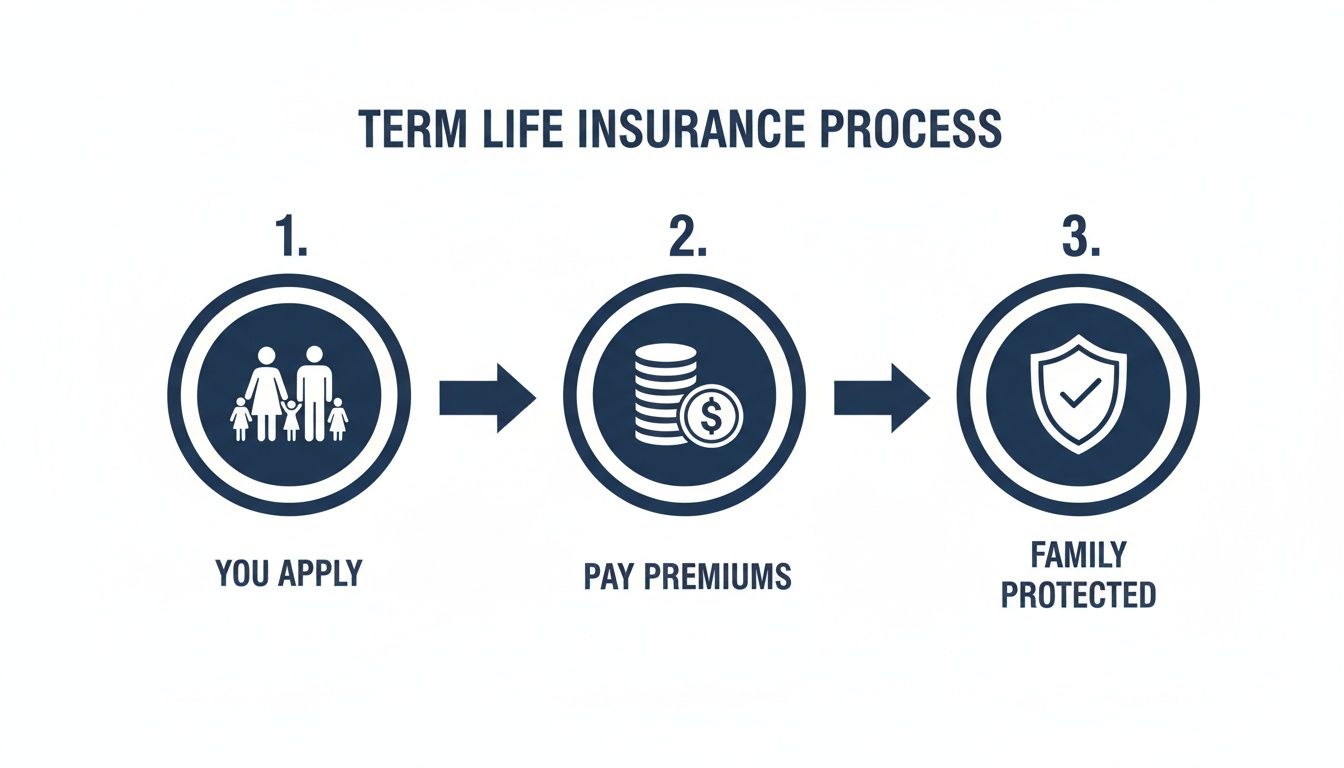
As you can see, it's designed to be simple: you pay your premiums to keep the policy active, and in return, your family has a safety net.
Putting the DIME Method into Practice
Let's walk through a real-world example. Imagine a family with two young kids and a primary earner who brings home $60,000 a year.
Here’s their financial snapshot:
- Debt: They have a $20,000 car loan and $5,000 on their credit cards. That's $25,000.
- Income: They want to replace that $60,000 salary for 15 years, which gets their youngest through high school. That’s $900,000 ($60,000 x 15).
- Mortgage: They have $250,000 left to pay on their home.
- Education: They estimate needing $50,000 per child for college, for a total of $100,000.
Now, let's add it all up:
$25,000 (Debt) + $900,000 (Income) + $250,000 (Mortgage) + $100,000 (Education) = $1,275,000
This family needs about $1.275 million in coverage to feel completely secure. That number might seem huge, but this level of detail is what true peace of mind is built on. For a personalized estimate, you can plug your own numbers into our life insurance needs calculator.
Your life insurance coverage should be a reflection of your responsibilities and your promises. It’s not just a number; it’s a plan to uphold your family’s dreams, even if you’re not there to see them through.
This is exactly why so many families trust term life insurance. While the United States makes up nearly 27% of global life insurance premiums, a lot of people are still underinsured. In 2023, 42% of people worldwide said they either need life insurance or need more of it, showing just how financially vulnerable many families are. Taking a few minutes to calculate your true need is the first step toward closing that gap for good.
Matching Policy Term Length to Your Family's Milestones
Figuring out your coverage amount is a huge step, but it's only half the story. Choosing the right policy length—the term—is just as important.
Think of your policy's term as a financial bridge. You're building it to carry your family over their most vulnerable years, connecting today's financial dependencies to a future where they can stand on their own.
You want that bridge to be long enough to cover the biggest risks, like a new mortgage or young children. But you don't want to keep paying for it once those responsibilities are behind you.

Mapping Your Financial Timeline
So, how do you find that perfect length? It's simpler than you think. Just look at your longest-running financial promise. That one single obligation is usually the best guide for choosing a term that protects your family for exactly as long as they need it.
Common milestones that help anchor a term length include:
- Paying off the mortgage: Just bought a home with a 30-year loan? A 30-year term is a natural fit.
- Raising your kids: You'll want coverage until your youngest is financially independent, maybe around age 22 or 25.
- Reaching retirement: For some, the goal is to have a policy that lasts until they can tap into their 401(k) or pension funds.
When you sync your policy with these major life events, you ensure your term life insurance for families is doing its job during the years that matter most.
Common Term Lengths and Who They're For
Insurers usually offer terms in 10, 15, 20, 25, and 30-year options. Each one is built for a different life stage and a different set of promises.
To help you see how this works, we've put together a table matching common family situations with recommended term lengths.
| Matching Term Length to Family Milestones |
| :— | :— | :— | :— |
| Family Scenario | Key Financial Obligations | Recommended Term Length | Reasoning |
| Newlyweds with a New Home | 30-year mortgage, planning for children | 30 Years | Covers the entire mortgage and the full timeline of raising future children to adulthood. |
| Parents with Young Children | Mortgage, childcare, future college costs | 20-25 Years | Provides protection until the youngest child is financially independent and the mortgage is nearly paid off. |
| Single Parent with a Teenager | Remaining mortgage, college tuition, daily expenses | 10-15 Years | Bridges the financial gap until the child finishes college and can support themselves. |
| Pre-Retirees, Nearing "Empty Nest" | Final mortgage payments, covering income gap until retirement | 10 Years | Protects the surviving spouse's ability to retire on schedule without draining their nest egg. |
This table is a great starting point, but every family's story is unique. The key is to match your policy to your longest-running promise—whether that's a mortgage payment or seeing your kids through college.
Let’s dig into a few of these scenarios.
1. The 30-Year Term for New Families
A couple in their early thirties just had a baby and bought their first home with a 30-year mortgage. Their financial timeline is the longest it will ever be. A 30-year term is their perfect safety net. It guarantees that if the unthinkable happens, the surviving partner can pay off the house, raise their child, and fund a college education without financial chaos.
2. The 20-Year Term for Growing Families
Imagine a family whose youngest child is five years old. They've got maybe 10 years left on their mortgage. A 20-year term is a great fit here. It provides coverage until their child is 25—well into adulthood—and the house is almost paid off. It perfectly bridges the gap until their biggest financial burdens have shrunk.
3. The 10-Year Term for Pre-Retirees
Now, picture a couple in their mid-fifties. The kids are grown and gone, the house is paid for, but they're still about a decade from retirement. A 10-year term acts as an income-replacement bridge. It ensures that if one partner passes away, the other can still retire on time without having to raid their nest egg.
Choosing the right term is all about balance. A longer term locks in your low rate for decades, but a shorter one costs less each month. The goal is to find that sweet spot that covers your family’s needs without breaking the bank.
And remember, life changes. If your needs evolve, you often have options. For instance, our guide on what is convertible term insurance explains how some policies offer the flexibility to adapt your coverage down the road.
Understanding Policy Riders That Protect Your Family
Your term life insurance policy has one core promise: a tax-free payout for your family if you die. Simple, right? But what about the crises that can happen while you’re still living? That’s where policy riders come in.
Think of riders as powerful upgrades you can add to your insurance. A rider is an add-on that gives you extra benefits that go way beyond the standard death benefit. For a small bump in your premium, these riders can turn your policy from a basic safety net into a financial tool that can help you through tough times, offering what many call “living benefits.”
These add-ons are especially important when you’re building a plan for term life insurance for families. They’re designed to tackle the real-world problems that could throw your finances into chaos long before a death ever occurs. Let's look at a few of the most important ones.
The Waiver of Premium Rider
Imagine you’re a self-employed contractor and you get seriously hurt on a job site. You can’t work for over a year, and your income grinds to a halt. How are you supposed to keep paying your life insurance premiums?
This is exactly what the Waiver of Premium rider is built for. If you become totally disabled and can’t work for a certain period (usually six months), this rider kicks in. The insurance company forgives your premium payments, but your policy stays fully active.
This rider makes sure that a long-term disability doesn't force you into an impossible choice between paying for groceries and keeping your family’s life insurance protection. It’s a safety net for your safety net.
For families, especially those relying on a single paycheck or where someone has a physically demanding job, this rider offers critical peace of mind. Your financial protection stays locked in, even when your ability to earn a living is gone.
The Accelerated Death Benefit Rider
Another incredibly powerful tool is the Accelerated Death Benefit (ADB) rider. This feature lets you access a big chunk of your own death benefit—often 50% to 80%—while you’re still alive, but only if you’re diagnosed with a qualifying terminal illness.
For example, say you have a $500,000 policy and are diagnosed with a terminal illness, with doctors giving you 12 months or less to live. This rider could let you access $250,000 or more right away. That money is yours, and you can use it for whatever you need.
People often use these advanced funds to:
- Cover Medical Bills: Pay for treatments, experimental therapies, or hospice care that health insurance won’t touch.
- Manage Household Expenses: Make sure the mortgage and bills are paid so your family can focus on spending precious time with you.
- Fulfill Final Wishes: Take a dream family vacation or create lasting memories without worrying about the cost.
The amount you take out is simply subtracted from the final death benefit that goes to your beneficiaries. The best part? Many modern policies include this rider at no extra cost, making it a priceless feature for families facing a devastating diagnosis.
Other Valuable Riders for Families
While the Waiver of Premium and ADB are two of the most popular, other riders can customize your family’s protection even further:
- Child Term Rider: This lets you add a small amount of life insurance for all of your children under one single rider. It's a very affordable way to cover final expenses if the unthinkable happens.
- Conversion Rider: This gives you the option to convert your term policy into a permanent whole life policy down the road, without having to pass another medical exam. It’s perfect if your needs change or you develop a health condition that would make new insurance impossible to get.
By hand-picking the right riders, you can build a policy that truly responds to your family’s unique life. To get a better handle on these valuable add-ons, you can learn more about what a rider on life insurance is and see exactly how each one works.
How Health and Lifestyle Affect Your Insurance Costs

When you apply for a term life policy, the insurance company starts a process called underwriting. Think of it as their way of getting to know you—a deep dive into your overall risk profile. They’re trying to answer one big question: How likely are you to live a long, healthy life?
The answer to that question directly sets the price you'll pay, also known as your premium. The lower your perceived risk, the less you’ll pay each month. Knowing what they look for puts you in the driver’s seat.
The Primary Factors That Shape Your Premiums
Insurers look at your life from all angles, but a few key things carry the most weight. These are the building blocks they use to calculate your specific rate for term life insurance for families.
Here’s what they care about most:
- Age: This is the big one. The younger and healthier you are when you lock in a policy, the cheaper it will be. Simple as that.
- Health History: They'll want to know about your personal and family medical history. Things like heart disease, diabetes, or cancer can signal higher risk and lead to higher rates.
- Smoking and Tobacco Use: This is a huge red flag for insurers. A smoker can easily pay two to three times more than a non-smoker for the exact same coverage.
- Lifestyle and Hobbies: What you do for fun—and for work—matters. Risky hobbies like skydiving or a dangerous job can nudge your premiums up.
Your life insurance premium is a direct reflection of your risk profile. While you can't change your age, other factors—like quitting smoking or managing a health condition—give you real power to lower your costs.
This whole evaluation is a standard part of the journey. You can get a much deeper look into how it all works in our guide to the life insurance underwriting process.
A Tale of Two Applicants
To see this in action, let’s imagine two different people applying for the same $500,000, 20-year term policy.
Applicant A: The Healthy Non-Smoker
- Age: 35 years old
- Health: Excellent, no chronic issues, healthy weight.
- Lifestyle: Non-smoker with a desk job.
- Estimated Monthly Premium: $25 – $35
Applicant B: The Older Smoker
- Age: 45 years old
- Health: Good, but managing high blood pressure.
- Lifestyle: Smoker who works a more physical job.
- Estimated Monthly Premium: $150 – $200+
The difference is staggering. Just a decade in age and a smoking habit can drive up the cost by over 500%. This is why getting a policy when you're young and healthy is one of the smartest things you can do for your family's future.
Occupation and No-Medical-Exam Policies
Your job also plays a part. A roofer, for instance, faces more daily risks than an accountant, and that can be reflected in the price. It's also why individual policies are so important. While 55% of working adults might have some life insurance through their employer, that leaves millions of self-employed people and gig workers needing to secure their own coverage.
Thankfully, there are more options today than ever. For those who want to skip the needles and appointments, no-medical-exam policies have become a popular choice. These plans use health questionnaires and database checks instead of a full medical exam.
The trade-off? They’re often more expensive. Because the insurer has less information, they take on more risk, and that’s reflected in the premium. But for busy families or anyone anxious about medical exams, the speed and convenience can be a lifesaver.
Comparing Term Life to Other Insurance Policies
To feel confident about protecting your family, you need to see the whole picture. Term life insurance is an amazing tool, but it's just one piece of the puzzle. Once you understand how it stacks up against other types of life insurance, it becomes clear why it's usually the best fit for families who need big-time protection without a huge price tag.
The easiest way to think about it is with a simple housing analogy. Term life insurance is like renting a home. It's straightforward, affordable, and gives you pure protection for a set amount of time—exactly when your family needs it most. When your "lease" (the term) is up, the coverage ends, and you can walk away.
Whole Life Insurance: The Homeowner Approach
On the other hand, permanent policies like whole life insurance are more like buying a home. It's a lifelong commitment that covers you for your entire life, as long as you keep paying the premiums. But it's more than just protection; whole life policies also build cash value over time, kind of like building equity in a house.
This cash value part is the key difference. It grows at a fixed rate and you can borrow against it or even withdraw from it, turning it into a financial asset. But this feature comes at a much higher price—premiums for whole life can be five to fifteen times higher than a comparable term policy.
For a young family, the high cost of whole life often means you're forced to settle for a much smaller death benefit. Term life lets you afford the massive coverage you actually need to replace your income and pay off the mortgage, without getting tangled up in a complex and expensive investment product.
Universal Life: A More Flexible Option
Another type of permanent insurance is universal life. Think of this as a more flexible kind of homeownership. It also gives you lifelong coverage and a cash value component, but with more wiggle room. You can often adjust your premium payments and even your death benefit as your life and finances change over time.
While that flexibility sounds great, it also adds another layer of complexity. The cash value growth is often tied to market interest rates, so it’s not as predictable as whole life. And just like whole life, it’s still way more expensive than term insurance.
The global life insurance market has soared to an estimated $3.1 trillion in 2024, which shows just how many families are looking for these solutions. You can dive deeper into these trends and see how they're shaping family decisions by checking out the latest life insurance statistics.
Common Questions About Family Term Life Insurance
Even after you get the basics down, a few practical questions always seem to pop up. It’s completely normal. These are the thoughts that can stand between a family and true financial peace of mind.
Let's cut through the noise and tackle these common concerns head-on.
Can I Get Coverage with a Pre-Existing Condition?
Yes, you almost certainly can. While your health is a big factor in setting your rates, having something like diabetes or high blood pressure doesn't automatically close the door on you. Insurers are experts at assessing different levels of risk.
You might be placed in a higher-risk category, which just means your premiums will be a bit more than someone in perfect health. But getting that coverage is still very possible, and the protection it gives your family is priceless.
What Happens When My Term Life Policy Ends?
When your policy's term is up, you're not left at a dead end. You've got options.
- Renew the Policy: You can often keep your coverage going, usually year by year. Just know that your premiums will be much higher because they’ll be based on your current age, not the age you were when you first bought the policy.
- Convert to a Permanent Policy: Many term policies have a built-in "conversion" feature. This lets you switch to a whole life policy without needing another medical exam. It’s a fantastic safety net if your health has declined over the years.
- Let it Expire: Maybe your biggest financial responsibilities are behind you—the mortgage is paid off and the kids are financially independent. In that case, you might not need the coverage anymore. You can simply let the policy end.
Is the Life Insurance from My Job Enough?
Probably not. Group life insurance through your employer is a great perk, but it's rarely enough for a family's real needs. These policies usually only offer a small amount of coverage, often just one or two times your annual salary. That won't go far when you’re trying to cover a mortgage, replace decades of lost income, and pay for college.
Even more importantly, you can't take it with you. If you change jobs, you lose the coverage. A personal policy that you own gives your family security that isn't tied to your employer.
Relying solely on your work's life insurance is like building your family's financial future on rented land. A private policy is something you own and control, providing a stable foundation no matter what your career brings.
It's also worth noting that coverage gaps can affect families in different ways. For instance, men are more likely to have life insurance than women (54% vs. 48%). This gap can leave single mothers and two-income families financially exposed if the woman's income is lost. You can discover more insights about life insurance trends to see how these gaps really impact families.
How Do I Update My Beneficiaries?
Life changes, and your policy needs to keep up. Updating who gets the benefit—your beneficiaries—is simple. After a major life event like a marriage, divorce, or the birth of a child, you just need to fill out a "change of beneficiary" form from your insurance company.
This is a really important step. It makes sure the money goes to the right people, exactly as you intend. It’s a good habit to review your beneficiaries every couple of years to make sure everything is still aligned with your wishes.
Ready to find the right term life insurance to protect your family? The team at My Policy Quote is here to help you compare options and get a personalized plan that fits your life and your budget. Get a free personalized life insurance plan and quote.