
If you’ve ever felt like finding a good primary care doctor is harder than it should be, you’re not imagining it. It’s a maze of insurance networks, confusing credentials, and hoping you find someone you actually connect with—all while facing months-long waiting lists.
But understanding why the search has gotten so tough is the first step. It helps you build a smarter strategy to find the right healthcare partner for you and your family.
Why Finding a Great Doctor Is So Challenging Today
Hearing that a great doctor isn't accepting new patients or has a six-month wait isn't just bad luck. It’s a symptom of a much larger issue in the American healthcare system. Knowing this from the start can make your search a whole lot less stressful.
The heart of the problem is a serious and growing physician shortage. It’s a tough reality, but approaching your search with patience and a clear plan makes all the difference.
The Nationwide Physician Shortage Explained
The United States is facing a critical shortage of primary care doctors, and it directly affects your ability to find one. Projections show we could be short by up to 40,000 primary care physicians by 2036.
Right now, that gap means about 76 million Americans live in areas with limited access to primary care. On top of that, more doctors are leaving the profession than ever before. You can read more about the stats behind the U.S. primary care shortage to see how this trend is impacting patients everywhere.
This isn't just some abstract number. It creates real-world problems you’ve probably already run into:
- Longer Wait Times: With fewer doctors, getting a new patient appointment can take months.
- Shorter Appointments: Overworked doctors have less time for each patient, making visits feel rushed.
- Increased Physician Burnout: Doctors are under immense pressure, which can affect the quality of care and their ability to connect with you.
- Consolidation of Practices: Many independent doctors are selling their practices to big hospital systems. This can change everything—the office culture, billing, and the personal relationship you’re used to.
The most important thing about a primary care provider is to have one. Find someone who understands your health goals now, so when a need arises, you can be seen quickly.
Setting Realistic Expectations for Your Search
Knowing about these challenges helps you reframe your search. Instead of feeling discouraged when a practice is full or has a long wait, you can see it for what it is: a part of today's healthcare environment. This empowers you to be more proactive and strategic.
It also shows why it's so important to start looking before you urgently need a doctor. When you’re healthy, you have the time to properly research your options and build a relationship with the provider you choose. The current challenges within the health insurance industry just add another layer of complexity, making a good plan even more critical.
Your goal is to find a trusted guide for your long-term health. Acknowledging the hurdles is the first step toward clearing them.
Building Your Initial List of Potential Doctors

Before you even type "doctor near me" into a search bar, let's pause. A great search doesn't start with Google; it starts with you. Taking a few minutes to figure out what you actually need in a doctor will save you hours of frustration later.
Think of it this way: you wouldn't build a house without a blueprint. So, what are your non-negotiables? Do you need someone who can see your kids, too? Is an office near work more convenient than one by your home?
Nailing down these answers first helps you build a short, high-quality list of candidates, so you aren't wasting time calling doctors who were never going to be the right fit.
To get your thoughts organized, try using a simple checklist like this one. Just jotting down your priorities makes the whole process feel much more manageable.
Your Personal PCP Needs Checklist
Use this checklist to define your priorities before you start searching for a primary care physician.
| Priority Area | What to Consider | My Personal Need |
|---|---|---|
| Location | Proximity to home, work, or school? Ease of parking? Public transit access? | |
| Practice Type | Solo practitioner? Large group practice? Hospital-affiliated? | |
| Doctor's Gender | Do you have a preference for a male or female doctor? | |
| Communication Style | Do you prefer a direct, data-driven approach or a warm, nurturing one? | |
| Technology Use | Is an online portal for appointments and results important to you? | |
| Special Needs | Do you need a doctor experienced with a specific chronic condition? | |
| Availability | Are evening or weekend hours a must-have for your schedule? |
Once you've filled this out, you've got your personal "blueprint" ready to go. Now you know exactly what you're looking for.
Start Inside Your Insurance Network
Your first and most important stop is your health insurance provider's online directory. This is the official list of doctors who are in-network—meaning they’ve agreed to discounted rates with your insurer.
Trust me, you don't want to skip this step. Going out-of-network can cost you a fortune.
Log in to your insurer's member portal and find their "Find a Doctor" or "Provider Search" tool. From there, it's all about using the filters to your advantage:
- Provider Type: Look for "Primary Care Physician (PCP)," "Family Medicine," or "Internal Medicine."
- Location: Pop in your zip code and set a reasonable search radius, maybe 10-15 miles.
- Accepting New Patients: This is the magic button. Always, always check this box. It’ll save you from calling offices that have a closed waiting list.
The type of plan you have also matters a lot here. If you're not sure how your network operates, our guide on the differences between HMO and PPO plans can help clear things up.
Widen Your Search With Smart Tactics
Okay, you've pulled a list from your insurer. Now what? Think of that list as your starting point, not the final word. You need more options, especially since many doctors' practices are full.
The unfortunate reality is that finding a PCP is getting tougher. In 2024, more than half of primary care physicians reported burnout, and the numbers are climbing. A big reason is money—specialists can earn twice as much, pushing new doctors away from primary care. This shortage means you need a solid list of backup options.
"The most important thing about a primary care provider is to have one. Find someone who understands your health goals now, so when a need arises, you can be seen quickly."
Here are a few proven ways to build out your list:
- Ask People You Trust: Good old-fashioned word-of-mouth is still gold. Ask friends, family, or coworkers who they see and why they love them. Just be sure to run any name you get through your insurance directory to confirm they're in-network.
- Check Hospital Affiliations: If there’s a hospital system you prefer, head to its website and use their doctor search tool. Many of the best PCPs are affiliated with major hospitals, which is great for coordinated care if you ever need it.
- Use Clinic Finders: Sometimes the easiest path is finding a local clinic that houses multiple PCPs. This is a great way to find several potential doctors all in one place.
By the time you're done, you should have a solid list of at least three to five promising doctors. That's your shortlist. Now you're ready to dig in and find your perfect match.
How to Properly Vet and Compare Your Top Choices
You've got a shortlist of potential doctors. Awesome. Now comes the real work—the detective part. This isn't just about finding someone with a medical degree; it's about finding your long-term health partner. You have to dig deeper than the insurance directory to make sure the doctor you choose has the right credentials, a solid reputation, and, most importantly, feels like a good fit for you.
This is the step that separates an okay doctor from a great one. You'll want to check out their professional background, see what other patients are saying, and think about the practical stuff that will impact your life day-to-day.
Verify Credentials and Board Certification
First thing's first: confirm that any doctor you’re considering is properly licensed and board-certified. This is non-negotiable. It’s the baseline that verifies their expertise and their commitment to a high standard of care.
Board certification is a big deal. It means a doctor has voluntarily gone above and beyond basic medical licensing to prove their expertise in a specialty, like family medicine or internal medicine.
The good news? You don't have to just take their website's word for it. You can check their status for free using official sources:
- State Medical Boards: Every state has a licensing board where you can look up a physician. You can see their credentials, where they went to school, and if they've had any disciplinary actions. A quick search for "[Your State] medical board lookup" will get you right there.
- Certification Boards: The American Board of Medical Specialties (ABMS) has a great tool called Certification Matters. In just a few clicks, you can verify a doctor's board certification status.
Think of it as a quick background check for your health. It takes only a few minutes but gives you essential peace of mind.
Decode Online Patient Reviews with a Critical Eye
Next up, it’s time to see what other patients have experienced. Websites like Healthgrades, Vitals, and even Google Reviews can be a goldmine of information, but you have to read them strategically. A single glowing review—or a single terrible one—doesn't paint the whole picture.
Instead, look for consistent patterns across multiple reviews. Are patients mentioning the same things over and over again?
Pay close attention to comments about the doctor's communication style, the helpfulness of the office staff, and wait times. These details often have a bigger impact on your overall experience than the doctor's clinical skills alone.
Focus on themes that matter most to you. If you see multiple comments about a doctor being a great listener who takes time with patients, that's a huge positive signal. On the flip side, if you see repeated complaints about disorganized billing or a rude front-desk staff, treat that as a red flag, even if the doctor themselves gets good ratings.
Assess the All-Important Personal and Practical Fit
A doctor can have perfect credentials and five-star reviews, but if their practice doesn't mesh with your lifestyle, it's just not going to work. This is where you get real about the day-to-day experience of being their patient.
One of the most critical factors is their hospital affiliation. When you're vetting your top choices, it's smart to consider the quality and scores of the hospitals they work with. For instance, you could check for Nassau County hospitals with perfect scores. A doctor's affiliation determines where you'll be admitted for more serious care, so it’s something you want to know ahead of time.
To make this easier, try laying out your options side-by-side.
Doctor Comparison Worksheet
Here's a simple tool to help you evaluate your top physician choices based on the criteria that really matter.
| Criteria | Doctor A | Doctor B | Doctor C |
|---|---|---|---|
| Board Certified | Yes (Family Med) | Yes (Internal Med) | Yes (Family Med) |
| Office Location & Hours | Near home, M-F 9-5 | Near work, has Sat AM | 30 min drive, standard hrs |
| Telehealth Offered | Yes, for follow-ups | Yes, for most issues | No |
| Patient Portal | Yes, full-featured | Basic portal | No portal |
| Review Patterns | Great listener, long waits | Efficient, sometimes rushed | Friendly staff, hard to book |
This simple process of elimination will help you narrow it down to the one or two candidates you’ll actually call. And right before you pick up the phone, it’s a good idea to refresh your memory on how to verify insurance coverage directly with their office. No one likes last-minute surprises.
While the current physician shortage can make this process feel tough, there is some good news. Congress recently introduced the 'Resident Physician Shortage Reduction Act of 2025' to help address the primary care crisis. The goal is to add 14,000 Medicare-supported residency positions over the next seven years. This is a huge step toward expanding physician training and improving patient access in the coming decade. You can learn more about how continued investment in medical education is projected to make a difference from the AAMC’s latest projections.
Scheduling and Preparing for Your First Appointment
You’ve done the heavy lifting—researching, shortlisting, and vetting your top choices. Now it’s time to make it real and schedule that first appointment.
This initial phone call is more than just getting on the calendar. It's your first direct interaction with the practice. A friendly, organized front desk is often a great sign of a well-run office, so pay attention to how they handle your call.
Making the Call to Book Your Visit
When you dial that number, you're not just looking for an open slot. You're doing a quick gut-check on the practice itself. This is your chance to confirm the important details and make sure there are no last-minute surprises.
Here are a few essential things to ask the office staff:
- Insurance Check: "Hi, I checked my insurance portal and it shows Dr. [Name] is in-network. Can you confirm you're still accepting [Your Insurance Plan Name]?"
- New Patients: "I'm looking to find a new primary care physician. Is Dr. [Name] currently accepting new patients?"
- Logistics: "What's the typical wait time for a new patient visit? And how long is that first appointment scheduled for?"
- Office Rules: "Could you tell me your policy for cancellations? And do you offer telehealth options?"
Their tone and the clarity of their answers will tell you a lot about how the office is managed. You want to feel welcome, not like you're an inconvenience.
This quick flowchart breaks down the process you've just been through—making sure a doctor has the right credentials and is a good personal fit.
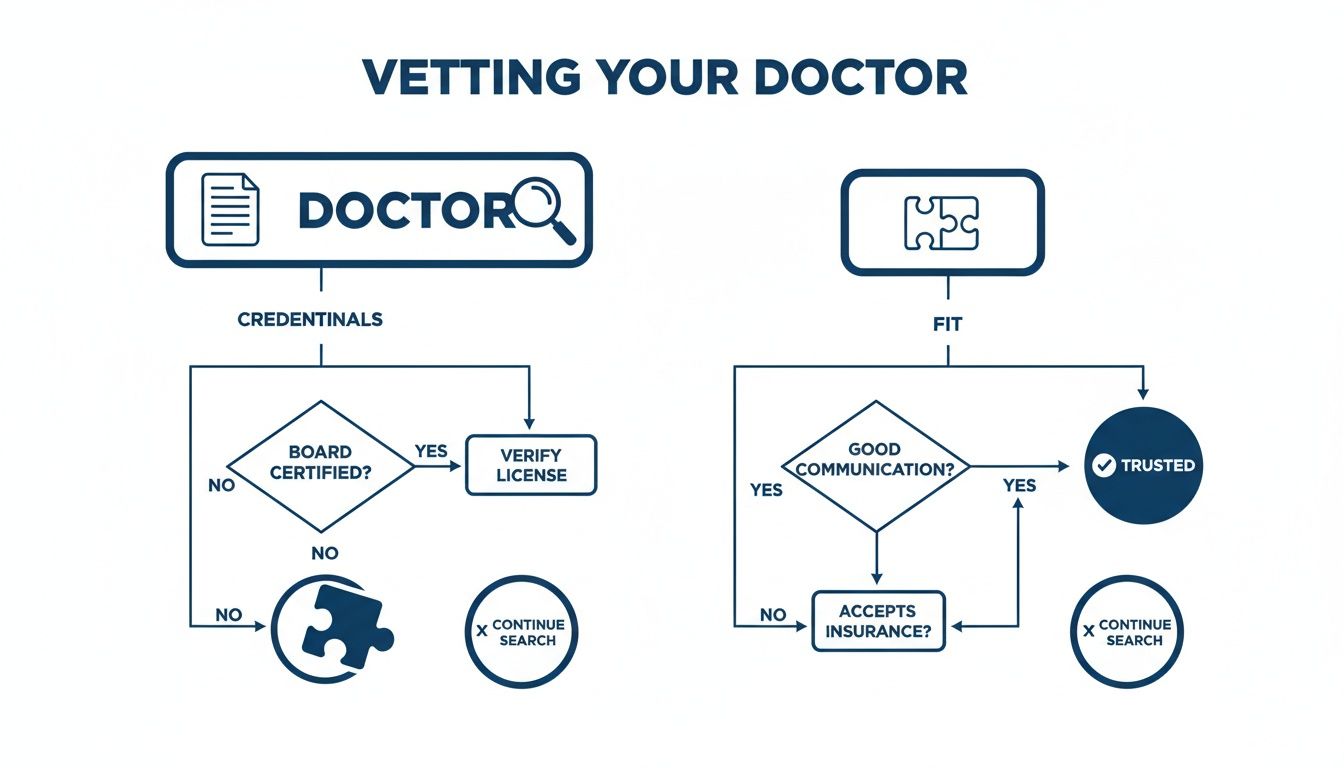
Remember, both sides of this coin are equally important for finding a doctor you can truly trust.
Preparing for a Productive First Meeting
Once the appointment is booked, it’s time to get ready. This first visit sets the stage for what could be a long-term healthcare relationship. Walking in prepared helps you make the most of every minute.
Don't be the person who leaves with a handful of unanswered questions. A little prep work makes all the difference.
Pull these things together before you go:
- Insurance Card and Photo ID: The basics they'll need for check-in.
- Current Medications List: Be thorough—include prescriptions, over-the-counter meds, vitamins, and supplements, along with dosages.
- Your Health Story: Jot down key surgeries, past illnesses, chronic conditions, and any major family health history (like heart disease or cancer).
- Previous Doctor's Info: Their name and phone number will make it easier for the new office to request your records.
Your new patient appointment is the real compatibility test. It should feel like a conversation, not an interrogation. You're looking for a partner in your health, not just a provider.
Questions to Ask Your Potential New Doctor
This meeting is a two-way street. The doctor is getting to know you, but you're also interviewing them for a very important job. Having a few questions ready shows you’re an engaged patient and helps you gauge their style.
Think about asking:
- How do you like to communicate with patients about lab results or follow-up questions? Do you use a portal, email, or phone calls?
- What's your philosophy on preventive care and wellness?
- If something urgent comes up after hours, who handles patient calls?
- How do you coordinate with specialists if I ever need a referral?
Their answers will reveal a lot about how they see the doctor-patient relationship. And if you find out later that things have changed, don't panic. Our guide explains what to do if your doctor is out-of-network.
By taking these steps, you can walk into that first appointment feeling confident and ready to make a great decision for your health.
Finding the Right Doctor for Your Life
Let's be honest: finding a primary care doctor isn't a one-size-fits-all deal. Your life circumstances—your job, your age, who’s in your family—change everything. They shape what you need from a doctor and how you should even begin your search.
A self-employed freelancer has completely different priorities than a growing family with toddlers. An early retiree managing a few health conditions has a different focus still. The key is to recognize your unique situation from the get-go. It helps you zero in on what truly matters and find a doctor who fits your life, not the other way around.
For Self-Employed Professionals and 1099 Contractors
When you’re self-employed, you wear all the hats—including HR manager. Navigating health insurance is a solo mission, which makes it absolutely critical to get this right.
Your search should live and die by the specifics of your marketplace plan. These plans are notorious for having narrower networks than the big group plans from employers. So, before you get your heart set on a doctor, you need to triple-check that they are in-network with your exact ACA plan. It’s not enough if they just "take" the parent insurance company. A doctor might accept Blue Cross from a corporate plan but not from the marketplace.
Actionable Tips for the Self-Employed:
- Be Super Specific When You Call: Don't just ask if they take your insurance. Say, "I have the [Plan Name] plan through the Health Insurance Marketplace. Can you confirm you are an in-network provider for this specific plan?"
- Virtual Care is Your Best Friend: Your schedule is your own, which means it’s probably jam-packed. A doctor who offers solid telehealth options for follow-ups and simple issues can save you hours of lost work time.
- Look for All-in-One Systems: Doctors tied to larger health systems with their own labs and imaging centers can be a lifesaver. It streamlines referrals and billing—a huge win when you're the one managing every single detail.
For Early Retirees and Pre-Medicare Adults
If you're in your early 60s, you're in a special kind of limbo. You might be managing a few chronic conditions while knowing that a switch to Medicare is just around the corner. Your goal is to find a doctor who gives you great care now and can help you make that future transition seamless.
The perfect doctor for this life stage is often an internist or even a geriatrician who has deep experience with conditions like hypertension, diabetes, or arthritis. They get the complexities of aging and are experts in the kind of preventive care that becomes so important as you near 65.
Continuity of care is everything for pre-Medicare adults. Look for a doctor who not only takes your current insurance but is also set up to accept Medicare. This little bit of foresight can save you from having to find a whole new doctor in just a few years.
For Busy Families with Children
For parents, it all comes down to two things: convenience and comprehensive care. Trying to juggle different doctors for the adults and the kids is a logistical nightmare. That's why a Family Medicine practice is often the perfect answer.
Family medicine doctors are board-certified to treat everyone, from newborns to grandparents. When you can find one practice where the whole family goes, it simplifies scheduling, keeps medical records in one place, and lets you build a real relationship with a doctor who understands your family's entire health story.
What to Look For in a Family Practice:
- Same-Day Sick Visits: Kids don't schedule their fevers. A practice that keeps appointments open for urgent needs is invaluable.
- On-Site Services: Does the office have its own lab for a quick strep test or blood draw? That can save you an entire extra trip when you're already stressed.
- Easy Communication: A good patient portal for asking quick questions or getting prescription refills without playing endless phone tag is a modern-day must-have.
If You Are Uninsured or on a High-Deductible Plan
Lacking insurance or staring down a massive deductible can make you feel like good care is out of reach. It isn't. You have options that go way beyond a costly trip to the emergency room. You just have to know where to look.
Here, your search shifts away from traditional private practices and toward community-based and alternative models of care.
Practical Alternatives for Affordable Care:
- Community Health Centers: These are federally funded clinics built to provide primary care to everyone, regardless of ability to pay. They work on a sliding scale based on your income, making them a fantastic resource.
- Direct Primary Care (DPC): This model is a game-changer. You pay a flat monthly fee—often around $70-$100—directly to the doctor. This covers most of your primary care needs, including visits, basic in-office procedures, and even direct access to your doctor via phone or text.
- Retail Health Clinics: You’ve seen them in pharmacies and supermarkets. They are a great bridge for immediate, straightforward issues like a cold, a flu shot, or a minor infection, and they offer clear, upfront pricing.
Still Have Questions? Let's Clear Things Up
Even when you feel like you've got a handle on the search, a few nagging questions can pop up. It's totally normal. Things like deciphering the letters after a doctor's name or figuring out a plan B can feel a little confusing.
Let's walk through some of the most common questions together. Getting these answers straight will help you move forward with confidence and find a doctor you genuinely trust.
MD vs. DO: What’s the Real Difference?
You’ve probably seen both "MD" and "DO" after a physician's name and wondered if it matters. Here’s the short answer: for most patients, it doesn’t.
Both MDs (Medical Doctors) and DOs (Doctors of Osteopathic Medicine) are fully qualified physicians. They go through similar, rigorous training, can prescribe medication, and practice in all specialties.
The main difference is in their educational philosophy. DOs get extra training in the body's musculoskeletal system, learning hands-on techniques called osteopathic manipulative treatment (OMT). In the real world, though, their day-to-day approach to patient care is often identical. The best fit will always come down to the individual doctor’s personality, not the letters they have.
What if My First-Choice Doctor Isn't Taking New Patients?
This is probably one of the most common roadblocks you'll hit, especially with the nationwide shortage of doctors. It’s frustrating, but don't let it stop you.
First, always ask the front desk if they have a waitlist. It can't hurt. A better question, though, is to ask if another doctor, nurse practitioner (NP), or physician assistant (PA) in that same practice is accepting new patients. Getting your foot in the door at a clinic you already like is a huge win.
This is exactly why I recommend making a shortlist of three to five potential doctors. If your top pick falls through, you can just pivot to the next name on your list without losing steam.
If the entire practice is closed to new patients, it's time to move on. Persistence is your best friend here.
Can I Change Doctors If the First Visit Feels… Off?
Yes, absolutely. Think of your first appointment as a vibe check. You're looking for a long-term partner in your health, and if the connection isn't there, it's okay to keep looking.
Did you feel rushed? Unheard? Did their communication style just not click with you? Trust that feeling. Your health is way too important to settle for a provider who doesn't make you feel comfortable and respected.
One quick tip: Before you switch, check your insurance policy. Some plans, especially HMOs, require you to officially select a new PCP through their website or by phone before they'll cover a visit.
How Does My Doctor Work with the Hospital?
It used to be common for your primary care doctor to visit and manage your care if you were admitted to the hospital. That's pretty rare these days. Now, most hospitals have hospitalists—doctors who specialize only in caring for patients while they're hospitalized.
If you’re admitted, the hospitalist team takes the lead on your care right away. They are in charge of keeping your PCP in the loop about your condition and treatment. Once you're discharged, your care goes right back to your primary doctor for all the follow-up and long-term management.
Finding the right doctor is a critical first step. Making sure you have the right health insurance to back you up is just as important. The team at My Policy Quote is here to help you find a plan that actually fits your life and budget. Let's explore your options together.